Choosing Patient Transport Vendors for Efficient Care

Coordinating safe, timely transportation for patients often means navigating a maze of mobility challenges, staff demands, and regulatory expectations. For healthcare logistics managers, each decision on vendor selection can directly impact both cost and patient outcomes. By focusing on a structured approach to assessing patient transportation needs and aligning with the latest standards, you can reduce no-shows, address health equity, and lay the groundwork for reliable, cost-effective patient flow.
Table of Contents
- Step 1: Assess Patient Transportation Needs
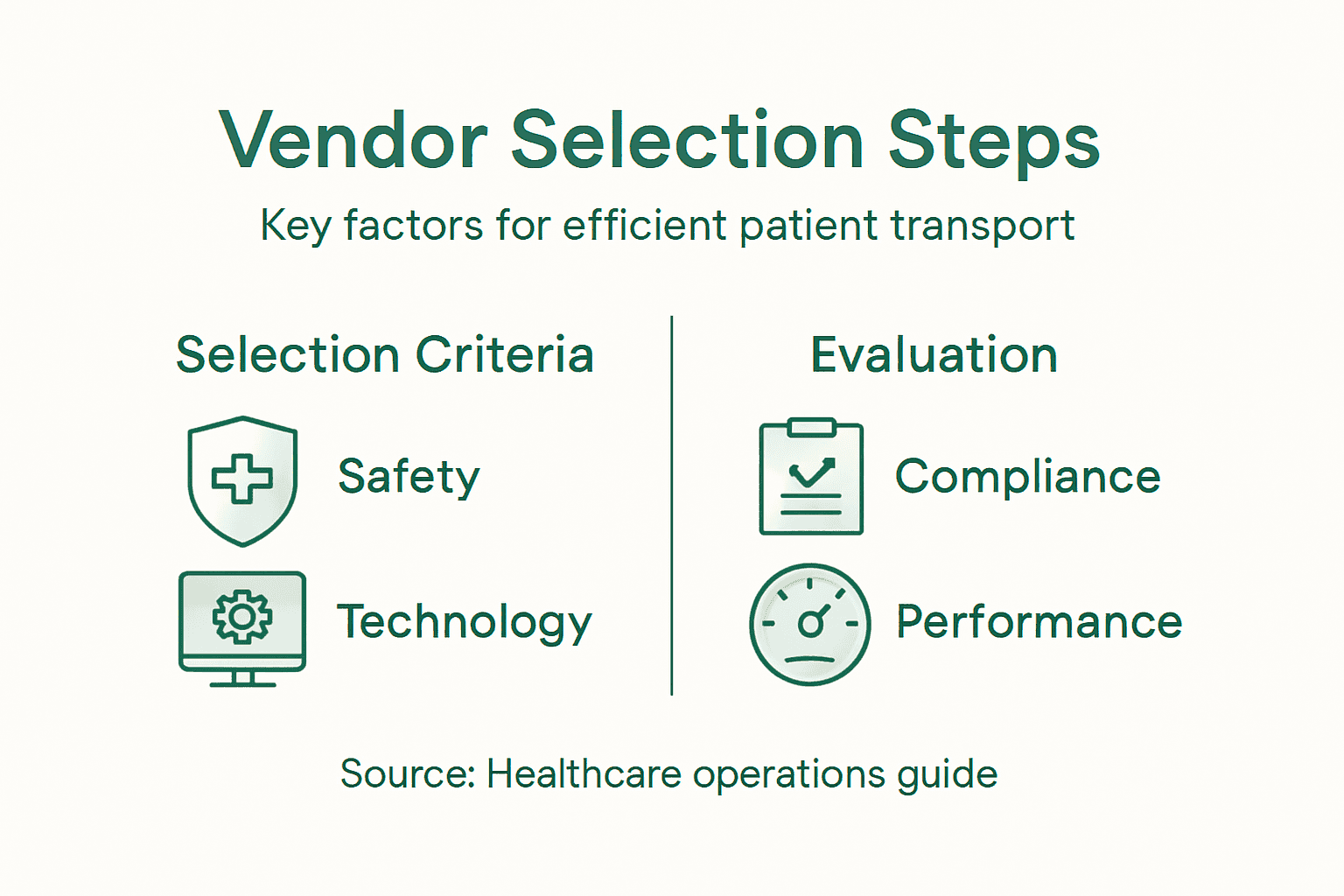
- Step 2: Define Vendor Selection Criteria
- Step 3: Evaluate Vendor Capabilities And Compliance
- Step 4: Compare Costs And Integration Options
- Step 5: Test Vendor Reliability And Performance
- Step 6: Confirm Vendor Selection And Start Onboarding
Quick Summary
| Key Takeaway | Explanation |
|---|---|
| 1. Assess patient transportation needs | Understand individual barriers to healthcare access for effective solutions. |
| 2. Define vendor selection criteria | Establish clear standards for safety, compliance, and service quality. |
| 3. Evaluate vendor capabilities thoroughly | Conduct comprehensive reviews to ensure patient safety and regulatory compliance. |
| 4. Compare costs and integration options | Consider total costs and technology compatibility for transportation vendors. |
| 5. Implement ongoing performance testing | Regularly assess vendor reliability and patient satisfaction levels. |
Step 1: Assess Patient Transportation Needs
Assessing patient transportation needs is a critical first step in creating an efficient and patient-centered transport strategy. The goal is to understand the unique mobility requirements and potential barriers each patient might encounter when seeking healthcare services.
Effective assessment begins with comprehensive data collection that goes beyond basic medical requirements. Understanding transportation barriers reveals complex challenges patients face in accessing care. Consider these key factors:
- Geographic location and distance from healthcare facilities
- Patient’s physical mobility limitations
- Available transportation modes (public transit, personal vehicle, specialized medical transport)
- Financial constraints affecting transportation options
- Special equipment needs for wheelchair or stretcher transport
To conduct a thorough assessment, healthcare teams should develop a structured approach that includes:
- Individual patient interviews to understand specific transportation challenges
- Review of patient medical records for mobility restrictions
- Consultation with social workers or case managers
- Analysis of local transportation infrastructure
Transportation is not just a logistical challenge, but a critical social determinant of healthcare access and patient outcomes.
Coordinating across multiple sectors ensures a holistic understanding of patient transportation needs. This might involve collaborating with local transportation authorities, social services, and healthcare providers to create a comprehensive support network.
Pro Tip: Develop a standardized transportation assessment form that captures both medical requirements and practical mobility challenges to streamline vendor selection and patient care planning.
Step 2: Define Vendor Selection Criteria
Defining vendor selection criteria is a strategic process that ensures your patient transportation partner meets critical safety, compliance, and service standards. By establishing clear, comprehensive criteria, you can select a vendor that provides reliable and patient-centered transportation solutions.
Patient transportation standards emphasize the importance of rigorous vendor evaluation. Healthcare organizations should consider the following key selection criteria:
- Safety protocols and emergency response capabilities
- Staff training and medical transportation certifications
- Vehicle condition and specialized medical equipment compatibility
- Geographic service coverage and response times
- Cost structure and billing transparency
- Compliance with state and federal healthcare transportation regulations
To develop a robust selection framework, healthcare teams should:
- Create a detailed vendor assessment questionnaire
- Request comprehensive documentation of safety procedures
- Verify insurance and licensing credentials
- Conduct site visits and vehicle inspections
Effective vendor selection is not just about cost, but about ensuring patient safety and service quality.
Additional considerations include evaluating the vendor’s technological capabilities, such as real-time tracking systems, electronic medical record integration, and communication protocols for patient care coordination.

Pro Tip: Develop a weighted scoring system for vendor evaluation that prioritizes patient safety and service quality over pure cost considerations.
Step 3: Evaluate Vendor Capabilities and Compliance
Evaluating vendor capabilities and compliance is a critical process that goes beyond surface-level assessments. Healthcare organizations must conduct a comprehensive review to ensure patient transportation vendors meet the highest standards of safety, regulatory compliance, and service quality.
Medicaid transportation assurance policies highlight the importance of rigorous vendor evaluation. Your assessment should encompass several key dimensions:
- Regulatory compliance with state and federal healthcare transportation regulations
- Professional certifications and industry memberships
- Staff training and qualification documentation
- Technology and communication infrastructure
- Patient safety protocols and emergency response capabilities
- Financial stability and operational track record
To thoroughly evaluate potential vendors, healthcare teams should:
- Request comprehensive compliance documentation
- Conduct on-site audits and facility inspections
- Interview key personnel about their safety procedures
- Check references from other healthcare providers
- Verify professional certifications and ongoing training programs
Compliance is not a one-time checkbox, but an ongoing commitment to patient safety and quality care.
Additional evaluation strategies include reviewing the vendor’s technology platforms, their ability to integrate with existing healthcare systems, and their track record of meeting performance metrics.
Here’s a helpful summary of common patient transportation barriers and their impact on healthcare access:
| Barrier Type | Impact on Access | Example Scenario |
|---|---|---|
| Geographic distance | Travel delays, missed appointments | Rural patient lacks public transit |
| Physical mobility limitations | Increased need for special transport | Patient requires wheelchair van |
| Financial constraints | Limited vendor choices | Patient cannot afford rideshare |
| Special equipment needs | Service delays, provider mismatch | Need for stretcher support |
This comparison table highlights key differences between patient transportation vendor evaluation methods:
| Evaluation Method | Process Focus | Typical Outcome |
|---|---|---|
| Document Review | Licenses, compliance | Initial safety screening |
| Site Visit | Facility, vehicle check | Real-world capability |
| Staff Interview | Team skills, procedures | Service reliability |
| Reference Check | Performance history | Trustworthiness insight |
Pro Tip: Create a detailed scorecard with weighted criteria that objectively assesses vendor capabilities, prioritizing patient safety and regulatory compliance over cost considerations.
Step 4: Compare Costs and Integration Options
Comparing costs and integration options for patient transportation vendors requires a nuanced approach that goes beyond simple price comparisons. Healthcare organizations must evaluate the comprehensive economic impact and technological compatibility of potential partners.
Cost-benefit analysis of medical transportation reveals that true value extends far beyond immediate transport fees. Your comprehensive evaluation should encompass multiple dimensions:
- Direct transportation service costs
- Administrative overhead expenses
- Potential missed appointment reduction
- Technology integration capabilities
- Electronic health record compatibility
- Long-term healthcare outcome improvements
To conduct a thorough comparison, healthcare teams should:
- Request detailed pricing structures from multiple vendors
- Analyze total cost of ownership, not just upfront expenses
- Evaluate technological integration capabilities
- Consider potential savings from reduced patient no-show rates
- Assess compatibility with existing healthcare systems
True vendor selection goes beyond price - it’s about creating a seamless, efficient healthcare transportation ecosystem.
Special attention should be paid to integration options that streamline workflow, such as real-time tracking, automated scheduling, and direct communication channels with healthcare providers.
Pro Tip: Develop a comprehensive scoring matrix that weights cost factors against technological capabilities and potential long-term healthcare improvements.
Step 5: Test Vendor Reliability and Performance
Testing vendor reliability and performance is a critical step in ensuring your patient transportation services meet the highest standards of quality and efficiency. This process goes beyond theoretical assessments to validate real-world operational capabilities.
Veterans Affairs rideshare pilot research highlights the importance of comprehensive performance testing. Your evaluation should focus on several key performance indicators:
- On-time performance metrics
- Patient satisfaction ratings
- Safety incident documentation
- Communication response times
- Healthcare utilization impact
- Driver training and professional conduct
To thoroughly test vendor reliability, healthcare teams should:
- Implement a structured pilot program
- Collect detailed performance data
- Compare results against predefined benchmarks
- Gather patient and staff feedback
- Analyze long-term operational effectiveness
Reliability is not a destination, but a continuous journey of measurement and improvement.
Additional testing strategies include monitoring real-time tracking accuracy, assessing communication protocols, and evaluating the vendor’s ability to handle unexpected challenges or special patient needs.
Pro Tip: Create a dynamic performance scorecard that allows for ongoing vendor assessment and provides clear, actionable insights for continuous improvement.
Step 6: Confirm Vendor Selection and Start Onboarding
Confirming vendor selection and initiating the onboarding process represents the critical transition from evaluation to active partnership. This stage transforms your careful vendor assessment into a functional, integrated transportation solution for patient care.
CMS guidance on transportation contract formalization emphasizes establishing clear service expectations and performance benchmarks. The onboarding process involves several strategic components:
- Formal contract execution with detailed service terms
- Comprehensive staff training protocols
- Integration with healthcare scheduling systems
- Defined communication channels
- Performance monitoring mechanisms
- Compliance documentation review
To ensure a smooth onboarding transition, healthcare teams should:
- Schedule comprehensive orientation sessions
- Develop joint communication protocols
- Establish performance reporting templates
- Conduct initial system integration tests
- Create contingency planning documents
Successful onboarding is not a single event, but an ongoing collaborative process of alignment and continuous improvement.
Additional critical steps include verifying insurance documentation, conducting background checks for transport personnel, and setting up initial performance review schedules.
Pro Tip: Create a dedicated onboarding team with representatives from both your healthcare organization and the vendor to facilitate seamless integration and address potential challenges proactively.
Streamline Patient Transport Vendor Selection with VectorCare
Choosing the right patient transport vendor means overcoming complex challenges like assessing unique patient mobility needs, ensuring safety compliance, and integrating vendor capabilities with healthcare systems. The article highlights key pain points such as managing regulatory compliance, verifying vendor reliability, and optimizing costs and workflows to improve patient outcomes. Addressing these demands calls for a comprehensive digital solution that empowers healthcare organizations to confidently select, evaluate, and onboard transportation partners.
VectorCare offers a powerful platform designed to eliminate these barriers with features including AI-driven dispatching, real-time updates, vendor management, and seamless healthcare integration. By leveraging automation and advanced data insights, VectorCare helps reduce delays, lower operational costs, and ensure patient safety at every step. Explore how VectorCare’s intuitive tools provide your organization with the transparency and control needed to transform patient transportation logistics.
Learn More About Vendor Management
Ready to optimize your patient transport operations and deliver efficient, patient-centered care? Visit VectorCare’s homepage today to get started.

Frequently Asked Questions
How do I assess patient transportation needs effectively?
Assess patient transportation needs by collecting detailed data on each patient’s geographic location, mobility limitations, and available transport options. Schedule individual patient interviews to identify specific challenges and use a standardized assessment form to streamline the process.
What criteria should I use to select a patient transportation vendor?
Define vendor selection criteria by focusing on safety protocols, staff training, compliance with regulations, and service quality. Develop a detailed vendor assessment questionnaire and prioritize patient safety over price when making your final decision.
How can I evaluate the compliance and capabilities of potential vendors?
To evaluate vendor compliance and capabilities, request comprehensive documentation, conduct site visits, and interview key personnel about their safety procedures. Create a detailed scorecard to objectively assess each vendor’s qualifications and performance metrics.
What factors should I consider when comparing costs among transport vendors?
Compare costs by analyzing both direct service fees and associated administrative expenses, focusing on total cost of ownership. Obtain pricing structures from multiple vendors to evaluate potential savings from reduced patient no-show rates and long-term healthcare outcomes.
How do I ensure the reliability and performance of my chosen transport vendor?
Ensure vendor reliability by implementing a structured pilot program and collecting performance data against predefined benchmarks. Gather feedback from patients and staff to continuously monitor and assess the vendor’s effectiveness and areas for improvement.
What steps are involved in onboarding a patient transport vendor?
To successfully onboard a transport vendor, execute a formal contract, conduct staff training, and integrate with existing healthcare scheduling systems. Establish clear communication channels and performance monitoring mechanisms to facilitate a seamless transition.
Recommended
- How NEMT Affects Patient Satisfaction Scores | VectorCare
- How Technology is Transforming Patient Logistics for SNFs | VectorCare
- Why Choose a Tech-Driven Transportation Marketplace Over a Single Provider | VectorCare
- Maximizing Efficiencies Through Better Patient Logistics | VectorCare
- Find a Doctor | thairapy.ai