What Are Care Coordination Services? Cut Patient Delays 30%

Up to 30% of patient care delays stem from inefficient scheduling and communication, costing healthcare organizations time, money, and patient trust. Care coordination services integrate logistics, communication, and scheduling to eliminate these bottlenecks. This article explains what care coordination encompasses, how technology drives measurable improvements, and practical steps to implement these services in your organization.
Table of Contents
- Understanding Care Coordination Services: Definition And Core Components
- Technological Tools Empowering Care Coordination
- How Care Coordination Services Improve Patient Logistics And Outcomes
- Common Misconceptions About Care Coordination Services
- Framework For Understanding And Implementing Care Coordination
- Best Practices And Case Studies In Care Coordination Implementation
- Applying Care Coordination Insights To Improve Healthcare Operations
- Streamline Your Patient Logistics With VectorCare Solutions
- Frequently Asked Questions About Care Coordination Services
Key Takeaways
| Point | Details |
|---|---|
| Delay Reduction | Care coordination reduces patient delays by up to 30% through improved communication and scheduling. |
| AI Impact | AI-driven dispatching increases patient transport on-time rates by up to 15%. |
| Beyond Clinical Care | Coordination extends to logistics like transportation and equipment delivery, not just clinical tasks. |
| Framework Approach | A three-dimensional framework integrating clinical, logistical, and communication domains guides effective coordination. |
| Proven Results | Case studies show 20-30% improvements in throughput and lowered no-show rates with coordination platforms. |
Understanding Care Coordination Services: Definition and Core Components
Care coordination services integrate multiple logistical facets that healthcare administrators often manage separately. Patient transportation, home health services, and durable medical equipment delivery operate as a synchronized network rather than isolated functions. According to What Is Care Coordination? Guide for Providers and Agencies 2025, these networks rely on communication and scheduling to bridge fragmented workflows.
U.S. healthcare organizations face unique challenges coordinating between providers, transport vendors, and equipment suppliers. Traditional manual processes create gaps where patients fall through cracks, appointments get missed, and resources sit idle. Modern coordination platforms centralize these moving parts into unified systems.
Three core components define effective care coordination:
- Transportation Management: Scheduling, routing, and tracking patient transport from facilities to appointments or home
- Home Health Coordination: Aligning visiting clinician schedules with patient availability and care navigation needs
- Equipment Logistics: Ensuring durable medical equipment arrives when needed, with proper setup and patient education
The health home care coordination model shows how these components work together. When a patient transitions from hospital to home, coordination services synchronize discharge timing, transport arrival, home health visits, and equipment delivery. Without this synchronization, delays cascade and care quality suffers.
Communication serves as the connective tissue. Real-time alerts notify all parties when schedules change, vendors confirm deliveries, or patients need assistance. This continuous information flow replaces phone tag and email chains that slow traditional workflows.
Technological Tools Empowering Care Coordination
Digital tools transform care coordination from labor-intensive manual work into streamlined automated processes. AI-driven dispatching algorithms represent the most significant advancement. AI in Patient Transport Coordination research shows these systems improve on-time rates by 12-15% compared to manual scheduling by analyzing traffic patterns, vehicle availability, and appointment timing simultaneously.
Automated scheduling eliminates double bookings and optimizes resource utilization. Instead of coordinators spending hours on phones juggling calendars, algorithms match patient needs with available slots across multiple providers and services. Healthcare dispatching improvements reduce administrative burden by up to 40% in some implementations.
No-code platforms let non-technical staff customize workflows without IT dependencies. Care coordinators can modify alert rules, adjust routing priorities, or add new vendors through visual interfaces. This flexibility matters because each healthcare organization has unique operational needs and constraints.
Key technological capabilities include:
- Intelligent Routing: AI calculates optimal transport routes considering real-time traffic, patient acuity, and appointment windows
- Vendor Integration: APIs connect multiple transportation companies, home health agencies, and equipment suppliers into single dashboards
- Automated Alerts: Triggered notifications when delays occur, appointments approach, or tasks need completion
- Performance Analytics: Dashboards track on-time rates, cost per trip, and vendor performance metrics
The AI-powered dispatching partnership between Priority Dispatch and VectorCare demonstrates practical implementation. Their system uses machine learning to predict delays before they happen, enabling proactive rescheduling.

Pro Tip: Start with one high-volume coordination challenge like patient transport scheduling. Master that workflow with healthcare workflow automation before expanding to additional services. Incremental implementation builds staff confidence and demonstrates ROI quickly.
How Care Coordination Services Improve Patient Logistics and Outcomes
Care coordination creates measurable improvements across multiple dimensions. Communication enhancements directly reduce wait times and transportation delays. When all parties see real-time status updates, they make informed decisions instead of assumptions. Care Coordination Measures and Impact research confirms up to 30% of patient care delays link to scheduling and communication inefficiencies that coordination mitigates.
Interdisciplinary collaboration improves when information flows freely. Physicians, nurses, transport coordinators, and equipment suppliers work from shared data rather than isolated silos. This transparency reduces medication errors, prevents missed handoffs, and ensures patients receive complete care plans.
Vendor management optimization ensures timely durable medical equipment delivery. Automated tracking shows when equipment ships, arrives, and gets installed. Coordinators spot delays early and take corrective action before patients notice problems.
Measurable improvements include:
- On-Time Appointments: Increase from 70-75% baseline to 85-90% with coordinated scheduling
- No-Show Reduction: Drop by 15-25% when patients receive timely reminders and easy rescheduling options
- Transport Efficiency: 20-30% more patients served with same vehicle fleet through optimized routing
- Operational Cost Savings: 15-25% reduction in coordination labor costs through automation
Patient care coordination tips emphasize that technology alone does not guarantee success. Staff training and workflow standardization matter equally. The best platforms support human coordinators rather than attempting to replace them entirely.
Critical Metric: Track end-to-end appointment completion rates, not just individual component performance. A patient who gets timely transport but finds the clinic closed due to miscommunication still experiences a failed care event. System-level metrics reveal true coordination effectiveness.
Common Misconceptions About Care Coordination Services
Healthcare administrators often misunderstand care coordination scope and requirements. Correcting these misconceptions accelerates effective implementation.
- Misconception: Care coordination only addresses clinical activities like medication management and care planning. Reality: Modern coordination encompasses complex logistics including patient transportation, home health scheduling, and health home care coordination of equipment delivery. These operational elements directly impact care quality.
- Misconception: Success metrics focus exclusively on clinical outcomes like readmission rates. Reality: Operational efficiency metrics matter equally. Reduced no-shows, lower transport costs, and improved staff productivity provide immediate ROI while clinical improvements take longer to materialize.
- Misconception: Technology represents a nice-to-have enhancement but remains optional. Reality: Digital tools like AI dispatching and automated scheduling are essential for managing coordination complexity at scale. Manual processes cannot achieve the same efficiency or reliability.
- Misconception: Only direct care providers participate in coordination activities. Reality: Effective coordination involves transportation vendors, equipment suppliers, payers, and administrative staff. The broader the network, the more comprehensive the coordination benefits.
- Misconception: One-size-fits-all solutions work for every healthcare organization. Reality: Platforms require customization for organizational workflows, patient populations, and regional vendor networks. Cookie-cutter approaches fail because operational contexts vary significantly.
Pro Tip: When evaluating coordination platforms, ask vendors for references from organizations with similar size, patient mix, and operational complexity as yours. Generic case studies from vastly different contexts provide limited insight into likely outcomes.
Addressing these misconceptions during planning stages prevents implementation pitfalls. Stakeholders need realistic expectations about what coordination services deliver, how quickly benefits appear, and what resources successful deployment requires.
Framework for Understanding and Implementing Care Coordination
A three-dimensional framework helps administrators design and evaluate care coordination programs systematically. This model integrates clinical care, logistical operations, and communication flow as equally important dimensions.
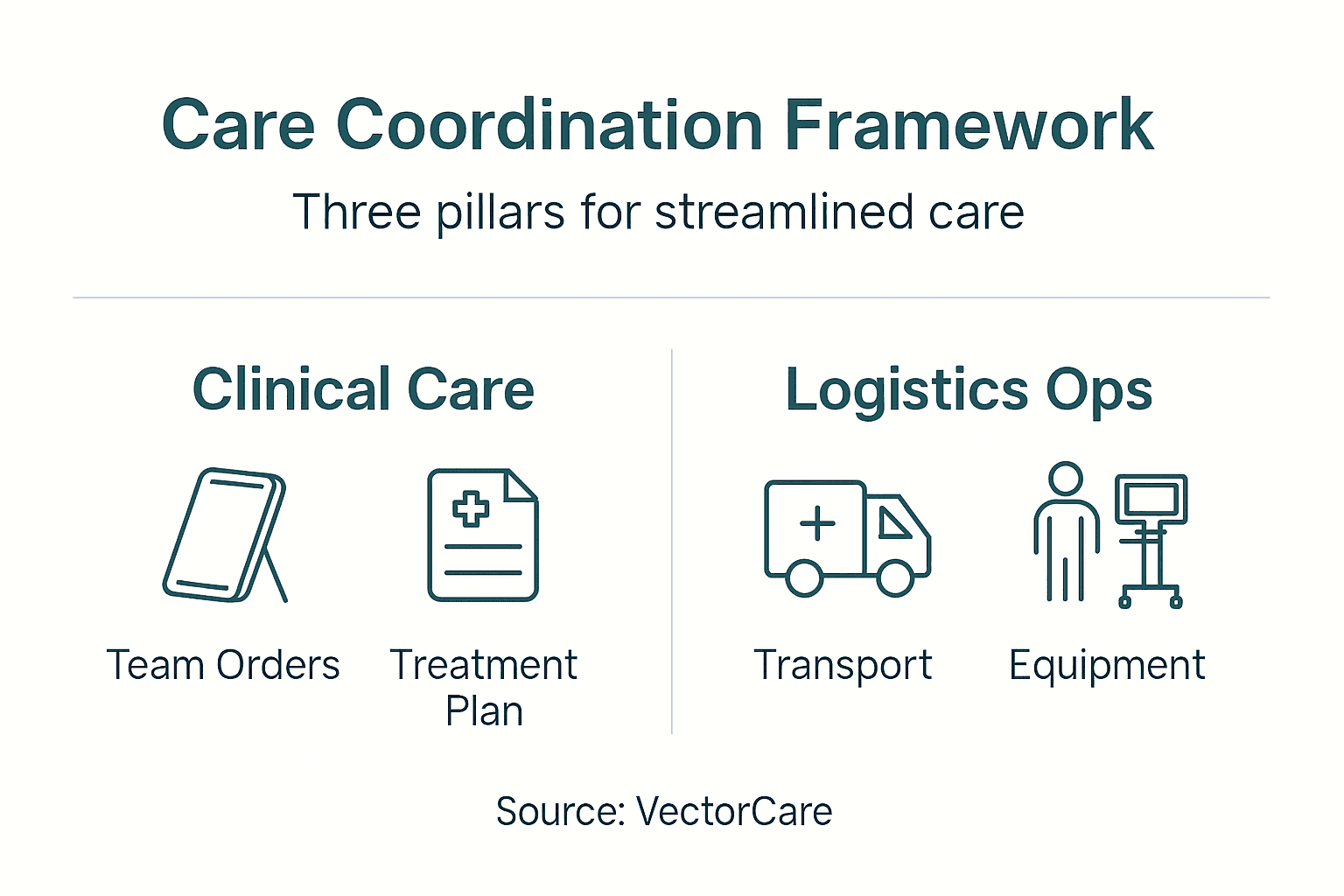
Clinical Care Integration connects coordination services with treatment plans. When physicians order home oxygen, the coordination system automatically triggers equipment delivery scheduling synchronized with hospital discharge. Clinical protocols drive logistical workflows rather than operating separately.
Logistical Operations encompasses transportation routing, equipment tracking, and vendor management. This dimension focuses on physical movement of patients and supplies. Optimization algorithms, real-time tracking, and performance metrics belong here.
Communication Flow ensures all parties receive timely, accurate information. Alerts notify stakeholders of schedule changes, delays, or issues requiring attention. Secure messaging replaces phone calls for routine coordination tasks.
| Coordination Approach | Clinical Integration | Logistics Capability | Communication Method | Typical Results |
|---|---|---|---|---|
| Manual Coordination | Disconnected | Phone/Fax-Based | Verbal/Paper | 70% on-time rate, high staff burden |
| Basic Digital Tools | Partial | Email/Spreadsheet | Digital messaging | 75-80% on-time rate, moderate burden |
| Advanced Platforms | Full Integration | AI-Optimized Routing | Automated Alerts | 85-90% on-time rate, minimal burden |
This framework supports ongoing evaluation and improvement. Organizations identify which dimension needs strengthening, then target investments accordingly. A facility with good clinical integration but poor logistics might prioritize routing optimization and vendor management tools.
Patient transition best practices demonstrate framework application during hospital discharges. All three dimensions must work together: clinical orders trigger logistics coordination, while communication keeps patient, family, and providers informed throughout the process.
The framework also reveals tradeoffs. Highly customized clinical workflows may require more complex logistics coordination. Organizations balance customization benefits against implementation complexity based on their unique priorities and constraints.
Best Practices and Case Studies in Care Coordination Implementation
Real-world implementations demonstrate measurable care coordination impacts. The Case Study: ESRD Care and Improved Patient Logistics | VectorCare documents how one ESRD care organization achieved up to 30% increase in patient throughput after implementing comprehensive coordination services. Patient no-show rates dropped over 20%, reducing wasted dialysis chair time and staff resources.
These results came from several best practices:
- Comprehensive Staff Training: Every role touching patient logistics received training on new workflows and platform features, not just coordinators
- Standardized Workflows: Organizations documented and optimized processes before automation, preventing digital recreation of inefficient manual methods
- Vendor Partnership Development: Successful implementations involve transport companies and equipment suppliers early, ensuring their systems integrate smoothly
- Continuous Metric Monitoring: Weekly performance reviews identify emerging issues before they become systemic problems
Another healthcare system reduced patient transport delays by 40% using AI-powered routing and real-time tracking. Their care transitions strategies emphasized proactive communication. Patients received text alerts with driver location and estimated arrival time, reducing anxiety and improving satisfaction.
Cost savings often exceed initial projections. One facility calculated 25% reduction in coordination labor costs within six months of platform deployment. The savings funded additional patient services and staff professional development.
Improving patient outcomes strategies require patience. Clinical outcome improvements like reduced readmissions take 12-18 months to appear in data. Operational improvements like on-time rates and no-show reductions manifest within weeks, providing early wins that maintain stakeholder support.
Successful organizations treat implementation as an ongoing process rather than one-time project. They continuously refine workflows based on staff feedback and performance data. This iterative approach delivers compounding benefits over time as processes mature and staff expertise deepens.
Applying Care Coordination Insights to Improve Healthcare Operations
Healthcare administrators need clear decision criteria when selecting and implementing coordination services. Start with integration capabilities. Platforms must connect with existing EHR systems, scheduling tools, and billing software. Isolated systems create new silos instead of eliminating old ones.
Compliance requirements cannot be overlooked. HIPAA security, patient privacy protections, and audit trails must meet regulatory standards. Ask vendors about their compliance certifications and security protocols during evaluation.
User experience matters enormously for adoption success. If coordinators find the platform confusing or cumbersome, they will resist using it fully. Request demonstrations with realistic workflows and observe how intuitive the interface feels for your team’s skill levels.
Implementation tradeoffs require careful consideration:
- Customization vs. Speed: Highly tailored solutions take longer to deploy but fit workflows better. Standard configurations launch quickly but may require workflow adjustments.
- Comprehensive vs. Phased Rollout: Implementing all coordination functions simultaneously maximizes integration benefits but increases change management complexity. Phased approaches reduce risk but delay some benefits.
- Cloud vs. On-Premise: Cloud platforms offer easier updates and lower IT burden but raise data security questions for some organizations. On-premise solutions provide more control but require significant IT resources.
- Build vs. Buy: Custom development creates perfect workflow alignment but costs significantly more and takes longer than commercial platforms. Buying proven solutions delivers faster ROI with less risk.
Track these performance metrics to evaluate coordination success:
- Patient Delay Reduction: Measure average wait time from appointment scheduling to completion
- No-Show Rate Changes: Track month-over-month trends in missed appointments
- Cost Per Coordination Event: Calculate total coordination costs divided by patients served
- Staff Satisfaction Scores: Survey coordinators about workload, tools, and stress levels
- Vendor Performance: Monitor transport company on-time rates and equipment delivery accuracy
Pro Tip: Establish baseline metrics before implementation, then measure monthly for at least six months. Short-term fluctuations are normal during transition periods. Focus on sustained trends rather than reacting to weekly variations.
Patient logistics optimization requires ongoing attention. Schedule quarterly reviews where stakeholders assess what’s working, what needs improvement, and what new opportunities exist. This continuous improvement mindset prevents stagnation and maintains coordination effectiveness as organizational needs evolve.
Streamline Your Patient Logistics with VectorCare Solutions
Healthcare organizations struggling with patient logistics delays can benefit from proven coordination platforms. VectorCare offers AI-powered scheduling and dispatch integrated across transportation and vendor coordination. Our customizable no-code workflows adapt to your unique operational needs without lengthy development cycles.
Leading U.S. providers trust VectorCare to reduce delays, lower no-show rates, and cut operational costs. The patient logistics platform centralizes communication, automates routine coordination tasks, and provides real-time visibility into all patient movement. Whether you manage ESRD care, hospital discharge planning, or regional health services, VectorCare scales to your requirements. Discover how maximizing patient logistics efficiencies transforms care delivery. Learn more about what patient logistics means for your organization at vectorcare.com.
Frequently Asked Questions About Care Coordination Services
What are the main benefits of implementing care coordination services?
Care coordination services deliver operational efficiency through reduced administrative burden, fewer patient delays via optimized scheduling, and improved patient satisfaction from reliable communication. Organizations typically see 20-30% improvements in on-time rates and 15-25% reductions in no-shows within the first year.
How does AI improve patient transportation scheduling?
AI analyzes multiple variables simultaneously including traffic patterns, vehicle locations, patient acuity, appointment windows, and historical delay patterns. This optimization reduces manual dispatcher workload while improving on-time performance by 12-15%. The system learns from past trips to make increasingly accurate predictions.
Can care coordination platforms integrate with existing EHR systems?
Most modern coordination platforms offer integration options through APIs and HL7 interfaces that connect with major EHR systems. This integration aligns clinical data with logistical coordination, ensuring transport schedules reflect current patient conditions and care plans. Ask vendors about specific EHR compatibility during evaluation.
What metrics should we track to evaluate care coordination success?
Monitor on-time appointment completion rates, patient no-show percentages, cost per coordination event, and staff satisfaction scores. Track these monthly to identify trends. Also measure vendor performance including transport punctuality and equipment delivery accuracy. Combine operational and financial metrics for comprehensive assessment.
Are care coordination solutions suitable for small healthcare providers?
Yes, especially platforms with no-code customization that minimize IT dependencies and implementation complexity. Smaller providers often see proportionally larger benefits because manual coordination consumes more of their limited staff resources. Cloud-based solutions offer affordable entry points without significant infrastructure investment. Start with high-volume coordination challenges to demonstrate quick ROI.