Top hospital vendors for patient logistics: 2026 guide

Selecting the wrong hospital vendor does not just create administrative headaches. It delays patient care, inflates operational costs, and exposes your organization to compliance risk. With healthcare systems under mounting pressure to reduce waste while improving outcomes, the vendor decisions made by procurement managers and administrators carry consequences that ripple across every department. Platforms like VectorCare report 10-20% patient experience improvements and a 90% reduction in scheduling time, illustrating just how much the right logistics partner can move the needle. This guide walks through evaluation criteria, leading vendor profiles, a side-by-side comparison, and expert implementation advice to help your hospital make evidence-based, cost-effective decisions.
Table of Contents
- How to evaluate hospital vendors: Critical selection criteria
- Top hospital vendors enhancing patient logistics and operations
- Comparison table: Which hospital vendor fits your needs?
- Expert tips for choosing and working with hospital vendors
- How VectorCare supports your hospital’s logistics goals
- Frequently asked questions
Key Takeaways
| Point | Details |
|---|---|
| Vendor choice matters | The right hospital vendor can improve patient experience, streamline logistics, and reduce costs significantly. |
| Criteria-driven selection | Evaluating vendors by integration, automation, support, and proven outcomes ensures the best fit for your needs. |
| Evidence-based decisions | Case studies reveal cost savings over $2M and measurable efficiency gains with top vendors. |
| Continuous improvement | Monitor KPIs and maintain strong relationships to ensure long-term success with your chosen vendor. |
How to evaluate hospital vendors: Critical selection criteria
Now that the stakes of effective vendor selection are clear, the most important criteria to evaluate when choosing a hospital vendor deserve a structured breakdown. A weak evaluation process is one of the most common reasons hospitals end up locked into contracts that underdeliver.
Effective vendor management best practices start with integration capability. Any vendor you consider must connect cleanly with your existing EHR, inventory management, and bed management systems. Fragmented data environments create delays, duplicate entries, and staff frustration. Ask vendors for documented API specifications and request a live integration demonstration before signing anything.
Automation and process transparency are equally critical. Patient flow best practices involve centralizing operations with technology, automating processes like barcode scanning and transport requests, and monitoring KPIs such as wait times and staff utilization ratios. Vendors who cannot show you how their platform surfaces these metrics in real time are not ready for enterprise deployment.
Here is a practical checklist of evaluation criteria to apply across every vendor conversation:
- EHR and inventory system integration: Confirm native connectors or certified middleware for your specific platforms.
- Automation depth: Assess whether the vendor automates scheduling, dispatching, and exception handling, or only partial workflows.
- KPI dashboards: Verify that wait times, staff utilization, and inventory turnover are tracked and exportable.
- Support responsiveness: Request documented SLAs for incident response, especially for after-hours disruptions.
- Compliance configurability: Confirm HIPAA, state-level privacy, and payer-specific compliance features are built in, not bolted on.
- Reference validation: Require case studies and direct reference calls from institutions of similar size and complexity.
Understanding hospital vendor management challenges before you begin negotiations gives your team a significant advantage. Vendors who resist reference calls or cannot produce outcome data from comparable deployments are a red flag.
Pro Tip: Ask every vendor to walk you through a real disruption scenario, such as a transport no-show or an inventory stockout, and show you exactly how their platform responds. The answer reveals more than any sales deck.
Staying current on vendor management trends also matters, because the market is evolving rapidly and yesterday’s best-in-class solution may already be falling behind on AI-driven automation and interoperability standards.
Top hospital vendors enhancing patient logistics and operations
With your selection framework established, here are the leading hospital vendors making quantifiable impacts in today’s marketplace.
VectorCare is an AI-powered patient logistics platform purpose-built for transport coordination, scheduling optimization, and durable medical equipment management. Hospitals and health systems using VectorCare report 90% scheduling time reductions and measurable gains in patient experience scores. The platform’s agnostic architecture, detailed in its analysis of agnostic software benefits, means it integrates with virtually any EHR or dispatch system without requiring a full infrastructure overhaul. For health systems managing high transport volumes or complex post-acute coordination, VectorCare is a strong fit.
GHX focuses on supply chain automation and contract compliance. Allina Health’s deployment of GHX for bill-only implant processing produced a 10% staff reduction, an 11.2% increase in spend under management totaling $10.4 million, and a 10% improvement in contract compliance. GHX is particularly well-suited for large health systems with complex implant and surgical supply chains.

hc1 specializes in strategic sourcing and laboratory supply chain management. Mercy Health leveraged hc1’s vendor negotiation and sourcing capabilities to save $2.4 million in lab supply costs. For procurement teams managing high-volume lab operations, hc1 delivers a focused, data-driven approach to cost reduction.
Tecsys brings point-of-use inventory management to the clinical floor. Concord Hospital reduced on-hand inventory by 30% after implementing Tecsys, freeing up capital and reducing waste. Tecsys is a strong choice for hospitals seeking to tighten inventory control at the department level without disrupting clinical workflows.
Pro Tip: Do not evaluate vendors in isolation. Map each vendor’s core strength to a specific operational gap in your hospital before scheduling demos. This keeps evaluations focused and prevents feature-bloat from clouding your decision.
The role of AI in hospital operations continues to expand, and vendors who have embedded machine learning into dispatching, demand forecasting, and anomaly detection are pulling ahead of those still relying on manual workflows. Understanding how technology is enhancing patient logistics helps frame which vendor capabilities will matter most over a three to five year contract horizon.
Comparison table: Which hospital vendor fits your needs?
To simplify choice, the comparison table below highlights how core hospital vendors stack up by feature set, outcomes, and operational fit.
| Vendor | Primary focus | Key outcome | Integration type | Best fit |
|---|---|---|---|---|
| VectorCare | Transport, scheduling, DME | 10-20% patient experience gain, 90% scheduling time reduction | Agnostic, API-based | Health systems with complex transport and post-acute needs |
| GHX | Supply chain, implant processing | $10.4M spend under management, 10% contract compliance gain | ERP and EHR connectors | Large systems with surgical supply complexity |
| hc1 | Lab supply chain, sourcing | $2.4M in lab supply savings | Lab system integrations | High-volume lab and diagnostic operations |
| Tecsys | Point-of-use inventory | 30% on-hand inventory reduction | ERP, WMS, EHR | Hospitals targeting clinical floor inventory control |
The table above makes one pattern clear: no single vendor dominates every logistics category. Hospitals with diverse operational needs often benefit from a layered approach, pairing a transport and scheduling platform like VectorCare with a supply chain tool like GHX or Tecsys. Reviewing strategies for maximizing logistics efficiencies can help your team identify where the highest-value gaps exist before committing to a vendor stack.
For skilled nursing facilities and post-acute care settings, the dynamics differ from acute hospital environments. Exploring how technology is transforming SNF logistics provides useful context for procurement teams managing transitions across the care continuum.
Expert tips for choosing and working with hospital vendors
Once you have identified your leading options, the following expert tips will help you maximize results throughout vendor selection, onboarding, and ongoing operation.
- Build supplier relationships before you need them. Supply disruptions such as COVID-era PPE shortages and vendor bankruptcies exposed hospitals that had transactional rather than relational vendor partnerships. Invest in regular business reviews and joint planning sessions.
- Enforce KPI accountability from day one. Define measurable targets in the contract, not just in the sales conversation. Tie renewal terms to performance benchmarks.
- Conduct reference calls with peer institutions. Ask specifically about how the vendor performed during a crisis or system outage, not just during normal operations.
- Budget for ongoing innovation. Vendors who do not release meaningful updates at least quarterly are falling behind. Build upgrade costs and training time into your total cost of ownership model.
- Verify interoperability across your full tech stack. A vendor may integrate cleanly with your EHR but conflict with your bed management or transport dispatch system. Test the full chain, not just the primary connection.
“Strong vendor relationships are not a soft benefit. They are a risk management strategy. Hospitals with deep supplier partnerships recovered faster from supply disruptions and maintained higher service levels during peak demand periods.”
Reviewing healthcare vendor management best practices as part of your onboarding process gives your procurement team a structured framework for holding vendors accountable over the life of the contract.
Pro Tip: Schedule a formal vendor performance review at the 90-day mark after go-live. Early course corrections are far less costly than waiting until contract renewal to surface problems.
How VectorCare supports your hospital’s logistics goals
VectorCare is purpose-built for the operational realities that hospital administrators and procurement managers face every day. From AI-driven transport dispatching to real-time scheduling visibility and DME coordination, the platform addresses the full patient logistics lifecycle within a single, integrated environment.
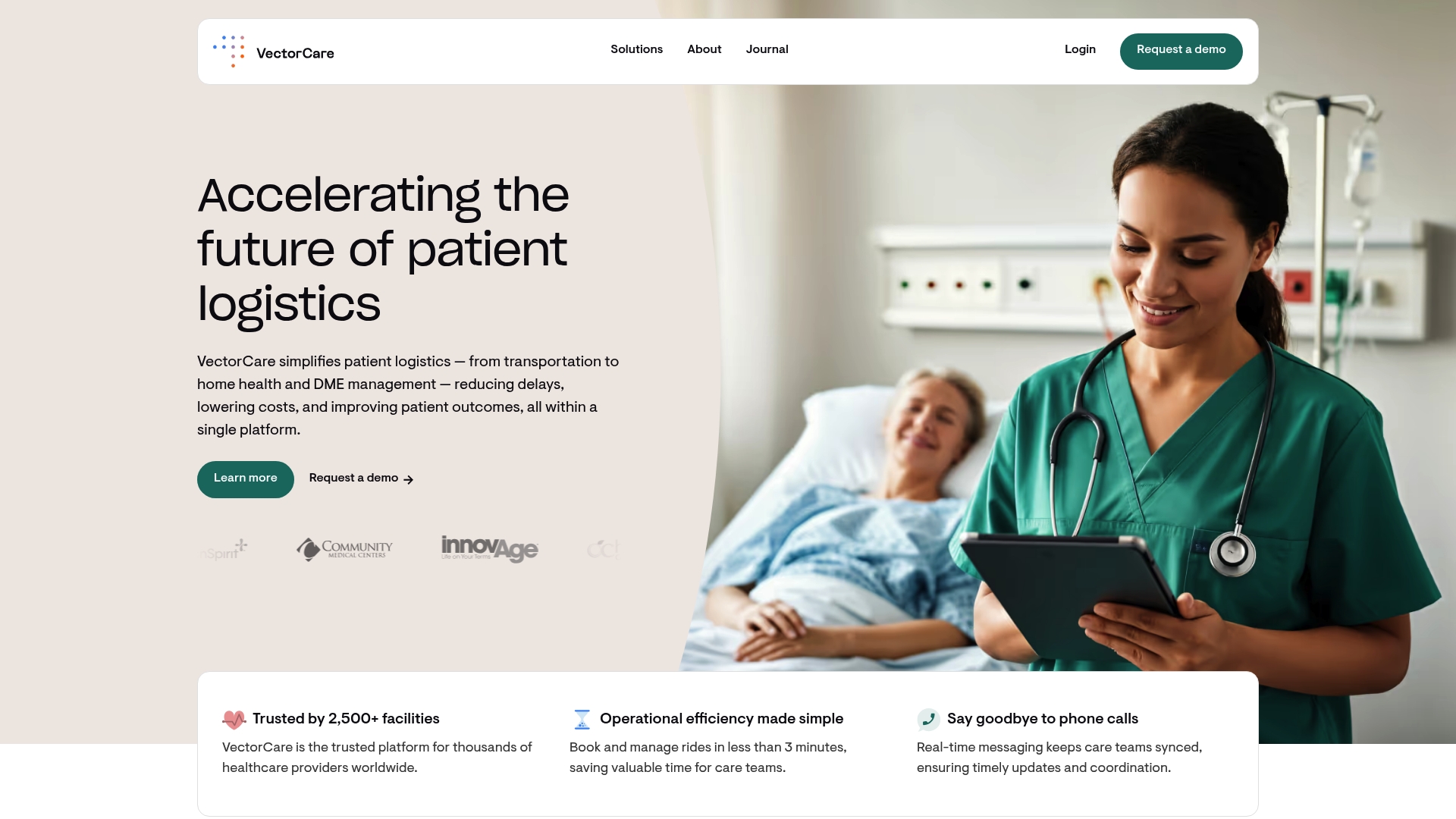
VectorCare’s no-code workflow configuration means your team can adapt the platform to your specific protocols without waiting on lengthy IT development cycles. The platform’s agnostic architecture ensures it connects with your existing EHR, payer systems, and third-party vendors without requiring a rip-and-replace infrastructure investment. For health systems evaluating vendors in 2026, VectorCare offers a proven combination of automation depth, compliance assurance, and measurable outcome data that procurement teams can bring directly to the C-suite. To see how VectorCare fits your organization’s logistics needs, explore the platform at vectorcare.com.
Frequently asked questions
What are the most important KPIs for evaluating hospital vendors?
Key KPIs include patient wait times, inventory turnover rates, staff utilization, and contract compliance, all of which reflect how well a vendor’s solution integrates with and improves core hospital operations. Tracking these metrics from the first month of deployment establishes a performance baseline that supports data-driven contract decisions.
How do leading vendors support integration with EHR and legacy systems?
Top vendors provide certified APIs, middleware connectors, or native EHR modules that enable data exchange with major platforms, reducing the need for manual data entry and minimizing integration-related delays. Always request a documented integration architecture review before finalizing any vendor agreement.
What are signs of a weak hospital vendor relationship?
Slow support response during disruptions, vague or absent KPI reporting, and infrequent system updates are the clearest indicators that a vendor relationship is underperforming, and supply disruptions tend to expose these weaknesses quickly. Proactive vendors schedule regular performance reviews and communicate roadmap updates without being prompted.
How can hospital vendor choices impact patient satisfaction?
Logistics platforms that reduce transport delays, automate scheduling, and improve care coordination have produced 10-20% patient experience improvements in documented case studies, demonstrating that operational efficiency and patient satisfaction are directly linked. Vendor selection is, in effect, a patient experience decision.
Recommended
- Best top healthcare logistics software – Expert Comparison 2025
- Top Healthcare Logistics Solutions – Expert Comparison 2025
- Why Hospital Executives Should Treat Patient Logistics as Infrastructure | VectorCare | VectorCare
- The Hidden Cost of Discharge Delays: Why Patient Logistics Is the Bottleneck Nobody’s Measuring | VectorCare
- Digital Product Design Tips for Healthcare UX