How patient logistics transforms healthcare efficiency and cost

Inefficient patient logistics costs hospitals far more than most administrators realize. When wait times run 45 to 60 minutes for routine transfers and discharges, the downstream effects compound quickly: delayed bed turnover, extended emergency department (ED) boarding, and ballooning operational costs. Optimized systems can reduce those same wait times to 15 to 25 minutes, but getting there requires more than a single technology fix. This guide breaks down what patient logistics actually means, which methodologies drive measurable results, where improvement efforts most commonly stall, and what strategic steps hospital leaders can take to build a system that performs consistently.
Table of Contents
- What is patient logistics in healthcare?
- Key methodologies and technologies driving efficiency
- Barriers to successful patient logistics optimization
- Strategic frameworks and real-world optimization steps
- A new mindset: Why patient logistics requires top-down and bottom-up alignment
- Explore solutions for seamless patient logistics
- Frequently asked questions
Key Takeaways
| Point | Details |
|---|---|
| Efficiency starts with logistics | Patient logistics is an untapped lever for reducing wait times and costs. |
| Technology plus process matters | IT tools improve logistics most when aligned with strategic frameworks and staff engagement. |
| Barriers are often cultural | Departmental silos and misaligned incentives commonly block logistics reforms. |
| Frontline involvement drives change | Successful optimization needs both top-down vision and frontline execution. |
| Data delivers measurable results | Empirical studies show logistics reforms can cut wait times and LOS by up to 30% and 20% respectively. |
What is patient logistics in healthcare?
Patient logistics is often conflated with patient transport, care coordination, or general hospital operations. In practice, it is a distinct discipline that spans every structured movement and handoff a patient experiences during an episode of care. That includes admissions intake, bed assignment, intra-facility transfers, discharge planning, external transportation, and post-acute placement. Each of these touchpoints involves scheduling, communication, resource allocation, and timing, all of which must align for the system to function without friction.
The scope of patient logistics extends well beyond moving people from point A to point B. According to a patient logistics overview, it encompasses the coordination of information, equipment, staff, and physical space to support every patient movement decision. That is why Operations Research techniques are central to patient logistics, offering a rigorous, data-driven foundation for managing complexity at scale.
In most hospitals, responsibility for patient logistics is distributed across multiple departments: case management, transport services, bed management, nursing, and environmental services. This distributed ownership is both a strength and a vulnerability. When teams are aligned, handoffs are smooth. When they are not, delays accumulate at every seam.
The major touchpoints where logistics performance is most visible include:
- Admissions: Intake accuracy and speed set the tone for the entire stay
- Bed management: Real-time visibility into bed status drives throughput
- Intra-facility transfers: ICU to step-down, OR to recovery, and similar moves require tight coordination
- Discharge processing: Delays here back up the entire system, from ED to inpatient units
- External transportation: Non-emergency medical transport (NEMT) and post-acute transfers close the loop
Patient logistics is not a support function. It is the operational backbone that determines whether clinical capacity translates into actual patient throughput.
Key methodologies and technologies driving efficiency
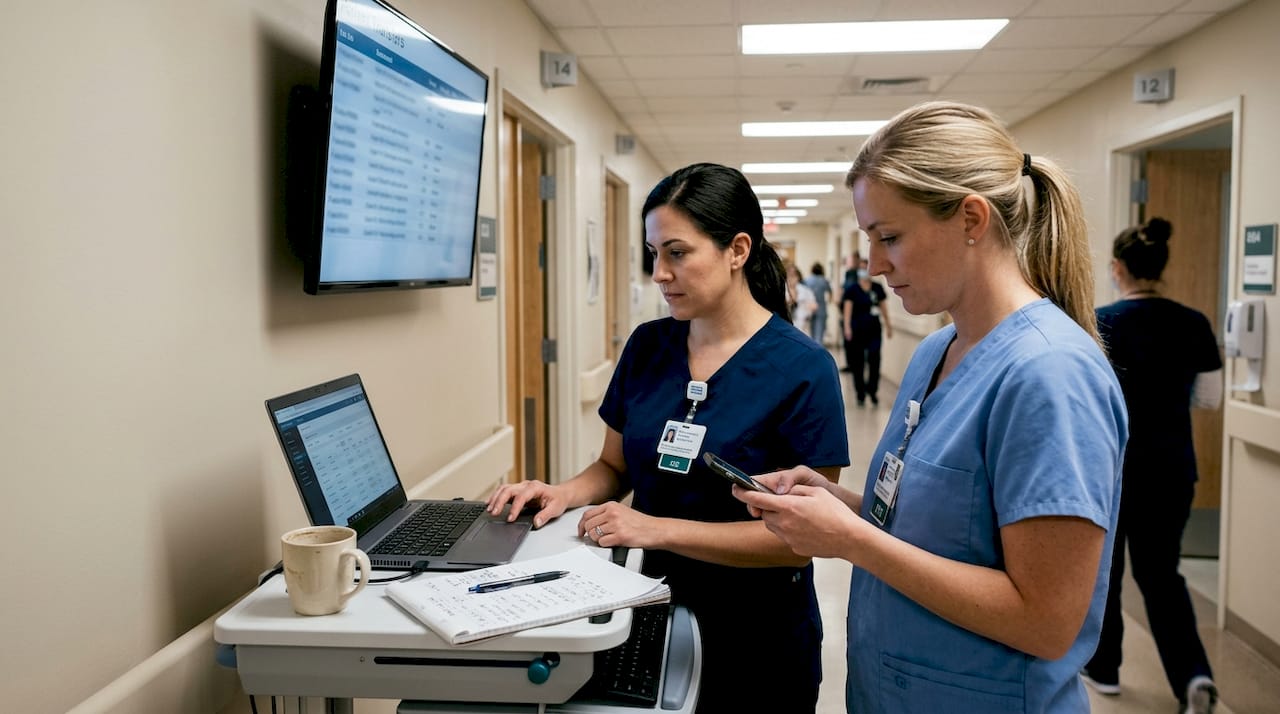
Understanding what patient logistics covers, the next step is to see how advanced tools and proven methodologies unlock measurable value. The field draws heavily from Operations Research (OR), a discipline that applies mathematical modeling to complex decision problems. In hospital settings, OR techniques include vehicle routing, simulation, AI-driven scheduling, and real-time dashboards integrated with EHR systems, each targeting a specific layer of the logistics challenge.
Simulation modeling, for example, allows planners to test discharge protocols or bed assignment rules against historical patient flow data before implementing changes in a live environment. AI-driven scheduling goes further by dynamically adjusting transport assignments and bed requests in real time, reducing the manual coordination burden on staff. When these tools connect to electronic health record (EHR) systems through standards like FHIR, the result is a logistics layer that responds to clinical events automatically rather than reactively.
The VectorCare platform exemplifies this integration approach, combining automated dispatching, vendor management, and real-time visibility into a single workflow. Platforms built on agnostic IT tools are particularly valuable because they connect across disparate hospital systems without requiring a full infrastructure overhaul.
Before and after: Common hospital logistics interventions
| Intervention | Baseline metric | Post-optimization metric |
|---|---|---|
| Discharge processing time | 90 to 120 minutes | 45 to 60 minutes |
| ED boarding time | 60 to 90 minutes | 20 to 35 minutes |
| Bed turnover time | 50 to 70 minutes | 25 to 40 minutes |
| Transport request fulfillment | 45 to 60 minutes | 15 to 25 minutes |
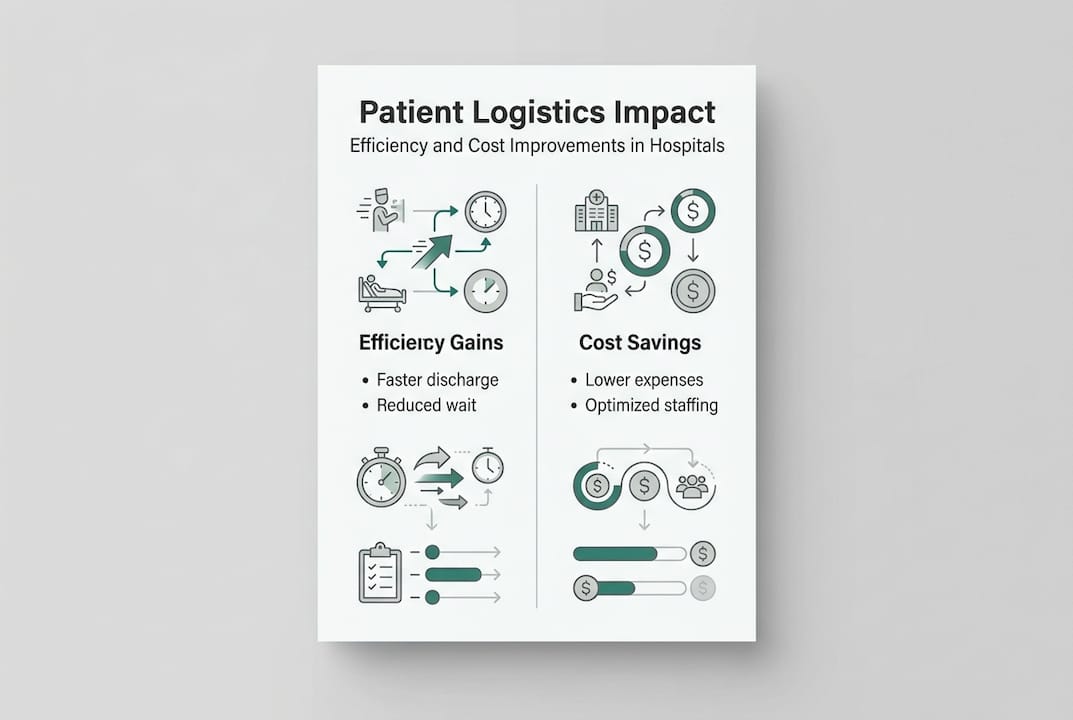
Optimized systems reduce bed turnover and ED boarding times significantly, and the financial impact compounds quickly when these gains apply across hundreds of daily patient movements. Technology-enhanced appointment logistics also reduces no-show rates and scheduling gaps, adding throughput without adding beds.
Pro Tip: Before selecting a logistics platform, map your current handoff points and measure average delay at each one. This baseline data will help you quantify ROI and prioritize which interventions to implement first.
The most effective implementations follow a structured sequence:
- Audit current patient flow and identify the three highest-delay touchpoints
- Integrate real-time bed management with transport scheduling
- Connect logistics workflows to EHR discharge orders
- Deploy AI scheduling for transport and bed assignment
- Monitor performance dashboards and adjust protocols monthly
Barriers to successful patient logistics optimization
Even with clear methods and strong IT, healthcare leaders often hit barriers that blunt logistics gains. The most persistent obstacle is the gap between theoretical optimization and real-world hospital constraints. An algorithm may recommend a discharge at 10 a.m., but if pharmacy, transport, and family coordination are not aligned, that recommendation is meaningless. Gaps in practical implementation, data integration, and incentive alignment consistently undermine even well-funded improvement initiatives.
IT fragmentation compounds this problem. Most hospitals operate with multiple legacy systems that do not share data in real time. A bed management system that cannot communicate with the transport scheduling tool creates manual workarounds, which introduce delay and error. Without a unified data layer, even sophisticated analytics tools produce insights that staff cannot act on quickly enough to matter.
Misaligned incentives present a subtler but equally damaging barrier. Individual departments often optimize for their own metrics rather than system-wide throughput. A nursing unit may prioritize patient safety checks over rapid discharge, while transport teams optimize for route efficiency rather than clinical urgency. Neither is wrong in isolation, but without shared goals, local optimization undermines hospital-wide performance.
The most common reason logistics projects stall is not technology failure. It is the absence of shared accountability across departments that each control a piece of the patient flow puzzle.
The following barriers appear most frequently in real-world implementations:
- Data silos: Disconnected EHR, transport, and bed management systems prevent real-time coordination
- Change resistance: Frontline staff who were not involved in design often work around new systems
- Incentive misalignment: Departmental KPIs that conflict with hospital-wide throughput goals
- Underinvestment in training: Tools deployed without adequate staff education underperform consistently
Theoretical benefit vs. frontline roadblock
| Optimization goal | Theoretical benefit | Common frontline barrier |
|---|---|---|
| Earlier discharge times | Frees beds by midday | Pharmacy and transport delays persist |
| AI bed assignment | Reduces wait for inpatient beds | Staff override algorithms without feedback loops |
| Automated transport dispatch | Cuts fulfillment time by 40% | Legacy systems cannot trigger automated requests |
| Predictive census modeling | Reduces surge-related bottlenecks | Data quality too inconsistent for reliable forecasts |
Addressing these barriers requires more than a technology investment. Reviewing efficiency strategies and treating logistics as infrastructure rather than a project helps organizations build the organizational muscle needed for sustained improvement.
Strategic frameworks and real-world optimization steps
Recognizing barriers is necessary, but what steps can leaders actually implement to drive measurable improvement? The answer depends partly on operational context. Expert frameworks recommend involving frontline staff, distinguishing pandemic and non-pandemic strategies, and using proactive forecasting as foundational elements of any serious logistics improvement program.
During surge or pandemic conditions, the priority shifts to rapid reallocation of transport and bed resources, with simplified decision rules that staff can execute under pressure. In routine operations, the focus returns to systematic process improvement, data-driven scheduling, and incentive alignment. Treating these as the same challenge leads to solutions that work in neither context.
Proactive forecasting deserves particular emphasis. Hospitals that use historical admission patterns, seasonal trends, and scheduled procedure volumes to anticipate demand can pre-position transport resources, staff bed management teams appropriately, and reduce reactive scrambling. This shift from reactive to proactive logistics management is one of the highest-leverage changes an organization can make, and it is enabled by the same data infrastructure that supports AI scheduling.
Pro Tip: Involve charge nurses and transport coordinators in logistics redesign sessions. They surface silent inefficiencies, such as informal workarounds and communication gaps, that never appear in system data but drive significant delay.
A practical sequence for hospital leaders ready to act:
- Establish cross-functional governance: Assign a logistics lead with authority across bed management, transport, and case management
- Align departmental KPIs: Tie unit-level metrics to system-wide throughput goals
- Implement proactive forecasting: Use 90-day rolling admission data to anticipate demand
- Standardize handoff protocols: Define clear triggers and accountability for each patient movement
- Review and iterate monthly: Use dashboard data to identify new bottlenecks as old ones are resolved
The transformational ROI of these changes extends beyond cost savings to include staff satisfaction, patient experience scores, and reduced clinician burnout from coordination failures.
A new mindset: Why patient logistics requires top-down and bottom-up alignment
The prevailing assumption in many health systems is that the right technology will solve the logistics problem. Purchase the platform, integrate the EHR, and efficiency follows. This framing is not just incomplete. It is the primary reason so many well-resourced logistics initiatives produce disappointing results.
Sustainable improvement requires simultaneous movement from two directions. C-suite leaders must set clear system-wide throughput goals, allocate cross-departmental authority, and hold teams accountable to shared metrics. Frontline staff, including transport coordinators, charge nurses, and case managers, must be active co-designers of the workflows they will use daily. Without that dual engagement, technology becomes a layer of complexity rather than a source of clarity.
The organizations that achieve lasting logistics gains are not necessarily those with the most advanced tools. They are the ones where a logistics director can walk a unit and immediately understand why a discharge is delayed, because the system surfaces that information and the culture supports acting on it. As technology transforms patient logistics for SNFs and other care settings, the same principle applies: tools amplify alignment, but they cannot replace it.
Explore solutions for seamless patient logistics
For healthcare administrators ready to move from analysis to action, the path forward starts with building a clear picture of where logistics gaps are costing your organization the most. Educational resources like the patient logistics overview and practical guides on how to maximize efficiencies provide the strategic grounding needed before selecting tools or redesigning workflows.
The VectorCare platform brings together AI-driven dispatching, real-time visibility, vendor management, and EHR integration into a single, scalable system designed for the complexity of modern hospital logistics. Whether your priority is reducing ED boarding, accelerating discharge, or coordinating post-acute transport, VectorCare provides the operational infrastructure to make measurable progress. The next step is a conversation about where your system stands today and what a realistic improvement roadmap looks like.
Frequently asked questions
How can patient logistics cut operational costs in hospitals?
Logistics optimization reduces LOS by 15 to 20%, shortens wait times, and decreases ED boarding, collectively lowering per-patient costs and improving bed utilization across the facility. These gains compound when applied consistently across high-volume patient movement categories.
What’s the difference between patient logistics and patient transport?
Patient logistics includes broader coordination functions such as admissions, bed assignment, discharge planning, and post-acute placement, while patient transport refers specifically to the physical movement of patients between locations. Transport is one component of a much larger logistics system.
Why do hospital logistics projects stall despite modern technology?
Barriers include IT fragmentation, optimization gaps, and siloed objectives that prevent departments from working toward shared throughput goals, meaning technology alone cannot resolve misaligned incentives or process gaps that exist at the organizational level.
How should hospitals start improving patient logistics?
Strategic frameworks emphasize frontline involvement and proactive planning, beginning with cross-team governance, aligned KPIs, and data-driven forecasting before layering in new technology tools or workflow automation.