Patient logistics basics: optimize hospital transport

Patient transport failures cost U.S. hospitals billions annually through delayed procedures, extended stays, and inefficient resource allocation. Yet many healthcare administrators lack a clear framework for optimizing these critical logistics operations. Understanding patient logistics fundamentals transforms how hospitals coordinate non-emergency intra-hospital and interfacility transfers. This guide breaks down core concepts, optimization methodologies, special case navigation, and practical technology strategies that reduce costs while improving patient safety and care delivery.
Table of Contents
- Key takeaways
- Understanding patient logistics: core concepts and processes
- Optimization methodologies in patient logistics
- Navigating special cases in patient transport logistics
- Practical strategies and technologies for improving patient logistics
- Explore VectorCare’s patient logistics solutions
- Patient logistics basics FAQ
Key Takeaways
| Point | Details |
|---|---|
| Core logistics scope | Non emergency intra hospital and interfacility transport involves scheduling, assessment, preparation, and tracking to ensure safety and efficiency. |
| Assessment and preparation | Clinical evaluation determines needs such as mobility aids, oxygen, infection control precautions, and appropriate transport equipment. |
| Standardized protocols | Standard checklists for each transport type reduce preparation time and improve safety. |
| Digital tracking integration | Tracking systems monitor location and ETA and can be integrated with hospital information systems to boost efficiency. |
| Optimization models | Vehicle routing problem variants and MILP bring data driven scheduling to minimize costs and delays while maximizing vehicle utilization. |
Understanding patient logistics: core concepts and processes
Patient logistics involves non-emergency intra-hospital and interfacility transport, focusing on scheduling, assessment, preparation, and tracking to ensure safety and efficiency. This operational domain differs fundamentally from emergency medical services because it centers on planned, coordinated movement of patients who require medical supervision but not urgent intervention. The scope includes transfers between hospital units, moves to diagnostic imaging, discharges to skilled nursing facilities, and scheduled appointments at specialty centers.
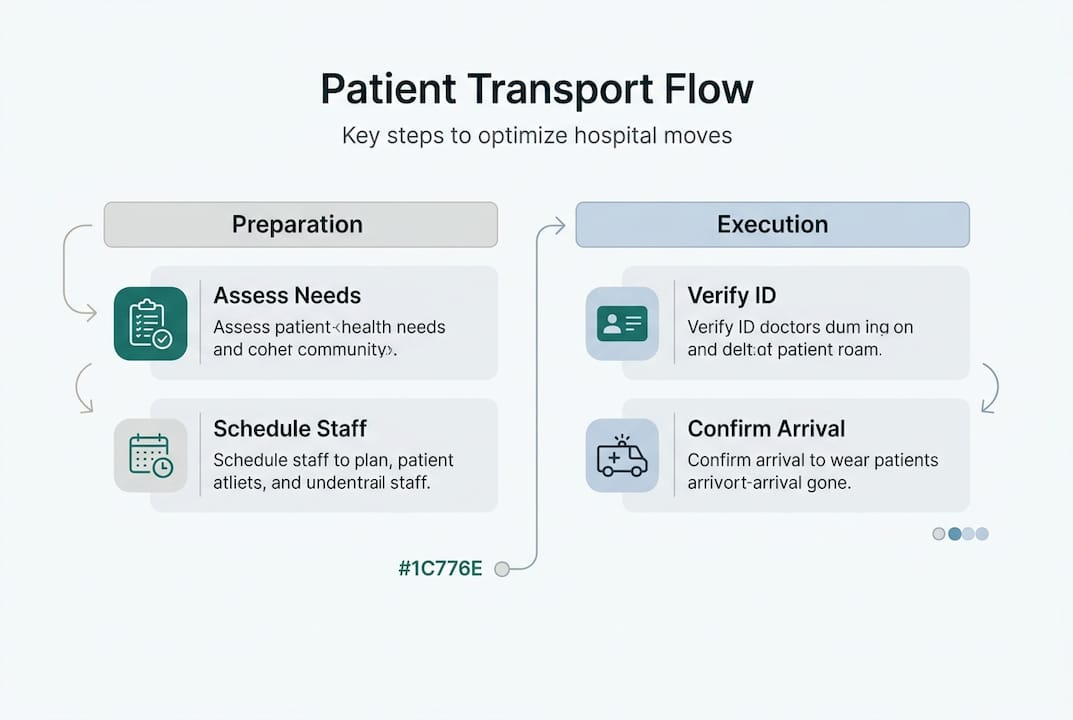
The patient logistics process follows a systematic workflow that begins long before actual transport. First, clinical staff assess patient needs including mobility limitations, oxygen requirements, infection control precautions, and cognitive status. This assessment determines whether the patient needs wheelchair assistance, stretcher transport with monitoring equipment, or bariatric-capable vehicles. Next, schedulers select appropriate providers based on patient acuity, distance, and required medical equipment. Scheduling coordinates pickup times with receiving facilities to minimize patient waiting and maximize vehicle utilization.
Preparation represents the most critical phase for safety and efficiency. Staff verify patient identity, gather necessary medical records and medications, ensure proper documentation accompanies the patient, and confirm the receiving facility is ready. Equipment checks include oxygen tanks, monitoring devices, and specialized positioning aids. During transport, tracking systems monitor vehicle location, estimated arrival times, and any delays or complications. Upon completion, staff verify safe patient handoff, document the transport in medical records, and return equipment to appropriate locations.
Non-emergency cases require different protocols than emergent situations. While emergency transport prioritizes speed and immediate life-saving intervention, non-emergency logistics emphasizes coordination, cost efficiency, and scheduled workflow integration. Safety protocols remain paramount in both contexts. Infection control measures prevent disease transmission during transport, particularly for patients with communicable conditions or compromised immune systems. Staff training on proper lifting techniques, fall prevention, and patient communication reduces injury risk for both patients and transport personnel.
Pro Tip: Create standardized checklists for each transport type (intra-hospital wheelchair, stretcher with monitoring, interfacility ambulance) to ensure consistent safety protocols and reduce preparation time by 25%.
Optimization methodologies in patient logistics
Advanced mathematical models revolutionize how hospitals approach patient transport scheduling and resource allocation. Operational research methodologies use vehicle routing problem variants like capacitated VRP, pickup and delivery VRP, and dial-a-ride problem formulations, combined with mixed-integer linear programming and stochastic models to minimize costs, delays, and maximize vehicle utilization. These sophisticated approaches transform intuitive scheduling into data-driven optimization that accounts for multiple constraints simultaneously.

Vehicle routing problem variants address different aspects of patient transport complexity. Capacitated VRP considers vehicle capacity limits when assigning multiple patients to single vehicles, crucial for shuttle services between facilities. Pickup and delivery VRP with time windows ensures patients arrive at appointments on schedule while minimizing empty vehicle miles. Dial-a-ride problem formulations specifically handle patient preferences, ride-sharing possibilities, and maximum ride time constraints that affect patient comfort and satisfaction.
Mixed-integer linear programming creates mathematical representations of logistics objectives and constraints. These models define decision variables (which vehicle serves which patient at what time), objective functions (minimize total cost or maximize on-time performance), and constraints (vehicle capacity, driver hours, patient time windows). Solving these equations produces optimal or near-optimal schedules that human schedulers cannot match through intuition alone. Stochastic models incorporate uncertainty in transport duration, patient readiness, and unexpected delays, creating robust schedules that perform well even when conditions deviate from predictions.
The benefits of optimization extend across multiple operational dimensions. Reduced wait times improve patient satisfaction and clinical outcomes, as delays in reaching diagnostic imaging or specialty consultations can extend hospital stays. Better resource allocation means fewer vehicles sit idle while others operate at capacity, improving return on asset investments. Lower operational costs result from reduced fuel consumption, decreased overtime labor, and higher vehicle utilization rates. One health system implementing VRP-based scheduling reduced non-emergency transportation costs by 18% while improving on-time performance from 76% to 94%.
| Optimization model | Primary benefit | Implementation complexity | Best use case |
|---|---|---|---|
| Capacitated VRP | Maximizes vehicle utilization | Medium | Multi-patient shuttle routes |
| PDVRP with time windows | Ensures appointment punctuality | High | Scheduled outpatient transports |
| Dial-a-ride problem | Balances efficiency with patient comfort | High | Patient-centered services |
| MILP scheduling | Optimizes across multiple objectives | Very high | Complex multi-facility systems |
| Metaheuristic approaches | Finds good solutions quickly | Medium | Real-time dynamic scheduling |
Pro Tip: Start with simpler heuristic rules (nearest neighbor, earliest deadline first) to establish baseline performance metrics before investing in complex optimization software, allowing you to quantify improvement potential and justify technology investments.
Navigating special cases in patient transport logistics
Real-world patient transport presents complexities that challenge even sophisticated optimization models. Edge cases include emergent versus non-emergent distinctions, air versus ground transport mode selection, weather and traffic impacts, high-risk patients who are frail or critically ill, and uncertainty in transport requests and delays. Understanding these nuances helps logistics managers build flexible systems that maintain performance under varied conditions.
Emergent transport fundamentally differs from non-emergent in resource allocation, decision-making speed, and cost considerations. Emergent cases require immediate response regardless of schedule disruption or vehicle availability, often necessitating dedicated emergency transport teams separate from scheduled logistics operations. Non-emergent transport allows advance planning, route optimization, and cost negotiation with transport vendors. However, the boundary between categories can blur when patient conditions change unexpectedly, requiring protocols for rapid escalation and communication between logistics and clinical teams.
Air transport selection involves complex tradeoffs between speed, cost, and patient needs. Medical air transport typically costs 10 to 15 times more than ground alternatives but becomes essential for distances exceeding 150 miles, time-critical specialist interventions, or geographic barriers like mountains or water. Weather conditions dramatically affect air transport availability, requiring backup ground transport plans even for scheduled air transfers. For distances under 50 miles, ground transport nearly always proves more cost-effective and reliable despite longer travel times.
Weather, traffic, and patient condition introduce variability that static schedules cannot accommodate. Winter storms can double ground transport times or ground air ambulances entirely, cascading delays throughout daily schedules. Urban traffic congestion creates predictable rush-hour delays but also unpredictable incidents that block major routes. Patient condition changes may upgrade transport urgency, require additional medical personnel, or necessitate route changes to closer facilities. Effective logistics systems build buffer time into schedules, maintain real-time traffic monitoring, and establish clear escalation protocols for condition changes.
High-risk patients present unique challenges requiring specialized equipment and trained personnel. Frail elderly patients need extra time for safe transfers, gentle handling to prevent skin tears or fractures, and careful monitoring for confusion or agitation during transport. Critically ill patients may require ventilator support, continuous medication infusions, or intensive monitoring that only specially equipped ambulances and trained critical care transport teams can provide. Bariatric patients need weight-rated equipment and additional personnel, often requiring advance coordination that standard scheduling systems may not trigger automatically.
Pro Tip: Develop a risk stratification system that flags high-complexity transports during scheduling, automatically allocating extra time, specialized equipment, and experienced personnel to prevent last-minute scrambling and delays.
Practical strategies and technologies for improving patient logistics
Healthcare administrators can implement concrete steps to enhance patient transport efficiency without complete system overhauls. These practical strategies combine process improvements, technology adoption, and organizational changes that deliver measurable results.
- Standardize assessment and documentation protocols across all units to ensure consistent information capture about patient mobility, equipment needs, and special requirements, reducing preparation delays and transport errors.
- Implement digital scheduling platforms that replace phone calls and paper logs with centralized systems providing real-time visibility into transport requests, vehicle availability, and completion status.
- Integrate transport systems with electronic health records to automatically populate patient information, reduce duplicate data entry, and trigger transport requests based on clinical orders without manual intervention.
- Establish clear service level agreements with internal transport teams and external vendors defining response times, on-time performance targets, and escalation procedures for different transport priority levels.
- Create dedicated transport coordination roles rather than assigning logistics as secondary duties to clinical staff, allowing specialized expertise development and consistent process execution.
Digital tools transform patient logistics from reactive coordination to proactive management. Real-time transport tracking provides visibility into vehicle locations, estimated arrival times, and potential delays, allowing staff to communicate accurate information to patients and receiving facilities. Digital scheduling eliminates phone tag between units, automatically matches transport requests with available resources, and maintains complete audit trails for quality improvement and billing purposes. Mobile applications give transport personnel instant access to patient information, turn-by-turn navigation, and digital signature capture for handoff documentation.
| Approach | Advantages | Disadvantages |
|---|---|---|
| Manual phone-based scheduling | No technology investment required, familiar to staff | High coordination time, no visibility, frequent errors, difficult to optimize |
| Digital scheduling platform | Centralized visibility, automated matching, audit trails | Requires training, initial setup effort, ongoing maintenance |
| EHR-integrated transport module | Seamless data flow, reduced duplicate entry, clinical context | Expensive, complex implementation, vendor lock-in |
| Standalone tracking devices | Real-time location data, works independently | Additional hardware costs, battery management, integration challenges |
Integration with hospital information systems eliminates data silos that plague patient logistics. When transport platforms connect to electronic health records, admission/discharge/transfer systems, and diagnostic scheduling, information flows automatically rather than requiring manual communication. A radiology order can trigger a transport request with patient location, mobility needs, and appointment time pre-populated. Discharge orders can initiate interfacility transport arrangements with destination facility, required medical equipment, and insurance information already attached. This integration reduces scheduling time from 15 minutes per transport to under 2 minutes while virtually eliminating transcription errors.
Predictive analytics represents the frontier of patient logistics optimization. By analyzing historical patterns in admission volumes, procedure schedules, discharge timing, and seasonal variations, machine learning models forecast transport demand hours or days in advance. This foresight allows proactive staff scheduling, vehicle positioning, and vendor capacity agreements that prevent bottlenecks before they occur. Practical AI applications in healthcare logistics also include predicting which patients will require complex transport arrangements based on diagnosis codes and demographic factors, enabling early coordination with specialized providers.
Pro Tip: Start measuring baseline metrics (average scheduling time, on-time performance percentage, cost per transport) before implementing new technologies so you can demonstrate ROI and identify which improvements deliver the greatest impact for your specific operation.
Explore VectorCare’s patient logistics solutions
Applying patient logistics fundamentals requires tools that translate theory into operational reality. VectorCare’s comprehensive platform addresses the complete patient transport lifecycle from request through completion, integrating scheduling optimization, real-time tracking, vendor management, and performance analytics in a single system. Healthcare administrators gain centralized visibility across all transport modes while logistics managers access the automation and intelligence needed to coordinate hundreds of daily movements efficiently.
The platform’s AI-driven dispatching applies the optimization methodologies discussed earlier, automatically matching transport requests with appropriate resources while considering patient acuity, vehicle availability, staff qualifications, and cost constraints. Integration with existing hospital systems eliminates duplicate data entry and ensures clinical context travels with patients. Real-time tracking and automated notifications keep all stakeholders informed without constant phone calls. By maximizing efficiencies through better patient logistics, hospitals reduce operational costs, improve patient satisfaction, and free clinical staff to focus on care rather than coordination. Explore how VectorCare’s hospital patient logistics platform transforms transport operations from reactive problem-solving to proactive service delivery.
Patient logistics basics FAQ
What are the main steps in patient transport logistics?
Patient transport logistics follows five core steps: assess patient mobility and medical needs, select appropriate transport provider and vehicle type, schedule pickup coordinated with receiving facility readiness, prepare patient with proper documentation and equipment, then track transport completion and verify safe handoff. Each step requires standardized protocols to ensure consistency and safety.
How can technology reduce delays and improve tracking?
Digital platforms centralize scheduling to eliminate phone tag, automatically match requests with available resources, and provide real-time vehicle location visibility. Integration with hospital systems triggers transport requests from clinical orders without manual data entry. Automated notifications alert staff to delays or arrival times, reducing coordination effort by up to 70% while improving on-time performance.
What challenges arise with emergent versus non-emergent patient transfers?
Emergent transfers require immediate response regardless of schedule disruption, dedicated resources, and rapid clinical decision-making, while non-emergent hospital transport allows advance planning, cost optimization, and scheduled workflow integration. The boundary between categories can blur when patient conditions change unexpectedly, requiring clear escalation protocols and communication between logistics and clinical teams.
How do hospitals balance cost and quality in selecting transport providers?
Hospitals establish service level agreements defining response times, on-time performance targets, and quality metrics, then evaluate providers on total value rather than price alone. Quality indicators include staff training credentials, vehicle maintenance records, patient satisfaction scores, and safety incident rates. Many organizations use tiered provider networks, reserving premium services for complex cases while using cost-effective options for routine transports.
Why is integration with electronic health records important for patient logistics?
EHR integration eliminates manual data entry by automatically populating patient demographics, mobility assessments, medical equipment needs, and destination information into transport requests. Clinical orders trigger logistics workflows without staff intervention, reducing scheduling time from 15 minutes to under 2 minutes per transport. Integration also maintains complete audit trails, supports accurate billing, and ensures transport personnel have current clinical context for safe patient handling.