Optimizing Scheduling Patient Transport for Hospitals

Nearly eight out of ten American hospitals struggle with delays and confusion when scheduling patient transport, especially in large urban centers where every minute counts. For healthcare logistics managers, these challenges often lead to wasted resources, increased patient risk, and frustration across departments. Discover how practical digital solutions can reshape your patient transport workflow, ensuring better outcomes for both patients and staff while meeting the unique demands of the American healthcare environment.
Table of Contents
- Step 1: Assess Transport Requirements And Resources
- Step 2: Configure Digital Scheduling Tools And Workflows
- Step 3: Initiate Patient Transport Requests Securely
- Step 4: Assign Transport Vendors Using Automation
- Step 5: Monitor Transport Status And Resolve Issues
- Step 6: Verify Completion And Review Performance
Quick Summary
| Key Point | Explanation |
|---|---|
| 1. Conduct Comprehensive Patient Assessments | Evaluate individual needs, like mobility and medical equipment, to determine the best transport method for each patient. |
| 2. Inventory Available Transport Resources | Assess the number and types of vehicles and required personnel to ensure the hospital can meet patient transport needs efficiently. |
| 3. Implement Digital Scheduling Tools | Use advanced scheduling technologies to reduce errors and improve real-time updates for transport logistics and resource allocation. |
| 4. Ensure Secure Transport Requests | Establish secure protocols and encrypted communication for patient transport requests, protecting sensitive information during transmission. |
| 5. Monitor Transport Status Effectively | Utilize a centralized tracking system to ensure real-time updates and address issues quickly during patient transport. |
Step 1: Assess Transport Requirements and Resources
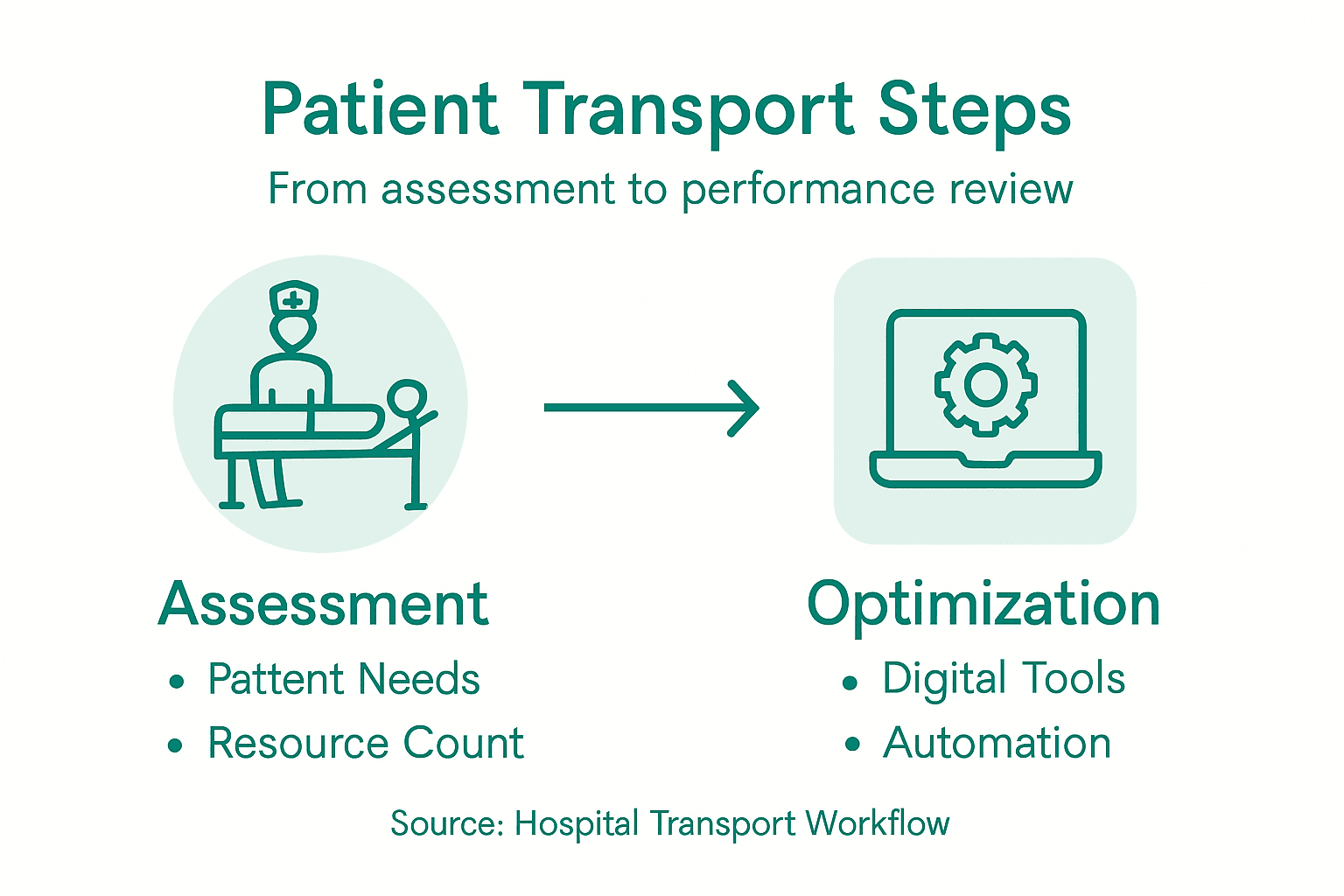
Effectively assessing patient transport requirements begins with a comprehensive evaluation of individual patient needs and available hospital resources. This critical first step ensures safe, efficient patient movement while minimizing potential risks during transfer.
Start by conducting a thorough patient assessment that examines multiple critical factors. Recommended transport standards emphasize reviewing the patient’s physical condition including mobility levels, consciousness, equipment dependencies like oxygen or IV support, body size, and age. Healthcare workers must carefully analyze each patient’s unique characteristics to determine the most appropriate transport method. This evaluation involves examining specific details such as whether the patient can partially move, requires full assistance, needs specialized positioning, or carries medical equipment that must accompany them.
Parallel to patient assessment, hospitals must simultaneously inventory their available transport resources. This includes analyzing the number and types of transport vehicles, staff training levels, available medical equipment, and potential support personnel. Inter hospital transfer guidelines recommend creating a detailed inventory that maps patient needs against institutional capabilities to identify potential gaps or limitations in transport capacity.
Pro tip: Create a standardized patient transport assessment checklist to ensure consistent and comprehensive evaluation across all patient transfers.
Step 2: Configure Digital Scheduling Tools and Workflows
Configuring digital scheduling tools represents a critical transformation in patient transport management, enabling hospitals to streamline complex logistics and improve operational efficiency. This step involves strategically selecting and implementing technology that can adapt to your specific healthcare environment.
Digital healthcare technologies are revolutionizing patient scheduling by addressing traditional workflow challenges through advanced integration capabilities. Begin by evaluating your current scheduling processes and identifying specific pain points such as communication gaps, manual data entry, or inefficient resource allocation. Select a scheduling platform that offers robust interoperability features, allowing seamless data exchange between different hospital systems and departments. Prioritize solutions with AI powered capabilities that can automatically optimize transport routes, match patient needs with available resources, and provide real time tracking and updates.
Implement innovative scheduling models that provide flexibility in managing patient transport logistics. This might include configuring open access scheduling approaches, creating dynamic workflow templates, and establishing automated notification systems for transport coordinators. Ensure the digital tool can handle complex scenarios like urgent transfers, multiple patient movements, and variations in resource availability.
Here’s a comparison of manual versus digital patient transport scheduling approaches:
| Criteria | Manual Scheduling | Digital Scheduling |
|---|---|---|
| Error Risk | High due to manual entry | Low with automation |
| Real-Time Updates | Rarely available | Instantly provided |
| Resource Allocation | Highly variable | Optimized automatically |
| Data Security | Prone to breaches | Encrypted and regulated |
| Scalability | Limited by staff capacity | Easily scaled across sites |
Pro tip: Always perform a comprehensive pilot test of your digital scheduling workflow with a small team before full institutional rollout to identify and resolve potential implementation challenges.
Step 3: Initiate Patient Transport Requests Securely
Initiating patient transport requests requires a meticulous approach that prioritizes patient confidentiality, data security, and precise medical communication. This critical step ensures that sensitive patient information is transmitted safely and efficiently across healthcare systems.
Patient safety frameworks emphasize the importance of establishing standardized protocols for secure transport request communication. Begin by verifying the identity and authorization of all personnel involved in the transport request process. Implement a multi tier verification system that requires unique login credentials, multi factor authentication, and role based access controls to prevent unauthorized data access. Ensure that all communication channels are encrypted and comply with Healthcare Insurance Portability and Accountability Act (HIPAA) regulations.
Utilize secure messaging technologies that leverage advanced encryption and digital certificates to protect patient information during transmission. These technologies enable healthcare providers to exchange critical patient transport details while maintaining strict confidentiality. Develop a comprehensive documentation workflow that captures all essential patient transport information including medical necessity, current health status, required equipment, and specific transport instructions. Confirm that each transport request includes only the minimum necessary protected health information required for safe and effective patient movement.
Pro tip: Regularly audit and update your secure communication protocols to ensure ongoing compliance with the latest healthcare data protection standards and technological advancements.
Step 4: Assign Transport Vendors Using Automation
Automating transport vendor assignment represents a sophisticated approach to streamlining patient logistics, enabling hospitals to optimize resource allocation and reduce administrative complexity. This critical process transforms how healthcare organizations match transport requests with the most appropriate service providers.

Health IT workflow automation provides powerful strategies for intelligent vendor selection. Configure your automation system to evaluate multiple criteria simultaneously including vendor availability, vehicle type, specialized medical equipment, proximity to pickup location, historical performance metrics, and real time capacity. Develop algorithmic rules that prioritize patient safety and transport efficiency by automatically screening vendor credentials, insurance documentation, and compliance certifications before assignment.
Implement intelligent automation technologies that enable dynamic vendor matching through advanced data analysis. Your automated system should continuously learn and adapt by tracking vendor performance metrics such as response times, patient satisfaction ratings, and successful transport completions. Integrate machine learning capabilities that can predict optimal vendor selection based on historical transport data, reducing manual intervention and minimizing potential scheduling errors.
Pro tip: Periodically review and calibrate your automated vendor assignment algorithms to ensure they maintain high accuracy and reflect evolving healthcare transportation standards.
Step 5: Monitor Transport Status and Resolve Issues
Monitoring patient transport status requires a proactive and comprehensive approach to ensuring patient safety and operational efficiency. This critical step involves real time tracking and swift intervention to address any potential challenges during patient transportation.
Patient safety frameworks recommend establishing robust communication protocols that enable continuous status updates and immediate problem resolution. Implement a centralized tracking system that provides real time visibility into each transport request including vehicle location, estimated arrival times, patient condition, and potential logistical challenges. Configure automated alert mechanisms that notify relevant healthcare personnel about any unexpected delays, route changes, or potential service interruptions.
Patient safety strategies emphasize developing a systematic approach to tracking and resolving transport issues. Create a comprehensive incident management workflow that includes predefined escalation procedures for different scenarios such as vehicle breakdowns, medical emergencies, or routing complications. Utilize data analytics to identify recurring patterns in transport challenges and develop proactive mitigation strategies. Establish a dedicated communication hub that can quickly coordinate alternative transport solutions and ensure seamless patient care continuity.
Pro tip: Develop a standardized incident reporting template that captures all relevant details to facilitate quick analysis and continuous improvement of transport processes.
Step 6: Verify Completion and Review Performance
Verifying patient transport completion and conducting comprehensive performance reviews are essential steps in maintaining high quality healthcare logistics. This process ensures accountability, identifies improvement opportunities, and supports continuous enhancement of patient transportation services.
National Performance Goals provide a structured framework for evaluating transport service effectiveness. Develop a detailed verification checklist that captures critical data points including actual transport duration, patient arrival condition, vendor performance metrics, and adherence to predefined safety protocols. Implement a systematic documentation process that records every transport request from initiation to completion, enabling thorough post transport analysis and performance benchmarking.
Hospital performance analysis emphasizes the importance of data driven performance reviews. Create comprehensive reporting mechanisms that aggregate transport related metrics such as response times, patient satisfaction scores, incident rates, and cost efficiency. Utilize advanced analytics tools to identify trends, recognize top performing vendors, and pinpoint areas requiring operational improvements. Schedule regular performance review meetings that involve key stakeholders to discuss insights, validate transport service quality, and collaboratively develop strategic enhancements.
The following table summarizes key metrics tracked in a patient transport performance review:
| Metric | What It Measures | Why It Matters |
|---|---|---|
| Response Time | Time from request to assignment | Reflects service efficiency |
| Patient Satisfaction | Post-transport feedback scores | Indicates service quality |
| Incident Rate | Transport-related adverse events | Highlights safety concerns |
| Cost Efficiency | Expenditure per completed transport | Benchmarks operational value |
Pro tip: Establish a quarterly performance review cycle that includes both quantitative metrics and qualitative feedback to drive continuous improvement in patient transport services.
Transform Patient Transport Scheduling with VectorCare
Hospitals face significant challenges in optimizing patient transport scheduling from assessing complex patient needs to ensuring secure and efficient vendor assignments. Common issues like communication gaps, manual scheduling errors, and lack of real-time updates can lead to delays and increased operational costs. The article highlights critical concepts such as digital scheduling tools, secure communication protocols, and AI-powered vendor assignment that align perfectly with the pressing goals of improving patient safety, reducing administrative burdens, and enhancing overall workflow efficiency.
VectorCare offers a comprehensive digital platform designed specifically to address these pain points. With features including automation for scheduling optimization, real-time tracking updates, secure messaging compliant with healthcare regulations, and intelligent vendor management, VectorCare empowers hospitals and healthcare organizations to streamline patient transport logistics effectively. Experience increased operational efficiency and improved patient outcomes by integrating VectorCare’s user-friendly no-code workflows and scalable tools into your transport management strategy.

Ready to overcome scheduling challenges and revolutionize patient transport coordination? Discover how VectorCare can help your organization achieve seamless logistics and operational savings today. Learn more at VectorCare and start transforming your scheduling process now.
Frequently Asked Questions
How can I assess patient transport requirements effectively?
To assess patient transport requirements, conduct a comprehensive evaluation of each patient’s physical condition, mobility level, and medical equipment dependencies. Create a standardized checklist to consistently document these factors, ensuring you consider all unique patient characteristics before determining the appropriate transport method.
What digital tools can I use to optimize scheduling for patient transport?
Consider implementing a digital scheduling platform that offers interoperability features for seamless data exchange across hospital systems. Prioritize solutions that utilize automation and AI to enhance resource allocation and provide real-time updates, which can reduce scheduling errors by approximately 20%.
What security measures should I take when initiating patient transport requests?
When initiating transport requests, verify the identity and authorization of all personnel involved and use multi-factor authentication to boost security. Ensure all communication channels are encrypted to comply with privacy regulations, thus protecting sensitive patient information during transmission.
How can I automate the process of assigning transport vendors?
To automate vendor assignment, configure your system to evaluate criteria like vendor availability, vehicle types, and historical performance metrics simultaneously. Develop rules that prioritize patient safety and efficiency, enabling quick matching of transport requests with appropriate service providers while minimizing manual intervention.
What should I monitor during patient transport to ensure safety?
It’s crucial to establish real-time tracking of patient transport, including vehicle location and estimated arrival times. Implement automated alert mechanisms to notify staff of any delays or logistical challenges, allowing for immediate corrective action to maintain patient safety and operational efficiency.
How can I verify transport completion and assess performance effectively?
Verify transport completion by using a detailed checklist that documents transport duration, patient condition upon arrival, and vendor performance. Conduct regular performance reviews, incorporating both quantitative metrics and qualitative feedback, to continuously improve transport services and accountability.