Boost hospital profitability: 6 cost reduction strategies

Cutting hospital costs doesn’t have to mean sacrificing quality care or patient outcomes. Healthcare organizations face unique constraints that make simplistic cost reduction strategies not only ineffective but potentially dangerous. However, scientific, data-driven approaches enable hospitals to improve profitability while maintaining or even enhancing care standards. This guide reveals evidence-based operational cost reduction methods that healthcare executives and finance managers can implement to achieve sustainable financial performance in 2026.
Table of Contents
- Understanding The Challenge: Balancing Costs And Quality In Hospital Operations
- Applying Scientific And Data-Driven Approaches To Reduce Operational Costs
- Optimizing Supply Chain And Vendor Management For Improved Profitability
- Integrating Revenue Cycle Management To Enhance Hospital Financial Performance
- Enhance Patient Logistics To Support Cost Reduction And Profitability
Key takeaways
| Point | Details |
|---|---|
| Quality preservation | Effective cost reduction strategies maintain or improve patient care standards while reducing expenses. |
| Supply chain optimization | Data-driven supply management and vendor consolidation yield significant savings without quality compromise. |
| Revenue cycle integration | Consolidated RCM platforms reduce claim denials and manual errors, improving revenue capture. |
| Strategic staffing | Proper workforce planning prevents costly agency reliance and quality deterioration. |
| Collaborative leadership | Multidisciplinary teams drive successful implementation and sustained cost reduction results. |
Understanding the challenge: balancing costs and quality in hospital operations
Hospital cost reduction initiatives often fail because they target the wrong areas or use the wrong methods. Cutting nursing staff to save on labor costs may seem logical on a spreadsheet, but it creates dangerous nurse-to-patient ratios that lead to adverse events, increased readmissions, and ultimately eroded revenues. Similarly, reducing physician availability can trigger quality declines that result in value-based reimbursement penalties, wiping out any initial savings.
The hidden costs of poor cost management extend beyond immediate quality metrics. When hospitals cut permanent staff positions, they often compensate by hiring expensive agency workers during peak demand periods. This reliance on agency staffing can cost 50-100% more per hour than permanent employees, completely negating intended savings. The cycle continues as remaining permanent staff face burnout, leading to higher turnover and even greater dependence on temporary workers.
Key healthcare cost strategies recognize these interdependencies. Strategic cost reduction requires maintaining or improving quality metrics while reducing operational waste. Success depends on identifying inefficiencies rather than eliminating essential resources.
Critical factors that complicate hospital cost reduction include:
- Regulatory compliance requirements that mandate minimum staffing levels and quality standards
- Complex reimbursement models that penalize quality declines through reduced payments
- Patient safety considerations that make certain resource cuts unacceptable
- Staff morale and retention challenges that increase when cuts are implemented poorly
Applying scientific and data-driven approaches to reduce operational costs
Implementing scientific approaches to improve healthcare systems can lead to significant cost savings and improved care quality. Mathematical modeling, process automation, and advanced data analytics identify waste and inefficiencies that traditional management approaches miss. These methods focus on optimizing workflows rather than simply eliminating resources.
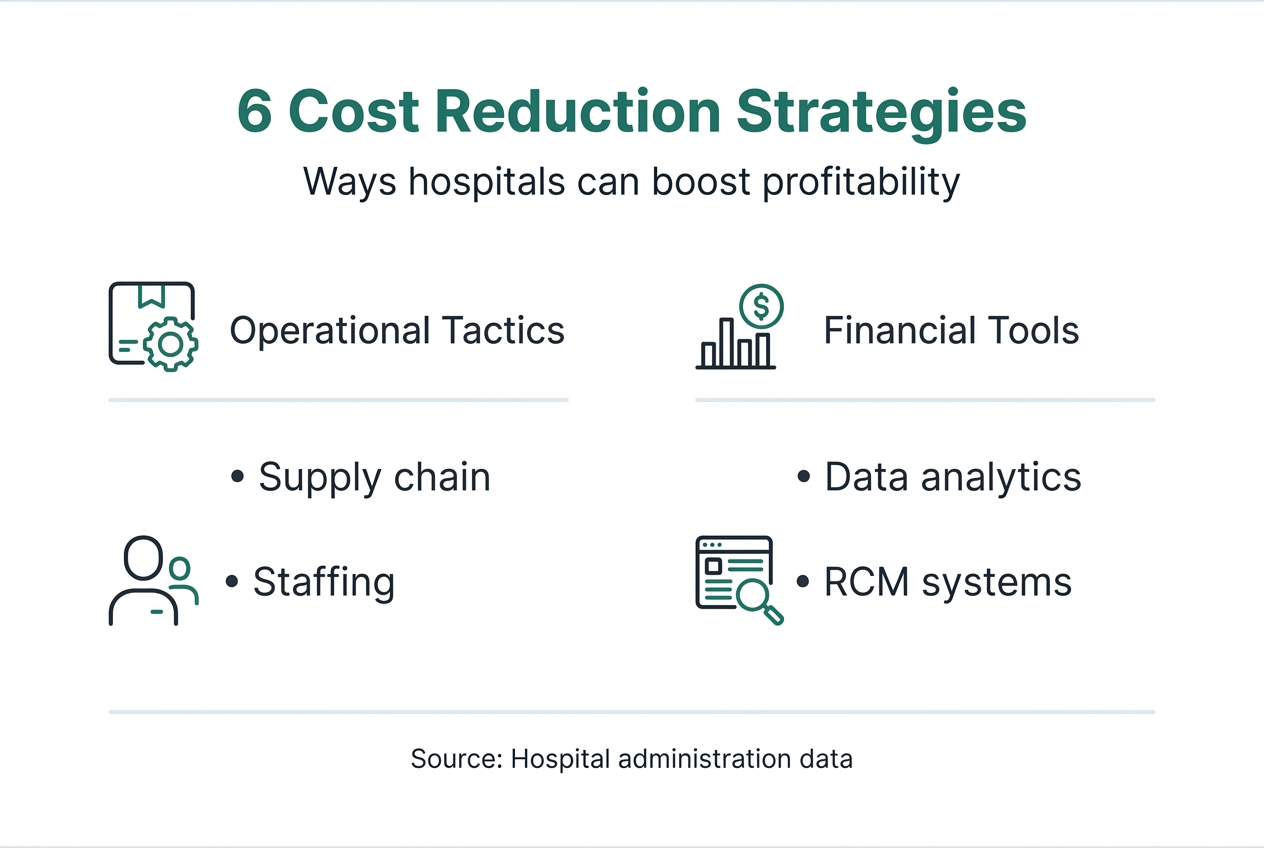
Data analytics platforms analyze millions of transactions to reveal patterns in supply usage, staffing efficiency, and revenue cycle performance. By identifying where resources are wasted or underutilized, hospitals can redirect spending to higher-value activities. For example, analyzing patient flow data may reveal that certain diagnostic equipment sits idle for hours each day while other units face backlogs, suggesting opportunities for better scheduling or resource redistribution.
Collaborative leadership teams amplify the impact of data-driven insights. When finance managers, clinical leaders, and operational efficiency experts work together, they make better decisions about where and how to reduce costs. These multidisciplinary teams also track progress more effectively and adjust strategies based on real-world results.
Effective scientific approaches to reducing operational costs in healthcare include:
- Process mapping and workflow optimization to eliminate unnecessary steps and redundancies
- Predictive analytics for demand forecasting and resource allocation
- Real-time monitoring systems that flag inefficiencies as they occur
- Standardization protocols that reduce variation and associated costs
Pro Tip: Establish baseline metrics before implementing cost reduction initiatives so you can measure both financial impact and quality outcomes accurately.
Optimizing supply chain and vendor management for improved profitability
Strategic sourcing initiatives deliver remarkable returns when executed properly. Supply savings yielded an estimated $365,868 for Q3 and Q4 2024 and a projected $732,600 for 2025 at one hospital system. These results came from engaging multidisciplinary teams that included finance managers, clinical leaders, and purchasing specialists who collaboratively identified opportunities without compromising patient care.

Standardizing products across departments and facilities represents one of the highest-impact supply chain strategies. When hospitals allow unlimited physician preference in medical devices and supplies, they sacrifice purchasing power and inventory efficiency. By establishing preferred product lists based on clinical evidence and negotiating system-wide contracts, hospitals reduce per-unit costs while maintaining quality standards.
| Supply Chain Strategy | Implementation Approach | Expected Savings |
|---|---|---|
| Product standardization | Establish preferred lists with clinical input | 15-25% per category |
| Vendor consolidation | Negotiate system contracts with fewer suppliers | 10-20% overall |
| Real-time scanning | Track usage patterns and eliminate waste | 5-10% inventory costs |
| Demand forecasting | Use data to optimize ordering and reduce excess | 8-15% carrying costs |
Real-time product scanning and detailed usage tracking identify waste that traditional inventory systems miss. When supplies are scanned at the point of use, hospitals gain visibility into actual consumption patterns versus purchased quantities. This data reveals expired products, redundant stockpiles, and items that could be substituted with lower-cost alternatives.
Supply chain cost savings case studies demonstrate that sustained results require ongoing oversight. Collaborative leadership teams should meet regularly to review metrics, address compliance issues, and identify new opportunities. Without this continued attention, old purchasing habits and preference variations creep back in, eroding initial gains.
Key supply chain optimization actions include:
- Engaging physicians early in standardization discussions to build buy-in
- Analyzing utilization data to identify high-cost, low-value items
- Negotiating bundled contracts that include price protection clauses
- Implementing automated reordering systems that prevent stockouts and overstocking
Pro Tip: Start supply standardization initiatives with high-volume, lower-risk categories where clinical variation matters least, then expand to more complex product areas as you build momentum and trust.
Integrating revenue cycle management to enhance hospital financial performance
Fragmented revenue cycle management systems create costly inefficiencies that drain hospital profitability. Claim denial rates reach as high as 10-15% and 65% of denials are never worked, causing 3% net revenue loss due to coordination failures. When hospitals use multiple RCM vendors for different functions, each handoff introduces opportunities for errors, delays, and lost revenue.
The root cause of RCM fragmentation stems from decades of technology acquisitions and legacy system dependencies. A typical hospital might use one vendor for eligibility verification, another for coding, a third for claims submission, and yet another for denial management. This patchwork approach leaves 70% of revenue cycle processes requiring manual intervention because systems don’t communicate effectively.
| RCM Approach | Vendor Complexity | Manual Intervention | Denial Rate | ROI Timeline |
|---|---|---|---|---|
| Fragmented system | 5-8 vendors | 70% of processes | 10-15% | N/A (negative) |
| Integrated platform | 1-2 vendors | 25-30% of processes | 4-6% | 12-24 months |
Integrated end-to-end RCM platforms consolidate these functions into unified systems that automate workflows and reduce manual touchpoints. By eliminating vendor coordination issues, hospitals improve claim accuracy, reduce denial rates, and accelerate payment cycles. These platforms typically deliver positive ROI within 1-2 years through reduced staffing needs, lower denial rates, and faster cash collection.
Reducing vendor complexity also improves accountability and transparency. When a single platform handles the entire revenue cycle, it’s easier to identify bottlenecks, measure performance, and hold vendors accountable for results. This clarity supports better decision making about process improvements and technology investments.
Critical RCM integration strategies include:
- Conducting comprehensive vendor assessments to identify redundancies and gaps
- Prioritizing platforms with proven interoperability and automation capabilities
- Establishing clear performance metrics tied to denial rates and collection speed
- Training staff on new systems to maximize adoption and minimize disruption
Strategic RCM adoption becomes even more important under value-based reimbursement models. As payers tie more revenue to quality metrics and cost efficiency, hospitals need revenue cycle systems that can track and report these complex data requirements accurately.
Enhance patient logistics to support cost reduction and profitability
Operational efficiency extends beyond traditional cost centers like supply chain and staffing. Patient logistics represents a significant but often overlooked opportunity to reduce costs while improving care quality. When hospitals optimize how patients move through the system for transportation, home health services, and durable medical equipment delivery, they reduce delays, prevent bottlenecks, and lower operational expenses.

VectorCare’s integrated platform addresses these patient logistics challenges through AI-driven dispatching, real-time scheduling optimization, and automated vendor management. By coordinating transportation and care logistics more efficiently, hospitals reduce costly delays that tie up beds and resources. The platform’s data insights help identify patterns that drive unnecessary costs, enabling continuous improvement.
Healthcare executives seeking to maximize efficiencies can leverage VectorCare’s solutions to complement broader operational cost reduction strategies. The platform integrates with existing hospital systems to provide seamless coordination across departments and external vendors, supporting the collaborative approach that drives successful cost management initiatives.
FAQ
What are the biggest operational cost drivers in hospitals?
Labor costs typically represent 50-60% of hospital operating expenses, making staffing the largest cost driver. Supply chain expenses account for another 20-30%, while fragmented revenue cycle management creates hidden costs through claim denials and manual rework. Strategic management of these three areas is vital to controlling operational expenses without compromising care quality.
How can hospitals reduce costs without affecting patient care quality?
Implement data-driven supply chain strategies that standardize products based on clinical evidence rather than arbitrary cuts. Maintain appropriate staffing levels while optimizing schedules and reducing expensive agency reliance. Successful cost reductions with no negative impact to quality outcomes require collaboration between finance and clinical leaders.
What role does revenue cycle management play in hospital profitability?
Integrated RCM solutions report positive ROI within 1-2 years and reduce claim denials from 10-15% to 4-6%. Efficient RCM reduces manual errors and accelerates payment collection to maximize revenue capture. Fragmented RCM systems cause 3% net revenue loss through coordination failures, making integration essential for financial health.
How quickly can hospitals expect to see results from cost reduction initiatives?
Supply chain optimization initiatives typically show measurable savings within 3-6 months of implementation. RCM integration delivers positive ROI within 12-24 months as denial rates decrease and automation reduces staffing needs. Long-term sustainability requires ongoing oversight through collaborative leadership teams that monitor metrics and adjust strategies based on results.
What metrics should hospitals track to measure cost reduction success?
Track supply costs per adjusted patient day to measure purchasing efficiency. Monitor claim denial rates and days in accounts receivable for revenue cycle performance. Measure quality indicators like readmission rates and patient satisfaction scores to ensure cost reductions don’t harm care outcomes. These metrics together provide a balanced view of financial and clinical success.