How to optimize operational efficiency in healthcare

U.S. healthcare wastes an estimated $760 to $935 billion every year, a figure that dwarfs the budgets of most industries. Yet many health systems respond by hiring more staff or purchasing additional supplies, interventions that address symptoms rather than root causes. True operational efficiency requires a system-wide, data-driven approach that touches labor, administration, patient logistics, and technology simultaneously. This guide unpacks the benchmarks, frameworks, and practical steps that healthcare administrators need to drive measurable, sustainable improvement.
Table of Contents
- What is operational efficiency in healthcare?
- The true cost of inefficiency: benchmarks and data
- The mechanics of efficiency: aligning people, process, and technology
- The role of patient logistics in operational efficiency
- CMS frameworks and compliance: aligning with national strategy
- Nuances and edge cases: culture, measurement, and context
- Steps to implement: practical roadmap for healthcare leaders
- Streamline patient logistics with advanced technology
- Frequently asked questions
Key Takeaways
| Point | Details |
|---|---|
| Healthcare waste is high | Over $760 billion is wasted in the U.S. annually, highlighting urgent need for change. |
| Data-driven process overhaul | Efficiency requires measuring processes, engaging teams, and redesigning workflows before investing in new technology. |
| Tech transforms logistics | Centralized, automated patient logistics platforms can cut costs and improve outcomes with measurable impact. |
| CMS sets new standards | Hospitals must align with CMS priorities, reducing admin burden and leveraging modern tech for compliance and efficiency. |
| Culture drives success | Sustainable efficiency depends on organization-wide buy-in and aligning culture with data-driven improvements. |
What is operational efficiency in healthcare?
Operational efficiency in healthcare means achieving the best possible clinical and financial outcomes while minimizing unnecessary resource consumption. It is not simply about cutting costs. It is about eliminating waste across every category: labor, administrative processes, supply chains, and patient logistics, so that every dollar and every hour of staff time translates directly into patient value.
“Operational efficiency is a top priority for 80% of U.S. health systems, reflecting the urgency leaders feel to balance quality care with financial sustainability.”
The four major pillars of efficiency are labor utilization, administrative cost control, supply chain performance, and patient logistics coordination. Each pillar interacts with the others, meaning a bottleneck in one area, such as delayed patient transport, can cascade into longer lengths of stay and higher labor costs. Leaders who want to make progress on streamlining hospital workflows must address all four pillars in a coordinated way rather than optimizing them in isolation.
- Labor: Accounts for the largest share of hospital operating expenses and is highly sensitive to scheduling and demand mismatches.
- Administrative costs: Billing, prior authorization, and documentation consume resources that could support direct care.
- Supply chain: Unstandarized procurement and poor inventory visibility drive unnecessary spending.
- Patient logistics: Transport delays, bed management failures, and discharge bottlenecks extend stays and reduce throughput.
The true cost of inefficiency: benchmarks and data
Hard numbers make the urgency concrete. Labor represents 56% of hospital expenses, while administrative costs consume roughly 25% of total revenue. Against that backdrop, hospital operating margins average just 1 to 2%, leaving almost no room for error. A single percentage point improvement in labor utilization or a one-day reduction in average length of stay can shift a facility from operating at a loss to generating a meaningful surplus.
| Metric | National benchmark | Impact of 10% improvement |
|---|---|---|
| Labor as % of expenses | 56% | Significant margin recovery |
| Administrative cost as % of revenue | 25% | Reduced overhead burden |
| Average hospital operating margin | 1 to 2% | Viability threshold |
| ER average wait time | 26 minutes (median) | Throughput and satisfaction gains |
| Supply chain cost as % of revenue | 15 to 17% | Direct savings opportunity |
Strategies focused on reducing operational costs and reducing administrative costs consistently show that even modest gains compound quickly across a large facility. Supply chain visibility insights further confirm that real-time inventory data alone can reduce procurement waste by double digits.
The mechanics of efficiency: aligning people, process, and technology
Understanding costs and benchmarks is the foundation. Acting on them requires aligning staffing, workflows, and technology in a deliberate sequence. The most common mistake organizations make is deploying new technology before redesigning the underlying process, which simply automates an inefficient workflow rather than eliminating it.
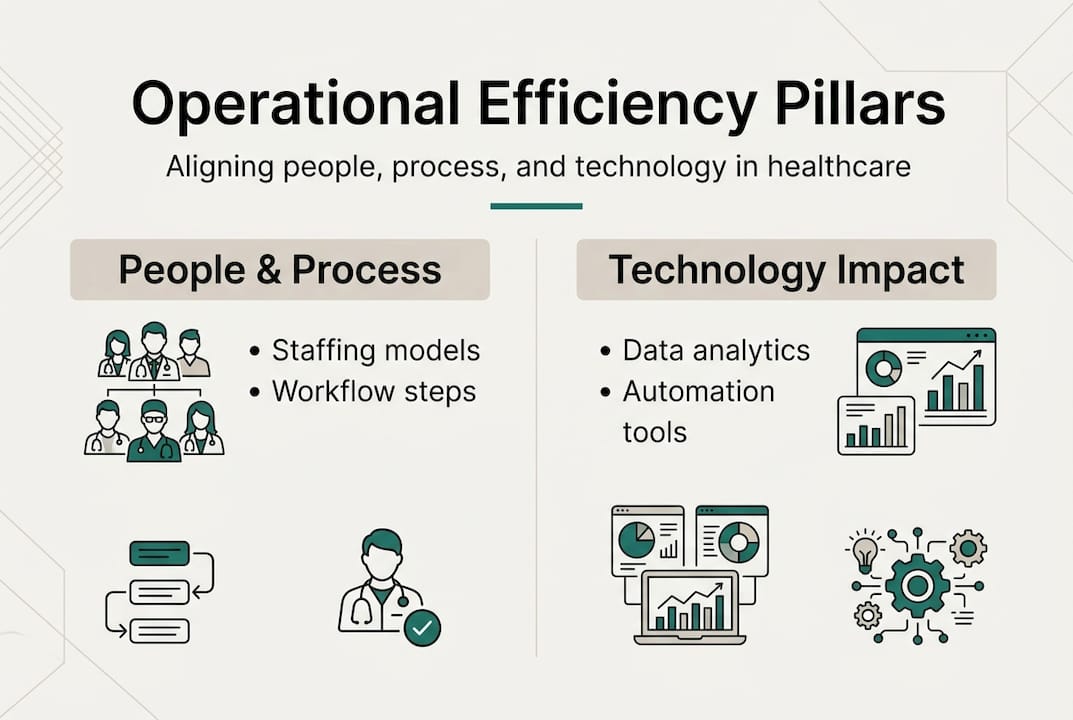
Effective efficiency strategies follow a clear order: measure existing processes first, identify the highest-impact bottlenecks, redesign those workflows, and only then implement technology to support the new design. Streamlining business operations research confirms that process redesign before technology adoption produces significantly better ROI than the reverse.
| Approach | Traditional | Data-driven |
|---|---|---|
| Staffing model | Fixed schedules | Demand-aligned analytics |
| Supply procurement | Decentralized, reactive | Standardized, predictive |
| Workflow design | Siloed, manual | Integrated, automated |
| Performance tracking | Periodic audits | Real-time dashboards |
| Technology role | Bolt-on addition | Core process enabler |
Predictive analytics in healthcare enables administrators to align nurse-to-patient ratios with actual census data, reducing both overtime costs and understaffing risks. Aligning staffing with demand, standardizing workflows, and applying predictive analytics are the three mechanics that consistently separate high-performing systems from average ones.
Pro Tip: Before purchasing any new platform, document your current process in a simple flowchart. Identify every handoff point where delays or errors occur. Those handoffs are your highest-value targets for redesign and automation.
The role of patient logistics in operational efficiency
Patient logistics encompasses transport coordination, bed management, durable medical equipment delivery, and discharge planning. It is one of the most fragmented areas in healthcare operations, and fragmentation is expensive. Delays in any one of these functions extend length of stay, consume nursing time, and reduce the facility’s capacity to accept new patients.

Automation and centralized coordination platforms address this fragmentation directly. According to a GEODIS healthcare logistics case study, continuous improvement programs achieved an 8% cost reduction per stop and 99% on-time shipment rates through automation. Those numbers translate directly to fewer missed appointments, lower transport costs, and better patient outcomes.
Key capabilities that drive logistics efficiency include:
- Centralized scheduling: Eliminates duplicate calls and manual coordination across transport vendors.
- Real-Time Location Systems (RTLS): Match available resources to patient demand in real time, reducing idle time and delays.
- Automated status updates: Keep care teams informed without requiring manual check-ins.
- AI-driven dispatching: Optimizes routing and vendor selection based on urgency, location, and availability.
Understanding patient logistics fundamentals is the starting point for any administrator looking to reduce waste in this area. Innovations like those described in dialysis logistics approaches demonstrate how specialized coordination tools can transform even the most complex recurring transport needs. Selecting the right healthcare scheduling tools is equally critical for sustaining these gains at scale.
Pro Tip: Build a logistics command center, even a virtual one, that consolidates transport requests, bed status, and equipment availability into a single dashboard. Holistic visibility is the single fastest way to identify and eliminate delays.
CMS frameworks and compliance: aligning with national strategy
Beyond internal process improvements, federal regulatory frameworks are actively shaping how efficiency must be designed. The CMS Optimizing Care Delivery Framework outlines seven priorities that directly affect how hospitals allocate resources and design workflows.
- Reduce administrative burden on providers and patients.
- Leverage technology for care innovation and delivery.
- Simplify prior authorization processes.
- Align payment models with value-based outcomes.
- Strengthen workforce capacity and well-being.
- Improve interoperability and data sharing.
- Advance health equity across care settings.
“CMS is pushing health systems to move beyond compliance checkboxes and toward genuine process transformation, using technology as a core enabler rather than an afterthought.”
Adapting to these priorities requires simultaneous changes in process, workforce training, and technology infrastructure. Articles on technology empowering clinicians illustrate how platforms that reduce documentation burden free clinicians to focus on direct care, which is precisely what CMS intends. Practical guidance on NEMT cost reduction shows how non-emergency medical transport, a major administrative cost center, can be restructured to align with both CMS expectations and operational efficiency goals.
Providers do caution that one-size-fits-all efficiency adjustments embedded in payment models can penalize facilities serving complex populations. Leaders should engage with CMS comment periods and industry coalitions to ensure that efficiency frameworks reflect the real-world diversity of patient needs.
Nuances and edge cases: culture, measurement, and context
Frameworks and technology provide structure, but organizational culture and context determine whether efficiency initiatives actually succeed. Culture is frequently the most underestimated barrier.
“Measuring before improving is not optional. Without baseline data, organizations cannot distinguish genuine improvement from random variation.”
Several contextual factors shape what is achievable:
- Culture and buy-in: Staff resistance to new workflows or reporting requirements can stall even well-funded initiatives. Leadership visibility and transparent communication about goals are essential.
- Baseline measurement: Collecting accurate data on current performance before launching any improvement program is non-negotiable.
- Pandemic and surge modeling: Advanced stochastic models, which account for random variation in patient volume, are necessary for bed and staffing allocation during surges.
- Urban vs. rural differences: Rural facilities face lower occupancy rates, longer transport distances, and thinner staffing pools, all of which require different efficiency strategies than urban health systems.
Improving patient scheduling best practices is one area where cultural and contextual factors converge. Scheduling changes affect every department and every patient interaction, making them high-stakes and high-reward targets for improvement.
Steps to implement: practical roadmap for healthcare leaders
With context and nuance established, here is a structured six-step roadmap for launching or advancing an operational efficiency initiative.
- Map current processes. Document every major workflow, from patient intake to discharge, identifying all handoff points and decision nodes.
- Collect baseline data. Measure current performance on key metrics: length of stay, wait times, labor utilization, and logistics on-time rates.
- Redesign high-impact areas. Focus first on the workflows with the largest gap between current and benchmark performance.
- Implement supporting technology. Deploy platforms that reinforce the redesigned workflows, not the old ones.
- Measure and report improvements. Track the same metrics from step two to quantify gains and identify new bottlenecks.
- Align culture and incentives. Recognize teams that hit efficiency targets and build efficiency metrics into leadership performance reviews.
Efficiency must be measured and aligned with both staffing and technology to produce durable results. Revisiting hospital workflow improvements and using predictive analytics at each stage of this roadmap ensures that gains compound rather than plateau.
Pro Tip: Start with a single department pilot. A focused 90-day pilot in one high-volume area, such as the ED or a surgical unit, generates rapid wins, builds internal credibility, and produces the data needed to scale the approach system-wide.
Streamline patient logistics with advanced technology
Having explored the frameworks, benchmarks, and implementation steps that drive operational efficiency, the next logical move is partnering with a technology platform purpose-built for healthcare logistics. Fragmented coordination across transport, bed management, and equipment delivery is one of the most solvable inefficiencies in modern health systems.
The VectorCare patient logistics platform connects these fragmented functions into a single, real-time operational view, supporting workflow alignment, automated dispatching, and regulatory compliance across providers, payers, and regional health agencies. For administrators ready to move from strategy to execution, exploring what patient logistics really means is a practical first step. Organizations managing complex transfer workflows can also evaluate the medical transfer protocol to see how standardized, technology-enabled coordination reduces delays and administrative burden at scale.
Frequently asked questions
What are the first steps to improve operational efficiency in my hospital?
Begin by mapping current processes and collecting real performance data before introducing any new technology. Measuring and aligning staffing with workflows is the essential foundation for any improvement program.
How can technology solutions enhance patient logistics?
Centralized platforms and automation improve scheduling, tracking, and on-time delivery, enabling lower costs and better patient outcomes. Logistics automation has demonstrated an 8% cost reduction per stop and 99% on-time rates in real-world deployments.
Why is culture change important for efficiency projects?
Without buy-in from staff and leadership, even the best technology and workflows will not drive sustainable improvements. Measuring before improving and communicating results transparently are the two most effective ways to build that buy-in.
How do CMS regulations affect operational efficiency?
CMS pushes hospitals to reduce administrative burden, adopt innovative technology, and align with value-based payment models. The CMS Optimizing Care Delivery Framework outlines seven specific priorities that should inform every efficiency initiative.
What are some quick wins for boosting efficiency?
Automate repeat patient logistics tasks, standardize supply workflows, and pilot predictive analytics in one high-volume department. Aligning staffing, standardizing workflows, and applying analytics consistently produce the fastest measurable returns.