Improving home health services in 2026: a practical guide

Home health agencies across the United States face mounting pressure to deliver exceptional patient care while managing complex logistics, tight budgets, and evolving reimbursement models. Fragmented systems, inefficient routing, and siloed operations create bottlenecks that compromise both patient outcomes and agency profitability. As Medicare Advantage plans reshape payment structures and patient volumes grow, administrators must adopt integrated strategies that optimize every touchpoint from referral to billing. This guide provides actionable frameworks to streamline operations, enhance patient flow, and negotiate favorable reimbursement terms, empowering your agency to thrive in 2026’s competitive landscape.
Table of Contents
- Understanding Operational Challenges In Home Health Services
- Preparing For Success: Essential Tools And Strategic Planning
- Executing Improvements: Optimizing Logistics And Patient Care In Home Health
- Verifying Results And Continuous Improvement In Home Health Services
- Improve Your Home Health Services With VectorCare Solutions
Key takeaways
| Point | Details |
|---|---|
| Integrated logistics optimization | Combining districting, fleet management, and scheduling reduces costs and improves route efficiency across home health operations. |
| Medicare Advantage negotiation | Securing episodic payment models instead of restrictive visit caps prevents adverse patient outcomes and preserves agency flexibility. |
| Technology-driven patient flow | Real-time monitoring and coordinated scheduling eliminate delays and enhance care delivery from admission through discharge. |
| Continuous performance tracking | Establishing KPIs for travel efficiency and hospitalization rates enables data-driven refinement and sustained operational gains. |
Understanding operational challenges in home health services
Home health care agencies confront a web of logistical obstacles that directly impact service quality and financial performance. Districting and fleet management create complexity as agencies struggle to assign patients to clinicians efficiently, balance workloads across territories, and optimize vehicle routes. When these elements operate independently, agencies experience uneven caseloads, excessive travel time, and wasted fuel costs that erode margins.
The consequences extend beyond inefficiency. Siloed operational improvements generate downstream friction that damages cash flow and patient satisfaction. An agency might optimize scheduling in isolation, only to discover that billing delays or authorization bottlenecks negate any time savings. Without holistic planning that connects referral intake, visit execution, claims submission, and payment collection, agencies face perpetual firefighting rather than sustainable growth.
Common logistical hurdles include:
- Unbalanced clinician workloads leading to burnout and turnover
- Long travel distances between patient visits reducing daily capacity
- Vehicle underutilization or poor maintenance scheduling
- Lack of visibility into real-time patient status and care progression
- Disconnected systems that prevent coordinated decision making
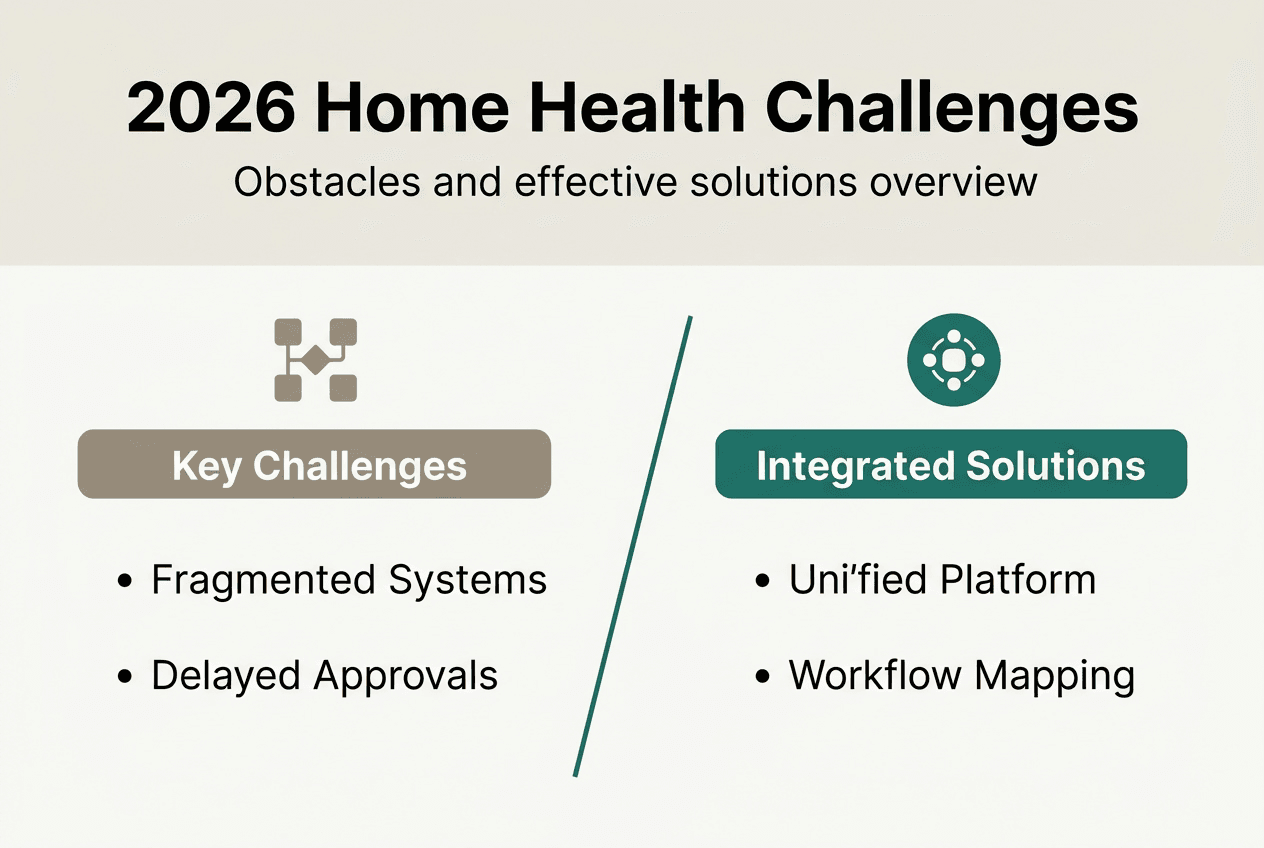
These challenges demand integrated solutions that address root causes rather than symptoms. Agencies seeking better patient logistics must evaluate their entire operational chain, identifying where handoffs break down and data silos prevent optimization. The path forward requires both strategic vision and practical tools that unify disparate processes into a coherent system.
Preparing for success: essential tools and strategic planning
Before implementing operational improvements, home health agencies need foundational infrastructure and strategic alignment. Access to integrated data systems is non-negotiable. Your technology stack must connect districting algorithms, scheduling platforms, fleet tracking, authorization workflows, and billing systems into a unified view. Fragmented data creates blind spots that undermine even well-intentioned optimization efforts.
Strategic planning must encompass the full patient journey. Efficiency gains require evaluation from initial referral through final payment posting. Map every step: how referrals enter your system, how you assign and schedule clinicians, how you authorize services with payers, how you document visits, and how you submit and reconcile claims. Identify bottlenecks at each stage and prioritize improvements that deliver the greatest impact on throughput and revenue cycle velocity.
Key tools and their roles:
| Tool Category | Primary Function | Impact on Operations |
|---|---|---|
| Scheduling software | Automates clinician assignment and visit coordination | Reduces manual errors and optimizes daily routes |
| Fleet management systems | Tracks vehicle location, maintenance, and fuel usage | Lowers transportation costs and improves reliability |
| Patient flow analytics | Monitors admission, visit completion, and discharge timing | Identifies delays and accelerates care progression |
| Authorization platforms | Streamlines payer approval workflows | Prevents visit denials and revenue leakage |
| Billing integration | Connects clinical documentation to claims submission | Accelerates reimbursement and reduces A/R days |
Leveraging technology like a home health scheduling app transforms reactive coordination into proactive orchestration. Real-time visibility enables dynamic adjustments when clinicians call in sick, patients reschedule, or emergencies arise. Analytics dashboards surface patterns that manual processes obscure, such as geographic clusters that warrant territory redesign or payer-specific authorization delays that require escalation.

Addressing patient flow barriers requires cross-functional collaboration. Clinical, operations, billing, and IT teams must align on shared objectives and data definitions. When these groups work in silos, optimization efforts conflict rather than reinforce each other.
Pro Tip: Convene a multidisciplinary task force early in your planning process to map current workflows, identify pain points, and establish consensus on improvement priorities, ensuring technology investments support unified goals rather than departmental agendas.
Executing improvements: optimizing logistics and patient care in home health
Transforming home health operations demands systematic execution across logistics, patient flow, and reimbursement management. Follow these steps to implement meaningful improvements:
- Deploy decision support systems that integrate districting and fleet optimization, analyzing patient locations, clinician territories, and vehicle capacity simultaneously to minimize travel and balance workloads.
- Establish dynamic scheduling protocols that adjust routes in real time based on traffic conditions, patient availability changes, and clinician skill requirements.
- Implement coordinated intake processes that verify payer authorization, assess clinical complexity, and assign appropriate resources before scheduling the first visit.
- Create standardized communication channels connecting clinicians, dispatchers, patients, and caregivers to eliminate information gaps that cause delays.
- Monitor patient progression metrics daily, flagging cases approaching authorization limits or clinical milestones that require intervention.
Research demonstrates that decision support systems reduce travel distance by 17% and workload deviation by 77% when districting and fleet management operate as integrated functions. These gains translate directly to lower fuel costs, increased visit capacity, and improved clinician satisfaction as excessive driving decreases.
Managing patient flow requires visibility into every care episode. Real-time monitoring identifies patients stuck in authorization limbo, those approaching discharge readiness, and cases where visit frequency no longer matches clinical need. Coordinated scheduling ensures smooth handoffs between acute care, home health, and outpatient follow-up, preventing gaps that lead to readmissions.
Medicare Advantage plans present unique challenges. Reimbursement structures that restrict visit types increase inpatient transfers and adverse outcomes compared to episodic payment models. Negotiate with MA plans for flexible episodic arrangements rather than rigid per-visit caps that incentivize undertreatment.
Comparison of Medicare Advantage reimbursement models:
| Reimbursement Model | Agency Flexibility | Patient Outcome Impact | Administrative Burden |
|---|---|---|---|
| Episodic payment | High - adjust visits based on clinical need | Positive - care aligns with patient condition | Low - predictable revenue per episode |
| Per-visit caps | Low - fixed visit limits regardless of acuity | Negative - premature discharge increases complications | High - constant authorization requests |
| Hybrid arrangements | Moderate - base episode plus authorized overages | Mixed - depends on authorization responsiveness | Moderate - requires documentation for exceptions |
Agencies using NEMT software integration coordinate transportation logistics alongside clinical visits, ensuring patients reach necessary appointments and reducing no-show rates that disrupt schedules. This holistic approach addresses social determinants that impact health outcomes while optimizing operational efficiency.
Fleet optimization extends beyond routing. Maximizing efficiencies includes vehicle selection, maintenance scheduling, and fuel management. Agencies adopting hybrid or electric vehicles reduce emissions and operational costs while demonstrating environmental stewardship that resonates with community stakeholders.
Pro Tip: Transition to hybrid and electric vehicles strategically, starting with urban routes where frequent stops maximize regenerative braking benefits and charging infrastructure is readily available, then expand to suburban territories as battery range improves.
Verifying results and continuous improvement in home health services
Measuring operational improvements requires establishing clear key performance indicators that reflect both efficiency gains and patient outcomes. Track metrics across three categories: logistics efficiency, clinical quality, and financial performance. Logistics KPIs include average travel time between visits, daily visit capacity per clinician, and fuel costs per mile. Clinical quality indicators encompass hospitalization rates, patient satisfaction scores, and care plan adherence. Financial metrics cover days in accounts receivable, claim denial rates, and revenue per episode.
Real-time monitoring and prescriptive recommendations enable continuous performance optimization rather than periodic retrospective analysis. Analytics dashboards should surface actionable insights: which territories consistently exceed travel time targets, which payers generate the highest authorization delays, which patient populations require care model adjustments. This visibility transforms data into decisions.
Implement these verification and refinement steps:
- Conduct weekly performance reviews comparing actual results against targets, investigating variances that exceed acceptable thresholds
- Gather structured feedback from clinicians regarding route efficiency, scheduling accuracy, and technology usability
- Survey patients about visit timeliness, communication quality, and care coordination effectiveness
- Analyze claim denial patterns to identify documentation gaps or payer-specific requirements
- Benchmark your metrics against industry standards and high-performing peer agencies
- Establish rapid-cycle improvement processes that test, measure, and scale successful interventions
Continuous improvement demands organizational commitment beyond initial implementation. Create feedback loops that channel frontline insights to decision makers. Clinicians navigating daily routes possess invaluable knowledge about traffic patterns, patient access challenges, and neighborhood characteristics that algorithms miss. Operations staff managing authorizations understand payer quirks and documentation requirements that impact approval speed. Billing teams recognize coding issues and reimbursement trends that affect revenue.
Agencies leveraging home health logistics solutions gain platforms designed for iterative optimization. These systems incorporate machine learning that improves routing recommendations as historical data accumulates, adapts to seasonal patterns, and identifies emerging trends before they impact performance. The technology becomes smarter over time, compounding initial efficiency gains.
Sustained improvement requires balancing standardization with flexibility. Establish core processes that ensure consistency and quality, but empower teams to adapt when circumstances demand deviation. Rigid adherence to optimized routes fails when patients experience acute changes or weather disrupts travel. Build exception handling protocols that maintain efficiency while accommodating real-world variability.
Regularly reassess your strategic priorities as the operating environment evolves. Regulatory changes, payer policy shifts, and competitive dynamics require periodic recalibration of improvement initiatives. What optimized operations in 2025 may need adjustment as Medicare Advantage penetration increases, value-based payment models mature, or workforce availability fluctuates. Agility separates agencies that maintain competitive advantage from those that optimize once and stagnate.
Improve your home health services with VectorCare solutions
Achieving the operational excellence described throughout this guide requires integrated technology that unifies scheduling, dispatch, tracking, and care coordination. VectorCare delivers comprehensive home health logistics solutions purpose-built for agencies seeking end-to-end efficiency gains. Their platform connects referral intake through final billing, eliminating the data silos and manual handoffs that undermine optimization efforts.
VectorCare’s AI-driven dispatching optimizes clinician assignments in real time, balancing workloads, minimizing travel, and adapting to dynamic changes throughout the day. Automated workflows streamline payer authorizations, reducing administrative burden and accelerating visit approvals. Secure communication tools keep clinicians, patients, and care teams synchronized, preventing the coordination breakdowns that cause delays and dissatisfaction.
Explore complementary resources including our non emergency hospital transport guide for coordinating patient movement across care settings and our healthcare logistics solutions comparison to evaluate platform capabilities. VectorCare empowers home health agencies to transform operational challenges into competitive advantages through intelligent automation and actionable insights.
How can decision-makers effectively improve home health services?
What are the biggest operational hurdles home health agencies face in 2026?
Agencies struggle most with fragmented systems that prevent coordinated decision making across scheduling, fleet management, and billing. Unbalanced clinician workloads and excessive travel time reduce daily visit capacity while increasing costs. Medicare Advantage authorization restrictions create administrative burden and can compromise patient care when visit caps don’t align with clinical needs.
How do Medicare Advantage reimbursement models impact home health delivery?
Plans using rigid per-visit caps rather than episodic payments force premature patient discharges and increase hospitalization rates. Agencies should negotiate flexible episodic arrangements that allow visit frequency adjustments based on patient acuity. This alignment between reimbursement structure and clinical need improves outcomes while reducing the administrative overhead of constant authorization requests.
What technology investments deliver the fastest ROI for home health operations?
Integrated home health scheduling apps that combine route optimization, real-time tracking, and automated authorization workflows generate immediate efficiency gains. These platforms reduce travel time, increase daily visit capacity, and accelerate reimbursement cycles. The compounding effect of multiple small improvements across scheduling, documentation, and billing typically achieves positive ROI within six months.
How can agencies balance standardization with the flexibility clinicians need?
Establish core routing and scheduling protocols that optimize efficiency under normal conditions, but empower clinicians to deviate when patient needs or circumstances require it. Build exception handling workflows that capture the reason for changes, enabling continuous learning about when standard processes need refinement. Technology should support rather than constrain clinical judgment.
What metrics best measure home health operational improvement success?
Track a balanced scorecard covering logistics efficiency such as travel time and visit capacity, clinical quality including hospitalization rates and patient satisfaction, and financial performance like days in A/R and revenue per episode. Focusing solely on efficiency metrics risks compromising care quality, while emphasizing only clinical outcomes ignores the operational sustainability required for long-term success. Successful Medicare Advantage plan strategies align all three dimensions.
Recommended
- Improving Patient Outcomes: Strategies for Healthcare Leaders 2025
- Improving Care Transitions: Strategies for Healthcare in 2025
- 7 Ways to Improve Outcomes for Medicare Advantage Members | VectorCare
- The Hospital-at-Home Care Model: What you need to know | VectorCare
- Geriatric medication management guide for caregivers 2026