Improve Communication for Patient Safety Impact

Communication failures often lead to unintended patient harm in hospitals, placing lives at risk and highlighting the urgent need for improvement. For American healthcare communication managers, creating clear, honest, and empathetic exchanges among teams and with patients is the foundation of safe care. By understanding the real-world challenges and adopting proven strategies, you can reduce errors, increase trust, and build a stronger safety culture across your organization.
Table of Contents
- What Is Effective Communication in Patient Safety
- Common Barriers to Safe Healthcare Communication
- Key Methods to Enhance Team Communication
- Role of Technology and Real-Time Updates
- Compliance, Risk, and Staff Responsibilities
Key Takeaways
| Point | Details |
|---|---|
| Effective Communication is Essential | Clear and empathetic communication is fundamental for patient safety and preventing errors in healthcare settings. |
| Identify and Address Barriers | Understanding obstacles like time pressures and language differences is critical to enhancing communication quality. |
| Leverage Structured Frameworks | Implementing standardized communication frameworks, such as SBAR, can significantly reduce errors during handoffs and ensure thorough information exchange. |
| Foster a Culture of Safety and Openness | Creating a psychologically safe environment encourages team members to speak up about concerns, improving overall communication and patient safety. |
What Is Effective Communication in Patient Safety
Effective communication in healthcare means exchanging information clearly, honestly, and with empathy across your entire care team and with patients. It’s the foundation that prevents errors, builds trust, and protects patient safety.
When communication fails, patients suffer. Communication failures are a leading cause of patient harm in hospitals and care settings worldwide. Your job as a healthcare communication manager is to eliminate these gaps before they harm someone.
Core Elements of Effective Communication
Effective patient safety communication rests on several pillars:
- Clear information exchange: Staff and patients understand treatment plans, diagnoses, and next steps without confusion.
- Active listening: Team members genuinely hear what others say rather than waiting to respond.
- Transparency: Honest conversations about risks, changes in care, and what patients should expect.
- Respect for confidentiality: Patient information stays protected and secure across all channels.
- Empathy: Communicators acknowledge patient concerns and respond with genuine care.
Common Barriers You Face
You’re likely battling several obstacles that undermine communication quality:
- Distracted environments in hospitals where noise and interruptions break focus
- Language differences between staff and patients that create misunderstandings
- Provider workload pressures that rush conversations
- Patient distrust from past negative experiences
- Siloed systems where information doesn’t flow between departments
- Inadequate time for meaningful exchange of critical information
Each of these directly impacts patient safety. Rushed handoffs miss critical details. Language barriers lead to medication errors. Distracted listening causes clinicians to miss symptoms patients report.
Why It Matters for Your Organization
Strong communication directly reduces adverse events, improves patient outcomes, and protects your organization from liability.
When communication improves, your team catches errors faster. Patients ask clarifying questions. Staff coordinate care more effectively. The result: fewer preventable harm events and better quality scores.
This applies across your entire logistics network too. Secure medical communication between transport providers, home health teams, and facility staff ensures patients receive consistent, safe care from start to finish.
Pro tip: Start with handoffs and shift changes as your first improvement target, since these are where most communication breakdowns occur. Use a simple checklist format to ensure critical patient information transfers completely every time.
Common Barriers to Safe Healthcare Communication
Your team faces real obstacles every single day. These barriers don’t exist in isolation—they compound, creating gaps where patient safety slips through the cracks.
Understanding what blocks effective communication is the first step to breaking those barriers down. Your communication strategy must address each one directly, or improvement efforts will stall.
Here’s a quick comparison of key barriers to effective healthcare communication and how they impact patient safety:
| Barrier Type | Typical Scenario | Patient Safety Impact |
|---|---|---|
| Time and Workload Pressures | Rushed handoffs, omitted details | Missed information, increased errors |
| Language and Literacy Gaps | Misunderstood instructions | Medication errors, non-adherence |
| Emotional and Trust Issues | Withheld important information | Delayed diagnosis, unaddressed needs |
| System and Information Silos | Departments not sharing updates | Repeated tests, safety event risk |
| Distracting Environments | Interruptions, noisy settings | Incomplete conversations, missed cues |
Time Pressure and Workload Constraints
Provider workload is one of the most damaging barriers. When clinicians are rushed, conversations suffer.
Staff skip key details during handoffs. Patients feel unheard because providers can’t allocate time to listen. Provider time constraints lead to rushed interactions that create medication errors, missed diagnoses, and patient dissatisfaction.

This isn’t about individual clinician behavior—it’s a system design problem. When schedules are packed, communication quality becomes collateral damage.
Language and Literacy Barriers
Language differences create dangerous gaps in understanding. Without adequate interpreter access, patients misunderstand instructions or hide symptoms they can’t explain.
Cultural competence matters too. Different backgrounds shape how people communicate trust, pain, and medical history. A provider unfamiliar with these cultural norms may misinterpret patient responses or fail to ask questions that surface critical information.
Patient Distrust and Emotional Barriers
Patients sometimes refuse to disclose sensitive information out of fear, shame, or past negative experiences. Racial distrust and historical abuses create legitimate barriers, particularly in minority communities.
Emotional trauma and intimidation silence patients. They nod along rather than ask clarifying questions. Your team never learns what patients actually understand or what concerns them.
System Fragmentation and Information Silos
When departments don’t share information effectively, communication breaks down:
- Transport providers lack patient context from the originating facility
- Home health teams don’t receive updated medication lists from hospitals
- Case managers work with incomplete discharge summaries
- Clinicians repeat questions because prior conversations weren’t documented
Each disconnect increases error risk and frustrates both staff and patients.
Environmental and Logistical Challenges
Distracted environments, time pressures, and siloed systems guarantee communication failures unless you actively intervene.
Noise in clinical settings breaks concentration. Interruptions derail conversations mid-sentence. Staff juggle multiple patients while trying to focus on one person’s complex needs.
Your physical and digital infrastructure either supports good communication or undermines it. How to improve team collaboration starts with examining these environmental factors.
Pro tip: Audit one department’s communication workflows this month. Track where handoffs happen, what information transfers, and where gaps occur. Use that data to redesign processes, not to blame individuals.
Key Methods to Enhance Team Communication
You can’t fix what you don’t systematize. Communication improvements require concrete methods that your entire team can implement consistently, day after day.
These methods work because they remove guesswork and create predictable exchanges of critical information. Start with one or two, build them into workflows, then add more.
Use Structured Communication Frameworks
SBAR is the gold standard for clinical handoffs. Structure every critical conversation around Situation, Background, Assessment, and Recommendation.
This format ensures nothing gets skipped. The receiving clinician knows exactly what information is coming and in what order. Structured communication techniques like SBAR reduce errors because they force completeness and clarity.
Other frameworks work too—the key is consistency. Pick one framework, train your team, and use it everywhere.
Practice Active Listening and Empathy
Active listening means your team member fully focuses on what the other person is saying, not planning their response.
Showing empathy doesn’t slow down communication—it strengthens it. When patients and staff feel heard, they disclose more, ask clarifying questions, and trust the care they receive.
Clear and simple language combined with empathy creates meaningful exchanges that prevent misunderstandings and build collaboration.
Implement Formal Shift Handoffs
Shift changes are where communication breaks down most. Make handoffs formal, documented, and focused on patient safety.
Include these in every handoff:
- Patient name, medical record number, and current diagnosis
- Recent changes in condition or treatment
- Outstanding test results or pending decisions
- Safety concerns or fall/infection risk flags
- Family communication needs or language barriers
Document handoffs so information persists beyond the verbal exchange. This creates accountability and a safety net for patients transferred between care settings.
Create Psychologically Safe Environments
Team members who fear speaking up stay silent when they spot problems. Fear kills patient safety.
Your leadership must explicitly invite dissenting opinions and treat mistakes as learning opportunities, not punishment triggers. Staff should feel safe questioning orders, raising concerns, and admitting confusion without retaliation.
Improving team collaboration starts with creating a culture where speaking up is expected and valued.
Use Technology to Support Communication
Secure messaging systems, shared documentation, and integrated alerts reduce reliance on memory and face-to-face communication alone.
Your technology should support, not replace, human connection. Choose tools that:
- Enable real-time information sharing across departments
- Create audit trails for compliance and safety reviews
- Reduce redundant communication and duplicate questions
- Alert staff to critical changes automatically
Pro tip: Start a monthly communication audit where you observe actual handoffs, document what transfers successfully and what gets missed, then redesign that specific moment in your workflow based on real data.
Role of Technology and Real-Time Updates
Technology isn’t optional anymore. Real-time updates transform how your team communicates, monitors patients, and prevents errors before they happen.
But technology only works when your team actually uses it. And it only improves safety when designed with your communication workflows in mind.
How Real-Time Data Improves Safety
Electronic health records (EHRs) create a single source of truth across your organization. When one department updates patient information, everyone sees it immediately—no chasing down old charts or calling to verify.
Real-time patient monitoring through EHRs and smart devices reduces medication errors, catches deteriorating conditions faster, and ensures care teams make decisions on current data, not yesterday’s status.
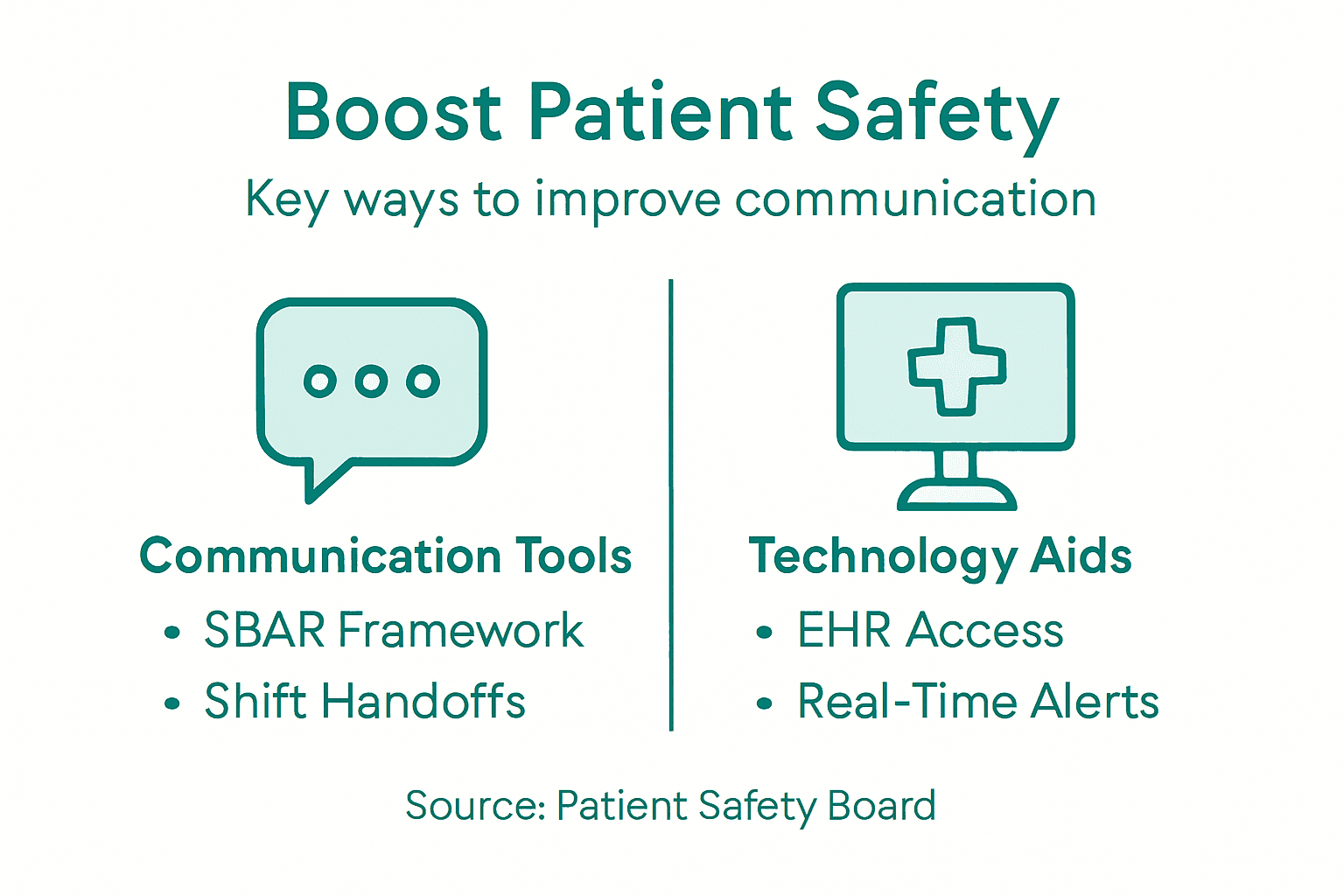
This matters enormously for patients transferred between units, facilities, or care settings. Real-time visibility eliminates the dangerous gaps where critical information gets lost in transition.
The table below summarizes how specific technologies support safe, efficient team communication in healthcare:
| Technology Tool | Main Function | Example Benefit |
|---|---|---|
| EHRs | Centralize patient data | Reduces errors during handoffs |
| Secure Messaging | Instant team updates | Faster reaction to critical info |
| Mobile Access | On-the-go information retrieval | Improves care coordination |
| Automated Handoff Tools | Standardizes shift change procedures | Prevents information loss |
Key Technology Solutions for Your Team
Consider these tools to strengthen communication:
- Secure messaging systems that alert staff to urgent updates instantly
- Integrated alerts that notify clinicians when labs result, medications are due, or safety flags appear
- Mobile access so providers check patient status from anywhere in the facility
- Audit trails that document who accessed what information and when
- Automated handoff tools that structure shift changes and ensure nothing skips documentation
Overcoming Digital Access Barriers
Not all patients can use digital tools equally. Some lack smartphones, internet access, or digital literacy. Others face language barriers or disabilities that make technology harder to navigate.
Assessing patient digital readiness before relying on text alerts, telehealth, or patient portals prevents digital disparities that harm vulnerable populations.
Your technology strategy must include low-tech backup options. Not every patient can receive discharge instructions via app. Some need printed materials, phone calls, or in-person education.
Balancing Technology and Human Connection
Technology amplifies good communication. It never replaces it.
Alerts save lives, but only if someone reads them. Portals improve access, but only if patients know they exist. Electronic messaging speeds information flow, but only if clinicians check it.
Your team still needs face-to-face conversations, phone calls, and moments of genuine connection. Technology removes friction. Humans provide understanding.
Pro tip: Before investing in any new communication technology, ask your frontline staff: “Will this tool reduce the time you spend on administrative tasks or searching for information?” If the answer isn’t yes, it won’t improve patient safety—it’ll just add another task to their overloaded day.
Compliance, Risk, and Staff Responsibilities
Compliance isn’t a box to check. It’s the foundation that protects patients, protects your staff, and protects your organization from preventable harm and legal liability.
When communication standards align with regulatory requirements, your team knows exactly what’s expected. When expectations are unclear, errors multiply.
Understanding Your Compliance Obligations
The Joint Commission’s National Patient Safety Goals establish clear communication standards your organization must meet. These include accurate patient identification, clear labeling of medications and specimens, and effective communication during care transitions.
These aren’t suggestions. They’re requirements that directly prevent harm. Your compliance program must translate these standards into actual workflows your team uses every day.
Building a Compliance Culture
Compliance happens through culture, not policing. Your staff needs to understand why communication standards matter—not just that they exist.
Core elements of an effective compliance program include:
- Staff education that explains regulations and connects them to patient safety outcomes
- Clear policies that specify who communicates what, when, and to whom
- Monitoring systems that identify gaps before they cause harm
- Reporting mechanisms where staff can raise concerns without fear of retaliation
- Continuous improvement based on incident reviews and near-miss reports
Staff Responsibilities in Patient Safety
Every person on your team shares responsibility for safe communication. Healthcare compliance programs require staff to maintain compliance, report concerns, and participate in education to protect patients and uphold organizational standards.
This means:
- Nurses and physicians follow standardized handoff protocols without shortcuts
- Administrative staff flag incomplete or unclear information before it reaches clinicians
- Transport providers communicate clearly about patient status and special needs
- Home health teams document care changes that other providers need to know
- Everyone reports near-misses and actual errors so the team learns
Managing Risk Through Communication
Proactive risk management prevents errors. Reactive responses clean up after harm happens.
Your communication standards must address the highest-risk moments: handoffs between shifts, transfers between units or facilities, medication administration, and patient education.
For each high-risk moment, ask: Who needs to know what? How will information transfer? How will we verify understanding? How will we document what happened?
When you answer these questions systematically, you eliminate the guesswork that leads to errors.
Pro tip: Conduct one “failure mode analysis” session per quarter focused on a specific communication process (like discharge handoffs). Ask your frontline staff: “Where could information slip through the cracks here?” Their answers reveal the real risks your policies need to address.
Elevate Patient Safety with Streamlined Communication and Coordinated Care
Effective communication is the backbone of patient safety. This article highlights how barriers like fragmented systems and rushed handoffs increase risk and impact care quality. If you are seeking ways to overcome these challenges, VectorCare’s comprehensive digital platform directly addresses these pain points by integrating real-time updates, secure communication, and automated workflows across patient logistics.
Discover how VectorCare empowers healthcare teams with tools that standardize handoffs, enhance transparency, and reduce errors. Our platform supports everything from patient transportation to home health services with AI-driven dispatching and scheduling optimization. Don’t wait for communication breakdowns to impact your patients. Visit VectorCare’s main site to explore how you can improve team collaboration and patient outcomes today. Learn more about secure communication solutions designed to protect patient information and ensure compliance while streamlining your operations.
Frequently Asked Questions
What are the core elements of effective communication in patient safety?
Effective communication in patient safety relies on clear information exchange, active listening, transparency, respect for confidentiality, and empathy. These elements help ensure that both staff and patients have a shared understanding of treatment plans and concerns.
How can healthcare organizations overcome barriers to effective communication?
Organizations can overcome barriers by addressing time pressures, language differences, emotional issues, system silos, and distracting environments through structured communication frameworks, training in active listening, and formalizing handoff procedures.
What role does technology play in improving patient safety communication?
Technology enhances communication by enabling real-time data sharing through electronic health records (EHRs) and secure messaging systems, thereby facilitating timely updates and reducing information loss during patient transitions.
How do compliance standards relate to communication in patient safety?
Compliance standards, such as those set by The Joint Commission, establish essential communication practices that organizations must follow to safeguard patient safety and mitigate risks, ensuring clarity and accountability in patient care.