Humana Non Emergency Medical Transportation: Boosting Access and Care

Coordinating transportation for vulnerable patients often feels like a high-stakes puzzle for healthcare organizations across the United States. Reliable access to non-emergency medical appointments directly impacts patient health outcomes and organizational efficiency. By examining Humana Non Emergency Medical Transportation and its operational structure, managers can discover clear strategies to remove mobility barriers and build smoother, more cost-effective patient journeys from start to finish.
Table of Contents
- Defining Humana Non Emergency Medical Transportation
- Available NEMT Services And Patient Scenarios
- Eligibility, Enrollment, And Plan Requirements
- Scheduling, Dispatch, And Vendor Integration
- Cost Structures, Limitations, And Compliance
Key Takeaways
| Point | Details |
|---|---|
| Coverage Variation | Humana’s Non Emergency Medical Transportation services depend on specific Medicare Advantage plan details and may require pre-authorization. |
| Eligibility Requirements | To access NEMT, beneficiaries must be enrolled in a plan and demonstrate medical necessity for transportation assistance. |
| Transportation Options | Humana offers a range of transportation modes to accommodate various patient needs, including taxi services, wheelchair-accessible vehicles, and ambulance transport. |
| Cost Management | NEMT services have limitations on trips and mileage, with potential copays; compliance with federal and state regulations is mandatory. |
Defining Humana Non Emergency Medical Transportation
Humana Non Emergency Medical Transportation (NEMT) represents a critical healthcare service designed to support Medicare beneficiaries who require transportation assistance to medical appointments. Non-emergency medical transportation services enable patients with mobility challenges or limited transportation options to access essential healthcare services.
Under Humana’s Medicare Advantage plans, NEMT provides structured transportation support with specific coverage parameters. The service typically includes:
- One-way trips to healthcare facilities
- Transportation for patients unable to drive themselves
- Trips to scheduled medical appointments
- Use of approved transportation vendors
- Mileage limitations based on specific plan details
The core objective of Humana’s NEMT program is ensuring healthcare accessibility for vulnerable populations. These transportation services are strategically designed to address mobility barriers that might otherwise prevent patients from receiving necessary medical care.
Operational Framework
Humana’s NEMT services operate within a comprehensive policy framework influenced by federal Medicaid guidelines. Transportation service policies mandate that transportation must represent the most appropriate and cost-effective mode for patient needs, connecting individuals to the nearest qualified healthcare provider.
Humana NEMT services bridge critical gaps in patient mobility, transforming transportation from a logistical challenge into a pathway for consistent healthcare engagement.
Key Considerations for Beneficiaries
Patients interested in Humana NEMT services should understand that:
- Coverage varies by specific Medicare Advantage plan
- Geographic location impacts transportation availability
- Pre-authorization might be required for transportation services
- Specific documentation may be necessary to qualify
Pro tip: Always verify your specific Humana plan’s NEMT details and contact your plan representative to understand exact transportation coverage and requirements.
Available NEMT Services and Patient Scenarios
Humana offers a comprehensive range of Non-Emergency Medical Transportation services designed to support diverse patient transportation needs. These services encompass multiple transportation modes tailored to different medical requirements and patient mobility levels, ensuring accessible healthcare for vulnerable populations.
The transportation options provided by Humana include:
- Taxi/Car Services: Standard transportation for patients with basic mobility needs
- Chair Car Transportation: Specialized vehicles for patients requiring wheelchair accessibility
- Ambulance Transport: Non-emergency medical transportation for patients with complex medical requirements
- Curb-to-Curb Service: Direct transportation to medical facilities
Patient scenarios for NEMT services typically involve individuals facing significant transportation challenges. Non-emergency medical transportation supports specific patient groups such as:
Here’s a summary comparing key Humana NEMT service types and their typical beneficiaries:
| Transportation Mode | Typical Medical Need | Intended Patient Group |
|---|---|---|
| Taxi/Car Service | Routine appointments | Seniors, low-mobility patients |
| Chair Car Transportation | Wheelchair access required | Individuals with mobility disabilities |
| Ambulance Transport | Medically complex travel needs | Patients needing medical supervision |
| Curb-to-Curb Service | Standard facility drop-off | Patients with basic transportation needs |
- Seniors unable to drive independently
- Individuals with mobility disabilities
- Low-income families without personal vehicle access
- Patients requiring regular medical treatments
NEMT services transform transportation from a barrier into a bridge, connecting patients with essential healthcare services.
These transportation services are strategically designed to address specific medical transportation needs. Humana’s NEMT program covers medically necessary trips including dialysis treatments, chemotherapy appointments, behavioral health consultations, and routine medical check-ups. Each transportation arrangement requires careful scheduling and often involves pre-authorization to ensure appropriate service delivery.
Key Service Characteristics
- Trips are limited to medical-related destinations
- Transportation is non-emergency in nature
- Services require prior approval
- Coverage varies based on specific Medicare Advantage plan
Pro tip: Contact your Humana representative to understand the precise NEMT coverage details specific to your individual healthcare plan and personal medical requirements.
Eligibility, Enrollment, and Plan Requirements
Humana’s Non-Emergency Medical Transportation (NEMT) services require specific eligibility criteria for enrollment. Potential beneficiaries must meet several key requirements to access these critical transportation services, ensuring that support is directed toward those with genuine medical transportation needs.
Core Eligibility Requirements
To qualify for Humana NEMT services, patients must typically demonstrate:
- Active enrollment in a Humana Medicare Advantage plan
- Documented medical necessity for transportation
- Inability to access alternative transportation methods
- Verification of medical appointment requirements
- Compliance with state-specific regulatory guidelines
The enrollment process involves multiple critical steps for patients seeking transportation assistance. Qualifying for non-emergency medical transportation requires careful documentation and proactive communication with Humana representatives.
Documentation Requirements
Patients must prepare the following documents for NEMT service enrollment:
- Valid Medicare/Medicaid identification card
- Government-issued photo identification
- Healthcare provider documentation verifying transportation needs
- Proof of plan enrollment
- Contact information for primary healthcare provider
Comprehensive documentation is the key to seamless NEMT service access and approval.
State regulations play a significant role in determining specific NEMT service eligibility. Each state maintains unique guidelines that influence transportation coverage, patient qualification criteria, and service delivery mechanisms. Humana adapts its NEMT programs to comply with these diverse regulatory environments, ensuring consistent and compliant service across different geographic regions.
Additional Enrollment Considerations
- Service availability varies by specific Medicare Advantage plan
- Some plans require pre-authorization for transportation
- Annual review of transportation benefits is standard
- Patients must regularly update medical documentation
Pro tip: Contact your local Humana representative directly to confirm specific NEMT eligibility requirements for your unique medical situation and geographic location.
Scheduling, Dispatch, and Vendor Integration
Humana’s Non-Emergency Medical Transportation (NEMT) services rely on a sophisticated transportation scheduling system that ensures efficient and reliable patient transportation. The complex network of vendors, dispatch protocols, and coordination mechanisms enables seamless medical transportation experiences for patients with diverse mobility needs.

Key Scheduling Requirements
The NEMT scheduling process involves critical parameters:
- Advance booking at least 72 hours prior to medical appointment
- Centralized dispatch coordination
- Route optimization strategies
- Potential ride-sharing opportunities
- Compliance with plan-specific guidelines
Humana carefully integrates transportation vendor networks to deliver consistent and high-quality medical transportation services. The vendor management process includes rigorous screening, performance monitoring, and continuous quality assessment to maintain service standards.
Vendor Selection and Management
Transportation vendors must meet stringent criteria:
- Compliance with safety regulations
- Professional driver certification
- Vehicle maintenance standards
- Consistent performance metrics
- Real-time communication capabilities
Effective vendor integration transforms medical transportation from a logistical challenge into a seamless patient care extension.
The dispatch process involves sophisticated coordination mechanisms that balance patient needs, appointment times, and transportation resource availability. Humana’s system prioritizes patient comfort, punctuality, and efficient routing to minimize travel complexity for individuals with medical transportation requirements.
Operational Considerations
- Digital platforms enable real-time tracking
- Automated scheduling reduces manual interventions
- Comprehensive vendor performance evaluations
- Continuous system improvements
Pro tip: Request a detailed breakdown of your specific NEMT vendor network and dispatch protocols to understand the precise transportation support available in your healthcare plan.
Cost Structures, Limitations, and Compliance
Humana’s Non-Emergency Medical Transportation (NEMT) services operate within a complex framework of cost management and regulatory compliance designed to balance healthcare accessibility with financial sustainability. The cost structures are meticulously crafted to ensure patients receive necessary transportation while maintaining program efficiency and adherence to federal guidelines.
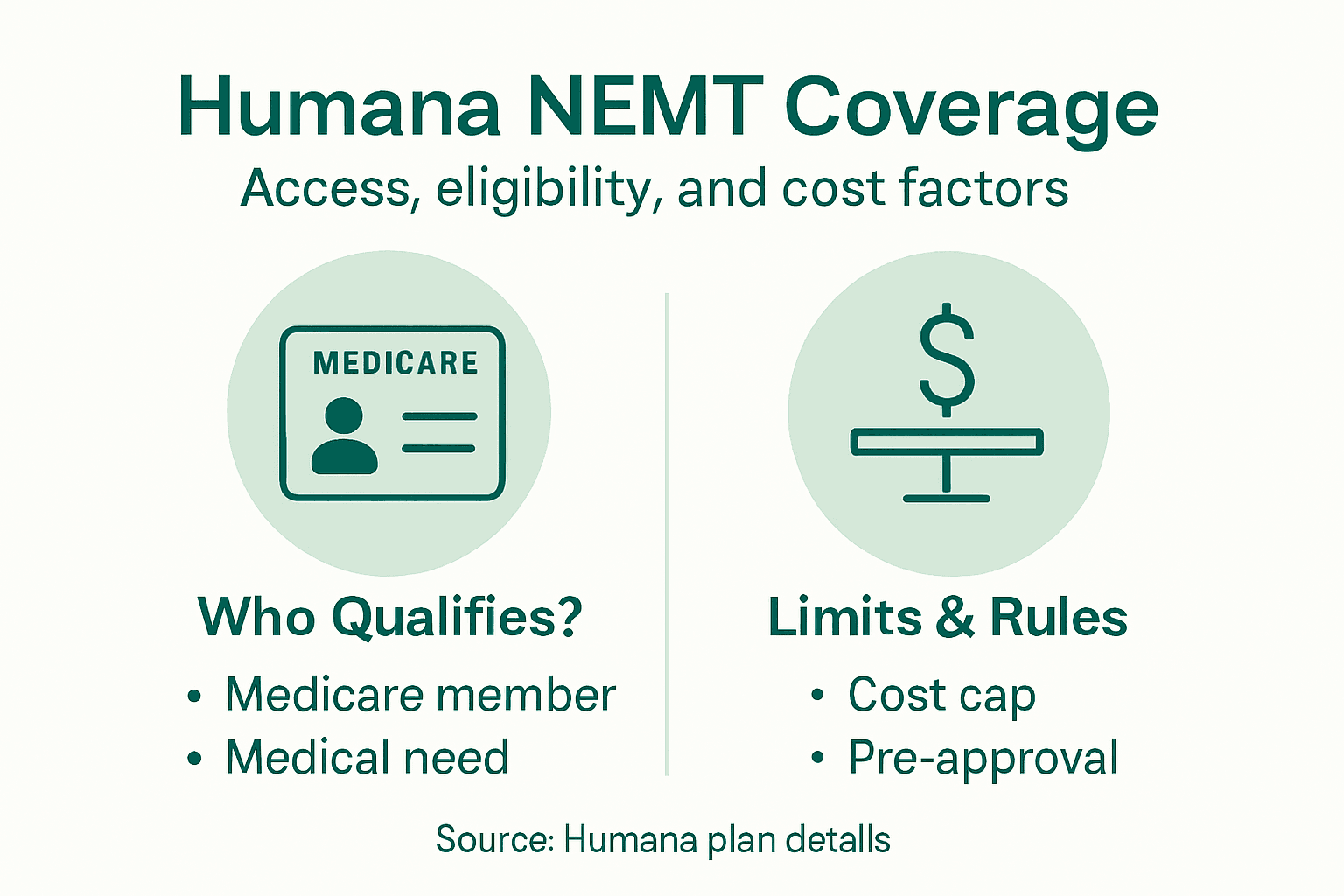
Cost Limitations and Coverage Parameters
Typical NEMT cost structures include:
- Yearly trip or mileage limitations
- Network-approved vendor requirements
- One-way transportation coverage
- Potential copays or co-insurance
- Plan-specific cost allocation
Medicaid transportation service guidelines mandate that transportation be provided in the most cost-effective manner possible. These regulations require managed care plans like Humana to balance cost containment with comprehensive patient care access.
Compliance Framework
Humana’s NEMT compliance involves multiple critical considerations:
- Federal Medicaid transportation regulations
- State-specific healthcare transportation rules
- Patient accessibility requirements
- Cost-effective service delivery
- Continuous performance monitoring
Transportation services must navigate the delicate balance between financial responsibility and patient care accessibility.
Regulatory Oversight
The Centers for Medicare and Medicaid Services (CMS) establish comprehensive guidelines that govern NEMT services. These regulations ensure that transportation benefits:
Compare common NEMT cost and compliance factors for Humana plans:
| Factor | Medicare Advantage (Humana) | Medicaid/Regulatory Requirement |
|---|---|---|
| Trip or mileage limits | Yes, based on plan details | Must be cost-effective and medically justified |
| Out-of-pocket expense | Usually copay or coinsurance may apply | States may limit patient costs |
| Vendor choice | Network-approved vendors only | Must ensure quality and compliance |
| Prior authorization | Often required for scheduled transportation | Required for cost control |
| Federal & State oversight | Must follow CMS and local health guidelines | Stringent compliance with Medicaid rules |
- Prioritize patient medical needs
- Maintain cost-effective service delivery
- Provide equitable access to healthcare
- Comply with federal and state standards
- Protect patient rights and dignity
Pro tip: Always review your specific Medicare Advantage plan documentation to understand precise NEMT cost structures, limitations, and your potential out-of-pocket expenses.
Enhance Non-Emergency Medical Transportation with Intelligent Coordination
Navigating the complex challenges of Humana Non Emergency Medical Transportation requires more than just reliable vehicles. Patients and providers alike face hurdles such as scheduling delays, vendor management complexity, and ensuring compliance with plan-specific requirements while maintaining patient dignity and timely care. VectorCare’s all-in-one digital platform directly addresses these critical pain points by offering automation, AI-driven dispatch, and real-time communication that streamline NEMT logistics and improve healthcare accessibility for vulnerable populations.
Transform your Humana NEMT operations by leveraging VectorCare’s optimized scheduling and vendor integration tools that reduce operational costs and minimize transport delays. Take control of patient transportation with data insights and no-code workflows designed to boost efficiency and compliance. Discover how you can improve patient outcomes and healthcare coordination today at VectorCare. Don’t wait to deliver the consistent, compassionate care your patients deserve—explore our platform now to start making a difference.
Frequently Asked Questions
What is Humana Non Emergency Medical Transportation (NEMT)?
Humana Non Emergency Medical Transportation (NEMT) is a healthcare service designed for Medicare beneficiaries to help them access essential medical appointments when they have mobility challenges or limited transportation options.
What types of transportation services are available under Humana NEMT?
Humana NEMT offers various transportation options, including taxi/car services, chair car transportation for wheelchair users, ambulance transport for patients with complex medical needs, and curb-to-curb service.
How do I qualify for Humana’s NEMT services?
To qualify for Humana NEMT, patients must be enrolled in a Humana Medicare Advantage plan and demonstrate a medical necessity for transportation. They also need to show an inability to use alternative transportation methods.
How do I schedule transportation through Humana NEMT?
To schedule transportation, patients must book at least 72 hours in advance of their medical appointment, using Humana’s centralized dispatch system. It’s important to coordinate with their healthcare providers for verification of medical appointments.