Healthcare logistics explained: optimize patient care

Healthcare organizations waste over $35 billion annually on logistics failures, from cold chain breakdowns to missed patient transport windows. Yet most administrators view logistics as a back-office function rather than a strategic lever for patient outcomes. The reality is stark: inefficient patient transportation increases hospital readmissions, delays critical treatments, and drives up operational costs by 20-30%. Modern healthcare logistics encompasses far more than moving patients from point A to point B. It integrates AI-driven routing, real-time tracking, predictive demand forecasting, and compliance management into a cohesive system that directly impacts care quality and financial performance. This guide breaks down the core components of healthcare logistics, explores cutting-edge optimization technologies, addresses real-world challenges like rural transport and cold chain management, and provides actionable strategies to transform your patient transportation and care coordination operations.
Table of Contents
- Key takeaways
- Understanding healthcare logistics: scope and critical components
- Advanced methodologies revolutionizing healthcare logistics
- Challenges and critical nuances in healthcare logistics management
- Practical strategies to optimize healthcare logistics and patient outcomes
- Explore VectorCare’s healthcare logistics solutions
- FAQ
Key Takeaways
| Point | Details |
|---|---|
| Logistics scope and components | Healthcare logistics includes inbound and outbound transportation, warehousing, materials handling, packaging, and network design to support patient care. |
| AI driven optimization | AI driven routing real time tracking and predictive demand forecasting cut waste and boost on time performance. |
| Costs and outcomes impact | Inefficiencies in patient transport and logistics waste billions and raise readmission risk and treatment delays. |
| Regulatory and special case needs | Rural transport cold chain and regulatory compliance require tailored protocols. |
| Phased implementations and KPIs | Phased rollouts with KPI tracking improve care coordination and demonstrate measurable gains. |
Understanding healthcare logistics: scope and critical components
Healthcare logistics represents the strategic coordination of resources, information, and services required to deliver patient care efficiently. Unlike commercial logistics focused solely on products, healthcare logistics encompasses inbound and outbound transportation, materials handling, warehousing, packaging, and network design with the added complexity of human lives at stake. Patient transportation forms the most visible component, but the system extends to medical supplies, equipment, pharmaceuticals, and even biological samples requiring precise handling protocols.
Patient transportation breaks into three primary categories. Non-emergency medical transportation (NEMT) serves patients who need reliable rides to appointments, dialysis sessions, or routine care visits but lack personal transportation. These trips must accommodate wheelchairs, walkers, and other mobility aids while maintaining strict pickup and dropoff windows. Intra-hospital transfers move patients between departments, floors, or facilities for specialized procedures and diagnostic tests. Care coordination transport links discharge planning with home health services, ensuring patients transition smoothly from acute settings to recovery environments. Understanding patient logistics basics provides the foundation for optimizing each category effectively.
Materials handling and warehousing operations support clinical teams with just-in-time inventory systems. Surgical supplies, medications, and durable medical equipment must arrive precisely when needed without creating storage burdens or expiration waste. Network design determines facility locations, service areas, and routing patterns that minimize response times while maximizing resource utilization. Poor network design forces longer patient travel distances, increases fuel costs, and creates bottlenecks during peak demand periods.
The logistics network must also account for specialized equipment transport. Oxygen concentrators, hospital beds, and mobility devices require careful handling and often same-day delivery to support patient discharge plans. Temperature-controlled transport for biologics and personalized medicine adds another layer of complexity, demanding real-time monitoring and rapid response protocols when deviations occur.

Advanced methodologies revolutionizing healthcare logistics
Artificial intelligence transforms healthcare logistics through dynamic route optimization that adapts to real-time traffic, weather, and patient needs. AI-driven algorithms analyze thousands of variables simultaneously to determine optimal vehicle assignments, pickup sequences, and delivery routes. Multi-load algorithms consolidate multiple patient trips into efficient routes without compromising individual pickup windows or comfort. These systems reduce empty vehicle miles by 30-40% while improving on-time performance.
Real-time GPS tracking provides visibility into every transport operation, enabling dispatchers to monitor vehicle locations, estimated arrival times, and potential delays. Automated alerts notify care teams when patients are five minutes away, allowing staff to prepare for arrivals and minimize wait times. Tracking data also supports compliance documentation for Medicaid GPS mandates and HIPAA requirements, creating audit trails that protect organizations during reviews. The non-emergency transportation guide explains how tracking integrates with broader care coordination workflows.
Predictive analytics forecast patient transport demand based on historical patterns, seasonal trends, and scheduled procedures. Machine learning models identify peak demand windows, allowing organizations to pre-position vehicles and staff resources proactively. Demand forecasting reduces last-minute scrambles for transport capacity and helps lower NEMT costs through better resource planning. Analytics also flag patients at high risk for no-shows, enabling targeted outreach and reminder campaigns.
Operations research models like Vehicle Routing Problem with Time Windows (VRPTW) and Dial-a-Ride Problem (DARP) provide mathematical frameworks for optimizing complex logistics scenarios. VRPTW determines the most efficient routes for fleets serving multiple locations within specific time constraints. DARP extends this to shared-ride scenarios where multiple patients travel together, balancing efficiency gains against individual comfort and dignity. These models power the algorithms behind modern logistics platforms, turning theoretical optimization into practical operational improvements. Advanced patient flow strategies build on these foundations to reduce bottlenecks across the care continuum.
Pro Tip: Implement AI solutions in phases starting with route optimization for your highest-volume transport corridors. This approach demonstrates value quickly while allowing staff to adapt to new workflows before expanding to more complex scenarios like multi-load routing or predictive analytics.
Challenges and critical nuances in healthcare logistics management
Temperature-sensitive pharmaceuticals and biologics create cold chain requirements that standard logistics networks cannot support. Cold chain failures cause $35 billion in annual losses across healthcare, with vaccines, insulin, and gene therapies requiring continuous temperature monitoring from manufacturer to patient. Even brief temperature excursions can render medications ineffective or dangerous, creating liability risks and treatment delays. Specialized refrigerated transport, validated packaging, and real-time temperature logging systems add significant complexity and cost to logistics operations.
Personalized medicine introduces unique logistics challenges as treatments become increasingly tailored to individual genetic profiles. CAR-T cell therapies require collecting patient cells, shipping them to manufacturing facilities, and returning customized treatments within narrow time windows. Chain of custody documentation, specialized handling protocols, and coordination across multiple organizations demand logistics capabilities far beyond traditional medical transport. The stakes are exceptionally high as delays directly impact patient survival rates for time-sensitive therapies.
Rural healthcare logistics face geographic barriers that urban systems rarely encounter. Patient trips in rural areas often span over 25 miles one way, with limited vehicle availability and longer response times. Sparse population density makes shared-ride efficiency difficult to achieve, forcing higher per-trip costs. Weather conditions and road quality create additional unpredictability, requiring buffer time that reduces daily trip capacity. Wheelchair transport in rural settings compounds these challenges with specialized vehicle requirements and longer loading times.
Regulatory compliance spans multiple frameworks that healthcare logistics must navigate simultaneously. HIPAA protects patient information during transport coordination and dispatch communications. FDA regulations govern pharmaceutical handling and documentation. Medicaid programs mandate GPS tracking for NEMT reimbursement in many states, requiring specific data retention and reporting capabilities. State-level licensing requirements for medical transport operators vary widely, creating compliance complexity for organizations operating across multiple jurisdictions.
Temperature-controlled logistics failures destroy $35 billion in pharmaceuticals annually, while rural transport distances exceeding 25 miles create cost and access barriers that urban-focused solutions cannot address.
Durable medical equipment coordination adds operational complexity to discharge planning and home health logistics. DME delivery must synchronize with patient discharge times, home health visits, and installation requirements. Equipment like hospital beds and oxygen concentrators requires specialized delivery teams with installation training. Inventory management, maintenance tracking, and retrieval logistics create ongoing operational demands that many healthcare organizations struggle to manage efficiently.
Five critical compliance and operational areas require constant monitoring:
- GPS tracking accuracy and data retention for Medicaid reimbursement audits
- HIPAA-compliant communication systems for patient information during transport coordination
- Driver certification and background check documentation for patient safety requirements
- Temperature monitoring logs and excursion response protocols for pharmaceutical transport
- Vehicle maintenance records and safety inspection compliance for liability protection
Practical strategies to optimize healthcare logistics and patient outcomes
Implementing modern logistics platforms requires strategic planning that balances technology capabilities with organizational readiness. AI and NEMT platforms reduce no-shows by 25% and drive claim denials under 5% through automated scheduling, real-time tracking, and predictive analytics. However, successful adoption depends on phased rollouts that allow staff to master core functions before adding advanced features. Start with scheduling automation and GPS tracking, then layer in route optimization and predictive analytics as teams gain confidence.
| Strategy | Implementation approach | Expected impact | Timeline |
|---|---|---|---|
| AI platform adoption | Phased rollout starting with scheduling automation | 25% reduction in no-shows, 5% claim denial rate | 90-180 days |
| KPI tracking system | Dashboard monitoring on-time rates, wait times, denials | 15-20% operational efficiency gain | 30-60 days |
| Compliance management | GPS tracking, HIPAA protocols, audit trail automation | Reduced audit risk, faster reimbursement | 60-90 days |
| Predictive analytics | Demand forecasting and capacity planning tools | 30% better resource utilization | 120-180 days |
Key performance indicators provide objective measures of logistics effectiveness and identify improvement opportunities. On-time pickup and delivery rates should exceed 95% for scheduled transports, with real-time tracking enabling proactive intervention when delays threaten this threshold. Average wait times for patients should stay under 15 minutes, measured from scheduled pickup time to actual departure. Patient transport satisfaction scores correlate directly with these operational metrics, making them valuable proxies for care quality.
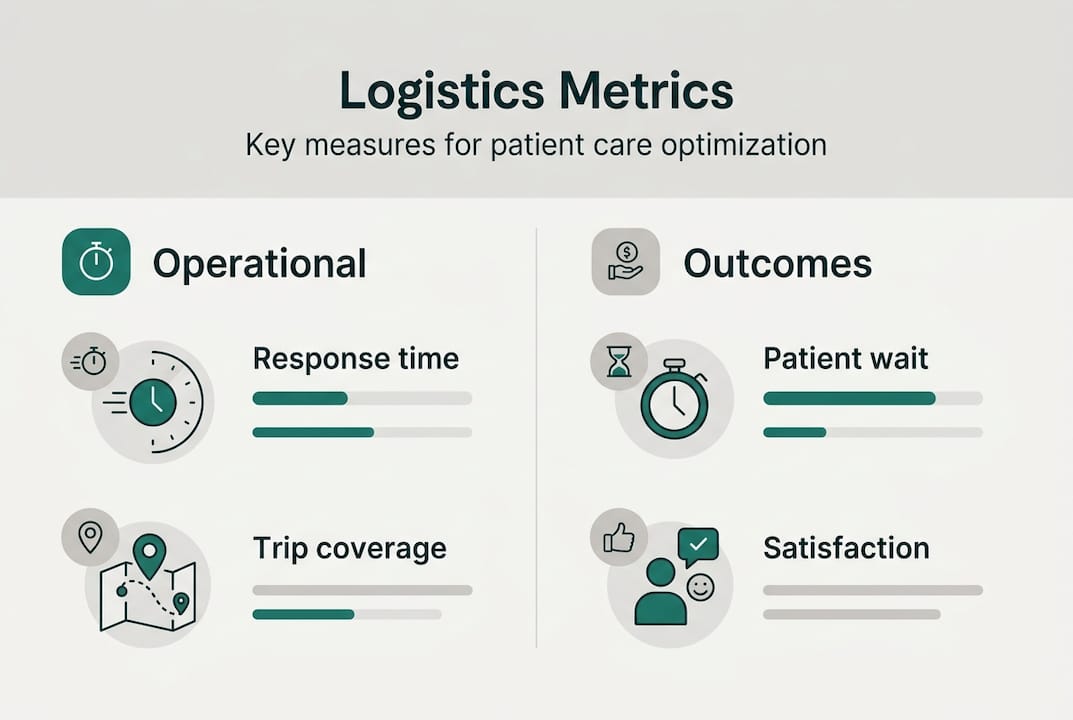
Claim denial rates reveal billing and documentation accuracy, with well-managed NEMT programs maintaining denial rates under 5%. High denial rates indicate problems with trip documentation, authorization processes, or GPS tracking compliance. No-show rates above 10% signal scheduling issues, reminder system failures, or patient access barriers that require investigation. Tracking these metrics weekly allows rapid response to emerging problems before they become systemic.
Compliance management systems automate documentation requirements that previously consumed administrative time. GPS tracking platforms capture trip data automatically, generating reports for Medicaid audits without manual intervention. HIPAA compliance features encrypt patient communications and restrict data access based on role permissions. Automated audit trails document every scheduling change, cancellation, and trip modification, providing defensible records during regulatory reviews.
Pro Tip: Benchmark your logistics performance against peer institutions using industry databases and regional healthcare coalitions. Identifying performance gaps helps prioritize improvement initiatives and demonstrates value when requesting budget for technology investments.
Phased implementation minimizes disruption while building organizational capability. Month one focuses on system setup, staff training, and parallel operation with existing processes. Month two transitions high-volume routes to the new platform while maintaining backup processes. Month three expands to full operations with continuous monitoring and adjustment. This approach reduces risk while allowing course corrections based on real-world feedback. Comparing healthcare logistics solutions helps identify platforms aligned with your specific operational requirements and integration needs.
Impact extends beyond operational metrics to patient outcomes and organizational performance. Optimized logistics reduce hospital readmissions by ensuring patients reach follow-up appointments and receive home health services on schedule. Shorter hospital stays result from efficient discharge coordination and DME delivery. Patient satisfaction scores improve when transport arrives on time and staff communicate proactively about any delays. These outcomes translate to better reimbursement under value-based care models and improved community reputation.
Explore VectorCare’s healthcare logistics solutions
Healthcare administrators seeking to transform patient transportation and care coordination can leverage VectorCare’s specialized platform designed specifically for complex healthcare logistics. The system integrates AI-driven routing, real-time tracking, and predictive analytics into a unified solution that addresses NEMT, intra-hospital transfers, home health coordination, and DME delivery. Automated scheduling reduces administrative burden while improving resource utilization, and compliance features ensure GPS tracking and HIPAA requirements are met automatically.
VectorCare provides comprehensive resources to support your logistics optimization journey. The non-emergency transportation guide offers detailed implementation frameworks for NEMT programs, while patient satisfaction insights reveal how operational improvements translate to better patient experiences. For organizations managing hospital discharge coordination, the hospital transport guide provides practical strategies to reduce delays and improve care transitions.
Pro Tip: Review VectorCare’s case studies and implementation guides before your next logistics planning meeting to identify quick wins that demonstrate value and build momentum for broader transformation initiatives.
FAQ
What is non-emergency medical transportation (NEMT) in healthcare logistics?
NEMT provides transportation services for patients who need rides to medical appointments, dialysis sessions, or routine care visits but lack personal vehicles or cannot use public transit due to mobility limitations. These services accommodate wheelchairs and walkers while maintaining strict scheduling requirements. NEMT plays a crucial role in ensuring healthcare access for vulnerable populations while helping organizations manage transportation costs systematically.
How do AI and predictive analytics improve patient transportation?
AI algorithms optimize transport routes by analyzing real-time traffic, weather, and patient needs simultaneously, reducing travel time and fuel costs by 30-40%. Predictive analytics forecast demand patterns based on historical data and scheduled procedures, allowing proactive resource positioning. These technologies reduce patient wait times, improve on-time performance, and decrease no-show rates through better scheduling and automated reminder systems.
What are the key regulatory considerations in healthcare logistics?
HIPAA protects patient information during all transport coordination and dispatch communications, requiring encrypted systems and role-based access controls. FDA regulations govern pharmaceutical handling, temperature monitoring, and documentation for drug transport. Medicaid programs mandate GPS tracking for NEMT reimbursement in most states, with specific data retention and reporting requirements that vary by jurisdiction.
How can healthcare organizations measure logistics performance effectively?
Monitor on-time pickup and delivery rates as primary indicators, targeting 95% or higher for scheduled transports with real-time tracking enabling proactive intervention. Track average patient wait times from scheduled pickup to departure, maintaining 15 minutes or less. Measure claim denial rates and no-show percentages monthly, investigating any increases above 5% and 10% respectively to identify and resolve systemic issues quickly.