Healthcare compliance program guide: essential 2026 framework

Most healthcare administrators believe compliance programs are static checklists designed to satisfy auditors. In reality, they’re dynamic risk management systems that protect your organization from regulatory penalties while improving patient care quality. The Office of Inspector General reports that healthcare providers with robust compliance programs experience 40% fewer fraud investigations and significantly better patient outcomes. This guide explains what healthcare compliance programs truly entail, their seven core components, and how to implement them effectively within your organization.
Table of Contents
- Understanding Healthcare Compliance Programs And Regulatory Requirements
- Core Components Of An Effective Healthcare Compliance Program
- Operationalizing Compliance Through Policies, Controls, And Continuous Monitoring
- Risks Of Non-Compliance And How An Effective Program Mitigates Them
- Explore Healthcare Logistics Solutions That Support Compliance
Key takeaways
| Point | Details |
|---|---|
| Dynamic risk systems | Healthcare compliance programs actively manage regulatory risks and enhance care quality, not just satisfy auditors |
| Seven OIG elements | The Office of Inspector General defines seven fundamental components that structure effective compliance frameworks |
| Continuous operations | Ongoing monitoring, training, and governance sustain compliance effectiveness across all organizational levels |
| Operational integration | Written policies and internal controls embed compliance standards directly into daily healthcare workflows |
| Dual protection | Strong programs simultaneously reduce fraud exposure and strengthen patient safety protocols |
Understanding healthcare compliance programs and regulatory requirements
Healthcare compliance programs represent systematic approaches to preventing fraud, waste, and abuse while ensuring adherence to federal and state regulations. These programs establish frameworks that guide clinical and administrative decisions, protecting both patients and organizations from regulatory violations. The Office of Inspector General advocates for healthcare providers to adopt compliance programs based on seven fundamental elements that form the foundation of effective risk management.
The regulatory landscape has intensified significantly. Healthcare fraud enforcement accelerated in 2025 under renewed Department of Justice priorities, making compliance programs essential rather than optional. Federal agencies now scrutinize billing practices, referral arrangements, and quality metrics with unprecedented rigor. Organizations without structured compliance frameworks face heightened investigation risks and substantial financial penalties.
For US healthcare entities, compliance programs address multiple regulatory domains simultaneously. Understanding healthcare compliance fundamentals helps administrators navigate complex requirements while maintaining operational efficiency. These programs must account for evolving standards across billing accuracy, patient privacy, clinical documentation, and quality reporting.
Key regulatory risks that compliance programs mitigate include:
- Billing fraud such as upcoding, unbundling, or billing for services not rendered
- Stark Law violations involving physician self-referrals and financial relationships
- Anti-Kickback Statute breaches related to improper inducements or remuneration
- HIPAA privacy and security failures exposing protected health information
- Quality of care deficiencies affecting patient safety and clinical outcomes
- Documentation inadequacies that fail to support medical necessity or services provided
Effective programs integrate regulatory compliance practices into organizational culture, transforming compliance from a defensive posture into a strategic advantage. This foundation enables healthcare leaders to build comprehensive frameworks that protect their institutions while advancing patient care missions.
Core components of an effective healthcare compliance program
The OIG’s seven essential elements provide the structural blueprint for compliance programs across all healthcare settings. These fundamental components include written standards, dedicated leadership, effective communication, comprehensive training, enforcement mechanisms, auditing procedures, and response protocols. Each element serves distinct functions while interconnecting to create resilient compliance ecosystems.
The seven core elements operate as follows:
- Written standards and procedures that clearly articulate compliance expectations and operational guidelines
- Designated compliance officer and committee with authority, resources, and direct board access
- Effective training and education programs ensuring all staff understand compliance requirements and responsibilities
- Communication channels including confidential reporting mechanisms and accessible compliance resources
- Internal monitoring and auditing systems that regularly assess compliance effectiveness and identify risks
- Enforcement and discipline procedures that consistently address violations and reinforce accountability
- Response and corrective action protocols that promptly investigate issues and implement preventive measures
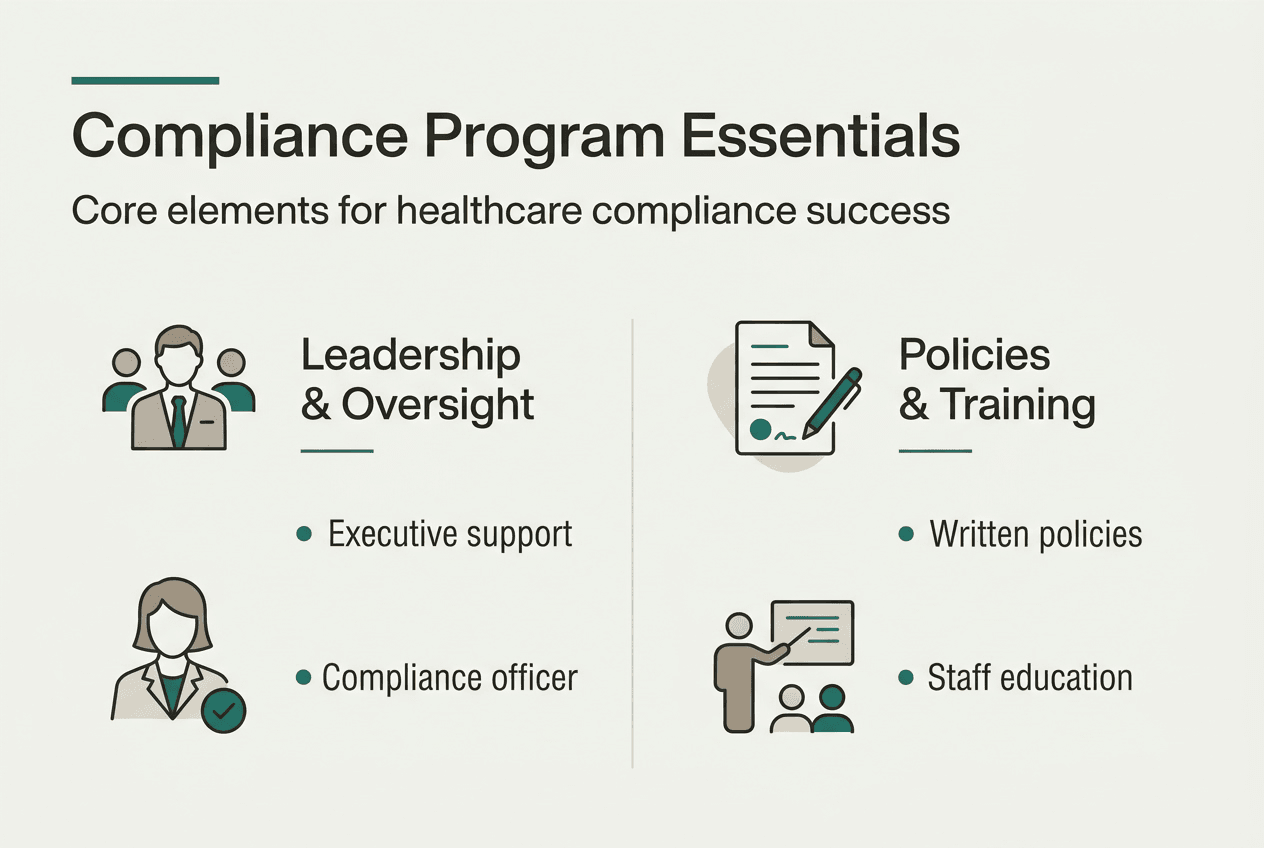
Leadership commitment determines program success. Effective OIG compliance programs require independent governance structures with empowered compliance officers who report directly to executive leadership and boards. These officers coordinate multidisciplinary committees comprising clinical, operational, financial, and legal expertise. Without adequate authority and resources, compliance functions become symbolic rather than substantive.

The compliance officer role extends beyond policy creation to active risk management. This position requires investigating reported concerns, conducting regular risk assessments, overseeing training initiatives, and maintaining relationships with regulatory bodies. Organizations must allocate sufficient budget, staff, and technology resources to support these responsibilities effectively.
Pro Tip: Involve executive leadership in quarterly compliance reviews and ensure your compliance officer has unrestricted access to all operational areas, including sensitive clinical and financial data that might reveal compliance risks.
Written policies translate regulatory requirements into actionable standards. These documents must address specific risks relevant to your organization’s services, payer mix, and geographic markets. Regular policy reviews ensure alignment with regulatory updates and operational changes. Effective healthcare compliance frameworks balance comprehensiveness with usability, making standards accessible to frontline staff.
Training programs embed compliance knowledge throughout organizations. Initial onboarding and annual refresher courses should cover general compliance principles, role-specific requirements, and reporting procedures. Documentation of training completion provides evidence of due diligence during audits or investigations. Organizations that address credentialing and compliance challenges proactively reduce operational disruptions.
Monitoring mechanisms include routine audits, claims reviews, and vendor oversight. These activities identify compliance gaps before they escalate into violations. Establishing clear vendor management protocols extends compliance expectations beyond organizational boundaries to contracted partners and suppliers.
Operationalizing compliance through policies, controls, and continuous monitoring
Transforming compliance frameworks into daily practice requires embedding standards directly into clinical and administrative workflows. Written policies provide the foundation, but operational effectiveness depends on internal controls that prevent violations before they occur. Internal controls such as approvals and reconciliations should integrate seamlessly into existing processes without creating unnecessary administrative burden.
Comprehensive policy libraries address all relevant regulatory domains while remaining accessible to staff who need them. Policies should specify clear procedures, assign responsibilities, and establish documentation requirements. Regular updates reflect regulatory changes, operational modifications, and lessons learned from audits or incidents. Centralized policy repositories with version control ensure staff access current guidance.
Internal controls operationalize compliance standards through systematic checks and balances:
- Segregation of duties preventing single individuals from controlling entire processes
- Authorization requirements ensuring appropriate review before executing sensitive transactions
- Reconciliation procedures verifying accuracy and completeness of financial and clinical records
- Data validation rules catching errors or anomalies in real time
- Access controls limiting system permissions based on job responsibilities
Training effectiveness determines whether staff can apply policies correctly. Documented and regular compliance training should track attendance, assess comprehension, and update content as regulations evolve. Role-specific training addresses unique risks faced by different departments, from billing offices to clinical units. Interactive formats and case studies improve retention compared to passive presentations.
Continuous monitoring provides objective evidence of compliance program performance. Tracking key metrics enables data-driven improvements and demonstrates due diligence to regulators. The following table illustrates essential compliance metrics:
| Metric Category | Key Indicators | Target Benchmarks |
|---|---|---|
| Training Completion | Annual compliance training rates, new hire onboarding completion | 95% within deadlines |
| Audit Activities | Scheduled audits completed, findings remediated | 100% scheduled, 90% resolved within 60 days |
| Reporting Mechanisms | Hotline calls received, investigations completed | Track trends, 100% investigated within 30 days |
| Policy Management | Policies reviewed annually, staff acknowledgments | 100% reviewed, 95% acknowledged |
| Risk Assessments | Comprehensive assessments conducted, high risks addressed | Annual completion, 100% mitigation plans |
Pro Tip: Leverage workflow automation and technology platforms to integrate compliance checks into existing systems, reducing manual effort while improving accuracy and creating automatic audit trails.
Organizations implementing workflow optimization strategies can embed compliance requirements without disrupting patient care delivery. Modern healthcare platforms enable real-time compliance monitoring through automated alerts, standardized workflows, and integrated documentation. These embedded workflow applications reduce human error while providing transparency into operational compliance.
Vendor relationships require particular attention since third-party actions can create organizational liability. Establishing robust vendor management practices ensures contractors, suppliers, and partners adhere to your compliance standards. Vendor agreements should specify compliance obligations, audit rights, and termination provisions for violations.
Regular compliance committee meetings review monitoring data, assess emerging risks, and adjust program elements accordingly. These forums facilitate cross-functional collaboration, ensuring compliance considerations inform strategic decisions rather than reacting to problems after they occur. Documentation of committee activities demonstrates governance oversight and informed decision making.
Risks of non-compliance and how an effective program mitigates them
Healthcare organizations face substantial risks when compliance programs fail or remain underdeveloped. These risks extend beyond financial penalties to encompass reputational damage, operational disruptions, and patient harm. Understanding specific vulnerabilities helps administrators prioritize compliance investments and allocate resources effectively.
Healthcare fraud and abuse thrive when oversight mechanisms weaken, documentation standards deteriorate, or financial incentives distort clinical judgment. Common fraud schemes include billing for unnecessary services, misrepresenting diagnoses to justify procedures, and accepting kickbacks for patient referrals. Each violation triggers potential False Claims Act liability, civil monetary penalties, and criminal prosecution.
Major compliance risks confronting healthcare organizations include:
- Billing fraud through upcoding, duplicate billing, or phantom billing for services never provided
- Kickback arrangements disguised as consulting agreements, medical directorships, or equipment leases
- Privacy breaches exposing patient information through inadequate security or unauthorized disclosures
- Documentation deficiencies failing to support medical necessity or accurately reflect services rendered
- Quality of care failures resulting in patient harm, readmissions, or adverse outcomes
- Cybersecurity vulnerabilities enabling ransomware attacks, data theft, or system compromises
Data breaches and cybersecurity failures represent growing compliance threats as healthcare digitization accelerates. Protected health information attracts cybercriminals due to its value on black markets. Breaches trigger mandatory reporting, regulatory investigations, and civil penalties under HIPAA. Beyond financial costs, breaches erode patient trust and damage organizational reputations.
Compliance lapses create cascading consequences. A single billing error can trigger audits revealing systemic problems, leading to corporate integrity agreements, exclusion from federal programs, and years of heightened scrutiny that constrains growth and innovation.
Effective compliance programs mitigate these risks through multiple protective mechanisms. Proactive auditing identifies issues before external parties discover them, enabling voluntary disclosure and reduced penalties. Clear policies and training prevent violations by ensuring staff understand requirements and consequences. Internal controls create barriers that catch errors or intentional misconduct before claims submission or patient harm.
Risk assessment processes systematically evaluate vulnerabilities across all organizational functions. These assessments consider factors like service lines offered, payer mix, geographic markets, and historical compliance performance. Prioritizing high-risk areas ensures limited resources address the most significant threats first. Organizations should conduct comprehensive risk assessments annually and targeted reviews when operations change substantially.
Implementing workflow automation solutions reduces compliance risks by standardizing processes and eliminating manual errors. Automated systems enforce business rules, validate data accuracy, and create comprehensive audit trails. These capabilities prove invaluable during investigations by demonstrating systematic controls and good faith compliance efforts.
Strong vendor management protocols extend risk mitigation beyond organizational boundaries. Third-party relationships create vicarious liability when vendors violate regulations while performing services on your behalf. Due diligence during vendor selection, ongoing monitoring, and contractual protections minimize these exposures.
Compliance programs also generate positive returns beyond risk reduction. Organizations with mature programs experience fewer claim denials, faster payment cycles, and improved operational efficiency. Staff morale improves when clear standards eliminate ethical ambiguity. Patient satisfaction increases when compliance priorities align with quality care delivery.
Explore healthcare logistics solutions that support compliance
Effective patient logistics and streamlined healthcare workflows reinforce compliance efforts by reducing administrative complexity and improving operational transparency. When transportation coordination, equipment delivery, and care transitions operate efficiently, organizations minimize documentation gaps and communication failures that create compliance vulnerabilities. Understanding patient logistics fundamentals helps administrators recognize how operational excellence supports regulatory adherence.
VectorCare provides a comprehensive platform helping healthcare administrators manage patient logistics while maintaining rigorous compliance standards. The VectorCare solution automates scheduling, vendor coordination, and real-time tracking, creating audit trails that document service delivery and support regulatory requirements. Healthcare payers and health plans benefit from specialized logistics capabilities that improve care coordination while reducing administrative burden. Explore how modern logistics technology can strengthen your compliance program while enhancing patient care delivery.
What is a healthcare compliance program?
What are the key elements of an OIG healthcare compliance program?
The OIG defines seven essential elements: written standards and procedures, designated compliance leadership, effective training programs, open communication channels, internal monitoring systems, consistent enforcement mechanisms, and prompt response protocols. Each element addresses specific compliance functions while working together to create comprehensive risk management frameworks.
How often should healthcare compliance policies be updated?
Organizations should review all compliance policies annually at minimum, with immediate updates when regulations change or audits reveal gaps. High-risk policies governing billing, privacy, or quality may require more frequent reviews. Document review dates and maintain version control to demonstrate ongoing policy management during audits.
What role does the compliance officer play in healthcare compliance?
The compliance officer leads program implementation, conducts risk assessments, oversees training initiatives, investigates reported concerns, and serves as the primary regulatory liaison. This role requires direct access to executive leadership and the board, sufficient resources, and authority to implement corrective actions across all departments.
How can healthcare organizations measure the effectiveness of their compliance program?
Track metrics including training completion rates, audit findings and remediation timelines, hotline utilization and investigation outcomes, policy acknowledgment rates, and risk assessment completion. Compare performance against benchmarks and industry standards. Regular compliance committee reviews of these metrics identify improvement opportunities and demonstrate program effectiveness.
What are the consequences of failing to maintain a compliance program?
Organizations without effective compliance programs face increased fraud investigation risks, substantial financial penalties, mandatory corporate integrity agreements, potential exclusion from federal healthcare programs, and reputational damage affecting patient trust and market position. Individual executives may face personal liability for compliance failures under their oversight.
Recommended
- What Is Healthcare Compliance? Essential Guide for 2025
- Understanding Regulatory Compliance in Healthcare
- Top Healthcare Cybersecurity Best Practices for Providers
- Secure Healthcare Communication Solutions for 2025 Providers
- PCI HIPAA Compliance – Avoiding Costly Mistakes in 2026
- Complete Guide to Software Compliance Software