Emergency vs Non-Emergency Ambulance: Key Impacts for Hospitals

Most American hospitals face intense pressure to manage patient transport efficiently, yet misunderstandings about ambulance services still disrupt workflows. Nearly 30 percent of patient transports in the United States are classified as non-emergency, revealing how crucial it is to distinguish between emergency and non-emergency ambulance operations. Knowing the real differences empowers healthcare administrators to improve logistics, allocate resources smartly, and prevent unnecessary emergency vehicle use for routine transfers.
Table of Contents
- Defining Ambulance Services And Misconceptions
- Core Differences And Service Levels Explained
- Legal Standards Governing Ambulance Transport
- Impact On Hospital Operations And Patient Flow
- Financial And Compliance Responsibilities For Hospitals
Key Takeaways
| Point | Details |
|---|---|
| Understanding Ambulance Services | Emergency and non-emergency ambulance services have different operational focuses that are essential for efficient patient transport. |
| Certification Levels Impact Care | The hierarchy of EMS certifications affects the type of medical care provided during transport, influencing patient outcomes. |
| Legal Compliance is Crucial | Hospitals must navigate intricate federal regulations governing ambulance transport to avoid legal penalties and ensure optimal reimbursement. |
| Optimize Resource Allocation | By developing comprehensive protocols and tracking systems, hospitals can enhance operational efficiency and improve patient flow. |
Defining Ambulance Services and Misconceptions
Ambulance services represent a critical lifeline in healthcare transportation, designed to provide swift medical transport for patients experiencing various medical situations. Ambulances are medically equipped vehicles that serve two primary functions: emergency medical response and non-emergency patient transportation. Unlike popular misconceptions, these services are not uniform but instead encompass distinct categories with specific operational protocols.
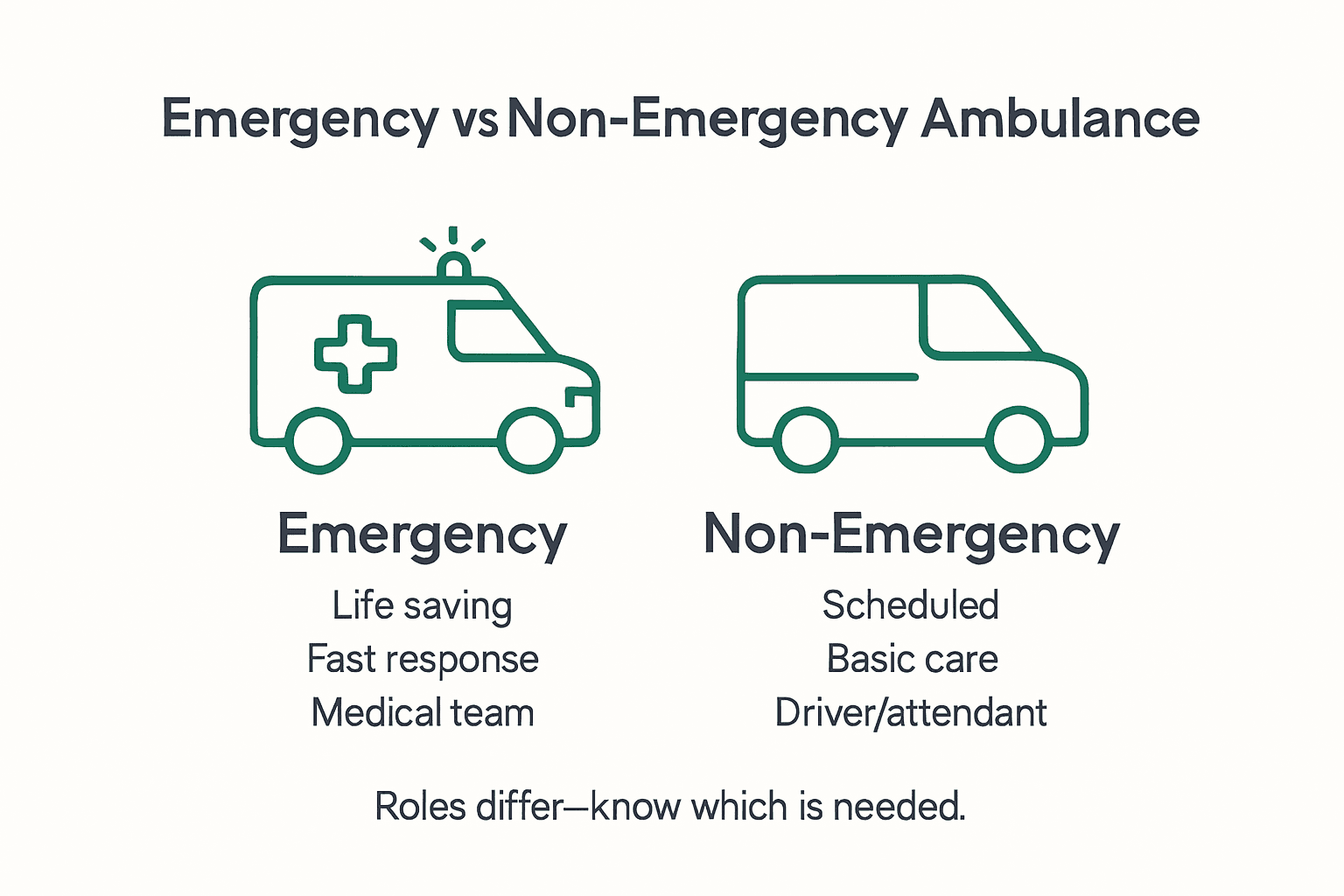
Emergency ambulances are characterized by their immediate response capabilities, equipped with advanced medical technology and staffed by highly trained professionals prepared to deliver life-saving interventions en route to medical facilities. Non-emergency ambulances, conversely, focus on scheduled patient transfers between healthcare locations, nursing homes, or rehabilitation centers. These vehicles prioritize patient comfort and basic medical monitoring rather than acute emergency intervention. Medicare regulations specify different support levels, including Basic Life Support (BLS) and Advanced Life Support (ALS), which determine the medical capabilities and staffing requirements for each ambulance service.
Hospital administrators must understand these nuanced distinctions to optimize patient logistics and resource allocation. While emergency ambulances require rapid deployment with sophisticated medical equipment, non-emergency transport vehicles can be more cost-effectively managed through strategic scheduling and routing. Understanding these differences enables healthcare systems to streamline patient movement, reduce unnecessary emergency vehicle deployments, and improve overall transportation efficiency.
Here is a summary of emergency vs. non-emergency ambulance services and their operational focus:
| Service Type | Primary Focus | Typical Staff Level | Main Benefit |
|---|---|---|---|
| Emergency Ambulance | Life-saving interventions | Paramedics/EMTs | Rapid response to crises |
| Non-Emergency Ambulance | Scheduled patient transport | EMTs/Basic support staff | Cost-effective patient moves |
Pro tip: Develop a comprehensive patient transport protocol that clearly differentiates between emergency and non-emergency ambulance needs to minimize operational confusion and optimize resource utilization.
Core Differences and Service Levels Explained
Emergency medical services in the United States encompass a complex network of medical transport and emergency response systems that vary significantly across different regions and communities. The core distinctions in ambulance services are primarily defined by the certification levels of healthcare providers and the specific medical capabilities they bring to patient care. These service levels range from basic emergency response to advanced life-saving interventions, each with unique operational protocols and medical competencies.
The medical professional certification hierarchy is structured across four primary levels, each representing increasing medical complexity and intervention capabilities. EMS certifications include Emergency Medical Responder (EMR), Emergency Medical Technician - Basic (EMT-B), Advanced Emergency Medical Technician (AEMT), and Paramedic. EMRs provide initial stabilization and basic life support, while EMT-Bs can perform more comprehensive basic medical procedures. Advanced Emergency Medical Technicians possess enhanced skills for more complex medical interventions, and Paramedics represent the highest level of pre-hospital medical care, capable of performing advanced procedures including medication administration and invasive treatments.
Below is a reference table outlining EMS provider certification levels and their key medical abilities:
| Certification Level | Key Skills | Example Procedure |
|---|---|---|
| EMR | Basic stabilization | CPR, bleeding control |
| EMT-Basic | Basic interventions | Oxygen administration |
| AEMT | Advanced procedures | IV therapy, basic meds |
| Paramedic | Comprehensive care | Advanced airway, drugs |
These service levels directly impact the type of medical care patients receive during transportation. Emergency ambulances staffed with higher-certified professionals can manage more complex medical situations, performing critical interventions that can mean the difference between life and death. Non-emergency transport vehicles, typically staffed with lower-certification level providers, focus on patient comfort, basic monitoring, and safe transportation between medical facilities. Understanding these nuanced differences helps healthcare administrators optimize resource allocation, staff scheduling, and patient care strategies.
Pro tip: Develop a comprehensive training and certification tracking system that enables real-time visibility into your ambulance service staff’s qualification levels and medical capabilities.
Legal Standards Governing Ambulance Transport
Federal regulations at 42 CFR § 410.41 establish comprehensive legal frameworks that govern ambulance transport services across the United States, creating a complex landscape of operational requirements and compliance standards. These regulations mandate specific criteria for ambulance providers, including detailed specifications for vehicle equipment, staff certifications, and documentation protocols that ensure patient safety and service quality. Hospital administrators must navigate these intricate legal requirements to maintain compliance and avoid potential regulatory penalties.
The legal standards encompass multiple dimensions of ambulance service delivery, ranging from personnel qualifications to billing documentation. Ambulance providers must employ certified medical professionals such as Emergency Medical Technicians (EMTs) or Paramedics, with strict guidelines about their training, recertification, and scope of practice. Moreover, these regulations require meticulous documentation demonstrating medical necessity for each transport, including detailed certification statements that justify the ambulance service from both medical and financial perspectives.
The Commission on Accreditation of Ambulance Services (CAAS) introduces an additional layer of regulatory oversight by establishing gold-standard accreditation requirements that frequently exceed state and federal minimums. These voluntary but highly respected standards create a comprehensive framework for operational excellence, covering clinical quality, risk management, and patient care protocols. By setting rigorous benchmarks, CAAS encourages ambulance services to continuously improve their practices beyond basic legal compliance, promoting a culture of professional development and patient-centered care.
Pro tip: Implement a comprehensive compliance tracking system that automatically monitors staff certifications, vehicle standards, and documentation requirements to proactively address potential regulatory gaps.
Impact on Hospital Operations and Patient Flow
Ambulance services fundamentally shape hospital operational dynamics, creating complex interdependencies that directly influence patient care efficiency and system-wide resource management. Ambulance service pressures reflect systemic challenges across healthcare delivery, with emergency medical transport serving as a critical interface between primary, community, and secondary care systems. The intricate relationship between ambulance services and hospital operations demands sophisticated coordination strategies to manage patient flow and optimize treatment pathways.
The differential impact of emergency and non-emergency ambulance services creates nuanced operational challenges for hospitals. Emergency ambulances introduce immediate, unpredictable patient volume that can rapidly overwhelm emergency department capacities, while non-emergency transport requires careful scheduling and resource allocation. These transportation modalities directly influence hospital throughput, bed management, and patient routing, necessitating dynamic response mechanisms that can adapt to fluctuating medical transport demands.

Emerging collaborative models emphasize integrated care systems that prioritize data sharing, cross-system planning, and proactive communication between ambulance services and hospital administrators. By developing robust communication protocols and real-time tracking mechanisms, healthcare systems can more effectively manage patient transfers, reduce bottlenecks, and ensure patients are routed to the most appropriate care facilities with minimal delay. This approach transforms ambulance services from standalone transportation providers to critical strategic partners in comprehensive patient care delivery.
Pro tip: Develop a centralized dispatch and tracking system that provides real-time visibility into ambulance status, patient condition, and hospital bed availability to optimize patient routing and reduce operational friction.
Financial and Compliance Responsibilities for Hospitals
Federal regulations governing ambulance transport services create intricate financial and compliance landscapes that hospitals must carefully navigate. These comprehensive requirements encompass precise billing protocols, documentation standards, and stringent verification processes that directly impact hospital revenue cycles and legal risk management. Hospitals must develop robust systems to ensure every ambulance transport meets complex regulatory criteria, balancing medical necessity documentation with accurate Medicare and Medicaid reimbursement claims.
The financial implications of ambulance service compliance extend far beyond simple transportation billing. Hospitals must meticulously track personnel certifications, vehicle standards, and medical necessity documentation to prevent potential audit risks and revenue recoupment. Each ambulance transport requires detailed certification statements, precise medical coding, and comprehensive documentation that demonstrates the critical medical need for the specific transportation mode, whether emergency or non-emergency.
Healthcare compliance programs are essential for maintaining institutional integrity and preventing potential legal vulnerabilities. These comprehensive programs must include detailed written policies, leadership oversight mechanisms, ongoing staff training, and proactive risk management strategies specifically tailored to ambulance service regulations. By implementing sophisticated compliance frameworks, hospitals can transform regulatory requirements from potential administrative burdens into strategic opportunities for operational excellence and financial optimization.
Pro tip: Develop an integrated compliance tracking system that automatically validates ambulance transport documentation, certification requirements, and medical necessity before submission to ensure maximum reimbursement and minimal audit risk.
Streamline Your Hospital’s Ambulance Coordination with VectorCare
Hospitals face growing challenges managing the complex demands of emergency and non-emergency ambulance services. The article highlights key pain points like unpredictable emergency patient flow, stringent compliance requirements, and the need for precise staff certification tracking. VectorCare’s comprehensive digital platform is designed to meet those exact needs by offering real-time updates, AI-driven dispatching, and automated compliance tracking. This enables hospitals to reduce delays, optimize ambulance routing according to medical necessity, and improve resource allocation between Basic Life Support and Advanced Life Support transport.
Discover how VectorCare can transform your patient transport logistics with integrated solutions tailored for healthcare providers and emergency services. Act now to reduce operational strain, ensure regulatory compliance, and enhance patient outcomes. Explore more at VectorCare’s platform and start optimizing ambulance coordination today.
Frequently Asked Questions
What is the difference between emergency and non-emergency ambulances?
Emergency ambulances provide rapid response and life-saving interventions for critical medical situations, while non-emergency ambulances focus on scheduled patient transportation between healthcare facilities.
How do the different certification levels of EMS providers impact ambulance services?
The certification levels of EMS providers, ranging from Emergency Medical Responder (EMR) to Paramedic, determine the complexity of medical care provided during transport, with higher levels capable of performing advanced interventions.
What regulations govern ambulance transport services in hospitals?
Federal regulations at 42 CFR § 410.41 establish requirements for ambulance providers, including personnel qualifications, vehicle standards, and thorough documentation protocols to ensure patient safety and compliance.
How do ambulance services affect hospital operations and patient flow?
Ambulance services shape hospital dynamics by influencing patient volume and resource allocation. Emergency transports can rapidly increase patient influx, while non-emergency transports require careful scheduling to maintain efficient flow.