What is home health logistics? Guide for optimal patient care

TL;DR:Home health logistics involves complex scheduling, routing, and resource coordination impacting patient outcomes and agency viability.Modern AI-driven platforms significantly reduce travel time and improve caregiver workload balancing.Success requires organizational discipline, staff engagement, and continuous feedback alongside advanced technology implementation.
Home health logistics is widely misunderstood as a simple scheduling problem, but that framing dramatically understates its complexity and its direct impact on patient outcomes and agency margins. At its core, home health logistics refers to the planning, routing, and scheduling of caregivers and resources to deliver healthcare services at patients’ homes. The decisions made within this operational discipline determine whether patients receive timely follow-up after discharge, whether caregivers are deployed efficiently, and whether agencies remain financially viable. This guide walks healthcare administrators and decision-makers through the full scope of home health logistics, from foundational definitions to advanced algorithmic solutions and real-world performance benchmarks.
Table of Contents
- Defining home health logistics: Beyond basic scheduling
- How home health logistics works: Methods and modern solutions
- Benchmarks and performance: What good looks like in home health logistics
- Difficulties and edge cases: Logistics in the real world
- Solution approaches: Algorithms and technology making it possible
- The truth most guides miss: Home health logistics is about people, not just math
- Streamline your home health logistics journey
- Frequently asked questions
Key Takeaways
| Point | Details |
|---|---|
| Comprehensive definition | Home health logistics goes beyond basic scheduling to coordinate staff, routes, time windows, and regulatory factors for effective in-home care. |
| Technology impact | AI and optimized scheduling tools cut travel and labor costs, boost productivity, and tackle complexities for better agency performance. |
| Critical benchmarks | Fast hospital-to-home transitions matter—aim for under three days to help reduce readmissions and maximize margins. |
| Real-world challenges | Complex staff shifts, regulations, and diverse patient needs mean robust systems and smart tech are essential. |
| Integrating the human element | Real success in logistics blends advanced tools with staff engagement, communication, and patient-centric processes. |
Defining home health logistics: Beyond basic scheduling
Home health logistics is not the same as managing a supply chain or dispatching a delivery truck. The distinction matters because the stakes are fundamentally different. When a caregiver arrives late or is mismatched to a patient’s clinical needs, the consequences extend beyond inconvenience to readmission risk, regulatory scrutiny, and lost revenue. Achieving logistics efficiency in home health requires coordinating multiple interdependent variables simultaneously.
The formal definition captures this complexity well. According to HHCRSP research, the Home Health Care Routing and Scheduling Problem encompasses decisions about which caregiver visits which patient, in what order, at what time, and via which route. This is categorically different from routing a package because caregivers have skill sets, certifications, shift limits, and patient relationships that must be preserved.
The fundamental components of home health logistics include:
- Caregiver scheduling: Matching staff skills and availability to patient acuity and care plans
- Route optimization: Minimizing travel time and mileage across distributed patient locations
- Time window management: Honoring patient-preferred visit windows while balancing operational constraints
- Continuity of care: Prioritizing consistent caregiver-patient pairings to build trust and improve outcomes
- Workload balancing: Distributing visits equitably to prevent burnout and reduce turnover
Core methodologies now include AI-driven scheduling and multi-objective optimization that simultaneously balance travel time, costs, patient satisfaction, caregiver workload, skill matching, and continuity of care. The technology impact on logistics is reshaping what agencies can realistically achieve without adding headcount. Understanding these components is the first step toward meaningful operational improvement.
“Solving the home health logistics problem well is not a back-office efficiency exercise. It is a clinical and financial imperative.”
Now that we’ve established why home health logistics isn’t just about dispatching staff, let’s dive deeper into its complexity and methods.
How home health logistics works: Methods and modern solutions
Understanding the framework is only the beginning. Let’s look at which logistics methods actually drive results in the field.
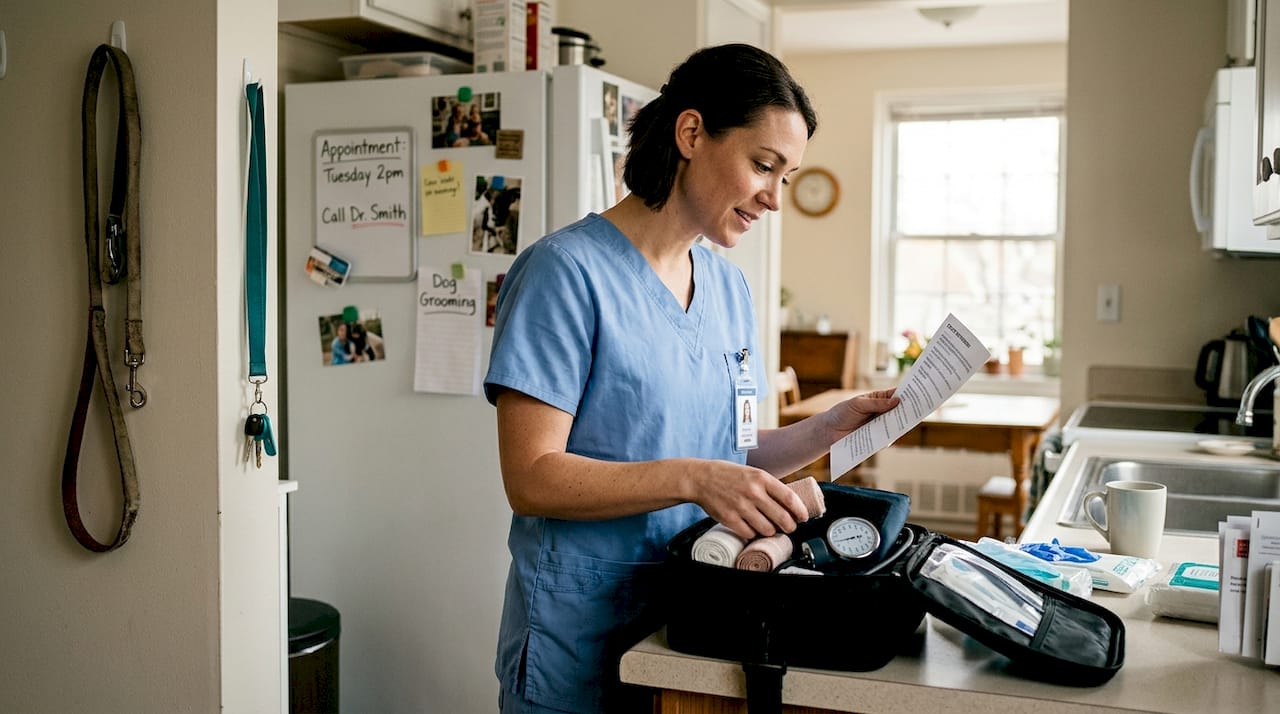
The real-world workflow begins at intake, when a referral or discharge order triggers the need for a home visit. A coordinator must then identify an available caregiver with the right credentials, assign a visit window that works for the patient, and build a route that accounts for geography, traffic, and the caregiver’s existing schedule. Traditionally, this process relied on spreadsheets, phone calls, and institutional knowledge held by a handful of experienced schedulers.
| Approach | Travel time reduction | Productivity gain | Workload deviation |
|---|---|---|---|
| Manual/spreadsheet | Baseline | Baseline | High |
| Decision support tools | 17% reduction | Moderate | 77% reduction |
| AI-driven scheduling | 30% reduction | 25% gain | Significant |
The performance gap between these approaches is substantial. AI scheduling reduces travel time by 30% and drives productivity gains of 25%, while decision support tools reduce travel by 17% and cut workload deviation by 77%. These are not marginal improvements. For an agency managing hundreds of daily visits, a 30% reduction in travel time translates directly into more visits per caregiver per day and lower per-visit costs.
Modern platforms also integrate with home health scheduling apps that provide real-time visibility into caregiver locations, enabling dynamic rescheduling when a visit runs long or a caregiver calls out sick. Agencies evaluating top scheduling tools should prioritize platforms that handle multi-constraint optimization natively rather than requiring manual workarounds.
Pro Tip: Most agencies underestimate the change management burden of implementing new scheduling technology. The algorithm is rarely the bottleneck. Coordinator adoption, data quality, and integration with existing EHR systems are the factors that most often delay or derail a successful rollout.
Routing algorithms in home health operations must account for constraints that don’t exist in commercial logistics, including patient acuity, caregiver certifications, and regulatory visit windows. That specificity is what makes purpose-built healthcare logistics platforms worth the investment.
Benchmarks and performance: What good looks like in home health logistics
Now that you’ve seen the methods, it’s critical to pinpoint what “good” actually means in home health logistics.
Performance measurement in home health logistics centers on a handful of high-impact indicators. Timeliness from hospital discharge to first home visit is the most consequential. Travel time per visit and workload balance across staff are operational efficiency measures. Patient satisfaction scores and readmission rates reflect the downstream clinical impact of logistics quality.
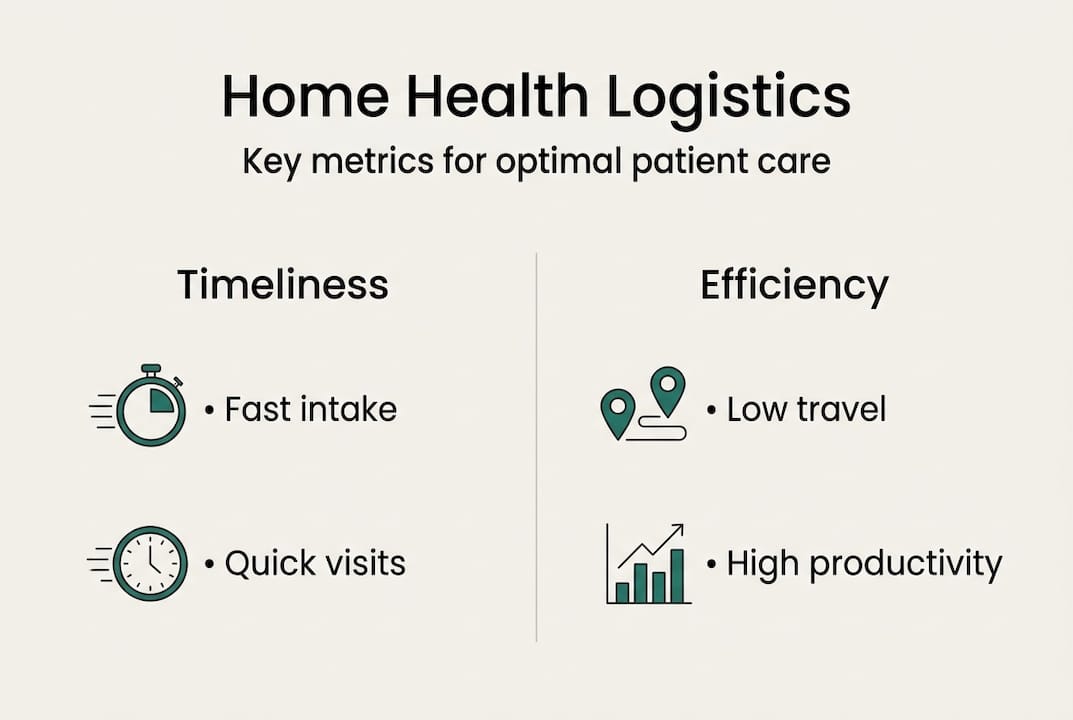
The national benchmark for discharge-to-visit timeliness is fewer than three days. The reality is more concerning. The U.S. average worsened from 2.3 to 2.4 days in 2019 to 3.2 to 3.3 days in 2024, moving in the wrong direction as demand has outpaced operational capacity. In 2023, Medicare served 2.7 million home health beneficiaries at a total cost of $15.7 billion, with agencies reporting 20.2% margins, meaning operational efficiency directly affects financial sustainability.
Key metrics every agency should track:
- Days from discharge to first visit (target: fewer than 3)
- Average travel time per caregiver per day
- Visit completion rate within scheduled time windows
- Caregiver utilization rate (visits per shift)
- 30-day readmission rate for home health patients
Even a half-day delay in the first post-discharge visit measurably increases readmission risk, which triggers financial penalties under Medicare’s value-based purchasing programs. Agencies that boost logistics efficiency through better scheduling and routing are not just improving operations. They are protecting revenue and improving clinical standing simultaneously. Reviewing your agency’s performance against these benchmarks and comparing logistics solutions is a practical starting point for identifying where the largest gains are available.
Difficulties and edge cases: Logistics in the real world
With performance standards in place, let’s address the nuanced challenges that can derail even the best logistics plans.
Real-world home health logistics rarely resembles a clean optimization problem. The complexity multiplies when agencies operate across both urban and rural geographies, manage a mix of full-time, part-time, and contracted staff, and serve patients with highly individualized care requirements. Rural-urban disparities, multiple time windows, variable staff models, and regulatory compliance are the edge cases that expose the limits of generic scheduling tools.
“The agencies that struggle most with logistics are rarely those with the worst technology. They’re the ones that haven’t mapped their operational constraints clearly enough to configure any tool effectively.”
Here are the steps most effective agencies follow to resolve common logistics obstacles:
- Audit your constraint inventory. Document all regulatory visit windows, staff work-hour limits, and patient preference requirements before selecting or configuring any platform.
- Segment your geography. Urban and rural zones require different routing logic. Build separate scheduling rules for each.
- Standardize caregiver skill tagging. Inconsistent credentialing data is one of the most common causes of poor automated matching.
- Build exception workflows. Define clear escalation paths for same-day cancellations, patient refusals, and emergency rescheduling.
- Review workforce optimization strategies regularly. Staff models evolve, and your logistics configuration should reflect current reality, not last year’s staffing mix.
Regulatory and HR compliance adds another layer of complexity. HIPAA requirements in home health logistics govern how patient data is transmitted during scheduling and routing workflows. Labor law constraints on consecutive shifts, overtime, and travel time compensation vary by state and must be embedded in scheduling logic to avoid violations. Case studies in logistics confirm that agencies that treat compliance as a scheduling constraint rather than an afterthought achieve significantly better outcomes.
Pro Tip: The most overlooked regulatory challenge in home health logistics is travel time compensation. In many states, drive time between patient visits is compensable work time under wage and hour law. Agencies that don’t account for this in their routing models face both legal exposure and inaccurate cost-per-visit calculations.
Solution approaches: Algorithms and technology making it possible
Finally, to put all this in practice, let’s look under the hood at the technology and methods powering smart logistics.
The algorithmic landscape for home health logistics spans a wide spectrum of sophistication. Exact algorithms, metaheuristics, heuristics, and reinforcement learning each have distinct strengths depending on the size of the agency, the complexity of constraints, and the computational resources available. Understanding which approach fits your operational profile is a meaningful decision point for agency leaders.
Key solution categories and their best-fit applications include:
- Exact algorithms (branch-price-and-cut): Best for smaller agencies with well-defined constraints; computationally intensive but provably optimal
- Heuristics: Fast, rule-based approaches suitable for real-time rescheduling and agencies with simpler routing needs
- Metaheuristics (genetic algorithms, simulated annealing): Effective for large, complex scheduling problems where near-optimal solutions are acceptable
- Reinforcement learning: Emerging approach that learns from historical scheduling outcomes to improve future decisions dynamically
For most mid-size to large home health agencies, metaheuristic and AI-driven platforms offer the best balance of performance and practicality. Routing problem solutions that incorporate patient preferences, caregiver work-hour limits, and real-time traffic data outperform static rule-based systems in both efficiency and staff satisfaction. Evaluating top healthcare scheduling platforms through a structured pilot is the most reliable way to validate performance claims before full deployment.
Agencies operating as patient logistics centers recognize that technology selection is not a one-time event. As patient volumes grow, staff models shift, and regulatory requirements evolve, the logistics platform must adapt. Scalability and integration capability with existing EHR and billing systems are therefore non-negotiable criteria in any technology evaluation.
The truth most guides miss: Home health logistics is about people, not just math
After reviewing every algorithmic approach and performance benchmark, the most important insight for agency leaders is this: technology is a necessary condition for logistics excellence, but it is not a sufficient one. The agencies that achieve and sustain the greatest improvements are those that treat logistics transformation as an organizational discipline, not a software implementation.
Caregiver trust in the scheduling process matters as much as the algorithm’s output. When staff believe the system is fair, transparent, and responsive to their constraints, adoption rates climb and data quality improves, which in turn makes the algorithm more effective. This is a reinforcing cycle that starts with communication and change management, not configuration settings.
A patient-centered logistics approach also requires that administrators regularly solicit feedback from both caregivers and patients about scheduling quality. The gap between what the algorithm optimizes and what patients and staff actually experience is where most logistics programs quietly fail. Closing that gap requires structured feedback loops, not just better data. The organizations leading in home health logistics in 2026 are those that have learned to treat their schedulers, caregivers, and patients as active participants in the system, not just variables to be optimized.
Streamline your home health logistics journey
Ready to apply what you’ve learned? Here’s how to take your agency’s logistics to the next level.
The gap between understanding home health logistics and operationalizing it at scale is where most agencies stall. The good news is that purpose-built platforms now make it possible to move from manual, error-prone workflows to AI-optimized operations without rebuilding your entire infrastructure.
Start by reviewing a structured comparison of logistics solutions to identify platforms that align with your agency’s size, geography, and integration requirements. For agencies seeking a proven dispatching and coordination platform, VectorCare’s dispatching platform offers AI-driven scheduling, real-time visibility, and compliance-ready workflows designed specifically for home health and patient logistics environments. Learn more about how VectorCare supports agencies at every stage of their logistics maturity.
Frequently asked questions
What exactly does home health logistics include?
It covers scheduling, routing, and coordinating caregivers and resources to deliver quality healthcare at patients’ homes while optimizing cost, time, and satisfaction across all operational constraints.
How does technology improve home health logistics?
AI-driven scheduling and route optimization reduce travel time by 30% and drive productivity gains of 25%, while simultaneously helping agencies balance complex regulatory and clinical constraints.
Why is timeliness after hospital discharge important in home health logistics?
Fast follow-up after discharge, ideally in fewer than three days, reduces readmission risk and protects agency revenue under Medicare value-based purchasing programs.
What are the main challenges in home health logistics?
Key challenges include rural-urban disparities, variable staff models, multiple time windows, regulatory compliance, and the change management burden of adopting advanced scheduling technology.
Which software or solutions help streamline home health logistics?
Specialized platforms with AI optimization can yield 10 to 30% efficiency gains and are best evaluated through structured pilots that test performance against your agency’s specific constraints and patient population.