Streamlining medically necessary transportation: 3.6M missed visits

TL;DR:3.6 million patients miss medical appointments annually due to transportation gaps, affecting outcomes and efficiency.Coordinating models like brokers and MCOs impact access, oversight, and data sharing in patient transportation.Technology such as AI dispatch and GPS tracking significantly reduce wait times, enhance compliance, and prevent fraud.
3.6 million patients miss medical appointments every year because of transportation gaps, a figure that challenges the assumption that logistics are a minor administrative concern. For healthcare administrators and executives, this represents a measurable threat to patient outcomes, care continuity, and operational efficiency. Transportation logistics sit at the intersection of regulatory compliance, clinical coordination, and financial performance. Understanding how to define, coordinate, and optimize medically necessary transportation is no longer optional. This article walks through foundational definitions, coordination models, technology best practices, compliance strategies, and a perspective on why the most effective organizations treat transportation as a strategic asset.
Table of Contents
- What qualifies as medically necessary transportation?
- Coordination models for patient transportation logistics
- Technology and best practices for efficient transportation
- Compliance, edge cases, and fraud prevention strategies
- A fresh perspective: Making transportation a strategic advantage, not just a compliance task
- Advance your patient logistics with purpose-built solutions
- Frequently asked questions
Key Takeaways
| Point | Details |
|---|---|
| Clear eligibility distinctions | Medicaid and Medicare have very different criteria for medically necessary transportation, requiring tailored approaches. |
| Broker model efficiency | Third-party brokers streamline coordination, but network adequacy and rural access must be closely monitored. |
| Technology drives improvement | AI dispatch, GPS tracking, and app scheduling dramatically improve reliability and reduce missed appointments. |
| Vigilant compliance essential | Facility confirmation, real-time analytics, and robust protocols minimize fraud and ensure reimbursement integrity. |
What qualifies as medically necessary transportation?
Medically necessary transportation refers to any transport service required for a patient to access covered healthcare services when no other means are available or appropriate. The definition varies significantly depending on the payer, and that distinction carries real operational consequences for healthcare administrators.
Under Medicaid, non-emergency medical transportation (NEMT) is a federally mandated benefit that covers rides to and from covered medical appointments for eligible beneficiaries who lack access to other transportation. This includes routine physician visits, dialysis, mental health services, and specialty care. The role of NEMT in health outcomes is substantial, particularly for low-income populations managing chronic conditions who depend on this benefit to maintain care continuity.
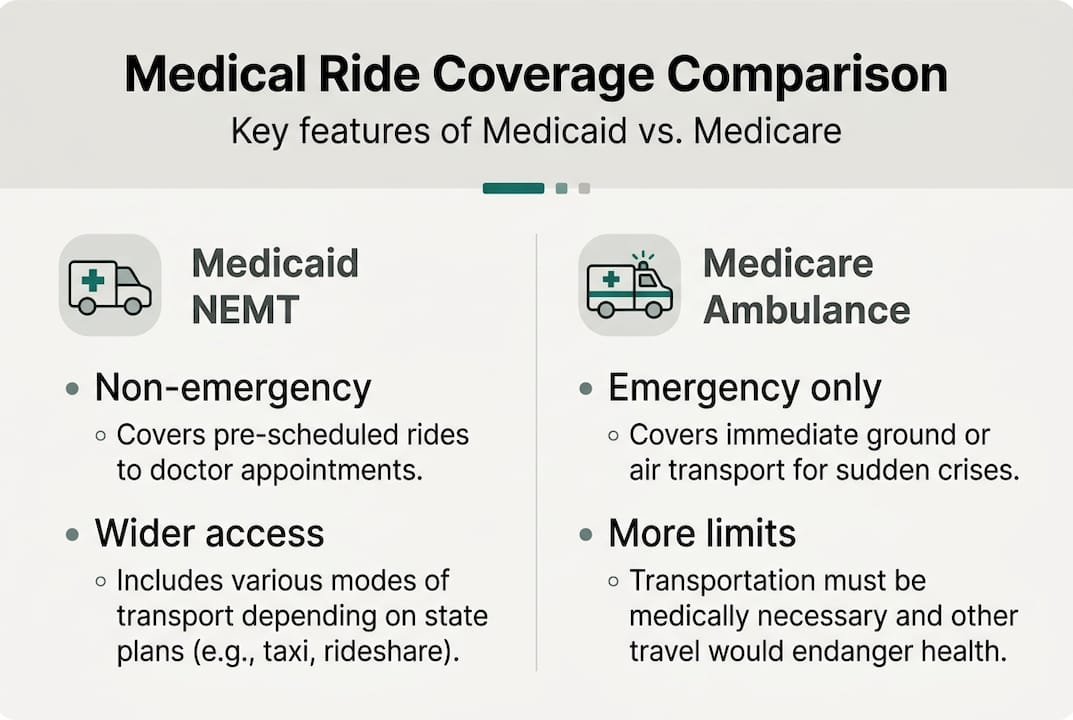
Medicare operates under a much narrower framework. Medicare covers ambulances only when the patient’s condition is such that any other form of transport would endanger their health. This means a patient who is ambulatory and cognitively intact will not qualify for Medicare-covered ambulance transport, even if they have no other way to reach a facility. Administrators who conflate Medicaid NEMT with Medicare ambulance coverage risk both compliance failures and claim denials.
| Feature | Medicaid NEMT | Medicare ambulance |
|---|---|---|
| Service type | Non-emergency rides | Emergency and medically required ambulance |
| Eligibility basis | Lack of transportation access | Medical necessity only |
| Coverage scope | Broad (physician, dialysis, behavioral health) | Narrow (life-threatening or endangerment situations) |
| State variation | High | Low |
| Billing pathway | State Medicaid agency or broker | Medicare Part B |
Edge cases add further complexity. Skilled nursing facility (SNF) residents in non-Part A stays, SNF patient transportation for outpatient services, intra-campus transfers, air ambulance for remote or critical cases, and recurring dialysis trips each carry distinct eligibility rules. Administrators must verify coverage at the individual trip level, not just the patient level, to avoid systematic billing errors.
Eligibility criteria typically include:
- Medicaid enrollment and active coverage at the time of service
- Medical necessity documentation from a treating provider
- Absence of alternative transportation (personal vehicle, family support, public transit)
- Covered service destination (not all facilities or appointment types qualify)
- Prior authorization in many states, particularly for specialty or long-distance trips
Getting these definitions right is the foundation of a defensible, efficient transportation program.
Coordination models for patient transportation logistics
With eligibility clarified, it is critical to understand how healthcare systems coordinate patient transport to improve efficiency and compliance. The model a health system or payer selects shapes everything from administrative workload to rural access and fraud exposure.

States use broker models, MCO carve-ins, and hybrid arrangements to manage NEMT benefits, and each approach carries distinct trade-offs. In the broker model, a third-party transportation broker handles scheduling, eligibility verification, routing, and real-time tracking on behalf of the state or payer. This centralized structure improves program integrity and creates a clear audit trail, but it can introduce access barriers in rural areas where network adequacy is a persistent challenge.
Managed care organization (MCO) carve-in models embed NEMT within the broader managed care contract, giving plans direct control over transportation coordination. This can improve care integration but may reduce transparency if transportation data is siloed within the plan. Hybrid models attempt to capture the strengths of both approaches, often using brokers for non-emergency trips while retaining plan oversight for high-acuity cases.
Self-administered models, where a health system manages its own fleet and scheduling, offer maximum control but demand significant infrastructure investment and are rarely scalable for organizations serving large or geographically dispersed populations.
Brokers improve program integrity but face real challenges around rural access and network adequacy, particularly in states with large frontier regions. Administrators evaluating broker contracts should scrutinize network coverage maps, response time guarantees, and escalation protocols for no-shows and late arrivals.
| Model | Strengths | Weaknesses |
|---|---|---|
| Broker | Oversight, fraud control, scalability | Rural gaps, access barriers |
| MCO carve-in | Care integration, plan control | Data silos, variable quality |
| Hybrid | Flexibility, balanced oversight | Coordination complexity |
| Self-administered | Maximum control | High cost, limited scalability |
Regardless of model, NEMT scheduling challenges remain significant across the industry. Fragmented communication between providers, drivers, and patients creates delays that compound across a day’s schedule. Choosing NEMT providers with interoperable platforms is essential for organizations that want scalable, auditable operations.
Pro Tip: Prioritize vendors and brokers who support open API integrations with your EHR and billing systems. Interoperability eliminates manual data entry, reduces errors, and enables real-time reporting that supports both compliance and performance management.
Technology and best practices for efficient transportation
After selecting a suitable coordination model, organizations can dramatically improve outcomes through technology and proven operational practices. The gap between high-performing and average transportation programs often comes down to how effectively technology is deployed at each stage of the trip lifecycle.
AI-enabled dispatch cuts wait times by 40%, while app-based scheduling handles 65% of trips in optimized programs and reduces administrative burden by 25%. These are not marginal improvements. They represent a structural shift in how transportation operations function, moving from reactive, phone-based coordination to proactive, data-driven logistics management.
The most impactful technology investments in patient transportation include:
- GPS and telematics for real-time vehicle tracking, route optimization, and driver accountability
- AI-enabled dispatch that matches trip requests to available drivers based on proximity, vehicle type, and patient needs
- App-based scheduling that allows patients, case managers, and providers to book, modify, and confirm trips without phone queues
- Automated billing integration that captures trip data and submits claims without manual entry, reducing denials and accelerating reimbursement
- Analytics dashboards that surface performance trends, flag outliers, and support vendor accountability
“The organizations that reduce missed appointments most effectively are those that treat transportation data as clinical data, feeding it back into care coordination workflows rather than managing it as a separate administrative function.”
Key performance indicators for a high-performing transportation program include on-time performance (OTP) at or above 90%, trip completion rates above 90%, and no-show rates below 10%. These benchmarks provide a baseline for vendor contracts and internal performance reviews.
Healthcare transportation software platforms vary widely in their capabilities, and selecting the right one requires aligning features with your coordination model, payer mix, and patient population. Reviewing steps for NEMT success can help administrators build a structured evaluation framework before committing to a platform.
Pro Tip: Build real-time vendor performance dashboards that track OTP, cancellation rates, and complaint volumes by provider. Reviewing these weekly, rather than monthly, allows you to intervene before performance issues affect patient care or compliance audits.
Compliance, edge cases, and fraud prevention strategies
Even with technology in place, administrators must ensure compliance across varying situations and protect operations from fraud. Patient transportation is one of the higher-risk areas for Medicaid and Medicare billing irregularities, and the consequences of non-compliance extend well beyond claim denials.
Facility attendance confirmation, GPS tracking, real-time analytics, and blockchain pilots can reduce transportation fraud by 30%. These tools create a verifiable chain of evidence for each trip, from dispatch to drop-off, that supports both routine auditing and investigation response.
Edge cases require particular attention. SNF residents in non-Part A stays, intra-campus transfers, multi-state trips, and recurring dialysis cases each fall into gray areas where standard eligibility rules may not apply cleanly. Administrators should develop written protocols for each edge case category, ensuring that documentation requirements and authorization workflows are clearly defined before a trip is scheduled.
Key compliance practices include:
- Standing orders for recurring trips (dialysis, chemotherapy) with periodic physician recertification
- GPS-verified trip logs that confirm pickup, route, and drop-off against scheduled parameters
- Facility attendance confirmation through electronic check-in or provider attestation
- Regular internal audits of trip records, billing submissions, and driver credentials
- Blockchain-based pilots for high-volume programs seeking tamper-resistant trip records
Reviewing NEMT fraud prevention protocols and using a structured NEMT fraud checklist are practical starting points for organizations building or refreshing their compliance programs. For SNF-specific operations, dedicated SNF NEMT scheduling workflows that account for facility discharge timing and physician order requirements can significantly reduce billing risk.
Pro Tip: Conduct quarterly audits of a random sample of trip records, cross-referencing GPS data, billing submissions, and facility attendance logs. This practice surfaces systemic errors before they accumulate into audit findings or recoupment demands.
A fresh perspective: Making transportation a strategic advantage, not just a compliance task
Stepping back from tactics, the most important shift healthcare executives can make is recognizing that patient transportation logistics are not a regulatory obligation to minimize. They are a performance variable that directly shapes patient satisfaction, care outcomes, and even revenue.
Most administrators focus on meeting regulatory minimums, avoiding fraud, and controlling costs. That is necessary but insufficient. The organizations that lead in patient retention, quality scores, and population health outcomes tend to treat transportation as patient logistics as infrastructure, investing in it with the same rigor applied to clinical workflows.
When a patient misses a follow-up appointment because transportation failed, the downstream costs include readmissions, emergency visits, and deteriorating chronic disease management. These costs are rarely attributed to transportation failures in financial reporting, which is precisely why the problem persists. Reframing transportation as a clinical continuity tool, rather than an administrative expense, changes how organizations measure its value and justify investment in better systems. The data-driven, tech-enabled programs that have made this shift consistently outperform peers on both clinical and financial metrics.
Advance your patient logistics with purpose-built solutions
Translating the frameworks in this article into operational results requires the right tools and the right partners. For healthcare administrators ready to move from reactive coordination to proactive logistics management, the next step is accessing resources built specifically for this challenge.
The non-emergency transportation guide provides a structured overview of program design, vendor selection, and performance benchmarking. For organizations focused on patient experience, understanding how logistics decisions affect patient satisfaction scores is essential context for building the business case for investment. The VectorCare platform brings together AI-driven dispatch, real-time tracking, vendor management, and compliance tools in a single integrated environment designed for the complexity of modern healthcare logistics.
Frequently asked questions
What is medically necessary transportation under Medicaid and Medicare?
Under Medicaid, medically necessary transportation covers non-emergency rides for eligible patients who lack other means of reaching covered services. Under Medicare, coverage is strictly limited to ambulance transport when any other form of transit would endanger the patient’s health.
How do healthcare administrators ensure eligibility and compliance for NEMT?
Eligibility is verified through broker platforms and state guidelines, combined with real-time GPS tracking and facility attendance confirmation to support ongoing compliance auditing.
Which technology is most impactful in improving transportation logistics?
AI dispatch and app scheduling deliver the greatest operational gains, reducing wait times by up to 40% and cutting administrative costs by 25% in optimized programs.
How can healthcare organizations prevent fraud in patient transportation programs?
Implementing GPS tracking, real-time analytics, and facility attendance confirmation creates a verifiable trip record; blockchain pilots have demonstrated the ability to reduce transportation fraud by 30% in high-volume programs.
Recommended
- How One Payer Improved Dialysis Transport for Over 40k Patients | VectorCare
- Scheduling NEMT Rides in a SNF: How to Streamline Patient Transportation | VectorCare
- Streamlining Non Emergency Patient Transport Services in 2025
- All About CMS’ New Dialysis Transportation Reimbursement Cuts | VectorCare
- Demivolt | News – Zoom expands healthcare solutions to streamline workflows and strengthen patient engagement