Streamline administrative burden in healthcare: a step-by-step guide

TL;DR:AI tools can reduce clinician note-writing time by up to 30% and lower burnout.Implementing automation in high-volume tasks improves efficiency and patient care outcomes.Successful adoption requires careful workflow mapping, stakeholder engagement, and ongoing measurement.
Clinician burnout is accelerating, patient wait times are growing, and administrative overhead now consumes a staggering share of every healthcare dollar. AI tools can reduce note-writing time by up to 30% and measurably lower burnout rates, yet most hospitals have barely scratched the surface of what automation and process optimization can deliver. For healthcare administrators and decision-makers, the pressure to act is real and immediate. This guide walks through the specific tools, implementation steps, and measurement frameworks that leading health systems are using right now to cut administrative overhead, reclaim clinician hours, and improve patient care outcomes.
Table of Contents
- Understanding the true cost of administrative burden
- Key tools and technologies for streamlining operations
- Step-by-step guide: Implementing scalable administrative solutions
- Troubleshooting, barriers, and tailoring for unique environments
- Measuring impact and sustaining improvements
- A practical perspective: What most guides miss about slashing administrative burden
- Take the next step: Connect with healthcare logistics innovations
- Frequently asked questions
Key Takeaways
| Point | Details |
|---|---|
| Admin burden impacts outcomes | High administrative overload reduces efficiency, clinician satisfaction, and care quality. |
| AI and EHR optimization work | Automated tools and improved EHR systems save time and dramatically lower burnout. |
| Policy changes drive compliance | New CMS rules require faster prior authorizations and interoperable APIs by 2026-2027. |
| Tailored approaches ensure success | Customizing solutions for your environment delivers better adoption and impact. |
| Continuous tracking is vital | Regular KPI measurement locks in progress and highlights further opportunities. |
Understanding the true cost of administrative burden
Administrative tasks in U.S. hospitals are not a minor inconvenience. They represent a structural drain on clinical capacity, financial resources, and staff wellbeing. Physicians spend roughly two hours on paperwork for every one hour of direct patient care, a ratio that has worsened steadily as documentation requirements have grown. The downstream effects reach patients directly, as delayed authorizations and bottlenecked workflows translate into longer wait times and reduced access to care.
Strategies for reducing admin costs are gaining urgency as the financial stakes rise. Prior authorization alone costs the average hospital millions annually in staff time, rework, and denied claims. When clinicians are trapped in documentation cycles, their cognitive bandwidth for clinical decision-making shrinks, and burnout follows.
“Rural hospitals dedicate 18% more resources to administration, with successful optimization driving 33% more patient capacity.”
This disparity is significant. Rural facilities operate with thinner margins and smaller teams, meaning administrative inefficiency hits them proportionally harder. Yet the same research shows that targeted interventions yield outsized returns in these settings.
| Impact area | Baseline challenge | Post-optimization outcome |
|---|---|---|
| Clinician time on documentation | 2 hrs per 1 hr patient care | Up to 30% reduction with AI |
| Rural admin resource allocation | 18% above average | 33% patient capacity gain possible |
| Burnout prevalence | Over 50% in some specialties | Significant reduction post-automation |
| Prior authorization delays | Days to weeks | Hours with API-driven workflows |
The pattern is consistent across health system sizes: administrative burden is not inevitable, and the organizations that treat it as an operational priority rather than a background cost are the ones gaining competitive and clinical ground.
Key tools and technologies for streamlining operations
Understanding the scale of the problem makes the case for action. The next question is which tools actually deliver results, and how to evaluate them without getting lost in vendor promises.
Ambient scribes represent one of the most impactful near-term interventions available today. These AI-powered tools listen to patient-clinician conversations and generate structured clinical notes automatically, eliminating the need for after-hours charting. AI scribes and digital documentation systems produce 20 to 30% reductions in note-writing time and save clinicians nearly 20 minutes of EHR interaction daily. That adds up to hours reclaimed each week per clinician.
Natural language processing (NLP) tools are also reshaping prior authorization workflows. Rather than requiring staff to manually compile clinical criteria and submit requests through payer portals, NLP systems extract relevant data from the EHR and populate authorization requests automatically. The result is faster approvals, fewer denials, and less staff time spent on rework.
| Process | Traditional approach | AI-powered approach |
|---|---|---|
| Clinical note creation | Manual, post-visit charting | Ambient AI, real-time generation |
| Prior authorization | Manual form completion | NLP extraction and auto-submission |
| EHR data retrieval | Keyword search, manual review | Semantic search, contextual surfacing |
| Scheduling coordination | Phone-based, staff-intensive | Automated, rules-based optimization |
EHR optimization and interoperability are equally critical. FHIR APIs (Fast Healthcare Interoperability Resources, the technical standard for health data exchange) allow modular add-ons to connect with existing EHR systems without costly full replacements. Exploring AI automation for clinicians and reviewing workflow optimization strategies can help administrators identify where interoperability gaps are costing the most time.
- Prioritize vendors with proven EHR integration track records
- Require FHIR API compatibility as a baseline procurement criterion
- Evaluate ambient scribe tools with a 30-day pilot before full deployment
- Assess staff training requirements before signing contracts
Pro Tip: Request reference calls with hospitals of similar size and EHR platform before committing to any documentation automation vendor. Peer validation is far more reliable than demo environments.
Step-by-step guide: Implementing scalable administrative solutions
With a clear picture of the available tools, the implementation phase requires a structured approach to avoid the common traps of scope creep, staff resistance, and stalled pilots.

Step 1: Map your current administrative workflows. Before selecting any technology, document every major administrative process, from prior authorization to discharge documentation to scheduling. Identify the top three friction points by volume and time cost. This baseline becomes your ROI benchmark.
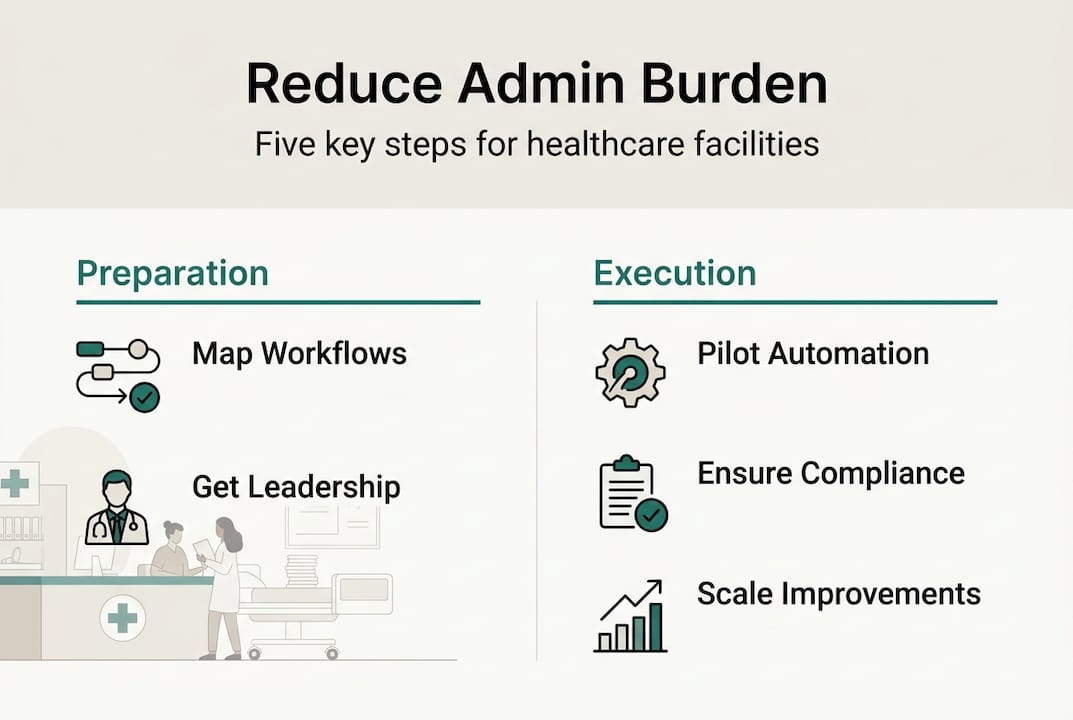
Step 2: Secure leadership buy-in with data. Present the financial and clinical case to executive leadership using your own operational data alongside published benchmarks. Administrators who frame automation as a patient safety and retention issue, not just a cost reduction play, tend to secure faster approval.
Step 3: Select automation targets and pilot platforms. Focus initial automation on the highest-volume, most standardized tasks. Prior authorization and clinical documentation are typically the best starting points. Run a structured 60-day pilot with defined success metrics before scaling.
Step 4: Align with CMS compliance requirements. The CMS Interoperability and Prior Auth Final Rule sets mandatory timelines and API requirements for 2026 to 2027, meaning compliance is no longer optional. Build API integration readiness into your procurement checklist now.
Step 5: Scale and iterate. After a successful pilot, expand to additional departments using a phased rollout. Maintain a feedback loop with clinical staff to catch workflow friction early. Reviewing API integration for healthcare and ways to reduce admin burden can support your scaling strategy.
Pro Tip: Assign a clinical champion in each department during rollout. Peer-led adoption consistently outperforms top-down mandates when introducing new documentation tools.
Troubleshooting, barriers, and tailoring for unique environments
Even well-designed implementations encounter friction. Anticipating the most common barriers and building mitigation strategies into your plan from the start significantly increases the probability of sustained success.
EHR compatibility is the most frequently cited obstacle. Legacy systems often lack native API support, requiring middleware solutions or phased upgrades. Before selecting any automation tool, conduct a technical assessment of your current EHR environment and identify integration dependencies. Reviewing AI implementation challenges provides a realistic picture of what organizations typically encounter during this phase.
HIPAA and data privacy requirements add another layer of complexity. Any AI tool that processes clinical notes or patient data must meet strict security standards, including encryption at rest and in transit, audit logging, and business associate agreements. Vet vendors thoroughly on these criteria before procurement.
“Rural hospitals benefit most from targeted data standardization and AI, but face unique resource gaps.”
For rural and resource-constrained facilities, the path forward often involves prioritizing a single high-impact intervention rather than attempting a broad transformation. Targeted EHR optimization and a single AI documentation tool can deliver meaningful gains without overwhelming limited IT and training capacity. Exploring workflow optimization frameworks designed for smaller organizations can accelerate this process.
- Conduct a technical readiness assessment before vendor selection
- Establish a HIPAA compliance checklist specific to AI tools
- Create a stakeholder engagement plan that includes frontline clinical staff
- For multi-site systems, pilot at one location before network-wide rollout
- For rural facilities, prioritize single-domain automation with measurable ROI
Stakeholder resistance is often underestimated. Clinicians who have experienced failed EHR implementations are skeptical by default, and that skepticism is rational. Addressing it requires transparent communication, early involvement of clinical staff in tool selection, and visible leadership commitment to adjusting workflows based on feedback.
Measuring impact and sustaining improvements
Once new processes are live and initial hurdles addressed, the focus must shift to quantifying gains and building the organizational habits that sustain them over time.
The right KPIs for administrative burden reduction are specific and measurable. EHR time per patient encounter, after-hours charting rates, prior authorization cycle time, patient throughput per clinician, and staff satisfaction scores all provide direct visibility into whether interventions are working. Tracking operational cost metrics alongside clinical indicators gives administrators a complete picture of ROI.
| KPI | Measurement method | Target outcome |
|---|---|---|
| EHR time per encounter | EHR audit logs | 20 to 30% reduction |
| After-hours charting rate | Timestamp analysis | Below 10% of total charting |
| Prior auth cycle time | Workflow tracking | Under 24 hours for standard requests |
| Clinician burnout rate | Validated survey tools | Sustained reduction quarter over quarter |
| Patient throughput | Scheduling and visit data | 10 to 33% increase |
The evidence for sustained improvement is compelling. Burnout rates dropped from 51.9% to 38.8% in just one month following automation implementation in one documented study. That kind of rapid shift demonstrates that administrative relief has immediate psychological and operational impact, not just long-term financial returns.
- Set a 90-day review cadence for all KPIs post-implementation
- Build a cross-functional reporting team that includes clinical, IT, and finance stakeholders
- Update automation configurations as CMS rules and payer requirements evolve
- Celebrate and communicate wins to reinforce adoption and sustain momentum
Sustaining improvements requires treating administrative optimization as an ongoing operational discipline rather than a one-time project. Policy changes, new payer requirements, and evolving clinical workflows mean that the best implementations are those designed for continuous iteration.
A practical perspective: What most guides miss about slashing administrative burden
Most implementation guides focus almost entirely on technology selection, as if choosing the right AI scribe or FHIR-compliant platform is the primary determinant of success. In practice, operational efficiency insights consistently point to a different conclusion: change management is the variable that separates organizations that achieve lasting relief from those that accumulate expensive tools with low adoption rates.
Clinician-led pilots matter more than vendor demos. When frontline physicians and nurses are involved in selecting and testing tools, adoption rates climb and resistance drops. Gold-carding programs, which exempt high-performing clinicians from routine prior authorization requirements, represent another underutilized lever that delivers immediate relief without requiring any technology investment.
Regulatory policy like the CMS Prior Authorization Final Rule creates a useful forcing function, but it does not create cultural change. Real, lasting administrative relief comes from ground-level engagement, flexible workflow design, and a leadership posture that treats clinician feedback as a continuous input rather than a one-time consultation. The organizations winning on this front are not necessarily the ones with the largest technology budgets.
Take the next step: Connect with healthcare logistics innovations
Reducing administrative burden is only one dimension of operational excellence in healthcare. Seamless patient logistics, from transportation coordination to home health scheduling and durable medical equipment delivery, represents the next frontier for health systems committed to improving both efficiency and care quality.
VectorCare’s platform connects understanding patient logistics directly to operational outcomes, offering AI-driven dispatching, real-time visibility, and automated workflows that reduce delays and lower costs across the care continuum. Whether you are looking to improve patient transport satisfaction or streamline coordination across multiple sites, the VectorCare patient logistics platform provides the infrastructure to scale efficiently. Explore our resources and connect with our team to see how integrated logistics can extend the gains you have already made in administrative streamlining.
Frequently asked questions
What are the fastest ways to reduce administrative burden in hospitals?
The quickest gains come from automating documentation with AI scribes, optimizing EHR workflows, and standardizing prior authorization processes. AI-driven documentation reduces admin time by up to 30%, making it one of the highest-ROI starting points.
How does the CMS Prior Authorization Rule affect hospitals in 2026?
Hospitals must respond to urgent prior authorizations within 72 hours and standard ones within 7 days, with API and metric reporting required. The CMS Prior Auth Final Rule mandates full API compliance by 2027, making early preparation essential.
What KPIs should administrators track after streamlining?
Focus on EHR time per patient, after-hours charting rates, patient throughput, and clinician burnout scores. Burnout rates and time-on-EHR are the most direct indicators of whether administrative burden reduction is working.
Are rural hospitals at a disadvantage for implementing these solutions?
Rural hospitals often carry higher administrative burdens but see significant gains when focusing on targeted AI and EHR optimization rather than broad transformation. Rural hospitals with 18% more admin allocation have achieved 33% patient capacity gains through focused interventions.
Recommended
- Streamlining Hospital Workflows for Optimal Efficiency
- 7 Tips for Reducing Administrative Costs in Healthcare
- How Technology Can Empower Healthcare Professionals | VectorCare
- How to Reduce Operational Costs in Healthcare Organizations
- Master Automating Administrative Tasks for Efficiency|CS
- Demivolt | News – Zoom expands healthcare solutions to streamline workflows and strengthen patient engagement