Scheduling optimization healthcare: streamline staffing in 2026

Healthcare administrators face mounting pressure from understaffing issues affecting 66% of organizations over the past two years. Manual scheduling methods drive up agency costs while exhausting nurses with administrative tasks. AI-driven scheduling optimization transforms this landscape by matching staff skills to patient demand in real time, cutting costs while improving care quality. This guide walks you through implementing intelligent scheduling systems that reduce burnout and boost operational efficiency.
Table of Contents
- Understanding Scheduling Optimization In Healthcare
- Prerequisites And What You Need Before Starting
- Choosing The Right Scheduling Software And Tools
- Implementing Ai-Driven Scheduling Optimization
- Common Mistakes And Troubleshooting
- Expected Results And How To Measure Success
- Optimize Your Healthcare Scheduling With Vectorcare
- Frequently Asked Questions
Key takeaways
| Point | Details |
|---|---|
| Cost reduction | AI scheduling reduces agency staffing reliance by 12% within six months through optimized allocation. |
| Efficiency gains | Organizations achieve 12–18% operational efficiency improvement within the first year of implementation. |
| Administrative relief | Automation eliminates 15–28% of nurses’ low-value administrative work, freeing time for patient care. |
| Patient outcomes | Automated appointment reminders cut no-show rates by up to 25%, improving care continuity. |
Understanding scheduling optimization in healthcare
Scheduling challenges plague healthcare facilities uniquely. Unlike retail or hospitality, hospitals operate 24/7 with strict compliance requirements, unpredictable patient volumes, and specialized skill matching needs. Understaffing affects 66% of healthcare organizations, creating dangerous care gaps and forcing expensive agency staffing solutions.
Inefficient scheduling creates cascading problems. Understaffing drives nurse burnout as remaining staff shoulder excessive loads. Overstaffing wastes budgets already stretched thin. Compliance violations from improper shift assignments risk legal penalties and accreditation issues. Patient care suffers when tired, overworked staff struggle to maintain quality standards.
AI and automation address these challenges through real-time demand forecasting and intelligent shift assignment. Modern systems analyze historical patterns, seasonal variations, and current census data to predict staffing needs accurately. They match nurses to shifts based on skills, certifications, preferences, and fatigue levels automatically. This precision eliminates guesswork while respecting labor regulations.
Scheduling software delivers more than shift calendars. Advanced platforms integrate compliance checking, credential verification, and predictive analytics. They flag potential violations before schedules publish, track overtime limits, and optimize staff utilization across departments. Exploring healthcare workforce optimization strategies reveals how these tools fit into broader operational improvements.
Key scheduling optimization capabilities include:
- Real-time demand forecasting using historical and current census data
- Automated shift assignment matching skills, certifications, and preferences
- Compliance monitoring for union rules, overtime limits, and fatigue management
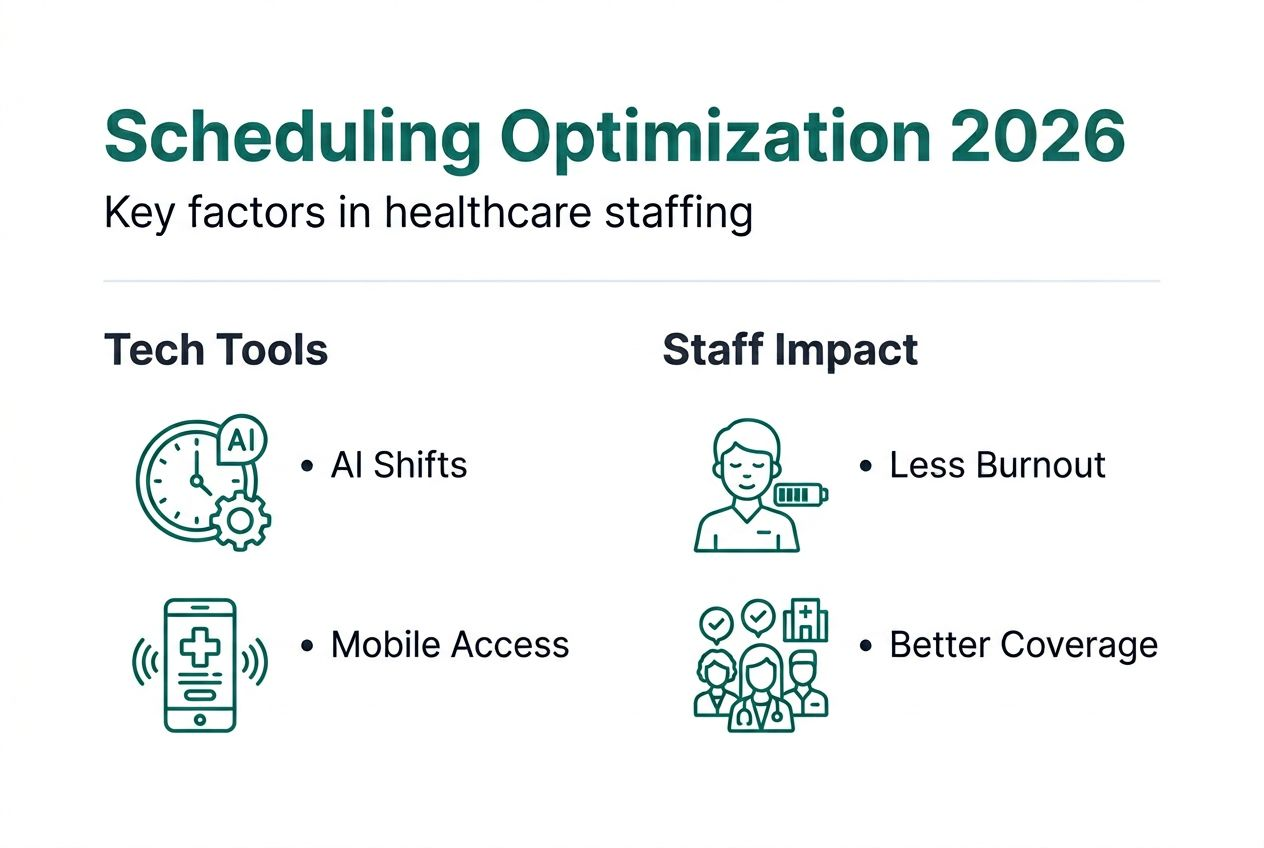
- Mobile access enabling staff to view schedules and request changes instantly
- Integration with payroll, HR, and EHR systems for seamless data flow
Pro Tip: Start by mapping your current scheduling workflow to identify the biggest pain points consuming staff time and creating errors. Focus optimization efforts on these high-impact areas first for faster ROI.
Prerequisites and what you need before starting
Successful scheduling optimization requires organizational readiness beyond purchasing software. Assess your current pain points methodically. Document recurring issues like last-minute callouts, frequent overtime, unfilled shifts, or compliance violations. Quantify these problems with metrics such as agency staffing costs, overtime hours, and schedule change frequency.
Your digital infrastructure must support modern scheduling tools. Verify that existing EHR, payroll, and HR systems offer integration capabilities through APIs or standard connectors. Legacy systems lacking integration options create data silos that undermine optimization benefits. Budget for potential middleware or system upgrades if needed.
Compliance understanding proves critical. Labor union agreements often mandate specific scheduling practices, shift rotations, and overtime distribution methods. State and federal regulations govern break requirements, maximum shift lengths, and on-call compensation. Document these requirements completely before evaluating software, as non-compliant systems waste investment and create legal risks.
Training capacity determines adoption success. Administrative tasks consume 15–28% of nurses’ work time, and new systems initially add learning curves. Plan dedicated training time, identify super-users who can support peers, and create reference materials addressing common scenarios. Consider workflow adjustments that accommodate the learning period without compromising care.

Address potential patient flow barriers that scheduling improvements might reveal. Optimized staffing exposes bottlenecks elsewhere in care delivery. Prepare to tackle these systematically.
Readiness checklist:
- Current scheduling pain points documented with quantified impacts
- IT infrastructure assessment confirming integration capabilities
- Complete compliance requirement documentation including union agreements
- Training plan with dedicated time and super-user identification
- Stakeholder buy-in from nursing leadership, HR, and legal departments
Pro Tip: Interview frontline nurses and schedulers before selecting software. Their daily frustrations often highlight requirements that executives miss, ensuring your chosen solution addresses real workflow needs.
Choosing the right scheduling software and tools
Effective scheduling software combines must-have features with healthcare-specific capabilities. AI-powered shift planning forms the foundation, using machine learning to predict staffing needs and optimize assignments. Predictive analytics forecast patient volumes based on historical patterns, seasonal trends, and local factors. Integration with EHR, payroll, and HR systems eliminates double entry while ensuring schedule accuracy.
Compliance support separates healthcare scheduling tools from generic workforce management systems. Look for built-in monitoring of union rules, break requirements, and maximum shift lengths. Fatigue management features prevent dangerous overtime accumulation and ensure adequate rest between shifts. Credential tracking alerts you when certifications expire, preventing unqualified staff assignments.
Mobile access dramatically improves adoption rates and flexibility. Staff need smartphone apps to view schedules, request time off, and pick up open shifts from anywhere. Push notifications about schedule changes reduce miscommunication. Self-service shift swapping, subject to manager approval, empowers staff while reducing scheduler workload.
Scalability matters for health systems managing multiple facilities. Cloud-based platforms handle growth without infrastructure investments. Multi-site management features let you view staffing across locations, transfer staff between facilities, and maintain consistent policies systemwide. However, only 28% of large U.S. health systems have implemented AI-powered scheduling as of 2025, despite 41% planning investments.
| Feature Category | Essential Capabilities | Why It Matters |
|---|---|---|
| AI & Analytics | Demand forecasting, automated shift assignment, pattern recognition | Reduces manual work while improving accuracy |
| Compliance | Union rule monitoring, fatigue management, credential tracking | Prevents violations and legal risks |
| Integration | EHR, payroll, HR system connectivity via APIs | Eliminates data silos and double entry |
| Mobile Access | Staff self-service, shift swapping, instant notifications | Boosts adoption and flexibility |
| Scalability | Multi-site management, cloud infrastructure, role-based access | Supports growth without complexity |
Understanding healthcare scheduling software options helps narrow choices to platforms meeting your specific needs.
Pro Tip: Request vendor demos using your actual scheduling scenarios, not generic examples. Evaluate how software handles your unique compliance requirements, shift patterns, and integration needs before committing.
Implementing AI-driven scheduling optimization
Successful implementation follows a structured approach that minimizes disruption while maximizing benefits. Begin with a thorough needs assessment involving schedulers, nursing leadership, HR, and IT. Define specific goals such as reducing agency costs by 15% or cutting scheduling time by 50%. Quantified objectives enable you to measure progress and justify investment.
Prepare your IT infrastructure by confirming integration requirements with vendors. Test data connections between the new scheduling system and existing EHR, payroll, and HR platforms. Clean up data quality issues in source systems, as inaccurate employee records or credential information will corrupt schedules. Establish data governance policies defining which system serves as the source of truth for each data element.
Select software meeting your compliance, scalability, and feature requirements. Negotiate contracts including implementation support, training, and ongoing technical assistance. Plan a phased rollout starting with one department or facility rather than organization-wide deployment. This approach lets you refine processes and address issues before broader adoption.
Train staff comprehensively across all user groups. Schedulers need deep system knowledge covering setup, rule configuration, and troubleshooting. Managers require training on reviewing and approving schedules, handling exceptions, and interpreting analytics. Frontline staff need clear instructions on viewing schedules, requesting changes, and using mobile features. Hands-on practice sessions work better than passive presentations.
Deploy AI features gradually after establishing baseline manual scheduling in the new system. Start with demand forecasting to compare AI predictions against actual needs. Add automated shift assignment for straightforward scenarios before tackling complex cases. Monitor key performance indicators weekly, including schedule change frequency, unfilled shifts, overtime hours, and staff satisfaction. Refine AI rules and constraints based on results.
“AI-powered scheduling reduces agency staffing reliance by 12% within six months through optimized allocation matching staff skills and preferences to actual demand patterns.”
Implementation steps:
- Conduct needs assessment with all stakeholder groups and define quantified goals
- Prepare IT infrastructure, test integrations, and clean source data
- Select compliant software and negotiate comprehensive support agreements
- Train schedulers, managers, and frontline staff with hands-on practice
- Deploy in phases starting with one department or facility
- Enable AI features gradually while monitoring KPIs weekly
- Refine rules and constraints based on performance data and user feedback
Review best healthcare scheduling software examples to understand successful implementation patterns.
Common mistakes and troubleshooting
Compliance oversights create the most damaging implementation failures. Ignoring union rules and regulations disables scheduling effectiveness by generating grievances and forcing manual schedule revisions. Verify that your software configuration mirrors every collective bargaining agreement clause affecting scheduling. Test schedules against known compliance scenarios before going live.
Integration complexity catches organizations unprepared. Underestimating the technical work required to connect scheduling software with EHR, payroll, and HR systems delays deployments by months. Legacy systems may lack modern APIs, requiring custom middleware development. Budget adequate IT resources and extend timelines to accommodate integration challenges. Engage IT staff early in vendor selection to assess integration feasibility realistically.
Insufficient training guarantees poor adoption and costly errors. Staff revert to familiar manual methods when they lack confidence using new systems. Schedule disappear into email rather than the official platform. Mistakes multiply as users work around features they don’t understand. Invest in comprehensive training covering not just button-clicking but the logic behind AI recommendations and optimization rules.
Data quality problems corrupt schedules silently. Outdated employee records, missing credentials, or incorrect skill classifications cause AI to make inappropriate assignments. Clean your data thoroughly before implementation and establish ongoing data governance. Assign ownership for maintaining accurate information in each source system.
Troubleshooting strategies:
- Involve HR and legal teams from day one to review compliance requirements
- Allocate realistic IT resources for integration work and testing
- Provide role-specific training with hands-on practice for all user groups
- Establish data governance policies and assign clear ownership
- Start with limited scope and expand gradually based on results
Pro Tip: Create a dedicated implementation team combining clinical, IT, HR, and legal expertise. Weekly meetings keep integration, training, and compliance work synchronized, catching issues before they derail your timeline.
Expected results and how to measure success
Healthcare organizations implementing AI-driven scheduling achieve substantial measurable improvements. Operational efficiency increases 12–18% within the first year as systems optimize staff allocation and reduce administrative overhead. These gains compound over time as AI learns from patterns and refines recommendations.
Cost reductions materialize quickly. Organizations cut agency staffing reliance by 12% within six months by filling more shifts with existing staff through better matching and scheduling flexibility. Overtime expenses decrease as balanced schedules prevent recurring overwork for specific individuals. These savings typically exceed software costs within the first year.
Patient outcomes improve alongside operational metrics. Automated appointment reminders reduce no-show rates by up to 25%, improving care continuity and resource utilization. Better-rested, less-burned-out nurses deliver higher quality care with fewer errors. Patient satisfaction scores often rise as adequately staffed units provide more attentive service.
Nurse satisfaction represents a crucial but harder-to-quantify benefit. Reduced administrative burden, more predictable schedules, and greater input into shift preferences decrease burnout and turnover. Exit interview data and employee surveys track these improvements over time.
| Metric | Typical Improvement | Timeframe |
|---|---|---|
| Operational efficiency | 12–18% increase | 12 months |
| Agency staffing costs | 12% reduction | 6 months |
| Nurse administrative time | 15–28% decrease | 6 months |
| Patient appointment no-shows | Up to 25% reduction | 6 months |
| Staff satisfaction scores | 10–15% improvement | 12 months |
Track these key performance indicators:
- Schedule creation time and number of manual adjustments required
- Unfilled shift percentage and agency usage frequency
- Overtime hours and associated costs by department
- Patient no-show rates for scheduled appointments
- Staff satisfaction scores and turnover rates
- Compliance violation incidents related to scheduling
“Hospitals report that optimized scheduling not only cuts costs but also improves nurse retention by reducing the administrative burden and providing more predictable, flexible schedules that respect work-life balance.”
Explore patient care logistics case studies demonstrating broader operational transformation beyond scheduling alone.
Optimize your healthcare scheduling with VectorCare
Scheduling optimization delivers powerful benefits, but it represents just one component of comprehensive patient logistics management. VectorCare’s platform integrates scheduling with transportation coordination, home health management, and equipment delivery to create seamless care experiences. When your optimized schedules align with coordinated patient movement and resource allocation, efficiency gains multiply.
Our AI-driven dispatching and real-time updates complement intelligent scheduling by ensuring patients arrive for appointments on time and staff have the resources they need when they need them. The platform reduces delays, lowers operational costs, and improves patient outcomes through automation and data insights. Healthcare organizations achieve true operational transformation by connecting workforce optimization with patient logistics. Explore what patient logistics encompasses and how integrated solutions drive better results than point solutions addressing individual problems.
Frequently asked questions
What is healthcare scheduling optimization?
Healthcare scheduling optimization uses AI and automation to align workforce allocation with patient demand in real time. Unlike manual scheduling relying on historical patterns and scheduler experience, optimized systems analyze multiple data sources to predict needs accurately. They match staff to shifts based on skills, certifications, preferences, and compliance requirements automatically. The result is better coverage with lower costs and reduced administrative burden.
How long does it take to see benefits from scheduling optimization?
Most organizations observe measurable benefits within six to twelve months of implementation. Initial improvements in schedule creation efficiency and reduced manual adjustments appear within weeks. Cost reductions from decreased agency staffing and overtime emerge over the first six months. Operational efficiency gains and staff satisfaction improvements build steadily throughout the first year as AI learns patterns and users become proficient.
What are common challenges when adopting scheduling software?
Integration complexity and compliance adherence create the biggest adoption hurdles. Connecting new scheduling systems to existing EHR, payroll, and HR platforms requires significant IT resources and careful testing. Ensuring software configurations match union agreements and regulatory requirements demands thorough legal review. Comprehensive training for all user groups and active stakeholder involvement throughout implementation mitigate these challenges effectively.
Can scheduling optimization reduce nurse burnout?
Yes, automation significantly reduces nurse burnout by eliminating administrative tasks and creating more predictable schedules. Nurses spend less time on paperwork and schedule changes, freeing capacity for patient care. Better-balanced workloads prevent chronic overwork affecting specific individuals. Greater input into shift preferences through self-service features improves work-life balance. These factors combine to decrease stress and lower turnover rates measurably.