Patient logistics explained: Efficient strategies for administrators

Transport delays cost hospitals millions annually, and the operational ripple effects extend far beyond a single missed pickup. Most healthcare administrators recognize patient transport as a logistical concern, but the full scope of patient logistics reaches into scheduling, resource allocation, bed management, and care coordination. Automation can reduce wait times by 30%, yet many organizations still rely on fragmented, manual processes that quietly erode efficiency and patient outcomes. This article breaks down what patient logistics actually encompasses, the methodologies powering modern optimization, actionable best practices, and the quantitative benchmarks that demonstrate real business impact.
Table of Contents
- What is patient logistics?
- Core methodologies: Operations Research and technology
- Best practices for optimizing patient logistics
- Empirical benchmarks and business impact
- Nuances, challenges, and edge cases
- Strategic, tactical, and operational frameworks
- Next steps: Implementing logistics solutions for your organization
- Frequently asked questions
Key Takeaways
| Point | Details |
|---|---|
| Patient logistics scope | Patient logistics covers transport, flow, scheduling, and resource coordination for timely, safe care. |
| Optimization methodologies | Operations Research and advanced technology drive efficiency, using AI scheduling and real-time dashboards. |
| Best practices | Centralize operations, automate tasks, and monitor KPIs to reduce wait times and boost outcomes. |
| Quantitative impact | Efficient logistics can cut length of stay by up to 20% and decrease wait times drastically. |
| Addressing challenges | Admin leaders must navigate pandemic surges, integration issues, and benchmarking gaps with flexible strategies. |
What is patient logistics?
Patient logistics is frequently reduced to a single image: a transport van moving a patient from point A to point B. That framing misses the majority of what the discipline actually involves. Patient logistics encompasses patient transport, flow management, scheduling, and resource coordination, all working in concert to move patients through the care continuum without unnecessary delay or friction.
Understanding what patient logistics truly means requires looking at its core components:
- Patient transport: Non-emergency medical transport (NEMT), ambulance coordination, and inter-facility transfers
- Patient flow management: Bed assignment, discharge planning, and intra-hospital movement between departments
- Scheduling: Appointment coordination, surgical scheduling, and outpatient visit sequencing
- Resource coordination: Staff allocation, equipment availability, and vendor management
When these components operate in silos, the consequences are measurable. Beds sit empty while patients wait in emergency departments. Discharge delays cascade into admission backlogs. The organizations that maximize patient logistics efficiency treat these components as an integrated system rather than isolated functions.
“Effective patient logistics is not a support function. It is a core clinical and operational capability that directly shapes patient outcomes and organizational performance.”
Strong patient engagement strategies also depend on logistics working correctly. When patients experience delays, missed appointments, or poor coordination, satisfaction scores and clinical adherence both suffer.
Core methodologies: Operations Research and technology
Once the scope of patient logistics is clear, the next question is how leading organizations actually optimize it. The answer increasingly lies in Operations Research (OR), a discipline that applies mathematical modeling and analytical methods to complex decision-making problems.
OR methodologies such as vehicle routing, simulation, and AI-driven scheduling are now core to logistics optimization in healthcare settings. These approaches move beyond reactive problem-solving and enable predictive, system-wide coordination.
Key technology drivers include:
- AI-driven dispatching: Algorithms that assign transport resources based on urgency, proximity, and availability in real time
- Simulation modeling: Digital replicas of hospital workflows used to test scheduling changes before implementation
- Real-time dashboards: Centralized visibility into transport status, bed availability, and patient location
- Predictive analytics: Forecasting demand surges, no-show rates, and discharge volumes to pre-position resources
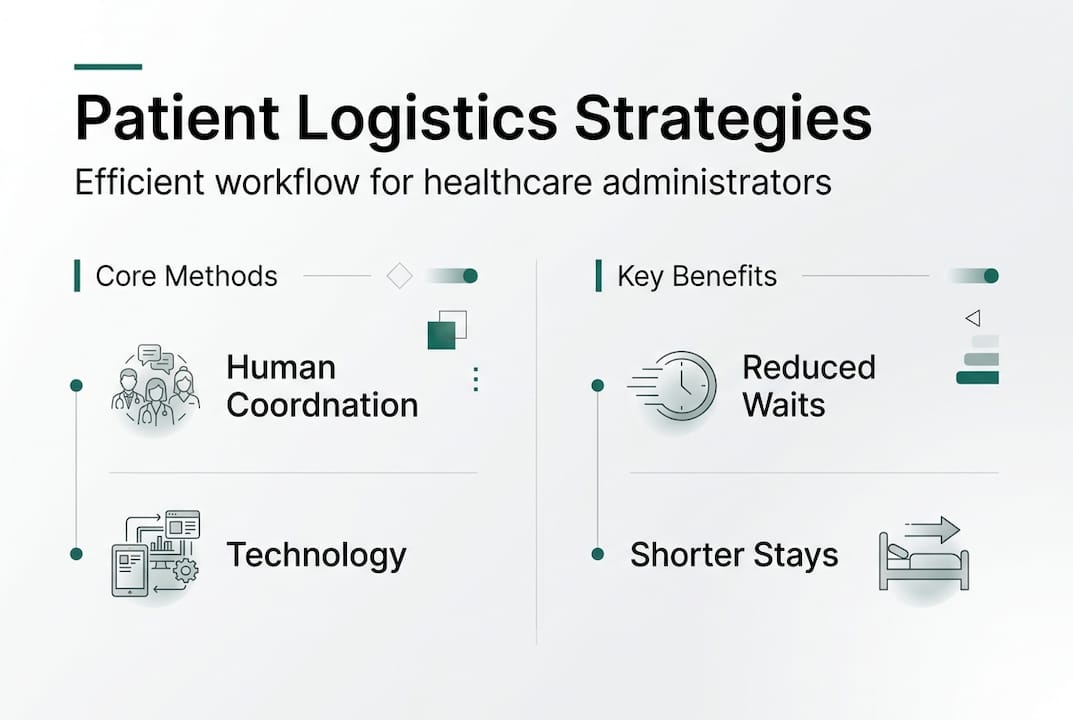
The contrast between human-managed and technology-driven logistics is significant. Human coordinators excel at handling exceptions and applying contextual judgment, but they struggle to process the volume and speed of data that modern hospital operations generate. Technology handles scale; humans handle nuance. The most effective systems combine both.

| Approach | Strengths | Limitations |
|---|---|---|
| Human coordination | Contextual judgment, exception handling | Limited scale, prone to error under volume |
| AI and automation | Speed, consistency, data processing | Requires clean data, initial setup investment |
| Hybrid model | Balances scale with judgment | Requires integration and change management |
Efforts to improve patient flow consistently show that hybrid models outperform either extreme. The goal is not to replace coordinators but to give them tools that eliminate low-value manual tasks.
Pro Tip: Before investing in new technology, audit your current data quality. AI scheduling tools are only as accurate as the data they ingest. Poor data hygiene is the most common reason logistics technology underperforms after implementation.
The connection between logistics technology and NEMT and satisfaction scores is also well established. Organizations that automate transport coordination report measurable improvements in on-time performance and patient-reported experience. Thoughtful healthcare UX design further amplifies these gains by making platforms intuitive for both coordinators and patients.
Best practices for optimizing patient logistics
Knowing the methodologies is one thing. Translating them into operational change requires a structured approach. The following steps reflect best practices for managing hospital logistics that consistently produce measurable results.
- Centralize operations: Consolidate transport coordination, bed management, and scheduling into a single command function rather than managing them across departments independently.
- Integrate systems: Connect your logistics platform with EHR systems, scheduling software, and vendor networks to eliminate manual data entry and reduce communication gaps.
- Automate vendor coordination: Use automated workflows to assign, confirm, and track transport vendors without requiring coordinator intervention for routine requests.
- Apply AI for predictive scheduling: Use historical data to anticipate demand patterns and pre-position resources before bottlenecks form.
- Monitor KPIs continuously: Track length of stay (LOS), patient wait times, no-show rates, and discharge efficiency on a real-time dashboard rather than reviewing them in weekly reports.
The data behind these practices is compelling. Organizations that implement centralized logistics command centers report significant reductions in transport-related delays and measurable improvements in bed turnover rates.
| KPI | Baseline (manual operations) | Optimized (automated operations) |
|---|---|---|
| Average patient wait time | 45-60 minutes | 15-25 minutes |
| Discharge processing time | 3-4 hours | 1.5-2 hours |
| Transport no-show rate | 18-22% | 8-11% |
| Bed turnover time | 90-120 minutes | 55-75 minutes |
Building strategies for patient flow into your operational planning cycle, rather than treating flow as a reactive concern, is what separates high-performing systems from average ones. A solid patient flow management guide can help administrators structure that planning process with clear milestones and accountability.
Pro Tip: Assign a dedicated logistics performance owner, not just a team, who is accountable for KPI trends. Distributed accountability often means no accountability. A single owner with cross-functional authority drives faster improvement cycles.
Empirical benchmarks and business impact
The business case for investing in patient logistics optimization is not theoretical. Quantitative evidence from multiple studies and health system implementations demonstrates consistent, significant returns.
Efficient patient logistics reduce hospital length of stay by 15 to 20%, cut patient wait times by 30%, and improve discharge efficiency by 12%. These are not marginal gains. A 15% reduction in LOS across a 300-bed hospital translates directly into increased capacity, reduced overtime costs, and improved throughput without adding a single bed.
The impact on emergency department (ED) overcrowding is equally significant. When inpatient bed assignment is delayed, ED patients wait longer for admission, which reduces ED capacity for new arrivals and increases diversion rates. Logistics optimization breaks this chain by accelerating the handoff between ED and inpatient units.
Key quantitative outcomes from optimized logistics programs include:
- 30% reduction in patient transport wait times through automated dispatching
- 15 to 20% decrease in hospital length of stay through coordinated discharge planning
- 12% improvement in discharge efficiency through integrated scheduling and transport coordination
- Significant cost savings from reduced overtime, lower readmission rates, and fewer transport vendor errors
Reviewing logistics efficiency case studies from comparable health systems provides administrators with realistic benchmarks for their own improvement targets. Understanding logistics as infrastructure rather than overhead reframes the investment calculus entirely.
“When patient logistics is treated as infrastructure, the return on investment becomes visible across clinical, financial, and operational dimensions simultaneously.”
Nuances, challenges, and edge cases
The benchmarks above represent what is achievable under favorable conditions. Real-world implementation is more complex, and administrators who ignore the nuances risk underperforming against their targets.
Pandemic versus non-pandemic settings present fundamentally different logistics demands. Surge capacity requirements, equity-based allocation of transport resources, and the need to isolate patient cohorts all introduce variables that standard optimization models do not account for. Organizations that built flexible logistics frameworks before 2020 adapted faster during COVID-19 surges than those operating rigid, volume-based systems.
Common challenges administrators encounter include:
- Integration complexity: Connecting logistics platforms with legacy EHR systems and third-party vendors often requires significant IT resources and extended timelines
- Data scarcity: Many organizations lack the historical data needed to train predictive models effectively, particularly for low-volume transport types
- Intra-hospital coordination: Moving patients between departments within a facility is often more chaotic than external transport, yet receives less systematic attention
- Equity gaps: Transport access disparities affect certain patient populations disproportionately, and logistics systems must be designed to surface and address these gaps
Addressing these challenges requires both technical solutions and organizational change management. Care coordination tips that focus on cross-departmental communication help bridge the human side of these gaps. A purpose-built discharge coordination platform can address the technical side by standardizing workflows across departments and vendors.
“The organizations that struggle most with logistics optimization are not those with the worst technology. They are those with the least clarity about who owns the problem.”
Approaches to optimizing healthcare UX also matter here. If coordinators find a platform difficult to use, adoption suffers and the technology investment fails to deliver its projected value.
Strategic, tactical, and operational frameworks
Effective patient logistics optimization requires decision-making at three distinct levels, each with different time horizons and priorities. Conflating these levels is a common source of planning failure.
Strategic, tactical, and operational frameworks each address different aspects of the logistics challenge:
- Strategic level: Long-term capacity planning, network design, and technology investment decisions that shape the system over a 3 to 5 year horizon
- Tactical level: Admissions planning, resource allocation, and vendor contract management that operate on a weekly to monthly cycle
- Operational level: Daily workflow management, bed turnover, real-time transport dispatching, and shift-level staffing adjustments
The methods appropriate at each level also differ. Strategic decisions benefit from simulation modeling and scenario analysis. Tactical decisions rely on historical data and demand forecasting. Operational decisions require real-time data and automated decision support.
| Framework level | Time horizon | Primary tools | Key decisions |
|---|---|---|---|
| Strategic | 3 to 5 years | Simulation, scenario modeling | Capacity, network, technology |
| Tactical | Weekly to monthly | Forecasting, analytics | Resource allocation, vendor management |
| Operational | Daily to real-time | Dashboards, AI dispatching | Bed assignment, transport routing |
Human coordinators remain essential at the operational level, where exceptions and edge cases require judgment. Technology handles the volume and speed that humans cannot. At the strategic level, the roles reverse: human leaders set direction, and technology provides the analytical foundation for those decisions.
Treating patient logistics as infrastructure means investing at all three levels simultaneously rather than focusing exclusively on operational fixes. Administrators who understand the patient logistics fundamentals at each planning level make more coherent investment decisions and achieve more durable results.
Next steps: Implementing logistics solutions for your organization
The frameworks, benchmarks, and best practices outlined in this article provide a clear roadmap, but translating strategy into operational reality requires the right platform and the right partner. Organizations that have moved from fragmented, manual logistics to integrated, automated systems consistently report faster time-to-value when they start with a clear understanding of their current state and a platform built specifically for healthcare logistics complexity.
VectorCare is purpose-built for exactly this challenge. Whether your organization is looking to deepen its patient logistics knowledge, identify specific logistics efficiency solutions, or deploy a fully integrated platform across transport, home health, and durable medical equipment coordination, the VectorCare platform provides the automation, real-time visibility, and AI-driven dispatching that modern healthcare logistics demands. The path from operational inefficiency to measurable, sustained improvement starts with a single, well-informed decision.
Frequently asked questions
What are the main components of patient logistics?
Patient logistics includes transport, flow management, scheduling, and coordinating related resources to ensure patients receive timely, well-sequenced care across the continuum.
How does advanced technology improve patient logistics?
AI-driven scheduling and real-time dashboards centralize operations, automate routine coordination tasks, and cut wait times by 30%, freeing coordinators to focus on exceptions and complex cases.
What KPIs matter most for measuring logistics efficiency?
The most actionable KPIs are length of stay, patient wait times, no-show rates, and discharge efficiency, all of which directly reflect logistics performance and can be tracked in real time with the right platform.
How do pandemics affect patient logistics?
Pandemic settings introduce surge capacity demands, equity-based allocation requirements, and data gaps that standard logistics models are not designed to handle, making flexible, scalable frameworks essential.
Are there proven quantitative benefits to optimizing patient logistics?
Yes. Studies consistently show that hospital length of stay can be reduced by 15 to 20% and discharge efficiency improved by 12% through coordinated logistics optimization programs.
Recommended
- Why Hospital Executives Should Treat Patient Logistics as Infrastructure | VectorCare | VectorCare
- The Hidden Cost of Discharge Delays: Why Patient Logistics Is the Bottleneck Nobody’s Measuring | VectorCare
- Change Management Guide for Patient Logistics Technology | VectorCare | VectorCare
- Maximizing Efficiencies Through Better Patient Logistics | VectorCare