Optimize AHCCCS non-emergency transportation in 2026
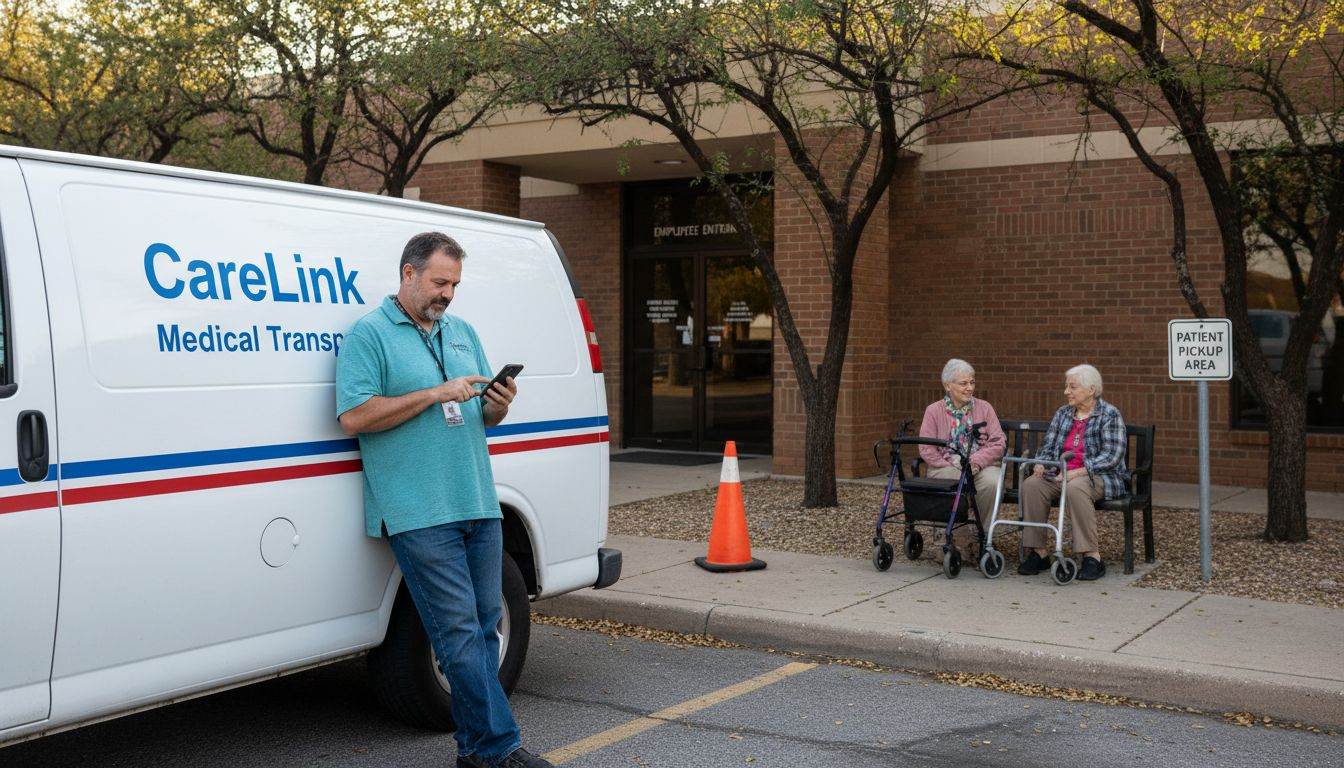
Managing AHCCCS non-emergency transportation (NEMT) for Medicaid patients presents unique challenges. Between stringent scheduling rules, complex provider certification requirements, and evolving compliance mandates, healthcare administrators face constant operational pressure. This guide breaks down Policy 310-BB requirements, provider standards, and proven optimization strategies to help you improve patient access while maintaining regulatory compliance and controlling costs.
Table of Contents
- Introduction To AHCCCS Non-Emergency Transportation
- AHCCCS NEMT Policy And Regulatory Compliance
- Scheduling And Advance Notice Requirements
- NEMT Provider Enrollment And Certification Standards
- Distinctions Between Emergency And Non-Emergency Transportation
- Operational Challenges And Risk Management In NEMT Services
- Technology-Enabled Optimization Of Medicaid Transportation Logistics
- Common Misconceptions About AHCCCS NEMT
- Conclusion And Best Practice Recommendations
- Enhance Your AHCCCS NEMT Operations With VectorCare Solutions
- Frequently Asked Questions About AHCCCS Non-Emergency Transportation
Key takeaways
| Point | Details |
|---|---|
| Policy 310-BB defines coverage | AHCCCS Policy 310-BB establishes NEMT rules, prior authorization requirements, and service exclusions for Medicaid transportation. |
| 72-hour advance scheduling required | Non-emergency rides must be requested at least 72 hours before appointments, with limited same-day exceptions. |
| Provider Type 28 certification mandatory | NEMT providers must meet strict licensing, training, and documentation standards including CPR, First Aid, and HIPAA compliance. |
| Technology optimizes operations | AI-driven scheduling and vendor management platforms reduce no-shows, control costs, and ensure compliance. |
| Common misconceptions create risk | Confusing emergency with non-emergency transport or assuming guaranteed same-day rides leads to claim denials. |
Introduction to AHCCCS non-emergency transportation
AHCCCS NEMT provides medically necessary ground transportation for Medicaid members who need rides to appointments, dialysis sessions, or pharmacy visits. This service differs fundamentally from emergency transportation, which involves life-saving interventions requiring no prior authorization.
AHCCCS Policy 310-BB defines coverage and regulatory requirements for both emergency and medically necessary non-emergency transportation services for Medicaid members. The policy specifies service provider responsibilities and member eligibility criteria that administrators must understand.
Key coverage elements include:
- Rides to medical appointments, therapy sessions, and dialysis treatments
- Transportation to pharmacies for medication pickup when specific distance criteria are met
- Ground ambulance services for non-emergency medical transfers
- Exclusions for community programs, social events, and non-medical trips
Members must qualify under AHCCCS program guidelines to access NEMT services. Coverage extends only to medically necessary transportation where other options are unavailable or unsuitable for the member’s condition.
Understanding these foundational distinctions helps administrators avoid costly misclassifications. Emergency transportation addresses immediate life threats with advanced equipment. Non-emergency transportation serves scheduled medical needs through planned logistics.
The policy framework balances patient access with resource stewardship. You must verify member eligibility, confirm medical necessity, and ensure proper authorization before arranging transportation. Complete AHCCCS NEMT policy details provide comprehensive guidance on coverage boundaries and compliance obligations.
AHCCCS NEMT policy and regulatory compliance
Navigating AHCCCS Policy 310-BB requires attention to specific authorization rules, coverage limitations, and documentation standards. The policy underwent significant updates in 2022 that continue to shape operational requirements in 2026.
Policy 310-BB outlines prior authorization rules, coverage exclusions, and documentation requirements for non-emergency transportation. These mandates protect program integrity while ensuring appropriate service delivery.
Critical policy requirements include:
- Prior authorization for all non-emergency transportation services
- Member signature collection on daily trip reports since mid-2022
- Exclusion of transportation for community programs and non-medical activities
- Strict documentation standards for billing and reimbursement
- Regular compliance auditing and provider performance monitoring
The member signature requirement strengthens accountability. Drivers must obtain signatures confirming trip completion, creating an audit trail that prevents fraudulent billing. This documentation protects both providers and the AHCCCS program from waste.
Recent policy revisions tightened coverage boundaries. Transportation to community events, social gatherings, or convenience trips falls outside NEMT scope. Only medically necessary rides qualify for reimbursement.
Non-compliance consequences affect your operations directly:
- Transport authorization denials delay patient care
- Missing documentation triggers payment rejections
- Repeated violations jeopardize provider enrollment status
- Audit findings require corrective action plans
Staying current with policy updates requires systematic monitoring. Subscribe to AHCCCS provider bulletins, attend training sessions, and implement internal compliance reviews. Your team must understand not just what the policy requires, but why these safeguards exist.
Pro Tip: Create a compliance checklist based on Policy 310-BB requirements. Review it monthly with your scheduling and billing teams to catch gaps before they become denials.
Integrate NEMT fraud prevention strategies into your operational workflows. Proper authorization, complete documentation, and accurate billing protect your organization while serving members effectively.
Scheduling and advance notice requirements
The 72-hour advance scheduling rule shapes every aspect of AHCCCS NEMT operations. This requirement balances resource availability with patient access, but creates planning challenges for providers and members.
AHCCCS requires that NEMT rides be scheduled at least 72 hours in advance, with exceptions being limited and strictly governed. This policy ensures adequate vehicle and driver availability while preventing last-minute scheduling conflicts.
Understanding scheduling rules prevents access failures:
- Standard medical appointments require 72-hour advance notice
- Pharmacy trips follow special mileage and distance criteria
- Same-day requests face high denial rates due to resource constraints
- Recurring appointments (dialysis, chemotherapy) benefit from standing orders
- Schedule changes must follow the same advance notice protocols
The pharmacy exception addresses urgent medication needs. Members can request pharmacy transportation with less advance notice if the trip meets specific distance requirements and medication necessity criteria. However, these exceptions represent a small fraction of total NEMT trips.
Same-day ride availability remains severely limited. Providers often lack capacity to accommodate last-minute requests, especially in rural areas or during peak demand periods. Members relying on same-day service frequently face denials or significant delays.
Effective advance scheduling improves patient outcomes. When members receive confirmed transportation 72 hours before appointments, they attend more reliably. This reduces no-shows, optimizes provider schedules, and ensures continuity of care.
Your scheduling system must enforce these timeframes automatically. Manual processes create gaps where non-compliant requests slip through, leading to service failures and member dissatisfaction.
Pro Tip: Implement automated reminders at 72 hours before appointments. Contact members to confirm rides and address any scheduling conflicts before they become cancellations.
Integrating patient scheduling best practices with AHCCCS requirements creates smoother workflows. Technology-enabled scheduling reduces errors while maintaining compliance with AHCCCS NEMT advance scheduling rules.
NEMT provider enrollment and certification standards
AHCCCS maintains rigorous standards for NEMT providers under Provider Type 28 classification. These requirements ensure qualified, compliant organizations deliver safe transportation services to vulnerable populations.
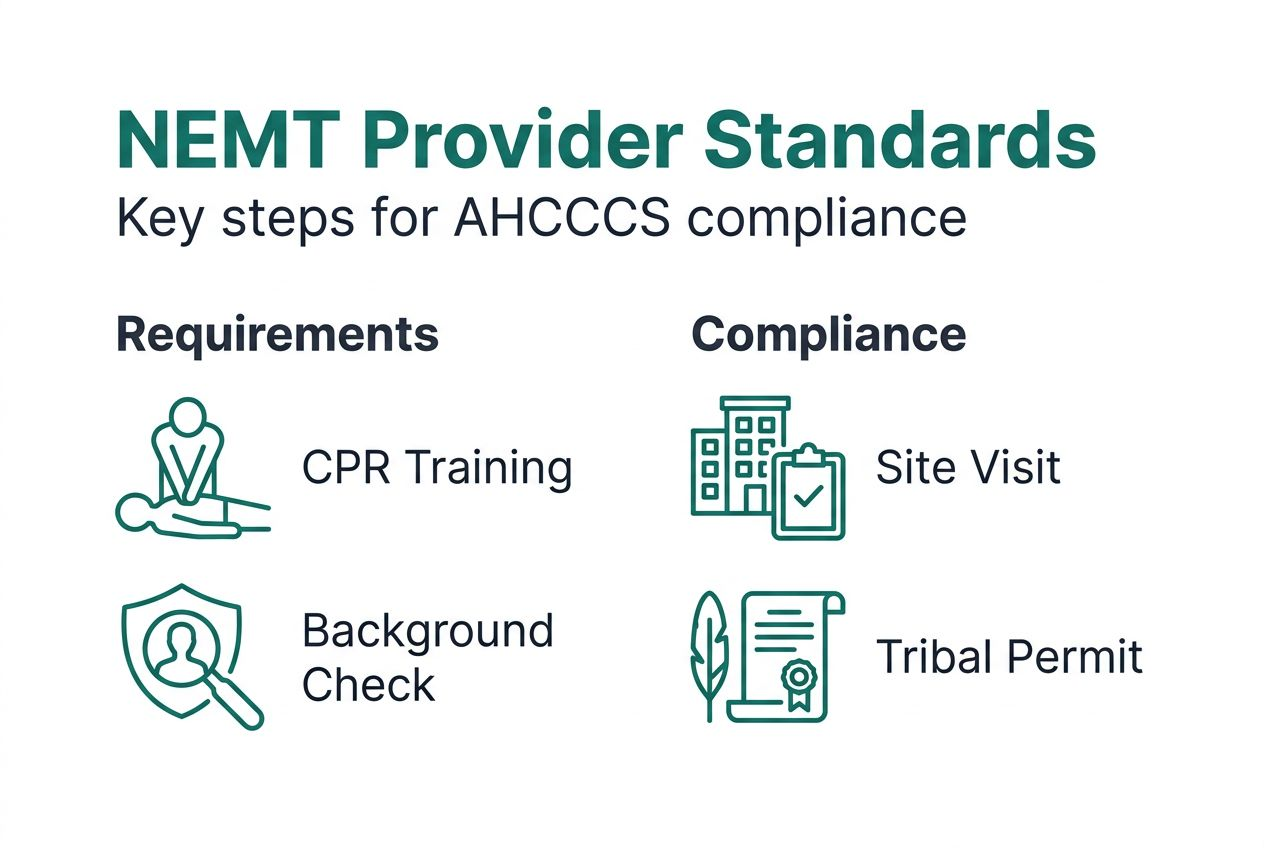
AHCCCS requires NEMT providers to comply with enrollment criteria including CPR and First Aid training, HIPAA certification, ADOT permits, and tribal business licenses if operating on tribal lands. These standards protect member safety while establishing professional service baselines.
Provider certification involves multiple steps:
- Submit Provider Type 28 enrollment application with complete documentation
- Obtain Arizona Department of Transportation Vehicle for Hire permits
- Complete mandatory CPR and First Aid certification for all drivers
- Demonstrate HIPAA compliance through staff training and privacy protocols
- Secure tribal business licenses when serving members on tribal lands
- Pass initial and ongoing compliance site visits
Driver qualifications extend beyond basic licensing. Every driver must maintain current CPR and First Aid certifications, demonstrating competency in emergency response. HIPAA training protects member privacy during transportation.
Vehicle requirements address safety and accessibility:
- Valid ADOT Vehicle for Hire permits for all transport vehicles
- Proper insurance coverage meeting AHCCCS minimum standards
- Wheelchair accessibility for members requiring mobility assistance
- Regular maintenance and safety inspections
Tribal land operations require additional authorization. Providers serving members on tribal lands must obtain business licenses from each relevant tribal government. Operating without proper tribal authorization violates both AHCCCS policy and tribal sovereignty.
AHCCCS conducts regular site visits to verify ongoing compliance. These audits examine driver certifications, vehicle conditions, documentation practices, and operational protocols. Deficiencies require corrective action within specified timeframes.
Pro Tip: Create a certification tracking system that alerts you 60 days before any license, permit, or training expires. This prevents service interruptions from lapsed credentials.
Maintaining Provider Type 28 status demands continuous attention to compliance. Your administrative systems must track multiple certifications, renewals, and documentation requirements simultaneously. NEMT provider compliance best practices help organizations manage these complex obligations effectively.
Review Provider Type 28 enrollment requirements annually to ensure your organization meets current standards.
Distinctions between emergency and non-emergency transportation
Confusing emergency and non-emergency transportation creates compliance problems and service delivery failures. AHCCCS defines these categories differently, with distinct operational protocols and billing procedures.
Emergency transportation requires no prior authorization and covers advanced life support, whereas non-emergency transportation must be medically necessary and prior authorized. Understanding these boundaries prevents costly misclassifications.
| Feature | Emergency Transportation | Non-Emergency Transportation |
|---|---|---|
| Authorization | None required | Prior authorization mandatory |
| Medical necessity | Life-threatening conditions | Scheduled medical appointments |
| Equipment | Advanced life support | Basic ground transport |
| Advance notice | Immediate response | 72-hour minimum |
| Billing codes | Emergency ambulance codes | NEMT service codes |
| Provider requirements | Paramedic certification | Provider Type 28 enrollment |
Emergency transportation addresses immediate life threats. Cardiac arrests, severe trauma, stroke symptoms, and other critical conditions require advanced medical equipment and paramedic intervention. These services operate under different regulatory frameworks.
Non-emergency transportation serves scheduled medical needs. Dialysis appointments, physical therapy sessions, routine specialist visits, and pharmacy trips fall into this category. The transportation itself provides no medical intervention beyond basic assistance.
Using the wrong service classification triggers claim denials. Billing emergency codes for scheduled appointments violates policy and may constitute fraud. Conversely, attempting to use NEMT for urgent medical situations delays critical care.
Operational protocols differ substantially. Emergency medical services maintain constant readiness with specialized equipment and immediate dispatch capabilities. NEMT providers focus on efficient scheduling, timely pickups, and comfortable transportation.
Your staff must recognize these distinctions during intake and scheduling. When members contact you for transportation, assess whether their situation involves immediate medical threats or scheduled care needs. Route emergency situations to 911 and appropriate emergency services.
Pro Tip: Train intake staff to ask specific questions that identify emergency situations: “Are you experiencing chest pain, difficulty breathing, or other symptoms requiring immediate medical attention?” Clear protocols prevent dangerous delays.
Implementing correct NEMT billing and authorization processes protects your organization from compliance violations. Review emergency vs non-emergency transport distinctions regularly with your team.
Operational challenges and risk management in NEMT services
AHCCCS NEMT operations face persistent logistical obstacles that affect service quality and compliance. Understanding these challenges helps you develop effective mitigation strategies.

Same-day transportation availability creates the most frequent access problems. Members requesting rides with insufficient advance notice often face denials, missed appointments, and care disruptions. Provider capacity rarely accommodates last-minute scheduling.
AHCCCS encourages using public transportation where available to reduce reliance on specialized fleets and control costs. Bus passes and transit vouchers offer cost-effective alternatives for members who can navigate public systems independently.
Key operational challenges include:
- Limited same-day ride capacity leading to appointment cancellations
- Rural service areas with sparse provider networks
- Weather events disrupting scheduled transportation
- Member no-shows wasting allocated resources
- Documentation gaps creating billing complications
Risk management starts with proper documentation. Collecting member signatures daily ensures documentation integrity and compliance. These signatures verify trip completion, confirm member identity, and create audit trails preventing fraudulent claims.
Payment denials result from incomplete compliance measures. Missing prior authorizations, unsigned trip reports, or inadequate medical necessity documentation trigger automatic rejections. Your billing team must verify every element before claim submission.
Vendor accountability requires systematic monitoring. Track provider performance metrics including on-time pickup rates, member satisfaction scores, vehicle condition reports, and compliance audit results. Underperforming vendors compromise service quality.
Resource allocation demands careful balancing. You must maintain sufficient capacity for predictable demand while avoiding excess overhead during low-utilization periods. Seasonal patterns, recurring appointments, and geographic service areas all influence capacity planning.
Public transportation integration reduces costs where viable. Members capable of using bus or light rail systems benefit from increased independence while freeing specialized NEMT resources for members with mobility limitations or complex medical needs.
Pro Tip: Develop contingency protocols for weather disruptions, vehicle breakdowns, and other service interruptions. Having backup providers and clear communication procedures minimizes appointment impacts.
Address NEMT operational challenges and compliance through systematic process improvements. Regular staff training, technology adoption, and vendor management strengthen operational resilience.
Technology-enabled optimization of Medicaid transportation logistics
Digital platforms transform AHCCCS NEMT operations from manual coordination challenges into streamlined, compliant workflows. Modern healthcare logistics technology addresses scheduling accuracy, vendor management, compliance tracking, and cost control simultaneously.
AI-driven dispatching and real-time communication technologies improve NEMT service efficiency, reduce no-shows, and help maintain regulatory compliance while cutting costs. These systems automate complex scheduling rules and optimize resource allocation.
Technology benefits span multiple operational areas:
- Automated enforcement of 72-hour AHCCCS scheduling requirements
- Real-time GPS tracking providing accurate pickup and arrival estimates
- Digital signature capture for immediate trip documentation
- Vendor performance dashboards monitoring compliance metrics
- Integrated billing systems reducing documentation errors
Automated scheduling eliminates manual calculation errors. The system validates advance notice requirements, checks member eligibility, confirms provider certification, and flags potential compliance issues before booking confirmation. This prevents problems rather than correcting them after failures occur.
Real-time updates revolutionize communication. Members receive automated appointment reminders, pickup notifications, and driver arrival alerts. Providers track vehicle locations, monitor route progress, and respond quickly to delays. This transparency reduces no-shows and improves satisfaction.
Vendor management modules centralize compliance tracking. Monitor driver certifications, vehicle permits, insurance expiration dates, and tribal business licenses through unified dashboards. Automated alerts notify you when renewals approach, preventing service interruptions.
AI optimization reduces operational costs substantially. Intelligent routing algorithms minimize drive time, consolidate compatible trips, and balance workload across your fleet. These efficiencies translate directly to lower per-trip costs and increased capacity.
Compliance auditing becomes systematic with digital documentation. Electronic trip reports, digital signatures, and automated data validation create comprehensive audit trails. When AHCCCS reviews your operations, complete documentation demonstrates compliance effortlessly.
Data-driven decision making replaces guesswork. Analyze no-show patterns, identify high-demand time slots, evaluate vendor performance trends, and optimize resource deployment based on actual utilization data. These insights drive continuous operational improvements.
Pro Tip: Implement technology gradually, starting with scheduling automation and digital documentation. Once staff adapts to these foundational tools, expand to advanced analytics and AI optimization.
Explore how technology benefits NEMT operations and discover modern healthcare dispatching approaches. Technology also helps with reducing delays throughout healthcare operations. Learn more about automation in healthcare logistics.
Common misconceptions about AHCCCS NEMT
Misunderstandings about AHCCCS NEMT rules create operational problems and compliance risks. Correcting these misconceptions helps administrators avoid costly mistakes.
Major misconceptions include confusing emergency and non-emergency transport, assuming guaranteed same-day NEMT rides, and overlooking strict provider certification standards. These errors lead to service failures and reimbursement denials.
Frequent misconceptions include:
- Believing emergency and non-emergency transportation use identical authorization processes
- Assuming same-day ride requests receive automatic approval
- Thinking basic vehicle licensing suffices for NEMT provider enrollment
- Expecting public transportation to work for all member situations
- Believing verbal trip confirmations satisfy documentation requirements
Emergency and non-emergency transportation operate under completely different frameworks. Emergency services require no prior authorization and provide advanced medical care during transport. NEMT requires authorization, serves scheduled appointments, and provides basic assistance only.
Same-day rides face high denial rates. The 72-hour advance scheduling requirement exists because providers need adequate notice to allocate resources. Assuming same-day availability sets unrealistic member expectations and creates appointment access failures.
Provider certification involves extensive requirements beyond vehicle ownership. CPR training, First Aid certification, HIPAA compliance, ADOT permits, and potential tribal licenses all factor into Provider Type 28 enrollment. Operating without complete certification violates AHCCCS policy.
Public transportation serves some but not all members effectively. Members with severe mobility limitations, cognitive impairments, or complex medical equipment needs require specialized NEMT services. Public transit works well for ambulatory members in urban areas with robust transit systems.
Verbal confirmations lack documentation value. AHCCCS requires written member signatures on trip reports. Phone confirmations or verbal agreements provide no audit trail and offer zero protection during compliance reviews.
Awareness prevents these errors. Regular staff training, clear policy documentation, and systematic compliance checks catch misconceptions before they create problems. When team members understand the reasoning behind requirements, they apply rules correctly.
Pro Tip: Create a misconceptions reference guide for new staff. Document common errors, explain why they’re wrong, and provide correct procedures. This accelerates training and reduces compliance risks.
Address these issues through busting NEMT misconceptions and reviewing AHCCCS NEMT FAQ corrections. Understanding automation’s role in healthcare helps prevent manual process errors.
Conclusion and best practice recommendations
Effective AHCCCS NEMT management requires understanding complex policies, maintaining rigorous compliance, and implementing operational best practices. Success depends on systematic processes that balance patient access with regulatory requirements.
Adherence to AHCCCS Policy 310-BB ensures compliant service delivery. The policy defines coverage boundaries, authorization procedures, and documentation standards that protect both members and providers. Regular policy reviews keep your operations aligned with current requirements.
Best practices for optimization include:
- Enforce 72-hour scheduling protocols through automated systems
- Maintain comprehensive provider certification tracking
- Implement digital documentation with member signature capture
- Monitor vendor performance through systematic compliance audits
- Leverage technology for scheduling, routing, and resource allocation
Strict scheduling protocols reduce access failures and improve appointment attendance. When members receive confirmed transportation well in advance, care continuity improves and no-show rates decline.
Provider enrollment requires ongoing attention. Driver certifications, vehicle permits, and tribal licenses all expire on different schedules. Systematic tracking prevents lapses that interrupt service delivery.
Technology integration transforms operational efficiency. AI-driven scheduling, real-time communication, and automated compliance monitoring reduce administrative burden while improving service quality. These tools pay for themselves through reduced costs and increased capacity.
Regular staff training maintains operational excellence. Healthcare logistics evolve constantly with policy updates, technology advances, and best practice developments. Invest in continuous education to keep your team current.
Continuous monitoring safeguards against compliance lapses. Conduct internal audits quarterly, review documentation practices monthly, and address deficiencies immediately. Proactive compliance management prevents problems before AHCCCS identifies them.
Pro Tip: Schedule annual comprehensive compliance reviews that examine every aspect of your NEMT operations. External consultants provide objective assessments and identify blind spots your internal team might miss.
Success in AHCCCS NEMT requires balancing multiple priorities simultaneously. Patient access, regulatory compliance, cost control, and service quality all demand attention. Organizations that systematically address each element through clear processes and appropriate technology consistently outperform those relying on manual coordination.
Enhance your AHCCCS NEMT operations with VectorCare solutions
Optimizing AHCCCS NEMT requires more than policy knowledge. You need integrated technology that enforces compliance automatically while streamlining operations.
VectorCare offers AI-powered scheduling and dispatch tools specifically designed for AHCCCS requirements. Our platform automates 72-hour scheduling validation, tracks provider certifications, captures digital signatures, and monitors compliance metrics in real time.
Reduce no-shows through automated member reminders and real-time driver tracking. Ensure proper documentation with electronic trip reports and integrated signature capture. Monitor vendor performance through comprehensive dashboards that track on-time rates, certification status, and service quality metrics.
Our technology optimizes resource allocation using AI-driven routing that consolidates compatible trips and minimizes drive time. This improves operational efficiency while controlling per-trip costs.
Explore our comprehensive NEMT guide to understand how technology transforms operations. Learn strategies to improve patient satisfaction with NEMT solutions and compare leading healthcare transportation software options.
Frequently asked questions about AHCCCS non-emergency transportation
What authorization is required for emergency versus non-emergency transportation?
Emergency transportation addressing life-threatening conditions requires no prior authorization and uses ambulance services with advanced life support capabilities. Non-emergency transportation for scheduled medical appointments requires prior authorization through AHCCCS and uses basic ground transport without medical intervention during the ride.
How do member signature requirements affect claim processing?
AHCCCS mandates member signatures on daily trip reports to verify service completion and prevent fraudulent billing. Missing signatures trigger automatic claim denials during the billing review process. Digital signature capture systems streamline compliance while creating comprehensive audit trails that satisfy AHCCCS documentation requirements.
Can same-day ride requests be accommodated under AHCCCS rules?
Same-day NEMT requests face strict limitations and high denial rates because AHCCCS requires 72-hour advance scheduling to ensure adequate provider capacity. Limited exceptions exist for pharmacy trips meeting specific distance criteria, but most same-day requests cannot be fulfilled due to resource constraints and policy requirements.
How are NEMT provider certifications verified?
AHCCCS verifies Provider Type 28 enrollment through documentation review of CPR certifications, First Aid training, HIPAA compliance, ADOT Vehicle for Hire permits, and tribal business licenses where applicable. Regular site visits and compliance audits confirm ongoing adherence to certification standards throughout the provider’s active enrollment period.
What role does technology play in AHCCCS NEMT compliance monitoring?
Technology platforms automate scheduling rule enforcement, track certification expiration dates, capture digital documentation, and generate compliance reports that simplify auditing. AI-driven systems optimize routing, reduce no-shows through automated reminders, and provide real-time visibility into operations that helps administrators identify and address compliance gaps before they become violations.
Recommended
- 7 Ways to Lower NEMT costs for Medicare Advantage plans | VectorCare
- All About CMS’ New Dialysis Transportation Reimbursement Cuts | VectorCare
- Eliminate NEMT Fraud with VectorCare Hub | VectorCare
- Streamlining Non Emergency Patient Transport Services in 2025
- Accessible Dental Care 2026: Options For Inland Empire Families