Complete Guide to Non Emergency Ambulatory Transportation

Missed medical appointments can lead to serious health complications, yet over 3.6 million Americans delay care each year simply because they lack reliable transportation. Non-emergency ambulatory transportation steps in to bridge this gap, helping patients get to routine checkups and essential treatments safely and on time. Understanding the different types of transport services and how they operate empowers families and caregivers to make informed choices for better long-term health.
Table of Contents
- Defining Non Emergency Ambulatory Transportation
- Types of Ambulatory Transportation Services
- How Scheduling and Coordination Work
- Compliance, Safety, and Regulatory Requirements
- Cost Structures and Reimbursement Insights
Key Takeaways
| Point | Details |
|---|---|
| Importance of NEMT | Non-emergency medical transportation (NEMT) is essential for ensuring patients access necessary healthcare services when they lack transportation options. |
| Diverse Service Types | NEMT includes ambulatory vehicles, wheelchair transportation, stretcher vans, and non-emergency ambulances to cater to varying patient mobility needs. |
| Coordination and Scheduling | A structured scheduling process involving transportation brokers is crucial for efficient patient transport to medical appointments. |
| Regulatory Compliance | NEMT services must adhere to strict licensing, patient safety standards, and regulatory guidelines to ensure quality and safety. |
Defining Non Emergency Ambulatory Transportation
Non-emergency medical transportation (NEMT) is a critical healthcare service designed to help patients access medical appointments when they lack reliable transportation. According to macpac, NEMT is a required Medicaid benefit specifically created to provide transportation to and from medical appointments for enrollees who have no alternative means of getting to their healthcare provider.
Non-emergency transportation differs fundamentally from emergency medical services by focusing on planned, scheduled patient movement rather than urgent medical crisis response. This specialized transportation serves diverse patient populations who might otherwise struggle to receive essential medical care. CMS emphasizes that NEMT represents an important benefit for individuals requiring assistance reaching medical appointments.
Key characteristics of non-emergency ambulatory transportation include:
- Scheduled and pre-planned medical appointments
- Transportation for patients with mobility challenges
- Services for individuals without personal transportation
- Coordinated rides to preventive care, specialist visits, and ongoing treatment sessions
The primary goal of non-emergency ambulatory transportation is to eliminate transportation barriers that might prevent patients from accessing necessary healthcare services. By providing reliable, safe, and accessible transportation, NEMT helps ensure that patients can consistently attend medical appointments, receive timely treatments, and maintain their overall health and wellness.
Types of Ambulatory Transportation Services
Non-emergency medical transportation encompasses a diverse range of service types designed to meet varied patient mobility needs. DMAS highlights several critical transportation modes that ensure patients can access essential healthcare services, including ambulatory, wheelchair, stretcher van, and non-emergency ambulance services.
Ambulatory Transportation Services represent the most common form of non-emergency medical transport. These services are tailored for patients who can walk independently or with minimal assistance. Typical users include elderly patients, individuals with temporary mobility limitations, and those requiring routine medical appointments. The primary goal is to provide safe, reliable transportation for patients who cannot drive themselves or lack alternative transportation options.
Key types of non-emergency transportation services include:
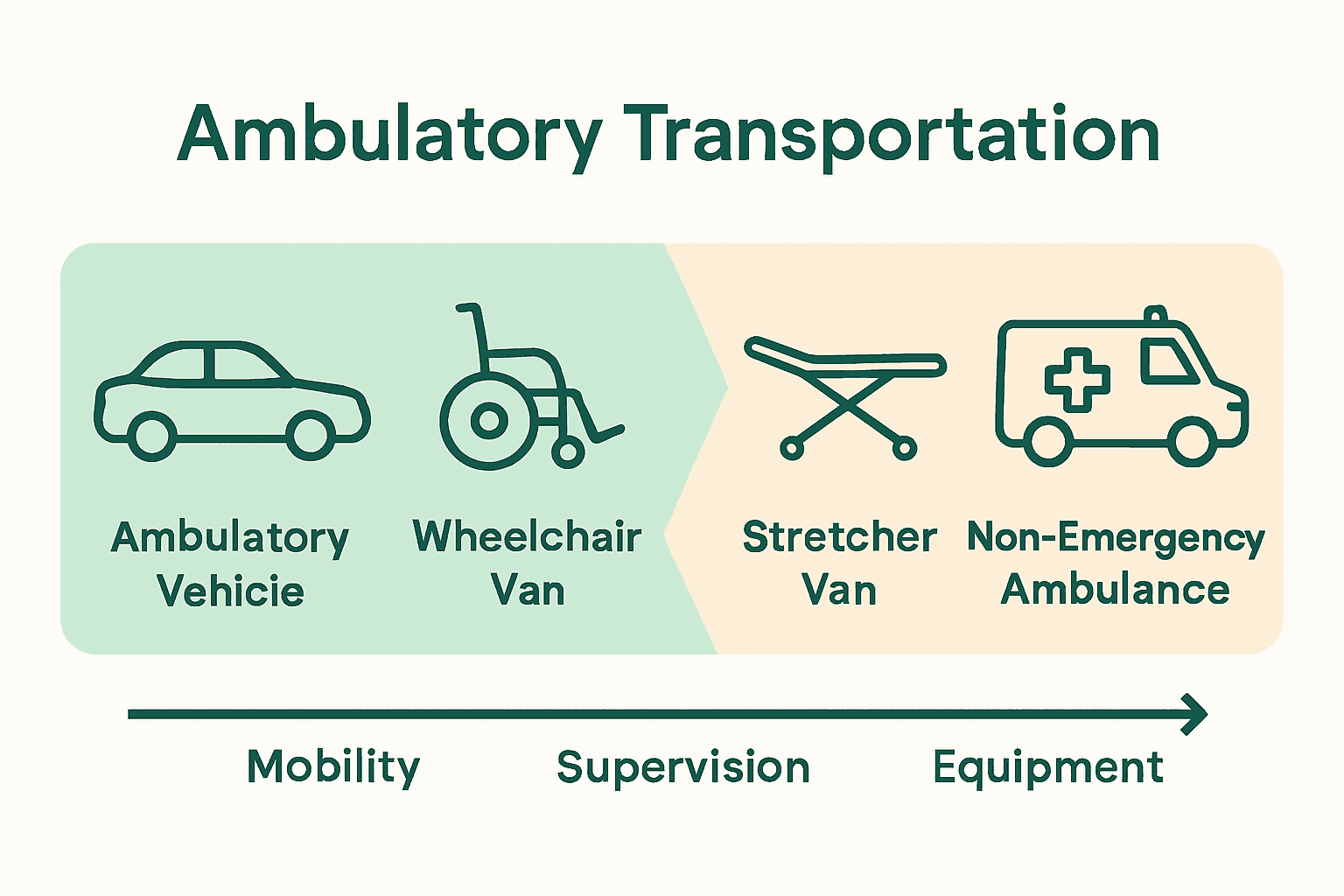
Here’s a comparison of the primary types of non-emergency medical transportation services:
| Service Type | Patient Mobility Needs | Key Features |
|---|---|---|
| Ambulatory Vehicles | Walks independently or with assistance | Standard cars For routine appointments |
| Wheelchair Transportation | Wheelchair users | Wheelchair lifts Secure restraint systems |
| Stretcher Vans | Requires horizontal transport | Stretcher-equipped Onboard staff |
| Non-Emergency Ambulance | Needs medical supervision | Medical staff Advanced equipment |
| Volunteer/Gas Reimbursement/Public Transit | Varies by patient needs | Flexible options Cost-effective choices |
- Ambulatory Vehicles: Standard vehicles for patients who can walk independently
- Wheelchair Transportation: Specialized vehicles with wheelchair lift and secure restraint systems
- Stretcher Vans: For patients requiring horizontal transportation
- Non-Emergency Ambulance: Medical transport for patients needing constant medical supervision
Beyond traditional vehicle services, DMAS also notes alternative transportation solutions such as:
- Volunteer driver programs
- Gas reimbursement options
- Public transit ticket provisions
These alternative methods ensure comprehensive coverage for patients with diverse transportation needs, addressing potential financial or logistical barriers to accessing medical care. The flexibility of these services underscores the critical role of non-emergency medical transportation in maintaining patient health and wellness across various demographic groups.

How Scheduling and Coordination Work
Non-emergency medical transportation scheduling involves a complex network of coordination between patients, healthcare providers, and transportation brokers. Maine illustrates this process by highlighting how transportation services work with local brokers to arrange rides for eligible members, ensuring patients can access necessary medical appointments.
Transportation Coordination typically follows a structured workflow designed to streamline patient movement and maximize efficiency. DMAS provides insight into this process, demonstrating how transportation brokers like ModivCare manage the entire transportation ecosystem - from member reservations to provider assignments and payment processing.
The typical scheduling process involves several key steps:
- Patient Request Initiation
- Patient or healthcare provider contacts transportation broker
- Provide necessary medical appointment details
- Verify transportation eligibility
- Trip Reservation and Verification
- Broker reviews transportation requirements
- Match patient needs with appropriate vehicle type
- Confirm pickup and drop-off logistics
- Provider Assignment
- Transportation broker allocates specific vehicle/driver
- Confirm driver credentials and vehicle readiness
- Communicate trip details to patient and provider
Key coordination components include:
- Real-time communication systems
- Comprehensive patient medical history tracking
- Adaptive scheduling algorithms
- Multilingual support capabilities
- Compliance with medical privacy regulations
The ultimate goal of this intricate coordination process is to create a seamless, reliable transportation experience that prioritizes patient comfort, safety, and timely medical access. By leveraging technology and human expertise, non-emergency medical transportation services continue to evolve, addressing the complex mobility needs of diverse patient populations.
Compliance, Safety, and Regulatory Requirements
Non-emergency medical transportation (NEMT) operates within a complex regulatory framework designed to ensure patient safety, protect healthcare rights, and maintain high-quality service standards. Law Cornell defines NEMT as a specialized prepaid ambulatory health plan service, highlighting the structured approach to transportation delivery that goes beyond simple point-to-point movement.
Regulatory Compliance encompasses multiple critical dimensions that transportation providers must navigate carefully. CMS provides comprehensive guidelines that cover essential aspects of non-emergency medical transportation, including:
- Differentiating between emergency and non-emergency transportation
- Establishing accepted transportation vehicle types
- Defining service delivery systems
- Creating driver and vehicle acceptance criteria
Key regulatory requirements for non-emergency medical transportation include:
- Licensing and Certification
- Commercial driver’s licenses
- Medical transportation certifications
- Background check requirements
- Vehicle safety inspection compliance
- Patient Protection Standards
- HIPAA privacy regulations
- Americans with Disabilities Act (ADA) accessibility guidelines
- Patient confidentiality protocols
- Informed consent documentation
- Medical Safety Protocols
- First aid and emergency response training
- Vehicle medical equipment standards
- Patient mobility assistance procedures
- Communication systems for medical emergencies
These comprehensive regulations ensure that non-emergency medical transportation remains a safe, reliable, and patient-centered service. By maintaining rigorous standards, transportation providers protect patient well-being while delivering critical healthcare access support.
Cost Structures and Reimbursement Insights
Non-emergency medical transportation (NEMT) reimbursement represents a complex financial ecosystem with multiple funding models and strategic approaches. MACPAC highlights the nuanced landscape of transportation funding, demonstrating that states utilize diverse reimbursement strategies, including fee-for-service (FFS) and mixed brokerage models.
Reimbursement Frameworks vary significantly across different healthcare systems and geographic regions. Some states, such as Michigan and Texas, have developed sophisticated hybrid approaches that blend traditional fee-for-service mechanisms with innovative brokerage systems. This flexibility allows healthcare providers to optimize transportation cost management while maintaining high-quality patient services.
Key cost structure components include:
- Fee-for-Service (FFS) Model
- Per-trip reimbursement
- State-coordinated and approved trips
- Direct payment for each transportation service
- Transparent cost tracking
- Brokerage Model
- Contracted transportation networks
- Negotiated bulk service rates
- Performance-based compensation
- Centralized management of transportation resources
- Hybrid Reimbursement Approaches
- Combination of FFS and brokerage elements
- Adaptive pricing strategies
- Risk-sharing mechanisms
- Scalable cost management
Critical factors influencing NEMT cost structures encompass:
- Patient distance and travel complexity
- Vehicle type and accessibility requirements
- Regional transportation infrastructure
- Medicaid and Medicare regulatory guidelines
- Individual state healthcare policies
CMS emphasizes the importance of understanding comprehensive transportation service delivery systems, which directly impact cost considerations and reimbursement strategies. By implementing sophisticated, data-driven approaches, healthcare systems can optimize non-emergency medical transportation while maintaining financial efficiency and patient care quality.
Streamline Your Non Emergency Ambulatory Transportation with VectorCare
Navigating the complex world of non emergency medical transportation requires precision and reliability. Patients face obstacles like scheduling challenges, coordination gaps, and strict regulatory standards that can delay care and add stress. VectorCare understands these pain points and offers a comprehensive digital platform that automates scheduling, optimizes vendor management, and ensures compliance. With real-time updates and AI-driven dispatching, your organization can reduce delays and improve patient outcomes while managing ambulatory, wheelchair, and stretcher transportation efficiently.
Ready to transform your non emergency medical transportation process? Discover how VectorCare’s platform can simplify patient logistics, cut operational costs, and support seamless coordination across providers and payers. Act now to enhance your transportation services and ensure every patient arrives on time and safely. Visit VectorCare to learn more and request a demo.
Explore our comprehensive solutions and see how healthcare organizations are leveraging modern technology to meet evolving transportation needs.
Frequently Asked Questions
What is non-emergency medical transportation (NEMT)?
Non-emergency medical transportation (NEMT) is a Medicaid benefit that helps patients access medical appointments by providing transportation when they lack alternatives. It focuses on scheduled, planned trips rather than emergency medical services.
What types of services are included in non-emergency ambulatory transportation?
Non-emergency ambulatory transportation includes various service types such as ambulatory vehicles for independent patients, wheelchair transportation for wheelchair users, stretcher vans for horizontal transportation, and non-emergency ambulances for patients needing medical supervision.
How do I schedule non-emergency medical transportation?
To schedule non-emergency medical transportation, patients or healthcare providers must contact a transportation broker, provide appointment details, verify eligibility, and then follow a structured process for trip reservation and assignment.
What are the regulatory requirements for NEMT providers?
NEMT providers must comply with several regulatory requirements, including licensing and certification for drivers, adherence to patient protection standards like HIPAA, and implementation of medical safety protocols to ensure safe and reliable transportation.