Medical transportation best practices for administrators 2026

Healthcare administrators face mounting pressure as transportation issues cause 25% of missed clinic appointments, driving up system costs and compromising patient outcomes. Non-emergency medical transportation (NEMT) services represent a critical yet often mismanaged component of care delivery. This guide provides evidence-backed best practices to help you optimize medical transportation operations, ensure regulatory compliance, and improve patient satisfaction in 2026.
Table of Contents
- Understanding The Problem: Challenges In Medical Transportation
- Preparation: Regulatory Compliance And Vehicle Standards
- Execution: Optimizing Patient Flow And Transportation Logistics
- Verification: Monitoring Performance, Compliance, And Continuous Improvement
- Empower Your Medical Transportation With VectorCare Solutions
- FAQ
Key takeaways
| Point | Details |
|---|---|
| NEMT reduces missed appointments | Strategic transportation services significantly improve patient access and satisfaction scores |
| Compliance protects revenue | Federal and state regulation adherence prevents costly penalties and maintains reimbursement eligibility |
| Technology optimizes operations | Advanced scheduling and routing systems reduce costs while improving resource utilization |
| Monitoring ensures sustainability | Regular performance evaluation and compliance audits maintain operational excellence over time |
Understanding the problem: challenges in medical transportation
Patient transportation inefficiencies create cascading problems throughout healthcare systems. Missed appointments harm clinical outcomes while generating substantial waste through unused provider time and rescheduling overhead. Emergency departments face increased burden when patients lack reliable access to preventive care. These operational challenges translate directly into financial losses that strain already tight healthcare budgets.
NEMT services bridge critical gaps in care access, yet many organizations struggle to implement them effectively. Poor coordination between transportation providers and clinical teams creates scheduling conflicts. Inadequate vehicle standards compromise patient safety and comfort. Insufficient driver training leads to unprofessional interactions that damage patient transport satisfaction scores. These systemic failures prevent healthcare systems from realizing the full value of transportation investments.
Compliance failures amplify these challenges with severe financial consequences. NEMT compliance failures lead to significant financial losses through penalties, denied reimbursements, and revenue disruption. Federal and state regulators impose strict requirements on vehicle standards, driver qualifications, and documentation practices. Organizations that fail to meet these standards risk losing Medicare and Medicaid participation, which can devastate operational viability. Understanding these multifaceted challenges provides the foundation for implementing effective solutions.
Pro Tip: Conduct a baseline assessment of your current transportation challenges before implementing new practices to measure improvement accurately and identify the highest-impact opportunities.
The complexity of medical transportation creates several specific pain points:
- Coordination gaps between clinical scheduling and transportation dispatch
- Inadequate real-time communication causing delays and confusion
- Limited visibility into transportation costs and utilization patterns
- Insufficient data for evidence-based process improvements
Preparation: regulatory compliance and vehicle standards
Regulatory compliance forms the foundation of sustainable medical transportation operations. The Medicare Benefit Policy Manual outlines vehicle and crew requirements that administrators must implement to maintain reimbursement eligibility. Federal regulations establish baseline standards, while state and local jurisdictions often impose additional requirements. You must maintain current knowledge of all applicable regulations and implement robust compliance management systems.

Vehicle standards directly impact patient safety and regulatory standing. Vehicles must comply with state/local laws and contain essential emergency medical equipment appropriate to the service level provided. Ambulances require specific medical equipment, communication systems, and safety features. NEMT vehicles need handicap access accommodations including wheelchair lifts or ramps, secure restraint systems, and climate control. Regular maintenance schedules prevent mechanical failures that compromise safety and create liability exposure.
Crew qualifications and training requirements vary by service type and jurisdiction. Ambulance services require licensed emergency medical technicians or paramedics with current certifications. NEMT drivers need appropriate commercial licenses, clean driving records, and specialized training in passenger assistance and medical equipment handling. Background checks and ongoing education programs maintain professional standards. Documentation systems must track all credentials, training completions, and renewal dates to prevent lapses that trigger compliance violations.
Pro Tip: Establish a compliance calendar with automated reminders for all license renewals, equipment inspections, and training requirements to prevent costly lapses.
Implementing comprehensive compliance management requires:
- Documented policies and procedures covering all regulatory requirements
- Regular internal audits to identify and correct deficiencies proactively
- Staff training programs with competency verification and ongoing education
- Vendor management systems ensuring third-party providers meet your standards
- Incident reporting and corrective action processes for continuous improvement
Consult the non emergency transportation guide for detailed implementation frameworks. Organizations that invest in robust compliance infrastructure avoid penalties while building operational stability that supports long-term growth and quality improvement.
Execution: optimizing patient flow and transportation logistics
Effective execution transforms compliance preparation into operational excellence. Strategic solutions in patient flow logistics improve operational efficiency by coordinating transportation with clinical workflows. Scheduling systems must integrate transportation dispatch with appointment booking to ensure seamless coordination. Real-time communication between clinical staff, dispatchers, and drivers prevents delays and enables rapid response to schedule changes. This integration reduces wait times, improves resource utilization, and enhances patient experience.
Transportation logistics vary significantly based on trip characteristics. Short-haul trips within local service areas allow for dynamic routing and shared rides that maximize vehicle utilization. Long-distance NEMT requires advance scheduling and coordination with multiple stakeholders including lodging providers and out-of-network facilities. You need different operational models for routine dialysis transport versus one-time specialty consultations. Segmenting services by trip type enables targeted optimization strategies that address specific operational challenges.
Technology adoption accelerates optimization efforts across all service types. Advanced routing algorithms reduce fuel costs and travel time while increasing daily trip capacity. GPS tracking provides real-time visibility into vehicle locations and enables proactive communication with patients about arrival times. Mobile applications streamline driver workflows by automating documentation, navigation, and communication tasks. Analytics platforms aggregate operational data to identify improvement opportunities and measure the impact of process changes.
Pro Tip: Use patient demographic data to tailor transportation services for specific needs, such as providing vehicles with enhanced accessibility features for neighborhoods with aging populations.
Implement these proven optimization strategies:
- Establish service level agreements defining performance standards for pickup windows, on-time arrival rates, and communication protocols
- Deploy dynamic scheduling systems that optimize routes based on real-time traffic conditions and priority levels
- Create dedicated coordination roles responsible for managing the interface between clinical operations and transportation dispatch
- Implement patient notification systems providing automated updates about vehicle arrival times and any delays
- Develop contingency protocols for handling vehicle breakdowns, driver absences, and emergency schedule changes
The following table illustrates key performance differences between optimized and traditional transportation operations:
| Metric | Traditional Operations | Optimized Operations | Improvement |
|---|---|---|---|
| On-time pickup rate | 72% | 94% | 22 percentage points |
| Vehicle utilization | 58% | 81% | 23 percentage points |
| Cost per trip | $47 | $34 | 28% reduction |
| Patient satisfaction | 3.2/5 | 4.6/5 | 44% increase |
Learn more about maximizing efficiencies through better patient logistics to implement these strategies effectively. Organizations should also explore reducing transportation costs through evidence-based approaches that maintain quality while improving financial performance.
Verification: monitoring performance, compliance, and continuous improvement
Sustaining operational excellence requires rigorous performance monitoring and continuous improvement processes. Establish key performance indicators covering punctuality, patient satisfaction, compliance adherence, and financial efficiency. Track metrics at multiple levels including individual drivers, vehicle fleets, and overall program performance. Regular reporting cycles enable timely identification of emerging issues before they escalate into major problems. Data visualization tools help stakeholders quickly understand trends and prioritize improvement initiatives.
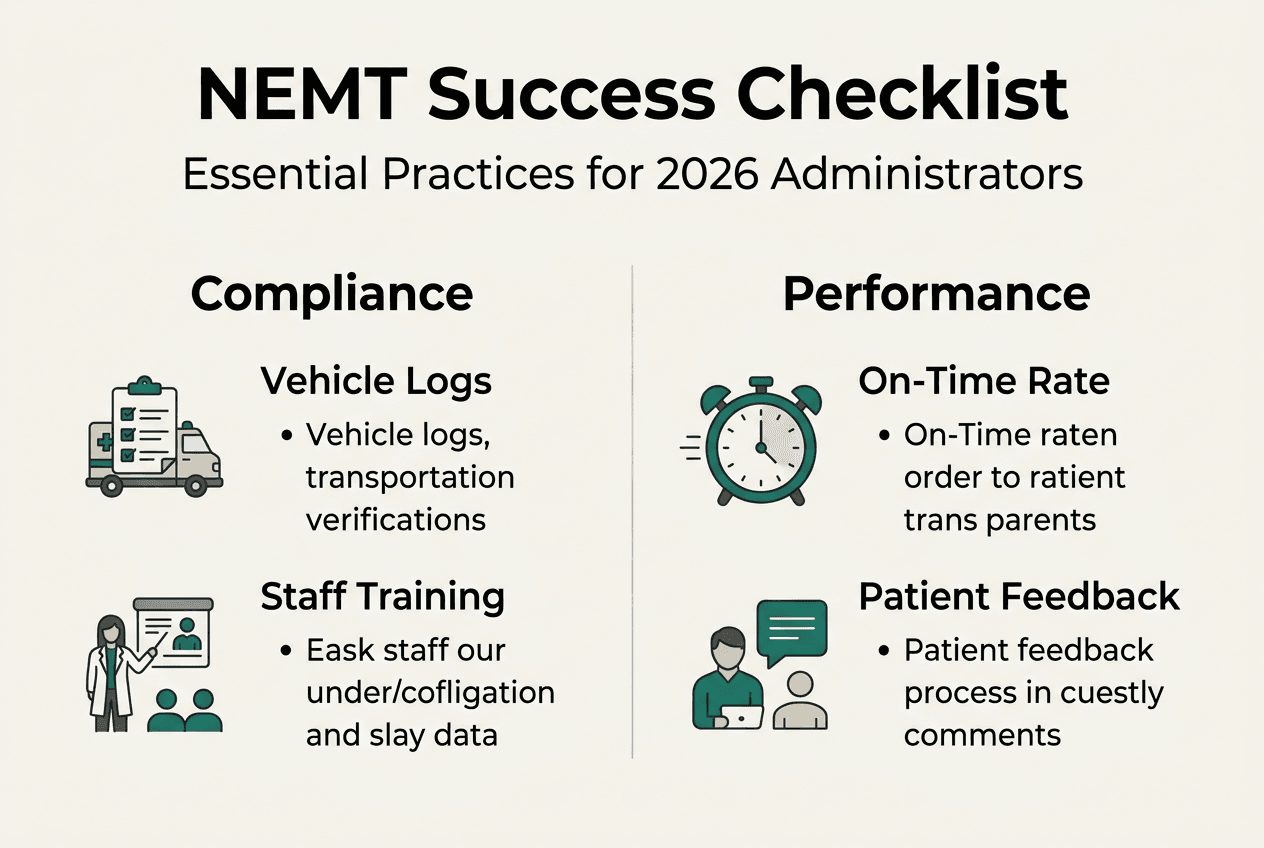
Program evaluation helps leaders use data-driven decisions to measure outcomes and refine service delivery. Conduct quarterly reviews analyzing operational data, patient feedback, and compliance audit results. Compare actual performance against targets and investigate root causes of any gaps. Engage frontline staff in problem-solving discussions to leverage their practical insights. Document lessons learned and update standard operating procedures to institutionalize improvements. This systematic approach prevents performance drift and drives continuous advancement.
Compliance monitoring protects your organization from fraud, abuse, and regulatory violations. Compliant NEMT providers achieve better financial outcomes through sustained reimbursement eligibility and reduced penalty exposure. Implement both preventive controls and detective monitoring to maintain nemt integrity across all operations. Regular audits verify adherence to documentation standards, billing practices, and service delivery requirements. Anonymous reporting channels enable staff to raise concerns without fear of retaliation.
The following comparison highlights different audit approaches:
| Audit Type | Frequency | Scope | Primary Value |
|---|---|---|---|
| Internal process audits | Monthly | Specific workflows | Early issue detection |
| External compliance audits | Annual | Full program review | Independent validation |
| Utilization reviews | Quarterly | Billing and authorization | Fraud prevention |
| Patient experience surveys | Ongoing | Service quality | Satisfaction insights |
Comprehensive monitoring systems should include:
- Real-time dashboards displaying critical operational metrics
- Automated alerts for compliance violations or performance anomalies
- Patient feedback mechanisms capturing satisfaction and service quality data
- Financial reporting tracking costs, revenues, and efficiency metrics
- Benchmarking comparisons against industry standards and peer organizations
Explore non emergency patient transport services best practices for additional verification strategies. Organizations should also ensure PCI HIPAA compliance 2026 standards are met when handling patient data through transportation systems. Sustained attention to verification activities separates high-performing programs from those that gradually deteriorate over time.
Empower your medical transportation with VectorCare solutions
Implementing these best practices requires robust technology infrastructure that many healthcare organizations struggle to build internally. VectorCare provides a comprehensive patient logistics platform specifically designed to optimize medical transportation operations. Our integrated solution addresses the challenges discussed throughout this guide by automating scheduling, enabling real-time coordination, and providing actionable analytics that drive continuous improvement.
Understanding what is patient logistics helps you recognize how VectorCare’s platform transforms fragmented processes into coordinated workflows. Our AI-driven dispatching reduces costs while improving service quality. Automated compliance tracking prevents regulatory violations. Real-time communication tools enhance coordination between clinical teams and transportation providers. Healthcare administrators across the country trust VectorCare to deliver the operational excellence and financial performance improvements detailed in this guide. Discover how maximizing efficiencies through better patient logistics becomes achievable with the right technology partner. Visit the VectorCare patient logistics platform to learn how we can support your optimization journey.
FAQ
How can healthcare administrators ensure compliance with medical transportation regulations?
Regularly review federal, state, and local ambulance and NEMT regulations to maintain current knowledge of all applicable requirements. Implement routine internal audits quarterly and engage external compliance experts annually for independent validation. Train staff comprehensively on documentation standards, vehicle requirements, and service delivery protocols with ongoing education to address regulatory updates.
What technologies improve efficiency in medical transportation scheduling?
Automated scheduling and dispatch software optimizes route planning while reducing manual coordination overhead. Real-time GPS tracking and communication tools provide visibility into vehicle locations and enable proactive patient notifications about arrival times. Data analytics platforms identify utilization patterns and improvement opportunities that drive evidence-based optimization. Learn more about patient logistics technology implementation strategies.
How does optimizing medical transportation impact patient satisfaction?
Efficient transportation directly addresses the fact that transportation is responsible for 25% of missed appointments, significantly improving access to care. Improved timeliness and reliability build patient trust in the healthcare system and reduce stress associated with medical appointments. Enhanced communication about pickup times and any delays demonstrates respect for patient time and contributes to higher patient satisfaction scores.
What key performance indicators should administrators track for medical transportation?
Track on-time pickup and arrival rates to measure reliability and identify scheduling inefficiencies. Monitor cost per trip and vehicle utilization rates to assess financial performance and resource optimization. Measure patient satisfaction through surveys and complaint rates to understand service quality from the user perspective. Review compliance audit findings and incident reports to maintain regulatory adherence and safety standards.
Recommended
- 7 Ways to Lower NEMT costs for Medicare Advantage plans | VectorCare
- All About CMS’ New Dialysis Transportation Reimbursement Cuts | VectorCare
- Maximizing Efficiencies Through Better Patient Logistics | VectorCare
- Eliminate NEMT Fraud with VectorCare Hub | VectorCare
- PCI HIPAA Compliance – Avoiding Costly Mistakes in 2026
- Handicap Approach - Objectif PN