Medicaid Transport 2026: Cut Costs 15% & Speed Scheduling 30%

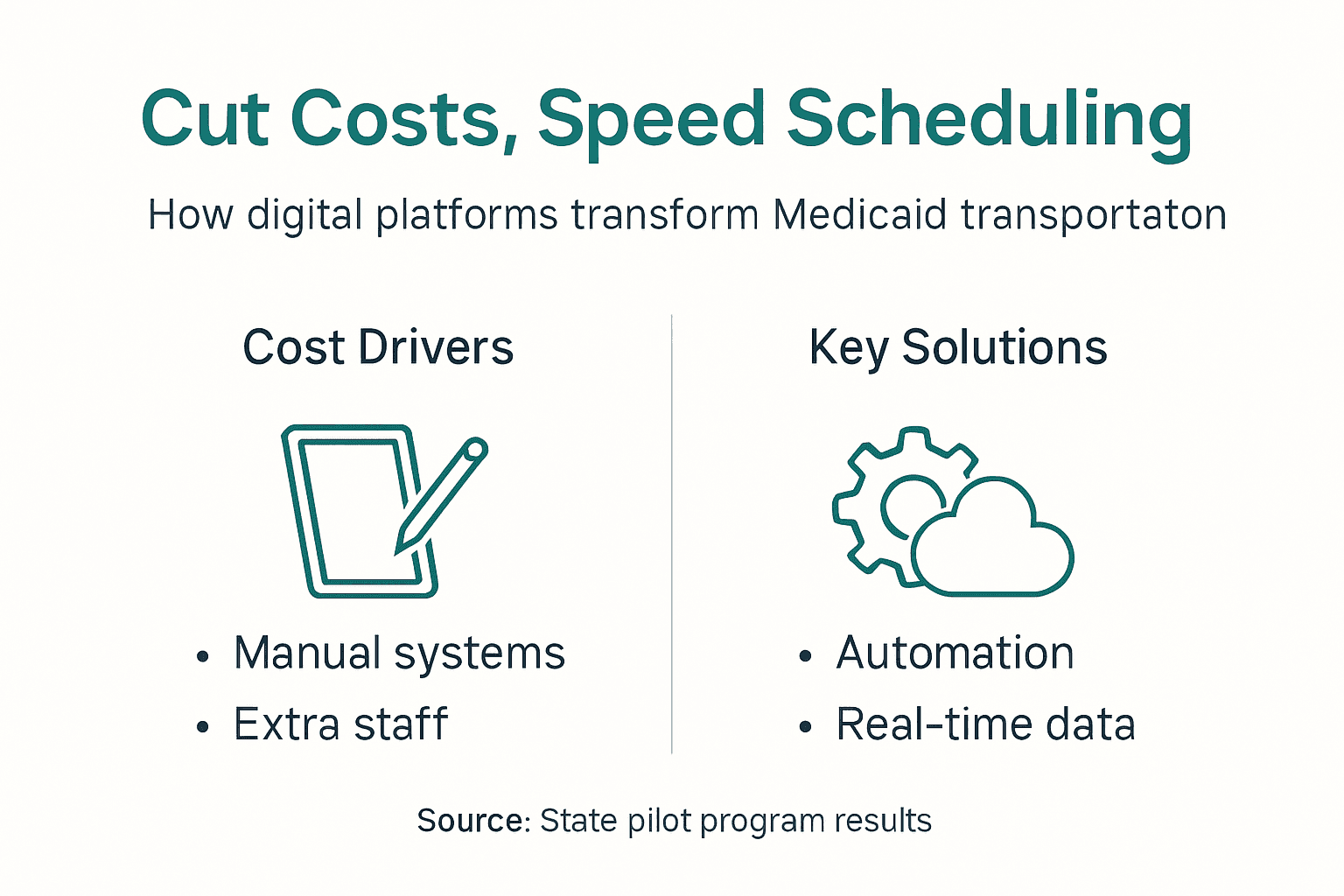
Medicaid transportation programs face a silent crisis: fragmented vendor networks, manual scheduling bottlenecks, and compliance complexity drain budgets by 15% to 25% annually. Yet digital coordination platforms have cut costs by 15% and sped scheduling by 30% in pilot programs nationwide. This article reveals how healthcare administrators can eliminate inefficiencies, strengthen compliance, and transform Medicaid Non-Emergency Medical Transportation (NEMT) operations through integrated patient logistics technology in 2026.
Table of Contents
- Understanding Medicaid Transportation and NEMT Requirements
- Regulatory Compliance Essentials for Medicaid Transportation
- Operational Challenges in Medicaid Transportation Management
- Leveraging Digital Platforms for Medicaid Transportation Coordination
- Cost and Delay Reduction Strategies in Medicaid Transportation
- Common Misconceptions and Corrections About Medicaid Transportation
- Bridging Understanding to Practice: Implementing Efficient Medicaid Transportation Solutions
- Optimize Medicaid Transportation With VectorCare Solutions
- Frequently Asked Questions About Medicaid Transportation
Key Takeaways
| Point | Details |
|---|---|
| Digital automation reduces costs | Platforms cut Medicaid transportation costs by 15% and speed scheduling by 30% through workflow optimization. |
| State regulations demand tailored compliance | Federal NEMT mandates overlay diverse state rules requiring customized integration with Medicaid Management Information Systems. |
| Fragmented vendor management increases risks | Manual coordination across multiple providers creates billing errors, service gaps, and fraud vulnerabilities. |
| Real-time communication lowers no-shows | Automated patient updates and reminders reduce missed appointments by approximately 25%. |
| Integrated platforms enhance outcomes | Unified scheduling, vendor oversight, and analytics dashboards improve patient satisfaction and operational efficiency. |
Understanding Medicaid Transportation and NEMT Requirements
Medicaid transportation serves as a critical safety net ensuring beneficiaries access necessary medical care regardless of mobility barriers. Federal mandate requires all Medicaid plans to cover NEMT services for eligible beneficiaries who lack transportation to medical appointments. Understanding the program’s scope and eligibility criteria forms the foundation for effective coordination.
Non-Emergency Medical Transportation covers routine medical trips that do not require emergency response. Covered services include:
- Scheduled doctor visits, specialist consultations, and preventive care appointments
- Recurring treatments such as dialysis, physical therapy, and chemotherapy sessions
- Hospital discharge transportation and pharmacy visits for prescription pickup
- Dental and vision appointments when medically necessary
- Mental health and substance abuse treatment facility transportation
Beneficiary eligibility depends on Medicaid enrollment status combined with documented medical necessity and absence of alternative transportation. Each state administers its own NEMT program parameters within federal guidelines, creating variation in prior authorization requirements, mileage reimbursement rates, and approved vendor networks.
Trip types range from ambulatory rides in standard vehicles to wheelchair-accessible van services and stretcher transportation for patients requiring horizontal positioning. Understanding these distinctions helps administrators allocate resources efficiently and match patients with appropriate service levels. Proper classification also prevents NEMT fraud through accurate service documentation and billing.
Grasping program fundamentals allows healthcare operations teams to build effective coordination systems that serve patient needs while maintaining regulatory compliance and cost efficiency.
Regulatory Compliance Essentials for Medicaid Transportation
Navigating Medicaid transportation compliance requires simultaneous attention to federal standards and state-specific regulations that govern program operations, vendor qualifications, and payment authorization. Missteps trigger audits, payment denials, and potential exclusion from Medicaid participation.
Federal regulations establish baseline NEMT coverage requirements under 42 CFR 431.53, mandating states ensure transportation for beneficiaries to and from medical providers. However, state Medicaid transportation rules vary significantly while federal guidelines set minimum standards, creating complexity for multi-state operators. Each jurisdiction determines:
- Prior authorization protocols and trip approval workflows
- Vendor credentialing standards including driver background checks and vehicle inspections
- Claims submission formats and documentation requirements
- Quality assurance metrics and performance reporting obligations
- Fraud prevention mechanisms and program integrity safeguards
Integration with state Medicaid Management Information Systems (MMIS) is non-negotiable for payment processing. MMIS platforms validate beneficiary eligibility, verify service authorization, and process claims according to state fee schedules. Disconnection from these systems results in payment delays or rejections regardless of service delivery quality.
Non-compliance consequences extend beyond administrative headaches. Penalties include claims recoupment for improperly documented services, exclusion from provider networks, civil monetary penalties, and potential criminal prosecution for intentional fraud. The 2026 regulatory environment emphasizes program integrity with enhanced monitoring capabilities.
Vendor oversight represents another compliance pillar. Transportation brokers and direct service providers must maintain current licenses, adequate insurance coverage, and adherence to Americans with Disabilities Act (ADA) accessibility standards. Regular audits verify continued compliance and service quality.
Successful compliance strategies balance regulatory adherence with operational efficiency through systematic documentation, staff training, and technology systems that embed compliance checkpoints within daily workflows rather than treating them as separate activities.
Operational Challenges in Medicaid Transportation Management
Medicaid transportation programs struggle with systemic inefficiencies that inflate costs, delay care access, and frustrate patients and providers alike. Identifying these pain points reveals opportunities for meaningful improvement through process redesign and technology adoption.
Fragmented vendor networks create the most persistent challenge. Many programs coordinate with dozens of independent transportation providers, each maintaining separate communication channels, scheduling systems, and billing processes. This fragmentation increases operational costs by 15% to 25% compared to consolidated vendor management approaches. Quality inconsistency across providers undermines patient experience and complicates performance monitoring.
Manual scheduling processes bottleneck operations at every stage:
- Phone-based trip requests require staff to manually verify eligibility, document trip details, and contact available vendors
- Paper-based authorization workflows delay trip approval by days rather than minutes
- Lack of real-time vehicle tracking prevents dynamic route optimization and timely patient updates
- Post-trip reconciliation involves matching paper trip logs with claims submissions, creating billing errors
Data silos compound these problems. Patient information, vendor availability, trip history, and billing records often reside in disconnected systems that prevent comprehensive visibility. Administrators cannot access real-time metrics on fleet utilization, on-time performance, or cost per trip without labor-intensive manual reporting.
Communication breakdowns between healthcare facilities, transportation coordinators, and patients generate the most visible failures. Missed appointments waste clinical capacity when patients receive insufficient trip reminders or face unexpected ride cancellations. Providers struggle to schedule follow-up appointments without confidence in transportation availability.
Operational inefficiencies create vulnerability to billing fraud and abuse. Manual claim review cannot detect sophisticated schemes like phantom trips, upcoding service levels, or excessive mileage billing at the volume typical Medicaid programs process. Technology solutions help overcome these resource management obstacles through automated validation and anomaly detection.
Pro Tip: Consolidate vendor oversight under a single digital platform with automated performance tracking. This immediately reduces coordination effort by 40% while improving service consistency.
Leveraging Digital Platforms for Medicaid Transportation Coordination
Integrated patient logistics platforms transform Medicaid transportation from reactive, manual operations into proactive, data-driven coordination systems that simultaneously improve patient outcomes and operational efficiency. Modern solutions address the core challenges plaguing traditional approaches.
Digital platforms automate scheduling workflows that previously consumed hours of staff time. Patients or healthcare staff submit trip requests through web portals or mobile apps, triggering automatic eligibility verification against MMIS databases. The system matches requests with qualified vendors based on vehicle type requirements, geographic proximity, and real-time availability. Automation reduces missed appointments by approximately 25% through timely patient notifications and ride confirmations.
Real-time communication tools eliminate the information gaps that cause service failures:
- Automated SMS and voice reminders notify patients 24 hours and 2 hours before scheduled pickups
- GPS tracking provides live vehicle location updates to patients and coordinators
- Two-way messaging allows drivers to communicate delays or address issues immediately
- Post-trip satisfaction surveys capture patient feedback for quality improvement
Vendor management capabilities centralize oversight of transportation provider networks. Digital dashboards display real-time metrics on on-time performance, patient satisfaction scores, vehicle utilization rates, and cost per trip across all vendors. Administrators identify underperforming providers quickly and redirect volume to high-quality alternatives. Credentialing workflows track license expirations, insurance renewals, and vehicle inspection due dates with automated alerts.
Analytics engines surface operational insights impossible to extract from manual records. Predictive algorithms forecast demand patterns, enabling proactive capacity planning. Route optimization reduces unnecessary mileage and trip duration. Anomaly detection flags suspicious billing patterns for investigation. These capabilities transform raw transportation data into strategic decision support.
Compliance integration ensures regulatory adherence without adding administrative burden. Systems validate trip necessity against medical appointment records, generate required documentation automatically, and submit claims to MMIS platforms in state-specific formats. Audit trails capture every action for program integrity reviews.
Implementing effective digital solutions follows a structured approach:
- Assess current state operations to quantify baseline metrics on costs, scheduling time, and patient satisfaction
- Define specific improvement goals aligned with program priorities and budget constraints
- Evaluate platform vendors on compliance capabilities, MMIS integration, vendor management tools, and user experience
- Pilot the selected platform with a subset of trips to validate functionality and train staff
- Scale deployment systematically while monitoring performance metrics and refining workflows
- Establish ongoing optimization processes that leverage platform analytics for continuous improvement
Pro Tip: Involve front-line schedulers and transportation coordinators in platform selection and testing. Their daily workflow insights ensure the chosen solution addresses real operational pain points rather than theoretical requirements.
Digital transformation in Medicaid transportation is not merely technology adoption but operational model evolution. Essential digital strategies for NEMT providers emphasize integration, automation, and data-driven decision making as foundations for sustainable improvement.
Cost and Delay Reduction Strategies in Medicaid Transportation
Reducing Medicaid transportation costs while maintaining or improving service quality demands strategic interventions across technology, processes, and vendor relationships. Quantifiable results from early adopters demonstrate significant ROI potential for healthcare organizations.
Automation of trip authorization and scheduling eliminates the largest time sink in traditional workflows. Digital platforms process trip requests in minutes rather than the hours required for manual phone-based coordination. This speed improvement of 30% in scheduling turnaround directly reduces administrative labor costs while improving patient access to timely appointments.

Scalable digital systems handle demand fluctuations without proportional cost increases. Traditional models require adding staff during peak periods, but cloud-based platforms process higher volumes through existing infrastructure. This elasticity is crucial for programs experiencing enrollment growth or seasonal variation in trip requests.
Comparison of coordination approaches reveals stark efficiency differences:
| Metric | Manual Coordination | Digital Platform Coordination |
|---|---|---|
| Average scheduling time per trip | 12-18 minutes | 3-5 minutes |
| Cost per trip processed | $8-$12 | $3-$5 |
| Billing error rate | 8-12% | 2-3% |
| On-time performance | 75-80% | 88-92% |
| Administrative staff hours per 1,000 trips | 200-300 hours | 50-80 hours |
Key cost reduction tactics healthcare administrators should prioritize:
- Consolidate vendor networks to negotiate volume discounts and reduce coordination complexity
- Implement automated payment processing to eliminate manual invoice reconciliation
- Deploy proactive patient scheduling that batches trips efficiently rather than reacting to last-minute requests
- Use route optimization algorithms to minimize mileage and vehicle hours
- Establish performance-based vendor contracts that incentivize quality and penalize failures
Pilot programs across multiple states demonstrate digital coordination achieves up to 15% cost savings through combined reductions in administrative overhead, billing errors, and optimized trip routing. The investment in digital infrastructure typically achieves payback within 18 to 24 months through operational savings.
Delay reduction improves both patient outcomes and healthcare system efficiency. Faster trip scheduling enables same-day or next-day appointments rather than week-long waits. Real-time tracking and communication reduce patient wait times at pickup locations. These improvements translate to better medication adherence, reduced emergency department utilization, and higher patient satisfaction scores.
Financial modeling for technology investment should account for both direct cost savings and indirect benefits like improved clinical outcomes and enhanced program reputation that support long-term sustainability and potential expansion.
Common Misconceptions and Corrections about Medicaid Transportation
Misunderstandings about Medicaid transportation coverage, operational requirements, and technology capabilities lead healthcare administrators to miss improvement opportunities or create compliance vulnerabilities. Clarifying these misconceptions enables evidence-based decision making.
Medicaid transportation covers routine non-emergency medical trips, not just emergency ambulance services. Many administrators incorrectly assume NEMT only applies to urgent situations or hospital discharges. In reality, the program ensures beneficiaries can access preventive care, specialist appointments, and ongoing treatment regardless of personal transportation availability. This broad coverage mandate creates the coordination complexity and volume that demands systematic solutions.
Program requirements and operational models vary significantly across states despite federal baseline standards. What works in California may not meet Texas requirements due to different prior authorization protocols, vendor credentialing standards, and MMIS integration specifications. Multi-state operators must customize compliance strategies rather than applying a one-size-fits-all approach.
Manual coordination is neither more personal nor more reliable than digital automation. Some administrators resist technology adoption believing human schedulers provide superior patient service. Evidence shows the opposite: automated systems reduce errors and improve patient satisfaction through consistent communication, timely reminders, and real-time updates that manual processes cannot match at scale.
Key misconceptions and corrections include:
- Misconception: NEMT only covers emergency or urgent medical transportation
- Reality: Coverage includes all medically necessary trips for Medicaid beneficiaries lacking alternative transportation
- Misconception: All states administer Medicaid transportation identically under federal rules
- Reality: State-specific regulations create substantial variation in requirements and operational procedures
- Misconception: Digital platforms are too complex for patients and reduce personal service quality
- Reality: Modern platforms improve patient experience through intuitive interfaces and proactive communication
- Misconception: Small transportation volumes don’t justify technology investment
- Reality: Even programs processing 500 trips monthly achieve ROI through reduced administrative time and error correction costs
- Misconception: Vendor management software increases rather than decreases oversight burden
- Reality: Centralized digital dashboards reduce coordination effort by 40% while improving performance visibility
Educating stakeholders on program realities helps build consensus for operational improvements. Clear understanding of coverage scope, regulatory requirements, and technology capabilities enables healthcare organizations to design transportation coordination systems that balance compliance, cost efficiency, and patient-centered service delivery.
Addressing misconceptions also strengthens fraud prevention. When staff understand normal operational patterns and appropriate service levels, they more readily identify anomalies that warrant investigation. This cultural foundation complements technical detection tools in maintaining program integrity.
Bridging Understanding to Practice: Implementing Efficient Medicaid Transportation Solutions
Transforming Medicaid transportation operations from understanding to implementation requires systematic planning, stakeholder engagement, and phased deployment that minimizes disruption while building toward comprehensive digital coordination.
Key selection criteria for patient logistics platforms:
- Compliance capabilities: Validate MMIS integration, state-specific regulatory support, and audit trail functionality
- Automation depth: Assess scheduling automation, eligibility verification, claims processing, and vendor notification workflows
- Vendor management tools: Evaluate credentialing tracking, performance dashboards, and quality assurance reporting
- User experience: Test interfaces for schedulers, patients, and drivers to ensure intuitive operation
- Scalability: Confirm platform can handle current volume and 3x growth without performance degradation
- Support infrastructure: Review vendor training programs, technical support availability, and implementation assistance
Implementation follows a structured sequence that builds capability incrementally:
- Baseline assessment: Document current trip volume, processing times, costs per trip, patient satisfaction, and compliance gaps to establish improvement targets
- Stakeholder engagement: Involve clinical staff, transportation coordinators, finance teams, and IT in requirements definition and solution evaluation
- Vendor selection: Issue RFP, conduct platform demonstrations, check references with similar organizations, and negotiate contracts with clear performance expectations
- Data migration and integration: Transfer existing beneficiary, provider, and vendor records to the new platform while establishing MMIS connectivity
- Pilot deployment: Launch with limited geography or patient population, validate workflows, train staff thoroughly, and gather feedback for refinement
- Scaled rollout: Expand systematically across additional service areas while monitoring performance metrics and addressing issues promptly
- Continuous optimization: Establish regular review cycles that leverage platform analytics to identify further improvement opportunities
Change management deserves explicit attention throughout implementation. Staff accustomed to manual processes may resist new workflows despite superior efficiency. Address resistance through:
- Early involvement in solution selection and testing
- Comprehensive training that emphasizes benefits to daily work rather than just technical procedures
- Quick wins that demonstrate immediate value like faster trip processing or reduced call volume
- Ongoing support channels for questions and troubleshooting
- Recognition and celebration of adoption milestones
Pro Tip: Start vendor evaluation conversations early, even 6 to 9 months before planned implementation. Selecting appropriate Medicaid transportation technology requires understanding not just features but vendor partnership quality, implementation methodology, and long-term product roadmap alignment with your program’s strategic direction.
Successful digital transformation positions Medicaid transportation programs for sustainable excellence. Integrated platforms create operational visibility, process consistency, and data-driven decision making that compound benefits over time. Organizations that invest strategically in these capabilities gain competitive advantage in value-based care models where care coordination and patient outcomes increasingly determine reimbursement and market position.
Optimize Medicaid Transportation with VectorCare Solutions
Healthcare organizations seeking to implement the strategies outlined in this article find proven solutions through VectorCare’s comprehensive patient logistics platform. Our integrated system addresses the full spectrum of Medicaid transportation coordination challenges from automated scheduling and vendor management to compliance support and advanced analytics.
VectorCare’s patient logistics platform streamlines operations through real-time coordination, AI-driven dispatching, and seamless MMIS integration tailored to state-specific requirements. Healthcare administrators reduce administrative burden by 40% while improving patient satisfaction and on-time performance. Our no-code workflow builder enables rapid customization without IT dependency.
Explore how leading Medicaid managed care organizations and regional health agencies achieve measurable improvements in cost efficiency, compliance, and patient outcomes. Visit VectorCare to schedule a platform demonstration and discuss your specific transportation coordination needs with our healthcare logistics specialists.
Frequently Asked Questions About Medicaid Transportation
Does Medicaid cover emergency and non-emergency transportation?
Medicaid covers both emergency ambulance services and non-emergency medical transportation (NEMT) for routine appointments. NEMT ensures beneficiaries access preventive care, specialist visits, dialysis, therapy, and other medically necessary services when they lack alternative transportation.
How do state regulations affect Medicaid transportation management?
State Medicaid programs implement varying rules for prior authorization, vendor credentialing, claims submission, and service documentation within federal baseline requirements. Healthcare administrators must customize compliance strategies and MMIS integration approaches for each state’s specific regulatory environment rather than applying uniform national standards.
What benefits do digital platforms bring to Medicaid transportation coordination?
Digital platforms automate scheduling workflows, provide real-time vehicle tracking and patient communication, reduce missed appointments by 25%, cut administrative costs by 15%, and support compliance through integrated MMIS connectivity. Analytics capabilities enable data-driven vendor management and continuous operational improvement.
How can providers prevent fraud in Medicaid transportation services?
Fraud prevention requires rigorous vendor credentialing with background checks, real-time GPS trip verification, automated claims validation against medical appointment records, anomaly detection algorithms that flag suspicious billing patterns, and regular audit reviews. Integrated digital platforms embed these controls within daily workflows rather than relying on manual oversight.
What timeline should organizations expect for implementing a digital transportation platform?
Typical implementations span 3 to 6 months from vendor selection through full deployment, including data migration, MMIS integration, staff training, and pilot validation. Organizations should allocate 2 to 3 months for vendor evaluation before contracting. Phased rollouts that start with limited geography or patient populations reduce risk while building staff confidence and refining workflows before system-wide adoption.