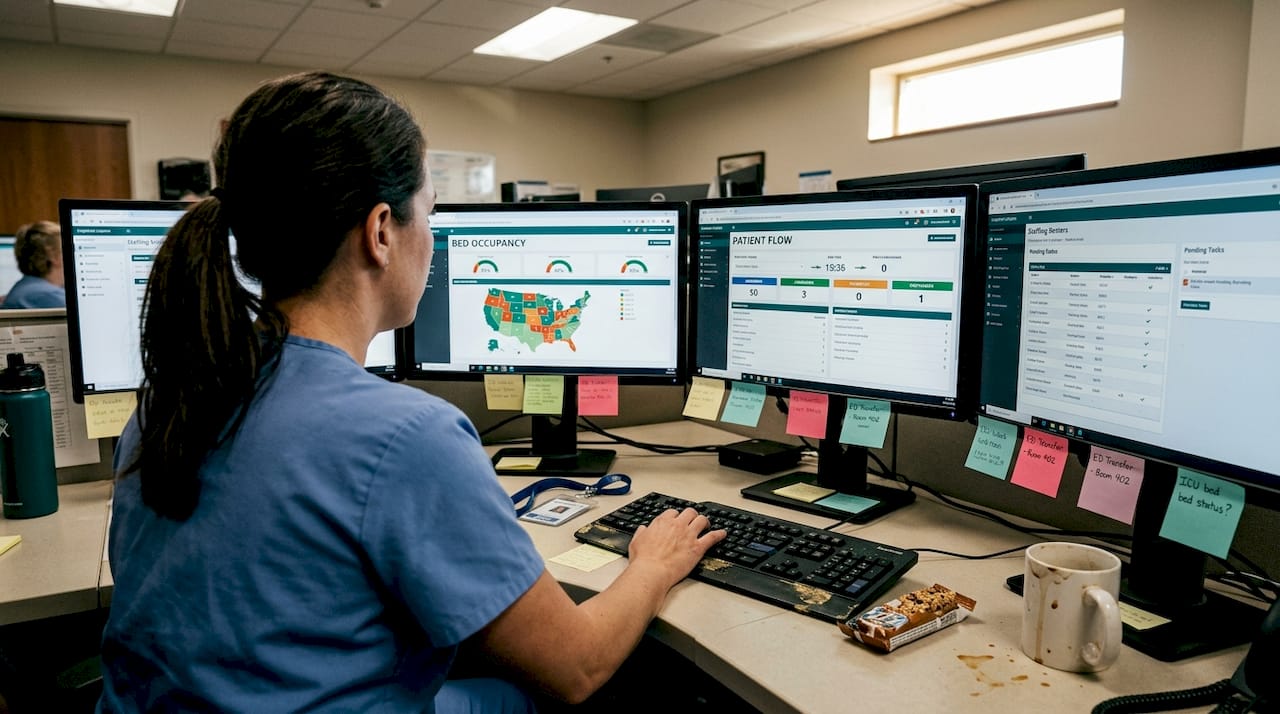
Improve patient care coordination: 2.5x better outcomes

TL;DR:Hospitals using multiple care coordination strategies achieve higher CMS star ratings and lower readmissions.Effective coordination requires operational infrastructure, clear roles, integrated logistics, and leadership commitment.Technology enhances logistics and communication but must be paired with process improvements and governance.
Hospitals that treat care coordination as a purely clinical function are leaving measurable performance gains on the table. Hospitals using 8-12 strategies have 2.5x the odds of achieving top CMS star ratings and significantly reduced readmission rates. Yet most improvement efforts focus narrowly on software upgrades or staffing tweaks, missing the broader operational and logistics architecture that actually drives results. This guide examines the full picture: why coordination fails, which models work, how integrated logistics amplify clinical efforts, and how to build a program that performs in practice, not just in planning documents.
Table of Contents
- Why care coordination matters: Impact on outcomes and benchmarks
- Best practices for improving patient care coordination
- The power of integrated logistics: Technology and operational efficiency
- Overcoming real-world barriers and fragmentation
- From theory to action: Implementing a winning care coordination program
- A smarter path: Why care coordination is about logistics, not just IT
- Transform your care coordination with the right logistics solution
- Frequently asked questions
Key Takeaways
| Point | Details |
|---|---|
| Care coordination boosts results | Implementing multiple coordination strategies improves CMS ratings and reduces readmission rates. |
| Digital logistics cut delays | Integrated logistics platforms can reduce patient delays and length of stay by 15-30%. |
| Address barriers head-on | Overcome EHR silos and role confusion with strong leadership and clear workflows. |
| Metrics drive improvement | Track CMS star ratings, readmissions, and KPIs to measure coordination progress. |
Why care coordination matters: Impact on outcomes and benchmarks
Care coordination is the deliberate organization of patient care activities and information sharing among all participants involved in a patient’s care, with the goal of achieving safer, more effective outcomes. It sits at the intersection of clinical quality, operational efficiency, and patient experience. When it works well, patients move through the system with fewer gaps, fewer errors, and fewer unnecessary readmissions. When it breaks down, the consequences are measurable and costly.
For hospital administrators, care coordination is directly tied to CMS benchmarks including the Hospital-Wide Readmission measure (HWR), Patient Safety Indicator 90 (PSI 90), and Accountable Care Organization (ACO) shared savings targets. These metrics influence reimbursement, public star ratings, and competitive positioning in regional markets. Poor performance on any one of them signals systemic coordination failure.
“Hospitals using 8-12 care coordination strategies have 2.5x the odds of achieving top CMS star ratings and demonstrate measurably lower readmission rates.”
The evidence on strategy adoption is clear: volume and diversity of coordination practices matter. Hospitals that implement a broad range of strategies, rather than relying on one or two interventions, consistently outperform peers on quality metrics. Explore care coordination tips that map directly to CMS outcome improvements.
| Strategies implemented | Readmission risk | CMS star rating likelihood |
|---|---|---|
| 1-3 strategies | High | Below average |
| 4-7 strategies | Moderate | Average |
| 8-12 strategies | Low | 2.5x more likely top-rated |
Poor coordination creates four compounding problems for hospitals:
- Increased readmissions driven by inadequate discharge planning and follow-up gaps
- Lower CMS star ratings that reduce patient volume and negotiating leverage
- Higher operational costs from redundant tests, extended length of stay (LOS), and avoidable admissions
- Staff burnout caused by unclear roles and fragmented communication across care teams
Addressing these issues requires more than good intentions. It requires a structured, data-informed approach that spans clinical workflows, logistics operations, and chronic care management approaches for high-risk populations.
Best practices for improving patient care coordination
With the ‘why’ established, let’s explore which coordination models and digital workflows really move the needle.
Effective care coordination starts with people and processes before it starts with technology. Key methodologies include training registered nurse coordinators with BSN-level preparation, standardizing handoff protocols, integrating electronic health records (EHR) across departments, and establishing dedicated roles such as nurse case managers. These are not optional enhancements. They are the structural foundation that determines whether coordination actually happens at the point of care.
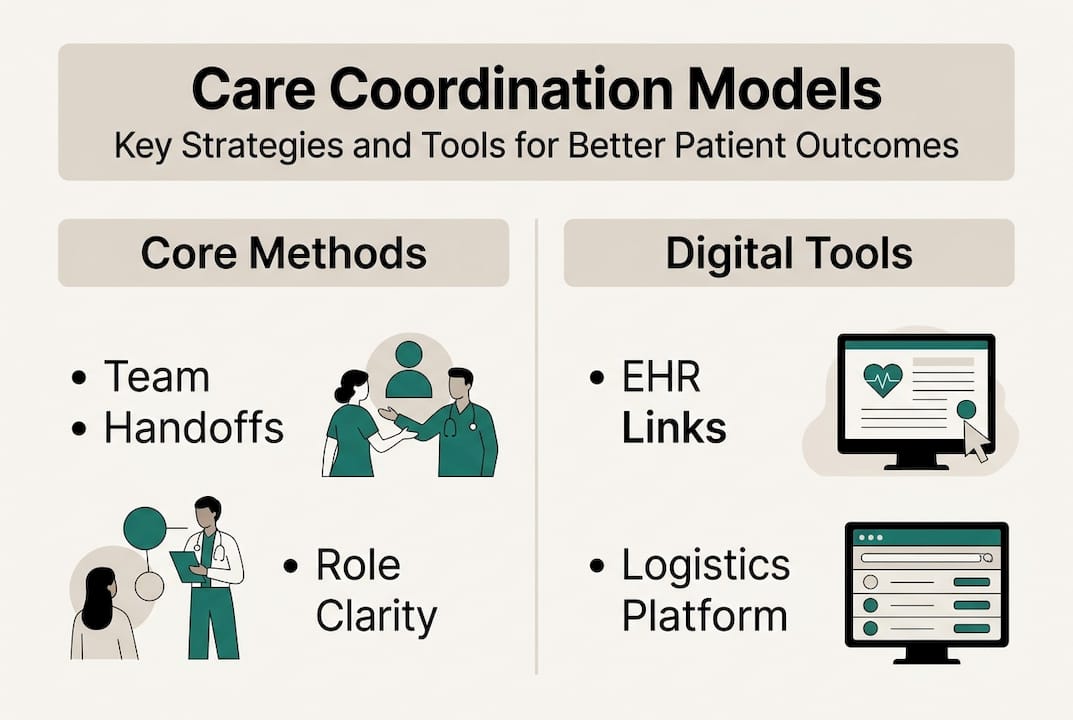
Two coordination models dominate real-world hospital settings, each with distinct tradeoffs:
| Model | Benefits | Drawbacks | Best fit |
|---|---|---|---|
| Institution-centric | Centralized data, easier oversight | Less responsive to individual patient needs | Large health systems |
| Patient-centric | Personalized, relationship-based care | Harder to scale, higher coordinator workload | Community hospitals, ACOs |
Implementing technology in patient logistics alongside these models accelerates results, particularly when agnostic software benefits allow platforms to connect across disparate EHR environments. The following steps reflect coordination best practices used by high-performing hospitals:
- Assign dedicated care coordinators to high-risk patient cohorts
- Standardize transition-of-care protocols for discharge and post-acute handoffs
- Integrate EHR systems to enable real-time information sharing across departments
- Establish interdisciplinary team rounds with defined roles and accountability
- Implement patient tracking tools that flag gaps in follow-up or medication adherence
Pro Tip: Define role boundaries explicitly for every care team member involved in transitions. Ambiguity about who owns a handoff is the single most common cause of coordination breakdowns, and it costs hospitals in both quality scores and staff morale.
The power of integrated logistics: Technology and operational efficiency
Great coordination starts with people, but technology and processes can amplify impact significantly.
Integrated logistics platforms manage the physical and informational movement of patients, equipment, and services across the care continuum. This includes non-emergency medical transportation, durable medical equipment (DME) delivery, and home health scheduling. When these functions are managed in silos, delays accumulate and patient outcomes suffer. When they are integrated into a single operational layer, the efficiency gains are substantial.

Integrated logistics solutions reduce patient delays by up to 30%, raise on-time appointment rates to 85-90%, and lower hospital LOS by 15-20%. These are not marginal improvements. They translate directly into better CMS scores, lower costs per episode, and higher patient satisfaction. Understanding technology’s impact on appointment logistics reveals how automation eliminates the manual coordination bottlenecks that slow discharge and post-acute transitions.
AI-driven platforms add another layer of capability, offering central dashboards that surface real-time KPIs, automated dispatching for transport and equipment, and predictive analytics that flag patients at risk of delayed discharge. The operational gains hospitals consistently report include:
- Reduced time from discharge order to physical departure
- Fewer missed or delayed specialist appointments
- Lower administrative burden on care coordinators
- Improved vendor accountability through real-time tracking
- Faster DME delivery to post-acute and home settings
The intangible ROI of transforming care logistics extends beyond cost savings to include staff retention, patient trust, and network reputation. Tracking all-cause readmissions data alongside logistics KPIs gives administrators a complete picture of where coordination is succeeding and where it is not.
Pro Tip: Integrate your logistics platform with both clinical EHR systems and operational scheduling tools. A platform that only connects to one side of the equation creates new silos rather than eliminating them.
Overcoming real-world barriers and fragmentation
Even with the best strategies and tools, hospitals face stubborn obstacles. Here’s where most efforts stumble and how to push through.
Fragmentation is the defining challenge of care coordination in 2026. EHR silos prevent care teams from accessing complete patient histories at critical transition points. Role ambiguity creates gaps where no one takes ownership of a handoff. Workflow misalignments between inpatient, outpatient, and post-acute settings mean patients fall through the cracks precisely when they are most vulnerable.
“The sickest patients suffer most from information transfer gaps, and the data confirms it: only 28% of dialysis patients are waitlisted for transplant in a timely manner due to coordination failures.”
The tension between open and closed coordination systems creates what practitioners call the ‘Care Transfer Paradox.’ Centralizing coordinators improves information sharing and administrative efficiency, but embedding coordinators directly within clinical practices tends to produce better quality outcomes for individual patients. Neither model is universally superior, and most health systems need a hybrid approach.
Addressing discharge delays with technology is one of the highest-leverage interventions available, because discharge is the point where fragmentation most visibly harms both patients and hospital throughput. Similarly, ambulance-driven logistics can serve as coordination hubs when properly integrated into the broader care network. Practical steps to reduce fragmentation include:
- Audit EHR interoperability gaps between inpatient and post-acute systems
- Assign explicit ownership for each transition point in the care pathway
- Implement standardized chronic care management solutions for high-risk cohorts
- Use real-time alerts to notify coordinators when a patient misses a post-discharge appointment
- Establish shared communication protocols across all care settings involved in a patient’s episode
From theory to action: Implementing a winning care coordination program
The final piece is putting everything together and creating a coordination approach that doesn’t just work on paper but delivers in practice.
Successful implementation requires more than a technology purchase or a policy update. Leadership buy-in, role clarity, team-based approaches, and social needs screening are the four pillars that determine whether a coordination program achieves lasting impact. Without executive sponsorship, coordination initiatives stall when they encounter budget constraints or competing priorities.
Critically, technical fixes alone are insufficient without corresponding changes to governance structures and incentive alignment. A new platform does not change behavior unless the organizational model rewards coordination and penalizes fragmentation. The following implementation checklist reflects what high-performing hospitals actually do:
- Define specific, measurable coordination goals tied to CMS benchmarks
- Secure visible leadership commitment from the C-suite and department heads
- Clarify roles and accountability for every transition point in the care pathway
- Select an integration platform that connects clinical and logistics workflows
- Set baseline KPIs for readmissions, LOS, on-time appointments, and discharge time
- Monitor progress monthly and adjust workflows based on data, not assumptions
Measuring success means tracking the right metrics consistently. Readmission rates, CMS star ratings, PSI 90 scores, and logistics KPIs such as transport on-time rates and DME delivery windows all provide actionable signals. Explore efficiency in patient logistics to understand how operational data integrates with clinical quality measurement.
Pro Tip: Screen every high-risk patient for social determinants of health (SDOH) and embed those findings directly into the coordination workflow. Transportation barriers, food insecurity, and housing instability are among the most predictable drivers of readmission, and they are addressable when identified early.
A smarter path: Why care coordination is about logistics, not just IT
Synthesizing these strategies brings us to a core lesson that many organizations overlook.
Most improvement guides focus on IT upgrades as the primary lever for care coordination. Install a new EHR module, add a patient portal, deploy a telehealth tool. These investments have value, but they consistently underperform expectations when the underlying logistics and operational governance remain fragmented. The hospitals that achieve durable improvement are not necessarily the ones with the most advanced technology. They are the ones that treat coordination as an operations and logistics challenge first.
The uncomfortable truth is that process gaps and teamwork failures persist even in organizations with best-in-class EHR systems. Information moves between systems, but people and equipment still move through physical and organizational structures that require deliberate management. As one framework puts it: it is not the platform that determines outcomes. It is how your teams actually move information, people, and equipment through the system.
Organizations that are transforming care logistics at scale are doing so by orchestrating the full logistics layer, not just digitizing existing workflows. That distinction separates incremental improvement from genuine transformation.
Transform your care coordination with the right logistics solution
For organizations ready to move from strategies to results, a logistics-first platform is the bridge between planning and performance. The practices outlined in this guide require operational infrastructure that connects clinical decisions to real-world patient movement, equipment delivery, and post-acute transitions.
VectorCare’s integrated platform is built specifically for this challenge. From understanding what patient logistics means in practice to implementing better patient logistics across your health system, the tools and resources are available to help your team execute. Visit the VectorCare platform to explore how AI-driven dispatching, real-time visibility, and automated workflows can put your coordination strategy into action today.
Frequently asked questions
What are the most effective strategies for improving care coordination in hospitals?
Training care coordinators, integrating EHR systems, standardizing handoff protocols, and appointing dedicated roles like nurse case managers are essential for successful care coordination. Hospitals that implement eight or more of these strategies consistently outperform peers on CMS quality benchmarks.
How do integrated logistics solutions improve patient care coordination?
Integrated logistics platforms reduce patient delays by up to 30%, increase on-time appointments to 85-90%, and decrease length of stay by 15-20%. These gains translate directly into better CMS scores and lower per-episode costs.
What are the main barriers to effective patient care coordination?
Major barriers include fragmented EHR systems, unclear staff roles, and inadequate communication across care settings. These gaps hit the highest-acuity patients hardest, as evidenced by chronic underperformance in timely specialist referrals and post-acute transitions.
How can hospitals measure success in patient care coordination?
Hospitals should track CMS benchmarks including HWR, PSI 90, and ACO shared savings, alongside operational KPIs such as transport on-time rates and discharge-to-departure times. Combining clinical and logistics metrics provides the most complete picture of coordination performance.
Why isn’t technology alone enough to fix care coordination issues?
Technical fixes are insufficient without corresponding changes to governance structures, incentive alignment, and team accountability. Technology enables coordination, but organizational design and leadership commitment determine whether it actually happens.
Recommended
- Maximizing Efficiencies Through Better Patient Logistics | VectorCare
- Healthcare Logistics for Payers | Optimize Utilization & Reduce Costs
- Top Patient Care Coordination Tips for Better Outcomes
- 4 Tools to Improve Patient Outcomes | VectorCare
- Chronic Care Management | Programs | Garden State Medical Group