How to Track Patient Transport for Efficient Care

Over 60 percent of American healthcare leaders report delays in patient transport impacting critical care coordination. For logistics managers, every slow transport can mean higher risk, lost time, and unnecessary stress for both staff and patients. Discover practical strategies to assess your transport needs, navigate compliance requirements, and build a smarter tracking process that brings real improvements to patient safety and American healthcare operations.
Table of Contents
- Step 1: Assess Transport Tracking Needs And Compliance Requirements
- Step 2: Select And Set Up An Integrated Tracking Platform
- Step 3: Configure Real-Time Notification And Communication Tools
- Step 4: Monitor Active Transports With Live Status Updates
- Step 5: Verify Transport Completion And Gather Performance Data
Quick Summary
| Key Point | Explanation |
|---|---|
| 1. Assess compliance requirements | Review patient transport safety standards to ensure adherence to regulations. Address logistical challenges specific to your organization. |
| 2. Choose the right tracking platform | Select an integrated tracking platform that enhances operational efficiency and supports real-time communication among healthcare teams. |
| 3. Implement real-time notifications | Configure a notification system that prioritizes critical events for instant communication among medical staff during patient transport. |
| 4. Monitor transports in real-time | Use systems that provide live updates on patient status, location, and transportation progress to ensure immediate response capabilities. |
| 5. Analyze transport performance data | Verify transport completion with standardized checklists and collect data to identify trends and improve transport protocols. |
Step 1: Assess transport tracking needs and compliance requirements
Effective patient transport tracking requires a comprehensive understanding of your healthcare organization’s specific compliance requirements and logistical challenges. This assessment will help you develop a robust system that ensures patient safety and operational efficiency.
Begin by thoroughly reviewing the patient transport safety standards established by regulatory bodies like the Joint Commission. These guidelines provide critical insights into communication protocols, safety measures, and procedural accuracy necessary for patient transportation. Organizations must evaluate key factors such as patient mobility levels, required medical equipment, potential physiological risks during transport, and appropriate transfer techniques. This involves conducting detailed patient assessments that consider individual health status, physical capabilities, and specific medical needs.
To create a comprehensive tracking approach, develop a structured framework that documents patient transport requirements, identifies potential risks, and establishes clear communication pathways between medical teams. This should include standardized checklists for pre transport evaluation, real time tracking mechanisms, and post transport documentation. By integrating systematic compliance checks and detailed patient information tracking, healthcare providers can significantly reduce transportation related risks and improve overall patient care outcomes.
Pro tip: Create a digital checklist template that medical staff can quickly complete for each patient transport to ensure consistent compliance and documentation.
Step 2: Select and set up an integrated tracking platform
Selecting the right integrated tracking platform is crucial for streamlining patient transport logistics and ensuring seamless communication across healthcare teams. Your goal is to implement a solution that enhances operational efficiency and patient care coordination.
Begin by evaluating platform infrastructure requirements that support comprehensive data management. Look for systems that provide robust interoperability capabilities, enabling smooth integration with existing electronic health record systems and communication tools. The ideal platform should offer real time tracking mechanisms, transparent data transmission, and advanced analytics features that allow healthcare providers to make proactive clinical decisions. Consider platforms that support detailed documentation workflows, enabling medical staff to capture critical patient transport information efficiently.
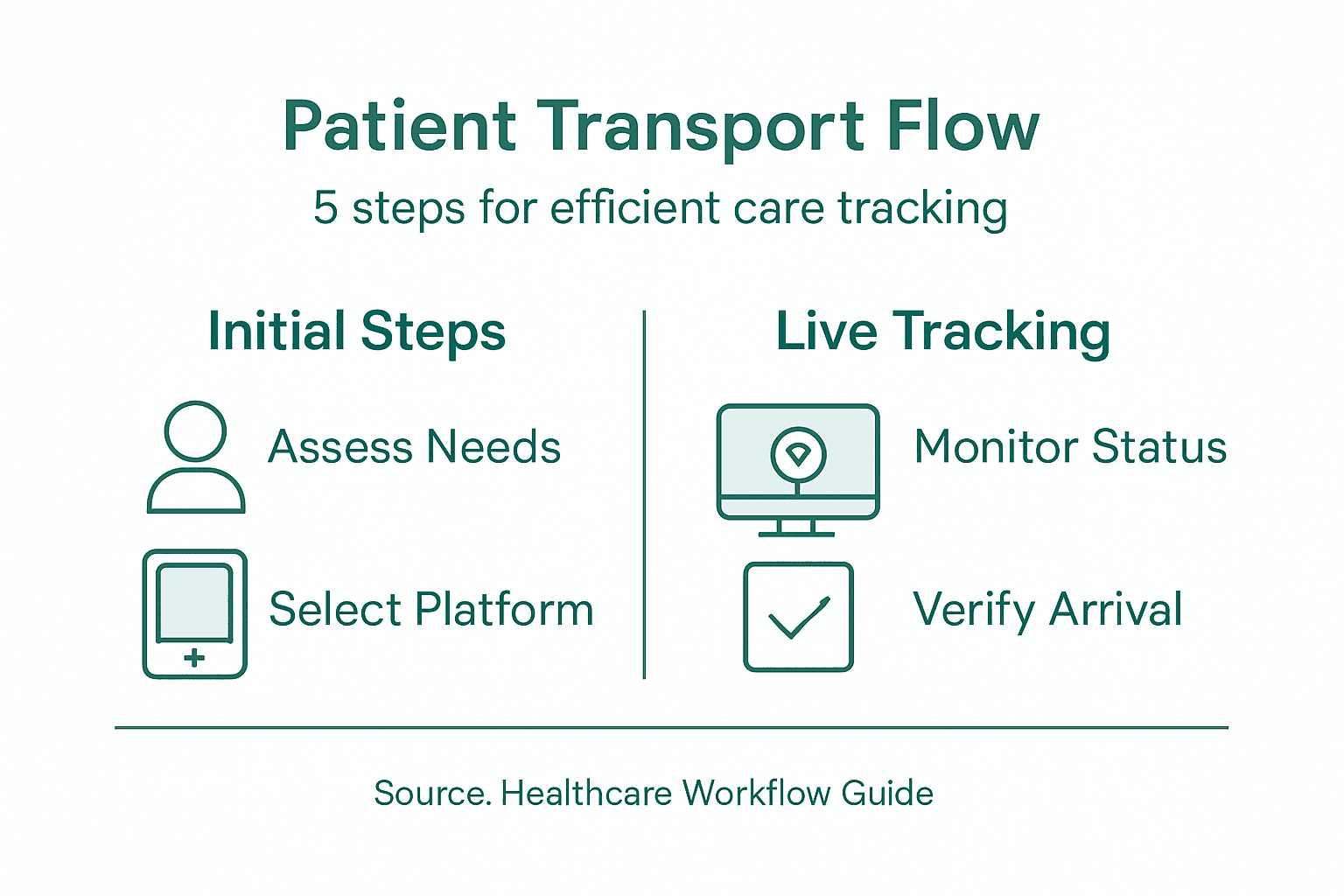
When assessing potential tracking solutions, prioritize platforms that align with your specific organizational needs. Engage key stakeholders from different departments to understand their workflow requirements and potential pain points. Develop a comprehensive evaluation framework that includes criteria such as user interface accessibility, data security protocols, reporting capabilities, and scalability. Conduct thorough vendor demonstrations and request detailed implementation support to ensure a smooth transition and maximum user adoption across your healthcare organization.
Pro tip: Request a pilot test period with potential tracking platforms to assess real world performance and user experience before making a final selection.
Step 3: Configure real-time notification and communication tools
Configuring robust real-time notification and communication tools is essential for creating a responsive and efficient patient transport tracking system. Your objective is to establish a seamless communication infrastructure that enables instant information sharing and rapid response capabilities.
Start by implementing strategic notification protocols that align with your organization’s specific clinical workflows. Design a comprehensive alert system that prioritizes critical events and ensures immediate communication among transport teams, medical staff, and support personnel. This involves setting up customizable notification triggers that can instantly communicate patient status changes, transportation delays, medical emergencies, or potential risk factors. Integrate these tools directly into your existing electronic health record systems to create a unified communication platform that supports real time updates and comprehensive tracking.
Carefully evaluate the technical capabilities of your communication tools to ensure they support multiple communication channels such as mobile alerts, secure messaging platforms, and automated status updates. Develop clear communication protocols that define response times, escalation procedures, and information sharing guidelines. Train your medical staff on effectively using these communication tools, emphasizing the importance of timely and accurate information exchange during patient transport. Consider implementing role based access controls that enable different team members to receive notifications relevant to their specific responsibilities while maintaining patient privacy and data security standards.
Below is a comparison of communication tools for patient transport tracking:
| Tool Type | Main Benefit | Common Limitation |
|---|---|---|
| Mobile Alerts | Rapid, direct notification | Device battery dependence |
| Secure Messaging | Data security for updates | May require training |
| Automated Status Updates | Reduces manual entry | Reliant on system uptime |
Pro tip: Conduct regular system simulations to test notification response times and identify potential communication bottlenecks before they impact patient care.
Step 4: Monitor active transports with live status updates
Monitoring active patient transports requires a sophisticated approach that ensures comprehensive tracking and immediate response capabilities. Your primary goal is to establish a robust system that provides real-time visibility into patient movement and critical transportation details.

Implement comprehensive patient transport tracking systems that enable continuous monitoring of patient status and transportation progress. These systems should integrate multiple data streams including live location tracking, vital sign monitoring, and real-time communication channels. Configure dashboards that display active transport details such as current location, estimated arrival time, patient condition, and assigned medical personnel. Develop automated alert mechanisms that instantly notify relevant healthcare professionals about any unexpected changes or potential complications during patient transport.
Establish clear protocols for continuous monitoring that involve multiple layers of oversight. Assign dedicated transport coordination staff who can actively track and manage ongoing patient movements, ensuring that each transport receives immediate attention and support. Implement role based access controls that allow different team members to view relevant transport information while maintaining patient privacy and data security standards. Create comprehensive documentation workflows that capture each stage of the transport process, enabling retrospective analysis and continuous improvement of patient transportation protocols.
Pro tip: Develop a centralized monitoring dashboard that provides a comprehensive overview of all active patient transports with color coded status indicators for quick situational assessment.
Step 5: Verify transport completion and gather performance data
Verifying patient transport completion and collecting performance insights are critical final steps in ensuring comprehensive patient logistics management. Your objective is to create a systematic approach for documenting transport outcomes and extracting valuable operational intelligence.
Begin by implementing rigorous transport verification protocols that confirm safe patient arrival and comprehensive documentation. Develop a standardized checklist that medical staff must complete at the conclusion of each transport, capturing critical details such as arrival time, patient condition, any incidents encountered, and total transport duration. Ensure that these verification processes integrate seamlessly with your electronic health record systems, creating an automatic documentation trail that supports both immediate care coordination and long-term performance analysis.
Establish a robust data collection framework that transforms transport completion information into actionable insights. Design performance metrics that track key indicators including transport time accuracy, resource utilization, potential delay factors, and patient safety markers. Create automated reporting mechanisms that generate comprehensive analytics, enabling your healthcare team to identify trends, recognize potential improvements, and continuously refine transport protocols. Implement regular review sessions where transport coordination teams can analyze collected data, discuss performance challenges, and develop strategic interventions to enhance overall patient transportation efficiency.
Pro tip: Develop quarterly performance dashboards that visualize transport data trends, allowing leadership to quickly identify systemic improvements and potential operational bottlenecks.
Here’s a summary of essential elements for a successful patient transport tracking system:
| Element | Purpose | Value to Organization |
|---|---|---|
| Compliance Framework | Ensures adherence to regulations | Reduces legal and safety risks |
| Real-Time Tracking | Monitors patient movement and status | Enables immediate interventions |
| Notification System | Alerts staff to critical events | Improves team responsiveness |
| Performance Analytics | Measures and improves transport process | Identifies areas for efficiency |
Streamline Patient Transport Tracking with VectorCare’s Integrated Solutions
Tracking patient transport demands precision and real-time responsiveness to ensure safety and efficiency. This article highlights critical challenges such as compliance frameworks, real-time status updates, and effective communication protocols. If you are striving to reduce delays, improve coordination, and enhance patient outcomes, VectorCare offers a comprehensive digital platform designed specifically to tackle these complex logistics hurdles.
With features like AI-driven dispatching, scheduling optimization, secure communication, and performance analytics, VectorCare empowers healthcare providers to monitor transports seamlessly from start to finish. Experience automated workflows that reduce administrative burdens while maintaining strict compliance and data security standards. Discover how your organization can benefit from improved operational efficiency and scalable solutions by visiting our main site and exploring how VectorCare supports healthcare logistics.
Take control of patient transport tracking today. Visit VectorCare to learn more about our integrated tools and start enhancing your healthcare coordination immediately.
Frequently Asked Questions
How can I assess my healthcare organization’s patient transport tracking needs?
To assess patient transport tracking needs, review compliance requirements and logistical challenges specific to your organization. Conduct thorough evaluations of patient mobility levels, medical equipment needs, and potential transportation risks for effective tracking.
What features should I look for in an integrated tracking platform for patient transport?
When selecting a tracking platform, prioritize real-time tracking, interoperability with electronic health records, and advanced analytics features. Ensure the platform supports easy documentation workflows to enhance efficiency and care coordination.
How can I set up effective real-time notifications for patient transport?
To set up real-time notifications, create a comprehensive alert system that prioritizes critical events and communicates updates promptly among healthcare teams. Implement customizable triggers that notify staff about patient status changes or emergencies to enhance responsiveness.
What steps should I take to monitor active patient transports effectively?
To monitor active transports, establish a robust tracking system that integrates live location data, vital sign monitoring, and communication channels. Assign transport coordination staff to oversee patient movements and automate alerts for any unexpected changes during transport.
How do I verify transport completion and gather performance data?
To verify transport completion, implement a standardized checklist at the end of each transport cycle that captures relevant details such as arrival time and patient condition. Develop a robust data collection framework to convert transport information into insights for ongoing improvement in patient care.