How to improve appointment scheduling for better patient care

TL;DR:Modern patient logistics require data-driven workflows and AI tools to reduce delays and no-shows.Implementing integrated scheduling systems, automation, and continuous analytics improves appointment efficiency.Tailoring strategies to patient populations and involving staff ensures sustainable scheduling improvements.
Waiting rooms full past capacity, a call center buried in rescheduling requests, and a no-show rate climbing toward 23% — these are not isolated problems. They are symptoms of scheduling workflows that have not kept pace with the complexity of modern patient logistics. For hospital administrators and home health operational managers, the cost of these inefficiencies is measured not just in wasted staff hours but in delayed diagnoses, reduced patient satisfaction, and preventable readmissions. This article walks through a structured, data-driven approach to improving appointment scheduling, from identifying root-cause bottlenecks to deploying AI-assisted tools, so your organization can close the gap between patient need and timely care delivery.
Table of Contents
- Identify bottlenecks and set measurable goals
- Choose and implement the right scheduling tools
- Reduce no-shows and optimize patient access
- Harness data analytics and AI for continuous improvement
- Why most scheduling ‘fixes’ fail — and what leaders should do differently
- Unlock seamless patient scheduling with integrated logistics solutions
- Frequently asked questions
Key Takeaways
| Point | Details |
|---|---|
| Pinpoint scheduling bottlenecks | Identify where delays or friction occur in your current appointment process. |
| Adopt the right tools | Choose scheduling technology that matches your needs and patient demographics. |
| Engage patients to reduce no-shows | Use reminders, telehealth, and easy rescheduling to keep patients on track. |
| Leverage data for ongoing improvement | Continuously track key metrics and use AI to refine scheduling practices. |
| Customize strategies for your setting | Tailor improvements to your staff, workflows, and patients rather than relying solely on tech fixes. |
Identify bottlenecks and set measurable goals
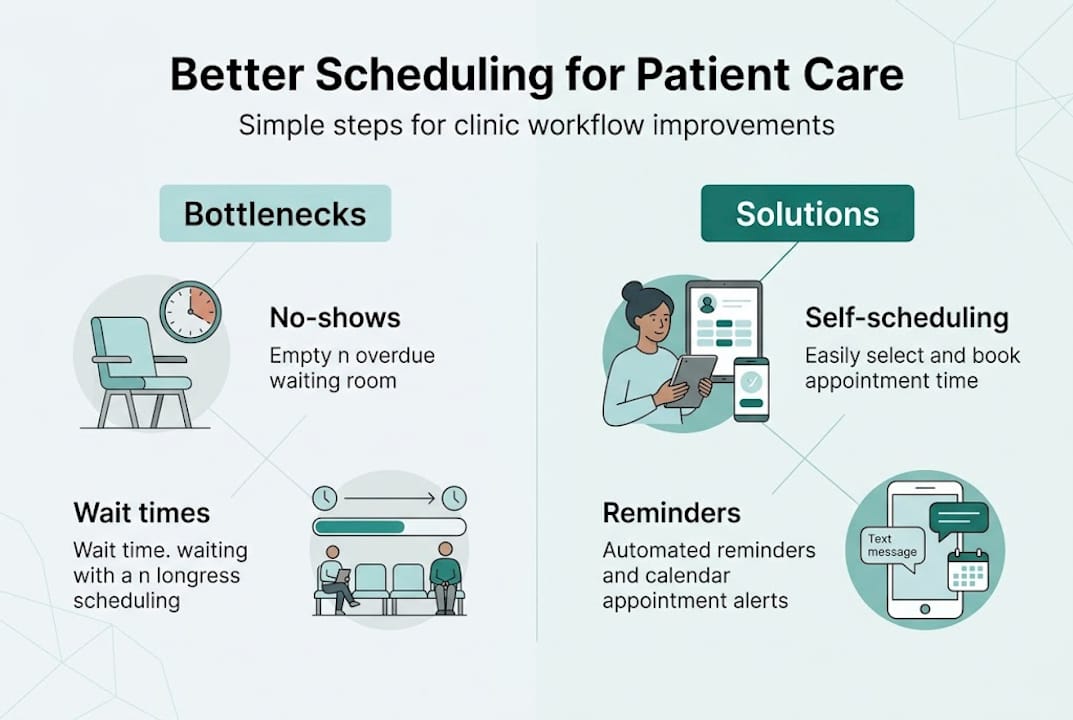
Every scheduling improvement initiative must begin with an honest audit of the current workflow. Map each step from initial patient intake through appointment completion, including referral receipt, eligibility verification, slot assignment, confirmation, and post-visit follow-up. This mapping exercise almost always surfaces hidden delays that staff have normalized over time, such as specialty referral queues that stretch beyond two weeks, check-in processes that add 20 minutes to every visit, or call-center backlogs that force patients to call back multiple times before securing an appointment.
Once the map is complete, identify the specific choke points that drive the most downstream harm. Common culprits include:
- No-shows and late cancellations that leave slots unfilled and inflate wait times for other patients
- Manual authorization workflows that delay specialist access by days or weeks
- Fragmented communication between care coordinators, transport teams, and clinical staff
- Overbooking or underbooking patterns that create either patient backlogs or wasted capacity
With bottlenecks identified, translate them into SMART goals: Specific, Measurable, Achievable, Relevant, and Time-bound. For example, a goal such as “reduce average appointment wait time for primary care by 20% within 90 days” gives your team a clear target and a defined evaluation window. Mathematical optimization models prioritize longest-waiting patients to reduce wait times, reinforcing that structured goal-setting and data-driven prioritization are inseparable.
| Bottleneck | Measurable workflow impact |
|---|---|
| High no-show rate | Unused capacity, revenue loss, longer patient wait lists |
| Delayed check-in process | Reduced daily throughput, staff overtime |
| Manual referral routing | Extended time-to-specialist, patient dissatisfaction |
| Poor patient rerouting | Repeat contacts, duplicated administrative effort |
Addressing reducing patient wait times requires more than good intentions — it requires a clear picture of where patient flow barriers exist in your specific environment.
Pro Tip: Capture timestamps at every handoff point in your scheduling workflow. Even a simple spreadsheet log can reveal that 40% of delays occur in a single 15-minute window during morning intake, which is far more actionable than knowing delays exist in general.
Choose and implement the right scheduling tools
With priorities defined, the next step is selecting technology that directly addresses your identified bottlenecks. The healthcare scheduling technology landscape spans a wide range, from basic EHR add-on modules to cloud-based self-scheduling portals to fully AI-optimized platforms that predict demand and auto-fill cancellations. The right choice depends on your patient volume, existing infrastructure, staff digital literacy, and the specific barriers your audit uncovered.
| Tool type | Key features | Best for | Relative cost |
|---|---|---|---|
| Manual/phone-based | Human oversight, flexible | Low-volume, complex cases | Low |
| Online self-scheduling portal | 24/7 patient access, automated reminders | Primary care, routine visits | Medium |
| AI-optimized platform | Predictive fill, no-show modeling, EHR integration | High-volume hospitals, home health | Higher |
For organizations evaluating options, the best healthcare scheduling software combines EHR integration with patient-facing self-service. Research shows that online self-scheduling reduces no-shows to 1.8% in private practice settings, compared to the industry-wide average that can exceed 20%. That is a meaningful operational difference, and it is achievable with the right platform configuration.
Implementation should follow a structured sequence to protect both staff adoption and patient experience:
- Secure stakeholder buy-in from clinical leadership, IT, and front-desk staff before any rollout begins
- Migrate and validate data carefully, ensuring historical scheduling data transfers cleanly into the new system
- Integrate with existing workflows, including EHR, billing, and transportation coordination systems
- Communicate changes to patients through multiple channels, including SMS, patient portal messages, and printed materials for those with limited digital access
Exploring scheduling software for healthcare in detail before committing to a vendor will help your team ask sharper questions during demos and avoid costly mismatches between tool capabilities and operational reality. Reviewing tips for online scheduling can also accelerate your configuration decisions.
Pro Tip: Pilot any new scheduling tool in a single department or care line for 30 to 60 days before full deployment. This limits disruption, surfaces integration issues early, and generates real performance data to support the broader rollout business case.
Reduce no-shows and optimize patient access
With scheduling tools in place, the focus shifts to the human and logistical factors that most commonly cause appointments to fail. No-shows are rarely random. They cluster around specific patient populations, appointment types, and access barriers that a well-designed intervention strategy can directly address.
A structured no-show prevention approach should include:
- Automated reminders sent via SMS and voice call at 72 hours and 24 hours before the appointment
- Easy rescheduling options embedded directly in reminder messages so patients can self-serve without calling
- Pre-appointment check-ins that confirm transportation, identify last-minute barriers, and flag high-risk patients for outreach
- Transportation assistance coordination for patients who lack reliable access, particularly in home health and post-acute settings
Telehealth integration is one of the highest-impact levers available. Telehealth reduces no-shows with an odds ratio of 0.61 compared to in-person visits, and simulation modeling shows it can cut turnaround time by more than 10%. Visits best suited for telehealth include medication management, behavioral health follow-ups, chronic disease check-ins, and post-discharge assessments.

Patient segmentation is equally important. A 65-year-old patient with limited broadband access and a 28-year-old managing a chronic condition via a smartphone app require fundamentally different outreach strategies. Reviewing patient scheduling best practices by population segment helps organizations avoid the trap of rolling out digital-first strategies that inadvertently widen access gaps. For agencies managing field-based care, a purpose-built home health scheduling app can synchronize caregiver availability with patient needs in real time, reducing missed visits at the point of care.
No-show rates average 23% industry-wide but drop to 1.8% with online self-scheduling in private practice settings, illustrating how much operational improvement is available through targeted intervention. Understanding how technology in patient appointment logistics drives these outcomes is essential for building a sustainable access strategy.
Pro Tip: When rolling out telehealth or digital scheduling, address privacy concerns and the digital divide directly in patient communications. Patients who feel their concerns are acknowledged are significantly more likely to adopt new access methods.
Harness data analytics and AI for continuous improvement
Sustaining scheduling improvements over time requires moving from reactive problem-solving to proactive, data-driven management. Organizations that treat scheduling as a set-and-forget process will see gains erode within months as patient volume shifts, staffing changes, and seasonal demand patterns emerge.
The core metrics every scheduling operation should monitor continuously include:
- Appointment wait times by care type, provider, and patient population
- Slot fill rates and same-day cancellation patterns
- No-show trends segmented by appointment type, reminder method, and patient demographics
- Appointment lead times from referral receipt to first available slot
- Rescheduling frequency, which often signals systemic access barriers rather than individual patient behavior
AI and machine learning models predict no-shows and improve scheduling through robust optimization that handles demand uncertainty and physician-patient heterogeneity. These models can flag high-risk appointments 48 to 72 hours in advance, triggering automated outreach or enabling proactive slot backfill from a waitlist.
“Robust optimization handles uncertainty and heterogeneity in patient scheduling processes.”
Regularly reviewing performance disparities across patient populations is not just an equity imperative — it is an operational one. If no-show rates are consistently higher among patients in a specific zip code or age group, that pattern points to a solvable access barrier, not a patient behavior problem. Reviewing how technology optimizing logistics applies at the system level helps administrators build feedback loops that turn data into actionable scheduling adjustments on a weekly or monthly cycle.
Why most scheduling ‘fixes’ fail — and what leaders should do differently
The uncomfortable reality is that most scheduling improvement projects deliver far less than promised. Organizations invest in new platforms, launch reminder campaigns, and redesign intake forms — then find that no-show rates and wait times have barely moved six months later. The reason is almost always the same: the intervention addressed the surface symptom rather than the underlying cause.
Technology upgrades alone cannot fix a scheduling problem rooted in staffing ratios, unclear referral ownership, or a patient population that lacks reliable transportation. Online self-scheduling benefits diverge significantly by setting, lowering no-shows in private practice but potentially increasing them in high-volume hospital environments where patient complexity and access barriers are more pronounced.
The leaders who achieve durable improvement treat scheduling as an organizational capability, not a software configuration. They involve frontline staff and patients in workflow design, build feedback mechanisms that surface problems before they become crises, and adapt strategies by population segment rather than applying a single solution universally. Reviewing patient scheduling best practices with this systems-level mindset is what separates organizations that sustain gains from those that cycle through vendor changes without progress.
Pro Tip: Involve both staff and patients in the design of scheduling changes. Staff who help build the workflow will defend it. Patients who are consulted will adopt it.
Unlock seamless patient scheduling with integrated logistics solutions
Improving appointment scheduling is not a standalone project — it is part of a broader patient logistics strategy that connects scheduling, transportation, home health coordination, and real-time communication into a single operational framework.
VectorCare’s platform is built to support exactly this kind of integrated approach. Whether your organization is managing high-volume hospital scheduling or coordinating home health logistics across a distributed care network, VectorCare provides the automation, real-time visibility, and AI-driven dispatching that translate scheduling improvements into measurable patient outcomes. Explore the full scope of patient logistics and learn how maximizing patient logistics can reduce administrative burden and improve care coordination at scale.
Frequently asked questions
What technology is most effective for reducing no-shows in healthcare?
Online self-scheduling reduces no-shows to 1.8% in private practice, and telehealth reduces no-shows with an odds ratio of 0.61 versus in-person visits, making both especially effective when combined with automated reminders.
How can AI help improve appointment scheduling?
AI and machine learning predict no-shows and optimize slot allocation by modeling demand uncertainty, enabling schedulers to proactively fill cancellations and reduce wasted capacity.
What are quick wins to reduce scheduling bottlenecks?
Start by logging timestamps at each workflow handoff, automating patient reminders, and enabling self-service rescheduling, since optimization models reduce wait times most effectively when the data feeding them is accurate and current.
Does online appointment scheduling work for all patient populations?
No. Telehealth and online scheduling benefits diverge by patient group, and older adults or patients with limited digital access may require supplemental outreach strategies to achieve the same access improvements seen in other populations.
Recommended
- Understanding Patient Scheduling Best Practices for Providers
- 7 Essential Tips for Online Scheduling in Healthcare
- Optimize Patient Care with a Home Health Scheduling App
- 7 Best Healthcare Scheduling Software for Smooth Operations
- Benefits of Online Scheduling: Boosting Business Efficiency | Ibrandmedia