Hospital Transport: Improving Patient Flow and Outcomes

Moving patients from one department to another often brings more risk than many hospital leaders realize. For American healthcare administrators, every intrahospital transfer is a critical moment where patient safety and operational costs hang in the balance. Effective hospital transport must deliver clinical support during each phase, whether managing ventilated patients or routine moves. This article clarifies the core elements of hospital transport logistics, highlights service differences, and shows how AI-driven tools can help reduce costly delays while protecting patient care.
Table of Contents
- Defining Hospital Transport In Healthcare
- Types Of Hospital Transport Services Explained
- How Hospital Transport Systems Operate
- Compliance, Safety, And Legal Considerations
- Cost Efficiency And Digital Optimization
Key Takeaways
| Point | Details |
|---|---|
| Complexity of Hospital Transport | Hospital transport involves critical patient movement, requiring careful planning and execution to minimize risks. |
| Phases of Effective Transport | Successful transport consists of pre-transport preparation, active movement monitoring, and post-arrival stabilization. |
| Impact of Transport Decisions | The choice of transport services directly affects patient outcomes and operational efficiency, thus informed decision-making is crucial. |
| Digital Optimization Benefits | Implementing digital automation can streamline transport operations, reduce costs, and improve patient flow efficiency across the facility. |
Defining Hospital Transport in Healthcare
Hospital transport is far more complex than simply moving a patient from one room to another. It encompasses the deliberate, coordinated movement of patients within a hospital facility, often involving critical care patients who require continuous monitoring and clinical intervention throughout the transfer.
What sets hospital transport apart from standard patient movement is the level of clinical risk involved. When patients move between departments for diagnostics, therapeutic procedures, or routine transfers, they leave the controlled environment of their current care setting. This transition requires careful preparation and ongoing monitoring to prevent adverse events.
Core Elements of Hospital Transport
Effective hospital transport involves three distinct phases:
- Pre-transport preparation, including risk assessment and equipment checks
- Active movement with continuous patient monitoring and clinical support
- Post-arrival stabilization in the new care location
Each phase demands attention to detail and coordination between clinical teams. Intrahospital patient transport often involves critically ill patients on ventilators or other life-support equipment, making the stakes considerably higher than routine transfers.
Why This Matters for Your Operations
Adverse events during transport occur more frequently than many administrators realize. Respiratory complications, cardiovascular instability, equipment failures, and monitoring gaps can all happen during patient movement. The challenge isn’t whether risks exist—they always do—but whether your hospital has systems in place to minimize them.
Understanding hospital transport logistics for mechanically ventilated patients is essential because continuity of oxygenation, ventilation, and real-time monitoring cannot be interrupted. A patient’s condition can change rapidly during a 10-minute transfer between floors, and your team must be prepared to respond immediately.
Common Transport Scenarios in Your Hospital
- Transfers to imaging departments for CT, MRI, or ultrasound
- Movement to operating rooms for scheduled procedures
- Relocations between inpatient units or to intensive care
- Transport for diagnostic testing requiring specialized equipment
- Inter-facility transfers requiring different vehicles and protocols
Hospital transport is always associated with risk—what matters is managing that risk strategically through preparation, protocols, and real-time decision-making.
Your team likely manages dozens of these transfers daily. Each one represents an opportunity for efficient, safe patient movement or a potential source of delays and complications. The difference often comes down to clear definitions, established workflows, and systems that give your staff the information they need when they need it.
Pro tip: Establish a standard definition of hospital transport for your facility and ensure all clinical and administrative staff understand which transfers require full monitoring protocols versus routine movement.
Types of Hospital Transport Services Explained
Hospital transport is not one-size-fits-all. Different patient situations demand different transport methods, each with distinct capabilities, staffing, and equipment configurations designed to match the acuity level and distance involved.
Your choice of transport service directly impacts patient outcomes, cost efficiency, and operational logistics. Understanding the distinctions between transport types helps administrators make informed decisions about which services to contract with and how to dispatch patients appropriately.
Ground Mobile Intensive Care Units
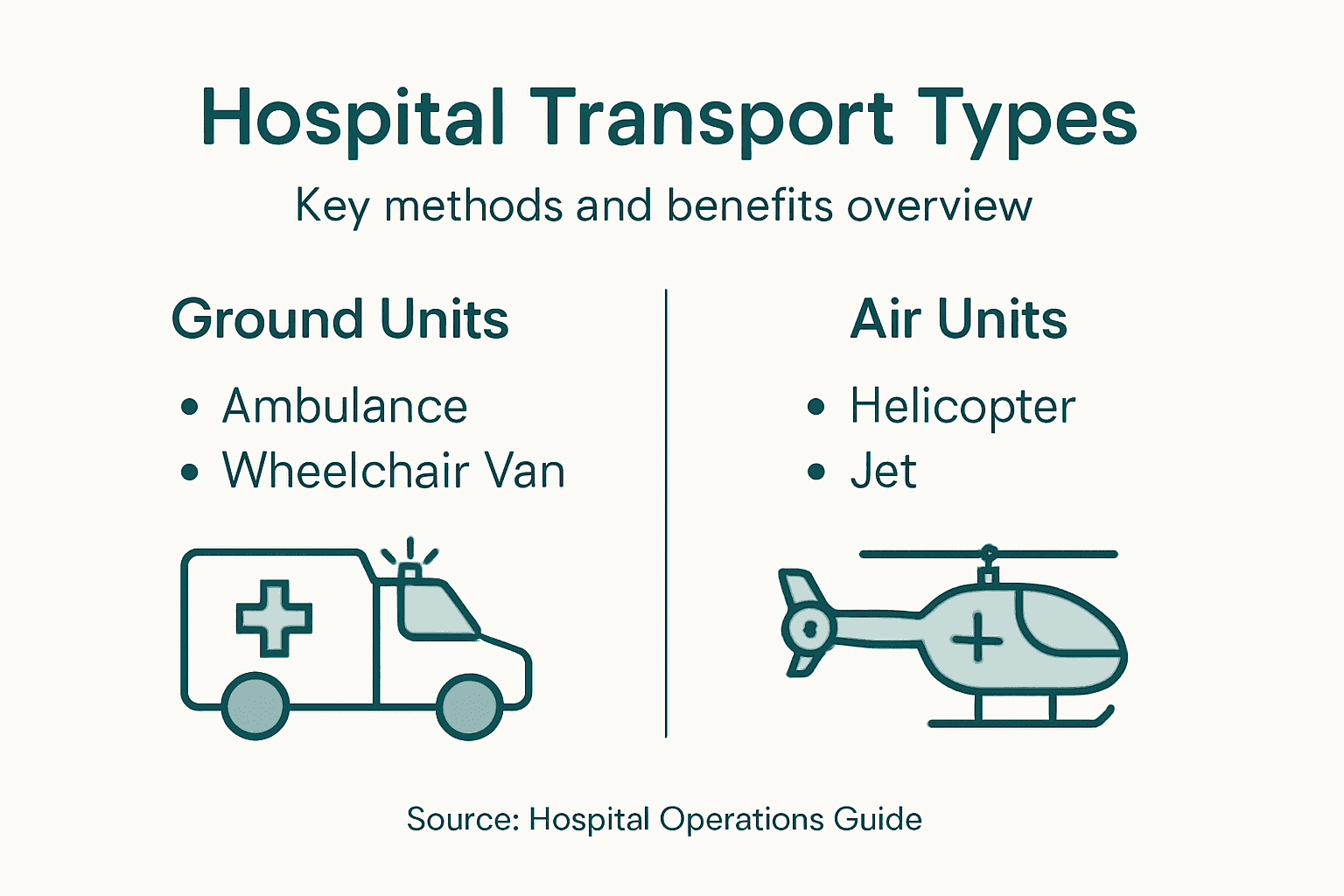
Ground ambulances remain the backbone of most hospital transport operations. These vehicles range from basic life support units to fully equipped mobile intensive care units with paramedics, nurses, and advanced monitoring equipment.
Ground transport works best for:
- Short to medium distances (under 100 miles)
- Stable patients requiring monitoring but not immediate intervention
- Urban and suburban transfers where road access is reliable
- Cost-sensitive transfers where speed is not the primary concern
Ground units provide the most flexibility for intra-hospital and inter-facility transport because they can access any location with road access. Critical care transport via ground ambulance is staffed by specialized healthcare providers trained specifically for high-acuity patient movement.
Air Transport: Rotor-Wing and Fixed-Wing
When ground transport is too slow or road access is impossible, air ambulances become essential. Your hospital likely contracts with rotor-wing helicopter services for emergency transports.
Rotor-wing helicopters are ideal for:
- Trauma cases requiring immediate surgical intervention
- Distances between 30 and 250 miles
- Geographic obstacles that prevent ground transport
- Time-critical conditions where minutes matter
Fixed-wing aircraft serve different purposes. These jets handle longer distances and are typically used when patients can tolerate longer transport times but still need advanced life support capabilities.
Advanced life support during air ambulance transport ensures patients receive continuous monitoring and treatment regardless of whether they travel by helicopter or jet. The difference comes down to distance and the specific clinical capabilities needed.
Specialized Transport Services
Beyond standard ground and air transport, hospitals increasingly contract with specialized services:
- Mobile stroke units for rapid thrombolytic therapy
- Critical care transport teams with physicians or advanced practice providers
- Neonatal transport services with specialized equipment and training
- Pediatric transport with age-appropriate protocols and staffing
Not every transport requires the same level of resources. Matching the right service to the right patient situation reduces costs while improving outcomes.
Your transport decisions compound daily. Inappropriate service selection leads to unnecessary expense or inadequate care.
Here is a comparison of hospital transport service types, highlighting their primary usage and unique advantages:
| Service Type | Preferred Use Cases | Key Benefits |
|---|---|---|
| Ground Ambulance | Local/interfacility, short trips | Broad access, cost effective |
| Rotor-Wing (Helicopter) | Emergencies, rapid response, obstacles | Fastest over medium distances |
| Fixed-Wing (Jet) | Long-distance, stable patients | Comfort, advanced monitoring |
| Specialized Teams | Neonatal, stroke, critical care | Patient-tailored expertise |
Pro tip: Develop a clear transport protocol matrix that specifies which service type to use based on patient acuity, distance, clinical condition, and time sensitivity—then ensure your dispatch team uses it consistently.
How Hospital Transport Systems Operate
Hospital transport systems are far more complex than simply calling an ambulance. They function as coordinated networks involving dispatch centers, specialized teams, real-time communication, and multiple decision points that determine whether a patient reaches their destination safely and on time.
Understanding how these systems work helps you identify bottlenecks, reduce delays, and allocate resources more effectively across your organization.

The Core Infrastructure
Access centers serve as the command hub for hospital transport operations. These 24/7 coordinated centers receive consultation requests, assess patient conditions, and dispatch appropriate transport teams based on clinical acuity and urgency.
Your access center handles:
- Intake calls from referring facilities or departments
- Initial risk assessment and clinical triage
- Transport team assignment and routing
- Real-time communication during transport
- Bed assignment coordination at the receiving facility
This centralized approach prevents duplicate requests, optimizes team utilization, and ensures continuity of care information flows to the receiving team before the patient arrives.
Transport Team Composition and Capabilities
Specialized transport teams with critical care-certified personnel deliver bedside-to-bedside care using either ground or air transport based on patient condition and distance. Your teams typically include:
- Critical care-certified nurses
- Paramedics with advanced life support training
- Technicians managing equipment and monitoring
- Drivers or pilots trained for emergency response
Team composition varies based on patient acuity. A stable discharge transfer requires different staffing than a critically ill patient requiring mechanical ventilation.
Risk Management During Transport
Coordinated multidisciplinary teams ensure patient monitoring and safety through systematic preparation and continuous assessment. Every transport involves:
- Pre-transport risk assessment and equipment verification
- Patient stabilization and monitoring setup
- Continuous physiological monitoring during movement
- Rapid response protocols for emergencies en route
- Handoff procedures at the receiving facility
Without these systematic steps, equipment failures, disconnections, or missed clinical changes can occur during the transfer window when patients are most vulnerable.
The Real Challenge: Coordination
The operational complexity comes from coordinating multiple moving parts simultaneously. Your teams must balance speed against safety, manage changing patient conditions, navigate traffic or weather, and communicate with receiving facilities—all while ensuring nothing slips through the cracks.
Effective transport systems don’t just move patients—they anticipate problems, prepare for complications, and maintain clinical continuity throughout the entire journey.
Most transport delays stem not from transport time itself, but from coordination gaps: unclear orders, missing information, delayed access center response, or bed assignment delays at the receiving facility.
Pro tip: Audit your transport system’s decision-to-dispatch time and bed assignment intervals—these metrics reveal whether delays come from transport logistics or internal coordination failures.
Compliance, Safety, and Legal Considerations
Hospital transport operates within a complex regulatory landscape where a single oversight can expose your organization to legal liability, patient harm, and compliance violations. Administrators who understand these requirements protect both patients and institutional assets.
Compliance isn’t just a legal checkbox—it directly affects patient outcomes and operational costs. Poor compliance practices lead to adverse events, litigation, and regulatory penalties that drain resources.
Critical Regulatory Frameworks
HIPAA protects patient privacy during transport. Patient information shared via radio, mobile devices, or between teams must be encrypted and handled according to privacy standards.
EMTALA requires emergency stabilization and appropriate transfer for patients presenting with emergency conditions, regardless of ability to pay. Transport decisions must align with this federal mandate.
The Joint Commission accredits hospitals and establishes safety standards for transport operations, including equipment maintenance, staff training, and adverse event reporting.
Additional compliance areas include:
- State EMS regulations governing transport operations
- Department of Transportation vehicle standards
- Occupational Safety and Health Administration worker safety requirements
- State-specific scope of practice laws for nurses and paramedics
Safety Protocols and Risk Management
Healthcare compliance frameworks establish risk management and ethics standards that reduce liability while ensuring lawful patient care. Your transport program must include:
- Pre-transport checklists verifying equipment function and patient readiness
- Documented patient consent and informed decision-making
- Clear protocols for managing deteriorating patients during transport
- Incident reporting systems for adverse events or near-misses
- Regular staff training on safety procedures and regulatory changes
Without these safeguards, your organization assumes unnecessary risk when problems occur.
Legal Liability and Patient Rights
Compliance in hospital transport maintains patient safety and organizational trust through adherence to regulations governing emergency treatment access and liability prevention. Critical legal considerations include:
- Patient consent: Documented authorization for transport method and destination
- Duty of care: Obligation to provide appropriate monitoring and intervention
- Abandonment: Legal risk when patients are left without appropriate care
- Negligence: Failure to follow established protocols that causes patient harm
Your transport documentation becomes the primary evidence in any legal dispute. Incomplete or missing records suggest inadequate care.
Practical Compliance Implementation
Compliance succeeds when built into daily operations, not treated as occasional audits. Your teams need clear policies, regular training, and accountability measures.
Regulatory violations often stem not from intentional wrongdoing but from unclear policies, inconsistent training, or gaps between written procedures and actual practice.
Audit your transport program quarterly against regulatory standards. Identify gaps before regulators or patients do.
Pro tip: Implement a monthly compliance checklist covering HIPAA data handling, equipment maintenance, staff certifications, and incident reporting—assign accountability to a specific team member to ensure consistent follow-through.
Cost Efficiency and Digital Optimization
Hospital administrators face a persistent tension: delivering better patient care while controlling costs. Transport operations represent a significant opportunity to address both priorities simultaneously through digital optimization and intelligent automation.
Most hospitals still rely on manual processes for transport scheduling, dispatch, and documentation. These inefficiencies cost thousands of dollars monthly and slow patient flow throughout your facility.
The Cost Impact of Manual Transport Operations
Manual transport workflows create hidden expenses that compound across your organization:
- Staff time spent on phone calls, coordination, and paper documentation
- Duplicate transport requests when communication fails
- Equipment delays due to tracking gaps or missing maintenance records
- Extended patient length of stay from delayed transfers to appropriate units
- Billing delays and missed revenue capture from incomplete transport documentation
When transport takes 45 minutes longer than necessary due to coordination gaps, that patient doesn’t reach their next care level on schedule. This cascades through your facility, delaying other admissions and discharges.
The following table provides a summary of digital automation benefits compared to manual hospital transport operations:
| Factor | Manual Workflow Impact | Digital Automation Benefit |
|---|---|---|
| Staff Time | Increased coordination effort | Streamlined, saves hours weekly |
| Error Rate | Prone to duplicate/missed requests | Reduces errors, improves tracking |
| Patient Flow | Delay in transfers/discharges | Faster movement between units |
| Revenue Capture | Billing gaps, possible losses | Automated, maximizes reimbursement |
Digital Automation Reduces Operational Costs
Intelligent automation eliminates manual tasks and improves data accuracy while supporting operational efficiency even during workforce shortages. Automation tools deliver:
- Faster dispatch decisions through real-time data integration
- Automated billing and charge capture, reducing revenue leakage
- Reduced administrative staff hours for transport coordination
- Better equipment tracking and preventive maintenance schedules
- Fewer duplicate requests and miscommunications
One hospital reduced transport coordination time by 30% through automation, freeing staff for higher-value clinical work.
Analytics Drive Smart Resource Allocation
Advanced analytics frameworks improve discharge planning and transport scheduling decisions that directly control costs and optimize patient throughput. By predicting patient length of stay accurately, you:
- Schedule transports more effectively based on expected discharge timing
- Allocate beds strategically across departments
- Reduce unnecessary patient moves between units
- Plan staffing levels matched to anticipated transport volume
- Identify bottlenecks where patients wait unnecessarily
Data-driven scheduling prevents the costly scenario where transport staff sit idle while transport requests pile up.
Building Your Optimization Strategy
Success requires moving beyond isolated improvements to systems thinking. Your transport optimization should address:
- Dispatch efficiency: Real-time visibility into team location, patient status, and destination readiness
- Workflow automation: Reducing manual handoffs and duplicate data entry
- Analytics integration: Connecting transport data with length of stay, readmission, and outcome metrics
- Billing accuracy: Ensuring every transport generates appropriate revenue
Cost efficiency and patient outcomes aren’t competing priorities—they’re linked. Faster, coordinated transports improve both metrics simultaneously.
Digital optimization isn’t about replacing your teams; it’s about eliminating the administrative friction that slows them down.
Pro tip: Start by measuring your current transport-to-destination time and discharge-to-transport delays—these baseline metrics reveal where automation will save the most money and time.
Enhance Hospital Transport Efficiency and Patient Safety Today
Hospital transport is a critical operation that demands precise coordination, continuous monitoring, and seamless communication to minimize risks and delays. The challenges detailed in the article highlight common pain points such as coordination gaps, manual workflows, and compliance complexities that can lead to costly delays and compromised patient outcomes. If your facility struggles with prolonged transport times, incomplete communication, or ineffective dispatching, adopting a digital approach is essential to meet patient care goals and operational efficiency.
VectorCare offers a comprehensive digital platform designed to streamline patient logistics and hospital transport management. Our solution emphasizes automation, real-time updates, and AI-driven dispatching to reduce delays, improve patient flow, and ensure continuous monitoring during transfers. By integrating scheduling optimization and secure communication across your care teams, you can bridge coordination gaps and reduce administrative burdens. Experience the advantage of improved compliance, accurate documentation, and cost-effective transport management in one unified platform.

Discover how you can transform your hospital transport operations and enhance patient outcomes with VectorCare’s powerful digital solutions. Visit VectorCare now to learn more and start optimizing your patient logistics today. Explore our platform and empower your teams to deliver safer and faster patient transfers with confidence.
Frequently Asked Questions
What does hospital transport entail?
Hospital transport refers to the coordinated movement of patients within a hospital, particularly those requiring continuous monitoring and care during transfers between departments or to different facilities.
Why is hospital transport considered risky?
Hospital transport involves risks such as respiratory complications, cardiovascular instability, and equipment failures due to the critical care nature of many patients. Proper preparation and monitoring are essential to minimize these risks during transfers.
What are the different types of hospital transport services?
There are various hospital transport services, including ground ambulances for short distances, rotor-wing helicopters for emergencies requiring rapid response, and fixed-wing aircraft for longer distances. Specialized services, like neonatal and pediatric transport, cater to specific patient needs.
How can hospitals improve their transport systems?
Hospitals can enhance their transport systems by implementing digital automation to streamline scheduling, improving team coordination, and utilizing analytics to optimize resource allocation. Regular audits and compliance checks also help in minimizing operational risks.