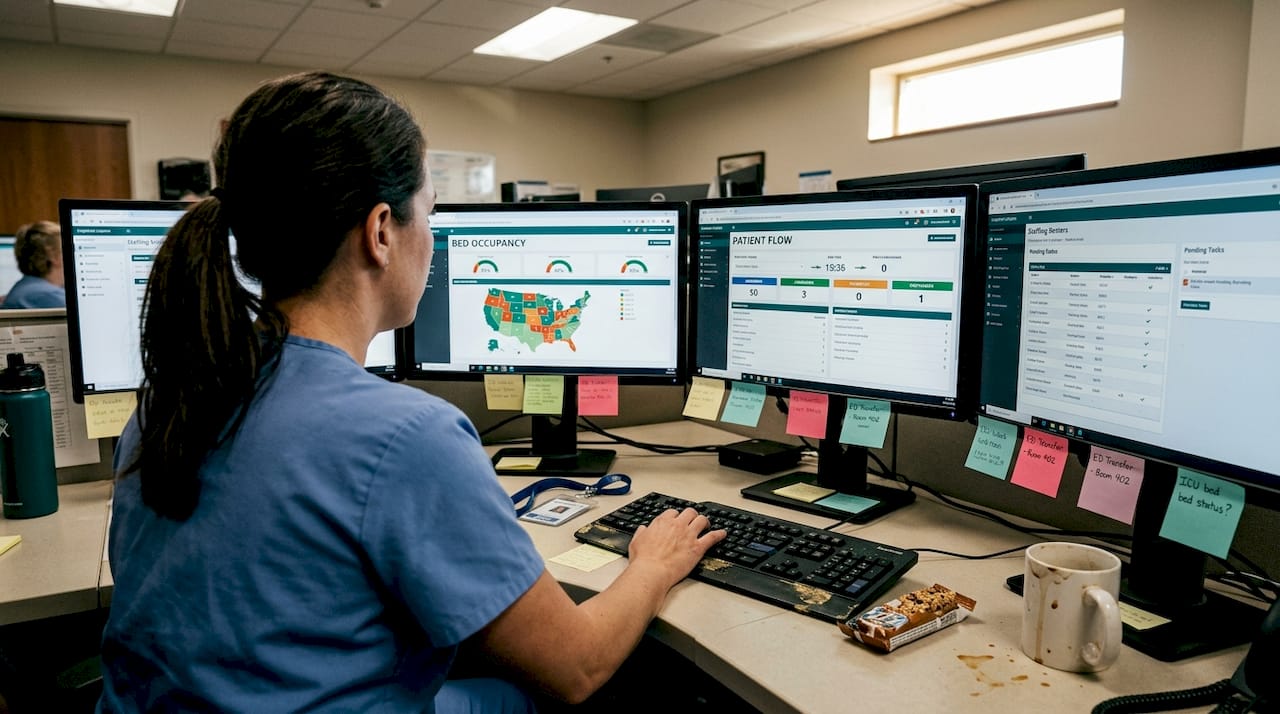
Home health logistics: 5 strategies for better care

TL;DR:Home health logistics involve coordinating scheduling, routing, skill matching, and care continuity.Advanced algorithms like AI and metaheuristics significantly improve efficiency and scalability.Meeting CMS timeliness benchmarks is crucial to reduce costs, improve care, and maximize reimbursements.
The CMS timeliness benchmark for start of care is 2 days from referral. The industry average is now 3.3 days. That gap is not a minor administrative inconvenience. For the 2.7 million Medicare beneficiaries who depend on home health services each year, it represents delayed recovery, increased readmission risk, and compounding costs across the care continuum. For healthcare decision-makers at hospitals, home health agencies, and insurance companies, closing that gap requires more than good intentions. It requires a clear understanding of what home health logistics actually involves, which optimization strategies work, and how regulatory benchmarks translate into operational priorities.
Table of Contents
- What is home health logistics?
- Core methodologies in home health logistics
- Regulatory benchmarks, metrics, and payer impact
- Comparing optimization strategies and real-world applications
- What most experts miss about home health logistics
- Next steps: Solutions for streamlining your home health logistics
- Frequently asked questions
Key Takeaways
| Point | Details |
|---|---|
| Timeliness matters most | Meeting CMS benchmarks for start-of-care is critical for optimal reimbursement and patient outcomes. |
| AI transforms efficiency | AI-driven scheduling cuts travel time by up to 30%, boosting staff productivity and care quality. |
| Multi-objective optimization wins | Balancing cost, continuity, and satisfaction is best achieved with robust, adaptive optimization models. |
| Rural strategy needs | Hybrid staffing and territory clustering help rural agencies manage distance and workload efficiently. |
What is home health logistics?
Home health logistics is the operational discipline of coordinating all the moving parts required to deliver care to patients in their homes. It encompasses scheduling, caregiver routing, skill matching, equipment delivery, and continuity of care management across a geographically dispersed patient population. Unlike facility-based care, home health logistics must account for travel time, patient availability windows, caregiver qualifications, and real-time demand changes, all simultaneously.
The complexity is substantial. A single agency managing hundreds of daily visits must assign the right clinician to the right patient at the right time, while minimizing travel costs and maintaining care continuity across visits. These home health scheduling challenges are compounded by regulatory requirements, payer rules, and patient preferences that shift constantly.
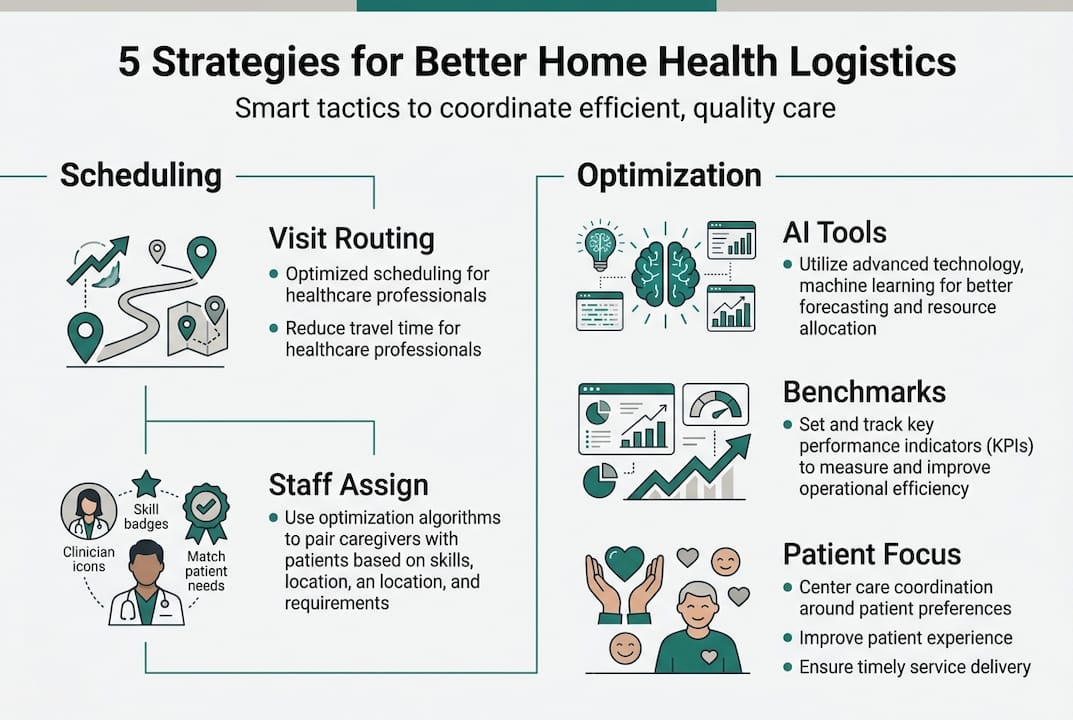
Researchers have formalized this challenge as the Home Health Care Routing and Scheduling Problem (HHCRSP), an extension of the Vehicle Routing Problem that assigns caregivers to patients with maximum efficiency while satisfying multiple constraints. The HHCRSP framework captures the core tension in home health logistics: optimizing for cost and efficiency while preserving clinical quality and patient satisfaction.
The main logistical challenges agencies face include:
- Timeliness: Meeting CMS and payer start-of-care windows without delays caused by scheduling bottlenecks
- Skill mix: Matching the right clinical credentials to each patient’s care plan requirements
- Continuity: Assigning consistent caregivers to the same patients to support therapeutic relationships and reduce errors
- Travel optimization: Minimizing drive time and fuel costs across large or rural service territories
- Patient preferences: Accommodating time windows, language preferences, and caregiver gender requests without breaking scheduling efficiency
These challenges interact with each other in ways that make manual scheduling increasingly untenable. As patient volumes grow and workforce constraints tighten, the organizations that invest in structured logistics frameworks gain a measurable advantage. The same principles that apply to SNF transport logistics apply here: systematic coordination outperforms reactive, case-by-case decision-making every time.
Core methodologies in home health logistics
Leading home health organizations are moving beyond spreadsheets and phone-based coordination toward algorithmic and AI-driven approaches that can handle the scale and complexity of modern operations. The methodologies vary in sophistication, but the performance differences are significant.
AI-driven scheduling reduces travel time by 30% and increases productivity by 25%, according to recent research. These gains come from the ability to process thousands of variables simultaneously, including real-time traffic, caregiver location, patient acuity, and visit duration estimates, and generate optimized schedules faster than any human dispatcher could.
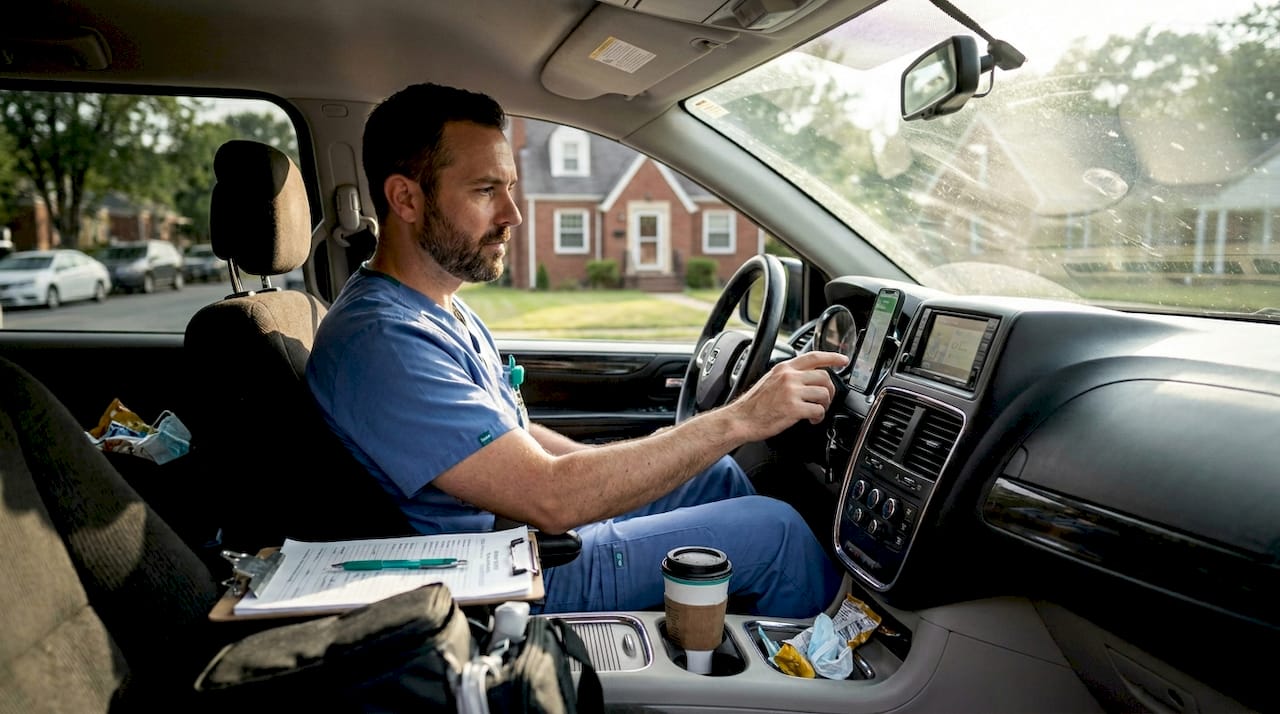
Metaheuristics, a class of optimization algorithms that include genetic algorithms and simulated annealing, are widely used when exact mathematical solutions are computationally impractical. For large agencies with hundreds of daily visits, exact algorithms become intractable. Metaheuristics find near-optimal solutions quickly, making them the practical backbone of most healthcare scheduling software platforms.
Decision support systems add a layer of strategic planning on top of operational scheduling. These tools handle territory districting, fleet management, and workload equity analysis, giving administrators visibility into systemic patterns rather than just daily schedules. Together, these approaches form a tiered methodology that addresses both tactical and strategic logistics needs.
Pro Tip: Use multi-objective optimization to balance cost, patient satisfaction, and continuity simultaneously. Single-objective models that minimize only travel cost often sacrifice continuity, which increases clinical risk and reduces patient satisfaction scores.
| Methodology | Travel time impact | Scalability | Best use case |
|---|---|---|---|
| AI-driven scheduling | Up to 30% reduction | High | Large urban agencies |
| Metaheuristics | Significant improvement | High | Complex multi-constraint environments |
| Decision support systems | Moderate, strategic | Medium | Territory planning, workload equity |
| Traditional manual methods | Minimal | Low | Small agencies, simple geographies |
The HHCRSP technical literature confirms that no single method dominates across all settings. The right approach depends on agency size, geography, payer mix, and workforce structure. What is consistent is that patient logistics technology that integrates scheduling, routing, and real-time visibility produces better outcomes than siloed tools. Organizations exploring these platforms should also review online scheduling best practices to ensure their configuration supports compliance and clinical goals.
Regulatory benchmarks, metrics, and payer impact
Technology alone cannot close the performance gap without a clear understanding of the regulatory standards that define success in home health logistics. CMS has established specific benchmarks through the OASIS-E process measures framework, and performance against these benchmarks directly affects reimbursement, star ratings, and competitive positioning.
The CMS start-of-care benchmark requires that the first skilled visit occur within 2 days of referral. With the industry averaging 3.3 days, a large portion of agencies are consistently missing this target. Across the 2.7 million Medicare beneficiaries receiving home health care annually, that 1.3-day average delay translates into millions of delayed care episodes each year.
The implications extend beyond compliance. Late starts of care are associated with higher rates of hospital readmission, which triggers penalties under the Hospital Readmissions Reduction Program and creates downstream cost pressure for payers. For home health agencies operating under value-based purchasing models, missing timeliness benchmarks reduces bonus payments and increases the risk of contract termination with managed care organizations.
Payer differences add another layer of complexity. Medicare Fee-for-Service operates under standardized OASIS-E reporting requirements, while Medicare Advantage plans impose their own prior authorization timelines, visit frequency limits, and documentation standards. These CMS reimbursement changes require logistics systems that can adapt to multiple payer rules simultaneously, not just a single standardized workflow.
Key metrics that logistics leaders should track include:
- Start-of-care timeliness: Percentage of referrals with first visit within 2 days
- Continuity of care rate: Percentage of visits delivered by the same caregiver across an episode
- Workload equity: Distribution of visit volume and travel burden across the clinical workforce
- Patient satisfaction scores: HHCAHPS results correlated with scheduling consistency
The hospital-at-home care model is raising the stakes further. As more acute care shifts into the home setting, logistics systems must handle higher-acuity patients with tighter clinical windows. The hidden cost of discharge delays compounds when home health logistics cannot absorb the volume and complexity of post-acute transitions efficiently.
Comparing optimization strategies and real-world applications
With benchmarks and methodologies clarified, the practical question becomes which optimization strategy fits a given organization’s operational reality. The answer depends on scale, geography, and the degree of uncertainty in daily operations.
Single-objective optimization focuses on one metric, typically minimizing total travel distance or cost. It is computationally simpler and easier to implement, but it consistently underperforms in real-world settings where clinical quality, continuity, and patient satisfaction must also be managed. Multi-objective optimization addresses this by simultaneously balancing competing priorities, producing solutions that are more robust across the full range of operational constraints.
Exact algorithms, such as integer programming, guarantee optimal solutions but become computationally intractable for large instances. An agency with 500 daily visits across a metropolitan region cannot rely on exact methods for real-time scheduling. Metaheuristics and AI-based heuristics fill this gap, delivering near-optimal solutions at operational speed.
Metaheuristics allow scaling coordination for thousands of daily home health visits, making them the practical standard for high-volume agencies.
Hybrid staffing and territory clustering are particularly valuable in rural settings, where drive times are long and demand is unpredictable. Clustering patients geographically into stable territories reduces travel waste, while hybrid staffing models that blend full-time employees with contracted clinicians provide the flexibility to absorb demand surges without sacrificing continuity.
Applying robust optimization in uncertain environments requires a structured approach:
- Map historical demand patterns by geography and day of week to identify predictable variation
- Build buffer capacity into schedules to absorb same-day cancellations and urgent referrals
- Cluster service territories to minimize cross-zone travel during peak demand
- Implement real-time rescheduling protocols that trigger automatically when disruptions occur
- Review patient care logistics platforms that support dynamic reoptimization throughout the day
| Strategy | Objectives | Scalability | Best use case | Key tradeoff |
|---|---|---|---|---|
| Single-objective | Cost or time | High | Simple, stable operations | Sacrifices quality metrics |
| Multi-objective | Cost, quality, continuity | Medium | Complex payer environments | Higher computational demand |
| Exact algorithms | Optimal solution | Low | Small agencies | Impractical at scale |
| Metaheuristics/AI | Near-optimal, fast | High | Large or rural agencies | Requires data infrastructure |
Organizations that have adopted AI automation efficiency frameworks report faster response times and lower administrative burden, reinforcing the case for moving beyond traditional scheduling approaches.
What most experts miss about home health logistics
Most industry analysis focuses on average performance, which obscures the edge cases that actually determine operational success or failure. The agencies that struggle most are rarely the ones with average complexity. They are the ones managing rural territories with sparse patient density, or urban agencies absorbing sudden demand surges during flu season or post-disaster recovery periods.
Generic optimization models built for average conditions fail precisely when conditions are not average. Tailoring strategies for rural areas and balancing continuity with efficiency are not optional refinements. They are the difference between a logistics system that holds under pressure and one that collapses.
The conventional wisdom that continuity and efficiency are in tension is also worth challenging. Rigid scheduling that prioritizes continuity at all costs creates fragile systems that cannot adapt to staff absences or demand spikes. Flexible, hybrid models that treat continuity as a weighted objective rather than an absolute constraint actually perform better on both dimensions over time. The discharge delays research supports this view: systems that cannot flex under pressure create downstream bottlenecks that affect the entire care continuum.
Pro Tip: Continuity and efficiency are not opposites. Successful logistics leaders balance both using adaptive, robust models that treat continuity as a priority, not a constraint.
Next steps: Solutions for streamlining your home health logistics
Closing the gap between regulatory benchmarks and real-world performance requires more than strategic insight. It requires the right platform infrastructure to execute at scale.
VectorCare’s platform is purpose-built for healthcare organizations seeking to reduce administrative burden, automate scheduling workflows, and gain real-time visibility across their logistics operations. For agencies ready to move from reactive coordination to proactive optimization, the home health providers solutions page outlines specific capabilities designed for your operational context. Decision-makers evaluating their options can also review a structured healthcare logistics software comparison to benchmark platforms against operational needs. The VectorCare patient logistics platform supports the full spectrum of home health coordination, from scheduling to vendor management to compliance reporting.
Frequently asked questions
What is home health logistics and why is it so complex?
Home health logistics manages scheduling, routing, and care assignments for in-home patients, factoring in constraints like clinical skills, time windows, patient needs, and regulatory requirements. The HHCRSP framework captures how these constraints interact, making optimization far more demanding than standard routing problems.
Which technologies have the greatest impact on optimizing home health logistics?
AI-driven scheduling and decision support platforms can reduce travel times by 30% and improve productivity by 25%, making them the highest-impact tools available to home health agencies today.
How do CMS and payer benchmarks influence home health operations?
CMS timeliness benchmarks set strict timing targets for start of care, while payer rules affect prior authorization, visit frequency, and reimbursement rates. Missing these metrics reduces financial returns and increases readmission risk.
Is outsourcing logistics better than managing it internally?
Outsourcing can improve efficiency for large-scale operations where internal capacity is insufficient, but hybrid optimization models that blend internal staff with contracted resources typically deliver the best balance of flexibility and continuity.
How should rural agencies adapt home health logistics?
Rural agencies benefit most from hybrid staffing strategies combined with geographic territory clustering and robust optimization models designed to handle distance variability and unpredictable demand patterns.