Home Care Scheduling Systems: Complete Guide for 2025

Nearly 80 percent of home healthcare providers report that outdated scheduling methods slow down patient care and increase staff stress. As the demand for in-home medical services grows, the need for smarter scheduling has never been more urgent. Home care scheduling systems now offer powerful digital solutions that help healthcare professionals coordinate care more efficiently, improve accuracy, and keep both patients and caregivers connected in real time.
Table of Contents
- Defining Home Care Scheduling Systems
- Key Features and Core Technologies
- Automation, Optimization, and Real-Time Coordination
- Compliance, Privacy, and Healthcare Regulations
- Integrations, Scalability, and Vendor Management
- Best Practices and Common Pitfalls to Avoid
Key Takeaways
| Point | Details |
|---|---|
| Importance of Home Care Scheduling Systems | These systems transform healthcare logistics by improving patient care coordination, workforce management, and service delivery efficiency. |
| Technological Integration | Advanced technologies like machine learning and data integration are essential for optimizing scheduling and adapting to patient needs in real-time. |
| Regulatory Compliance | Adhering to healthcare regulations, particularly HIPAA, is critical for protecting patient information while facilitating seamless care delivery. |
| Vendor Management Strategies | Effective vendor relationships and integration capabilities are key for building scalable, resilient home care scheduling systems that meet evolving organizational demands. |
Defining Home Care Scheduling Systems
Home care scheduling systems represent sophisticated digital platforms designed to coordinate and optimize healthcare service delivery directly to patients’ residences. These advanced technological solutions transform how healthcare organizations manage patient care logistics, workforce allocation, and service coordination. According to research from PubMed, such systems are critical for addressing complex planning challenges involving individual patient requirements, staff qualifications, and intricate service operation interdependencies.
At their core, home care scheduling systems are specialized software platforms that enable healthcare providers to strategically plan, assign, and track home-based medical services. These systems go beyond simple appointment management by integrating multiple sophisticated features like real-time staff tracking, patient matching algorithms, and comprehensive service coordination tools. PubMed research highlights that effective scheduling requires carefully considering individual patient needs, matching those needs with appropriately qualified healthcare workers, and maintaining seamless operational workflows.
Key components of modern home care scheduling systems typically include:
- Intelligent workforce management capabilities
- Real-time patient and staff location tracking
- Automated service matching and assignment algorithms
- Comprehensive compliance and documentation features
- Secure communication channels between healthcare providers
- Dynamic scheduling that adapts to changing patient requirements
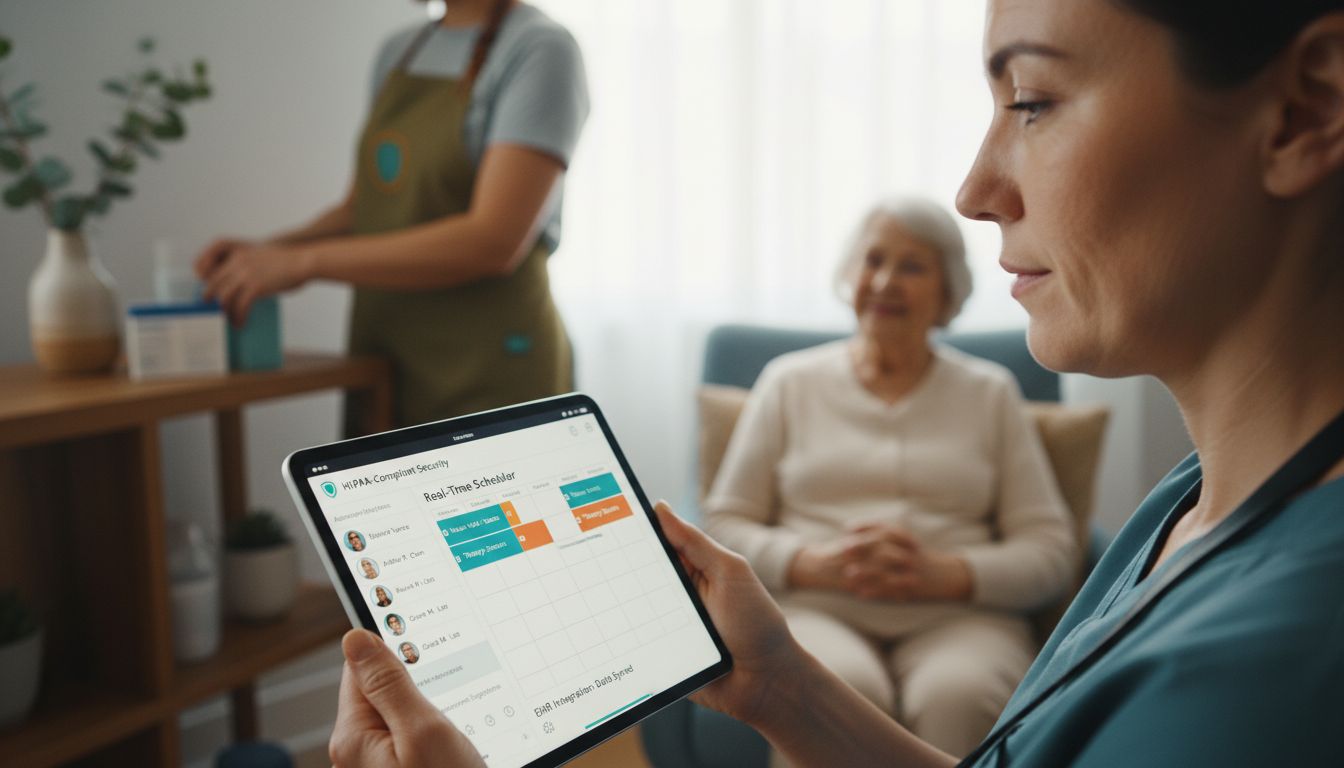
As healthcare continues evolving, understanding online scheduling techniques becomes increasingly important. These systems represent more than technological tools they are strategic solutions designed to enhance patient care, optimize resource allocation, and improve overall healthcare service delivery efficiency. By leveraging advanced digital platforms, healthcare organizations can create more responsive, patient-centered care models that meet the complex and dynamic needs of modern home healthcare services.
Key Features and Core Technologies
Home care scheduling systems leverage cutting-edge technologies to revolutionize healthcare service delivery. According to PMC research, these platforms are increasingly incorporating machine learning algorithms to optimize appointment scheduling, particularly in handling complex service time variations and improving operational efficiency.
The core technological infrastructure of modern home care scheduling systems comprises several sophisticated components. Data integration technologies play a critical role, enabling seamless communication between various healthcare platforms. As highlighted by PMC research, these systems now support advanced ‘Hospital at Home’ services by integrating point-of-care diagnostic capabilities directly into home-based care workflows.
Key technological features include:
- Advanced machine learning matching algorithms
- Real-time geolocation and workforce tracking
- Integrated electronic health record (EHR) systems
- Predictive analytics for service demand forecasting
- Secure, HIPAA-compliant communication channels
- Automated compliance and documentation tools
The technological evolution of home care scheduling systems represents a significant leap forward in healthcare delivery. By understanding online scheduling techniques, healthcare providers can leverage these advanced platforms to create more responsive, efficient, and patient-centered care models. The future of home healthcare lies in these intelligent, interconnected systems that continuously adapt to changing patient needs and technological advancements.
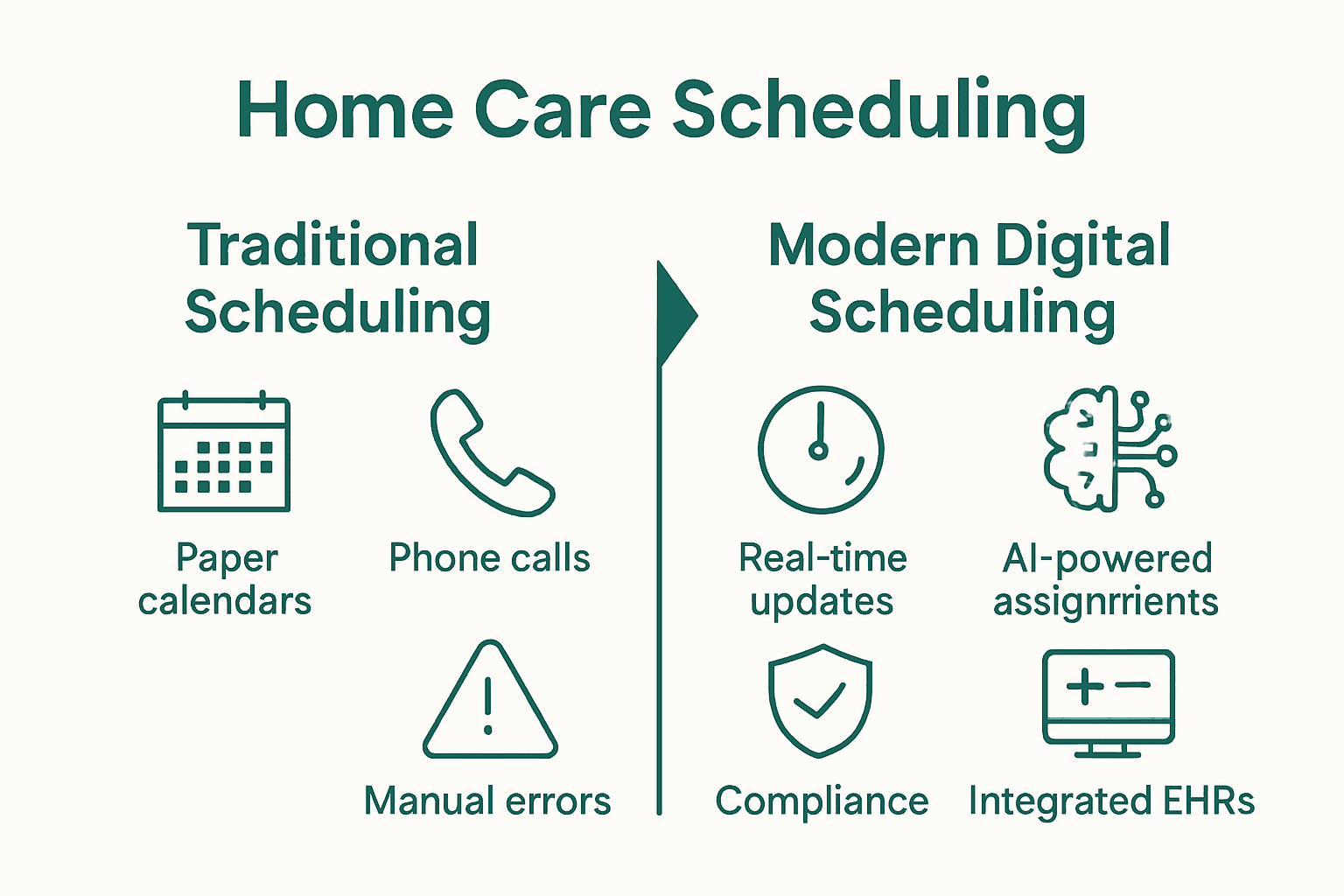
Automation, Optimization, and Real-Time Coordination
Modern home care scheduling systems are transforming healthcare delivery through advanced real-time coordination and sophisticated automation technologies. PMC research highlights the critical importance of optimization models that address complex challenges like uncertain service times, caregiver qualifications, and dynamic workload management.
The optimization strategies in home care scheduling go far beyond traditional linear approaches. As demonstrated by PMC research, cutting-edge models now incorporate nuanced factors like chargeable overtime and precise caregiver-patient preference matching. These advanced algorithms enable healthcare providers to create more responsive, efficient scheduling systems that adapt in real-time to changing patient needs and workforce dynamics.
Key optimization and automation strategies include:
- Predictive routing algorithms
- Dynamic workload balancing
- Real-time caregiver skill matching
- Automated overtime and compensation calculations
- Intelligent patient-caregiver preference alignment
- Continuous performance monitoring and adjustment
By exploring healthcare workflow automation trends, providers can unlock unprecedented levels of operational efficiency. These intelligent systems represent a paradigm shift in home care delivery, transforming scheduling from a static, administrative task into a dynamic, data-driven process that prioritizes patient outcomes, caregiver satisfaction, and organizational effectiveness. The future of home healthcare lies in these sophisticated, interconnected platforms that continuously learn, adapt, and optimize service delivery.
Compliance, Privacy, and Healthcare Regulations
Home care scheduling systems must navigate a complex landscape of healthcare regulatory requirements that prioritize patient privacy and data protection. According to NCBI research, personal health records in home healthcare demand rigorous interoperability standards that ensure patients maintain comprehensive control over their sensitive health information.
The regulatory framework for home care scheduling extends far beyond simple data protection. PMC research examining patient-centered medical home implementations reveals the intricate challenges of maintaining compliance while delivering personalized care. Healthcare providers must balance stringent regulatory requirements with the need for flexible, patient-focused service delivery.
Critical compliance considerations include:
- HIPAA privacy rule adherence
- Secure electronic health record management
- Patient consent and information sharing protocols
- Data encryption and transmission standards
- Regular compliance auditing and reporting
- Staff training on regulatory requirements
By understanding healthcare compliance fundamentals, organizations can develop robust systems that protect patient rights while enabling efficient care delivery. The future of home healthcare compliance lies in intelligent, adaptive platforms that seamlessly integrate regulatory requirements into everyday operational workflows, transforming compliance from a bureaucratic challenge into a strategic advantage for patient care.
Integrations, Scalability, and Vendor Management
Home care scheduling systems demand sophisticated integration capabilities that enable seamless communication across complex healthcare ecosystems. PMC research highlights the critical importance of web-based medical appointment systems that can effectively integrate diverse technological platforms while maintaining robust scalability.
The landscape of vendor management in home care scheduling has evolved dramatically, moving beyond traditional transactional relationships to strategic partnerships. PMC research demonstrates that implementing automated scheduling tools requires careful vendor selection and management strategies that align technological capabilities with organizational objectives. Successful implementations depend on vendors who can provide flexible, adaptable solutions that grow with an organization’s changing needs.
Key considerations for integrations and scalability include:
- Comprehensive API and interoperability support
- Modular system architecture
- Cloud-based infrastructure
- Multi-platform compatibility
- Seamless electronic health record integration
- Adaptive vendor partnership models
By understanding healthcare vendor management principles, organizations can develop more resilient, future-proof home care scheduling systems. The future of healthcare logistics lies in creating interconnected platforms that can rapidly adapt to technological innovations, regulatory changes, and evolving patient care models.
Best Practices and Common Pitfalls to Avoid
Navigating home care scheduling systems requires a strategic approach that balances technological sophistication with practical implementation. Georgia Tech research emphasizes the critical importance of consistency in patient-aide assignments, highlighting that successful scheduling goes far beyond simple logistical matching and requires nuanced, thoughtful approaches.
Researchers have identified multiple complex challenges in home healthcare scheduling. Carnegie Mellon University research suggests that optimization strategies must incorporate sophisticated decision-making frameworks that account for multiple variables simultaneously. The most effective systems use advanced algorithmic approaches that can dynamically adjust to changing patient needs and workforce constraints.
Critical best practices to implement include:
- Maintain consistent caregiver-patient relationships
- Develop flexible scheduling algorithms
- Implement robust communication protocols
- Create comprehensive skill-matching mechanisms
- Enable real-time schedule adjustments
- Prioritize caregiver and patient preferences
- Conduct regular performance evaluations
By exploring vendor management best practices, healthcare organizations can mitigate common scheduling challenges and create more resilient, patient-centered care delivery models. The future of home healthcare scheduling lies in developing intelligent, adaptive systems that seamlessly balance operational efficiency with personalized, high-quality patient care.
Transform Your Home Care Scheduling Challenges into Seamless Solutions Today
Home care scheduling systems face complex challenges like matching patient needs with qualified caregivers, managing real-time updates, and ensuring compliance with healthcare regulations. These pain points often lead to inefficiencies, operational delays, and increased costs that impact both providers and patients. By adopting a platform that prioritizes automation, dynamic scheduling, and AI-driven coordination, you can overcome these obstacles and deliver truly patient-centered care.
VectorCare offers a comprehensive digital platform designed to streamline patient logistics and home health service delivery through features such as intelligent scheduling optimization, secure communication, and robust vendor management. Backed by real-time updates and scalable solutions, it empowers healthcare organizations to reduce administrative burdens and improve outcomes. Learn how you can leverage VectorCare’s innovative scheduling technology to create adaptable, efficient workflows tailored to your needs.
Ready to elevate your home care scheduling process right now?
Explore the future of healthcare logistics with VectorCare. Visit VectorCare’s website to discover how to transform scheduling complexity into operational excellence. Don’t wait—streamline your care coordination today and see lasting improvements in patient satisfaction and organizational efficiency.
Frequently Asked Questions
What are home care scheduling systems?
Home care scheduling systems are advanced digital platforms designed to coordinate and optimize healthcare services delivered to patients at home. They facilitate the planning, assignment, and tracking of home-based medical services by integrating various features such as real-time staff tracking and patient matching algorithms.
What technologies are used in modern home care scheduling systems?
Modern home care scheduling systems leverage technologies like machine learning algorithms for appointment scheduling, data integration technologies for seamless communication, and predictive analytics for forecasting service demand. They may also include geolocation tracking and secure communication channels.
What are the compliance requirements for home care scheduling systems?
Home care scheduling systems must adhere to healthcare regulations such as HIPAA privacy rule, ensuring secure electronic health record management and patient consent protocols. Regular compliance auditing and staff training on regulatory requirements are essential for maintaining adherence.
How can home care scheduling systems improve patient care?
Home care scheduling systems enhance patient care by optimizing resource allocation, ensuring appropriate caregiver assignments, and improving service delivery responsiveness to changing patient needs. They create more patient-centered and efficient care models through advanced scheduling and automation features.