Healthcare Compliance Programs 2026: Cut Violations 50%

Many healthcare leaders think compliance programs exist solely to dodge fines. That’s a costly mistake. These frameworks reduce violations by up to 50% while protecting patient safety and fostering ethical cultures. You need a compliance program that transforms your organization, not just checks boxes. This guide shows you exactly how to build one.
Table of Contents
- Introduction To Healthcare Compliance Programs
- Core Components And Frameworks Of Healthcare Compliance Programs
- Regulatory Foundations And Critical Laws Impacting Compliance Programs
- Common Misconceptions And Challenges In Compliance Program Implementation
- Benefits Of Compliance Programs: Legal Risk Reduction And Patient Care Improvement
- Role Of Compliance Officers And Multidisciplinary Teams
- Technology’s Essential Role In Modern Compliance Programs
- Implementing A Healthcare Compliance Program: Best Practices And Frameworks
- Frequently Asked Questions About Healthcare Compliance Programs
Key Takeaways
| Point | Details |
|---|---|
| Violation Reduction | Effective compliance programs reduce fraud violations by up to 50%, significantly lowering legal risk. |
| Core Framework | Programs require written policies, role-based training, confidential reporting channels, regular auditing, and consistent enforcement mechanisms. |
| Regulatory Drivers | HIPAA, False Claims Act, Stark Law, and Anti-Kickback Statute mandate specific compliance structures and behaviors. |
| Training Impact | Annual compliance training increases employee adherence by 35%, reducing inadvertent violations. |
| Patient Safety Gains | Compliance programs reduce HIPAA data breaches by 20% annually while strengthening organizational ethics. |
Introduction to Healthcare Compliance Programs
A healthcare compliance program is a legally mandated framework under the Federal Sentencing Guidelines for Organizations that reduces criminal liability while promoting ethical conduct. These structured systems go beyond avoiding penalties. They create cultures where staff understand regulations, report concerns without fear, and prioritize patient wellbeing in every decision.
The FSGO requires healthcare organizations to implement programs with specific elements. You must establish compliance standards, assign oversight responsibility, provide training, create reporting systems, conduct audits, enforce disciplinary measures, and continuously improve based on findings. Missing any component weakens your entire framework.
Effective programs serve three primary goals. First, they ensure legal compliance with federal and state healthcare regulations. Second, they build ethical cultures where doing the right thing becomes the default. Third, they protect patient safety by preventing privacy breaches, billing fraud, and substandard care. When you view compliance through this lens, it becomes a strategic advantage rather than a burden.
Your compliance program should include these mandatory elements:
- Written standards and procedures addressing regulatory requirements
- Designated compliance officers with sufficient authority and resources
- Regular training programs tailored to different roles and responsibilities
- Confidential reporting mechanisms for suspected violations
- Ongoing monitoring through internal audits and risk assessments
- Consistent disciplinary processes for policy violations
- Prompt corrective action when issues surface
Understanding healthcare compliance essentials helps you see how these elements connect. The focus extends beyond checking regulatory boxes. You’re building an environment where every team member understands their role in maintaining standards.
Core Components and Frameworks of Healthcare Compliance Programs
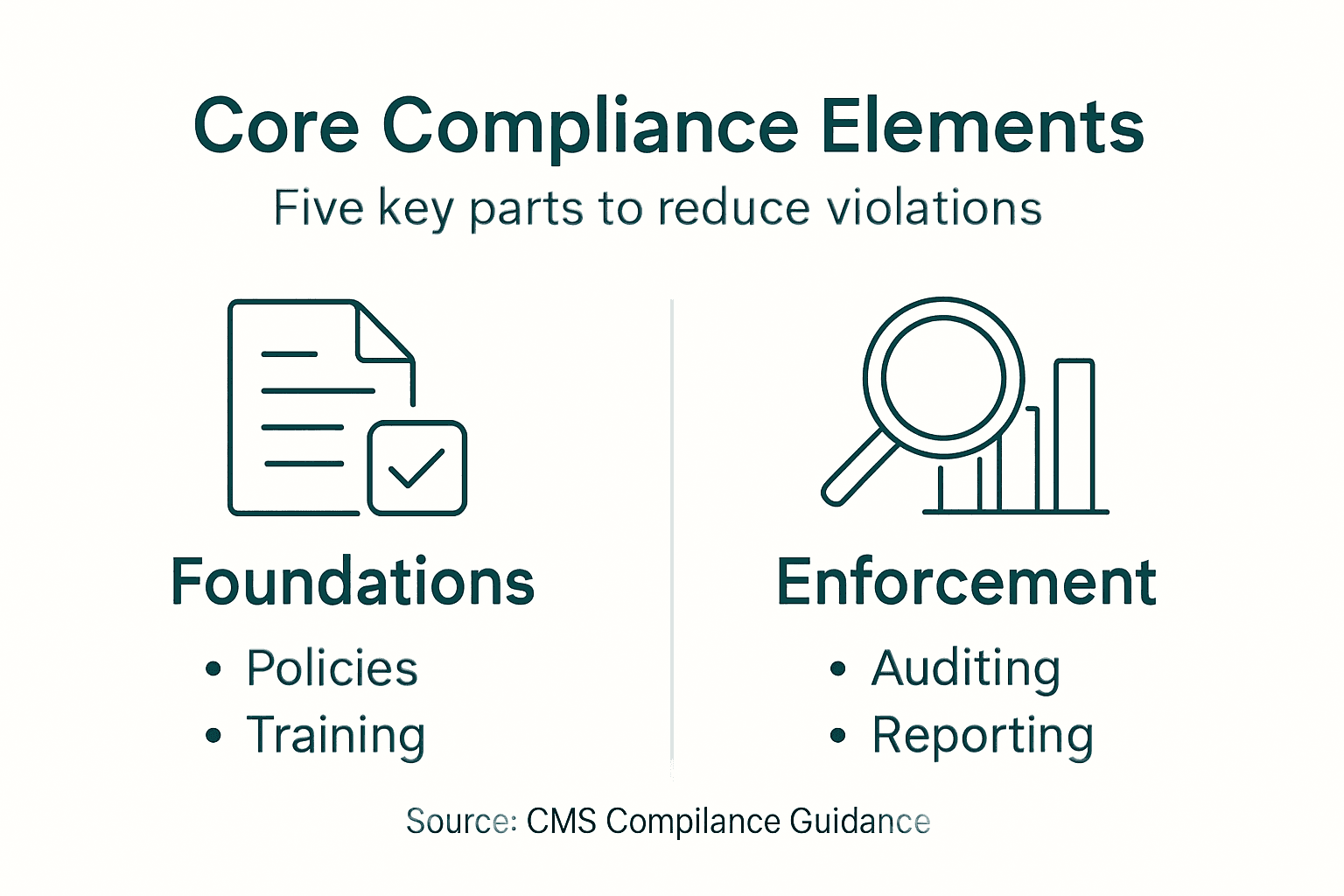
Five core components form the backbone of every successful compliance program. Each element strengthens the others, creating a system that catches problems early and prevents violations before they occur.
Written policies and procedures translate complex regulations into clear actions. Your staff needs plain language guidance on HIPAA privacy rules, billing procedures, referral protocols, and documentation standards. Generic templates fail. Policies must reflect your specific workflows, patient populations, and service models.
Training drives understanding and adherence. Effective compliance training increases employee adherence by 35% when delivered annually with role-specific content. Physicians need different information than billing staff or transport coordinators. Generic sessions waste time and miss critical points.

Communication channels enable early detection. Anonymous hotlines, compliance email addresses, and designated officers give staff safe ways to report concerns. Fear of retaliation kills reporting. You must protect whistleblowers and investigate every complaint seriously.
Monitoring and auditing provide objective performance data. Regular chart reviews, billing audits, and process observations reveal patterns before they become crises. Monthly or quarterly audits catch drift from standards while issues remain manageable.
Enforcement demonstrates commitment. Consistent disciplinary measures show compliance matters. Staff who violate policies face consequences proportional to the severity and intent of their actions. This consistency builds credibility.
CMS Compliance Program Guidance offers a proven framework for structuring these elements. The guidance provides industry benchmarks and best practices developed through years of enforcement experience. Organizations following this framework demonstrate good faith efforts to regulators.
Pro Tip: Customize training by role and risk level. Front desk staff need deep HIPAA knowledge, while clinical teams require billing compliance focus. This targeted approach maximizes retention and application.
| Program Component | Implementation Frequency | Primary Responsibility | Success Metric |
|---|---|---|---|
| Policy Updates | Annually or when regulations change | Compliance Officer | 100% staff acknowledgment |
| Training Sessions | Annually with onboarding | HR and Compliance | 90%+ quiz scores |
| Internal Audits | Quarterly | Compliance Team | Issue detection rate |
| Risk Assessments | Semi-annually | Compliance Officer | Risk mitigation plans |
| Hotline Reviews | Monthly | Compliance Officer | Response time under 48 hours |
Understanding regulatory compliance helps you prioritize which components need immediate attention versus longer-term development.
Regulatory Foundations and Critical Laws Impacting Compliance Programs
Four major federal laws shape healthcare compliance program design and enforcement priorities. Understanding each law’s requirements guides where you focus resources and attention.
HIPAA mandates privacy and security protections for patient health information. Your compliance program must address electronic and physical safeguards, staff access controls, breach notification procedures, and business associate agreements. Organizations with strong compliance programs reduce HIPAA data breaches by 20% annually compared to those with weak or absent programs. Penalties range from $100 to $50,000 per violation, with annual maximums reaching $1.5 million per violation category.
The False Claims Act prohibits submitting fraudulent claims to federal healthcare programs. Compliance programs must prevent upcoding, unbundling, billing for services not rendered, and medically unnecessary procedures. Violations trigger penalties of $11,000 to $22,000 per false claim plus three times the damages. Whistleblowers receive 15% to 30% of recovered funds, creating powerful incentives for employees to report suspected fraud.
The Stark Law forbids physician self-referrals for designated health services when financial relationships exist. Your program needs policies governing physician investments, compensation arrangements, and referral patterns. Violations result in claim denials, refunds, and civil penalties up to $24,000 per service.
The Anti-Kickback Statute criminalizes exchanging anything of value to induce referrals for federal healthcare program services. Compliance programs must monitor marketing arrangements, vendor relationships, and professional courtesy policies. Criminal penalties include fines up to $100,000 and five years imprisonment per violation.
These regulations don’t exist in isolation. Your compliance program must address all four simultaneously while staying current with updates and new guidance. The Federal Sentencing Guidelines for Organizations reward organizations with effective compliance programs through reduced criminal liability and lighter penalties when violations occur.
Learn more about HIPAA compliance requirements specific to patient logistics and care coordination.
Common Misconceptions and Challenges in Compliance Program Implementation
Three persistent myths undermine compliance efforts and waste resources. Dispelling these misconceptions helps you build programs that actually work.
Myth one: Compliance exists only to avoid fines. This narrow view misses the broader purpose. Yes, programs reduce legal risk. But they also create ethical cultures, improve patient outcomes, and build community trust. Organizations viewing compliance as pure risk mitigation miss opportunities to use it as a competitive advantage.
Myth two: Compliance is the compliance officer’s job alone. This siloed approach fails immediately. Effective programs require engagement from leadership, clinical staff, billing teams, IT departments, and every role touching patient care or data. The compliance officer coordinates and monitors, but everyone owns compliance daily.
Myth three: Small organizations don’t need formal programs. Size doesn’t exempt you from regulations. Smaller organizations face the same HIPAA, fraud, and referral laws as large health systems. You can scale program elements to your resources, but you cannot skip them entirely.
Implementation challenges extend beyond misconceptions. Cultural resistance tops the list. Clinical staff often view compliance requirements as bureaucratic interference with patient care. This perception changes when you demonstrate how compliance protects patients and supports quality care rather than hindering it.
Cost concerns create another barrier. Leadership sees compliance as expense rather than investment. Quantifying the cost of violations helps shift this perspective. A single HIPAA breach settlement averages $2.5 million. Compare that to the $150,000 annual cost of a robust compliance program for a mid-sized organization.
Resource constraints particularly impact smaller practices. You lack dedicated compliance staff, training budgets, and audit capabilities. Shared compliance services, online training platforms, and risk-based audit priorities help smaller organizations meet requirements within budget limits.
Pro Tip: Involve clinical champions early in policy development. Physicians and nurses who help write protocols become advocates who explain the clinical rationale to peers, dramatically improving adoption rates.
Benefits of Compliance Programs: Legal Risk Reduction and Patient Care Improvement
Well-designed compliance programs deliver measurable improvements in both legal risk and patient care quality. The data proves these aren’t opposing goals but complementary outcomes.
Organizations with effective compliance programs reduce fraud violations by up to 50% compared to those without structured programs. This reduction stems from better staff training, clearer policies, and early detection systems that catch problems before they become violations. When violations do occur, documented compliance efforts significantly reduce penalties and demonstrate good faith.
Patient safety improvements parallel legal benefits. Compliance programs reduce HIPAA data breaches by 20% annually through stronger access controls, regular security training, and prompt breach response protocols. Fewer breaches mean protected patient privacy and maintained trust.
Financial penalties drop substantially when programs exist. Organizations without compliance programs face maximum penalties and exclusion from federal programs. Those with documented programs receive penalty reductions of 40% to 60% under federal sentencing guidelines. This differential represents millions in potential savings for mid-sized and large organizations.
| Outcome Metric | Before Compliance Program | After Program Implementation | Improvement |
|---|---|---|---|
| HIPAA Violations | 15 per year | 6 per year | 60% reduction |
| Billing Errors | 8% claim error rate | 2% claim error rate | 75% improvement |
| Staff Reporting | 3 concerns reported | 24 concerns reported | 700% increase |
| Audit Findings | 47 issues identified | 12 issues identified | 74% reduction |
| Patient Complaints | 89 per quarter | 34 per quarter | 62% decrease |
“Healthcare compliance programs transform organizational culture from reactive crisis management to proactive risk prevention. The patient safety gains alone justify program investments, with legal protection serving as additional benefit rather than primary driver.”
Accountability improves throughout the organization. Clear standards and consistent enforcement create environments where cutting corners becomes unacceptable. Staff understand expectations and consequences, leading to better decision-making at every level.
Role of Compliance Officers and Multidisciplinary Teams
Compliance officers serve as the central hub coordinating program activities, but success requires broad organizational engagement. Understanding each role’s responsibilities clarifies how programs function effectively.
Compliance officers carry specific duties that cannot be delegated. They develop and update policies reflecting current regulations and organizational practices. They design and deliver training programs addressing identified risks and regulatory requirements. They conduct internal audits revealing process gaps and potential violations. They investigate reported concerns and recommend corrective actions. They serve as primary contacts with regulators and external auditors.
Effective officers possess three critical attributes. First, they have sufficient authority to access information, interview staff, and escalate concerns to leadership without permission. Second, they maintain independence from operational pressures that might compromise objectivity. Third, they communicate effectively across clinical, administrative, and executive audiences.
Multidisciplinary involvement strengthens every program element. Clinical staff provide ground-level insights into workflow realities that policy writers might miss. Billing specialists identify documentation requirements preventing claim denials. IT teams implement technical controls protecting patient data. Legal counsel interprets regulation implications for organizational practices.
Successful teams include representatives from:
- Executive leadership providing resources and setting tone
- Clinical departments implementing policies in patient care
- Revenue cycle staff ensuring billing compliance
- Human resources managing training and disciplinary processes
- Information technology securing data and systems
- Quality improvement linking compliance to clinical outcomes
- Legal counsel addressing regulatory interpretation
This collaborative approach yields practical policies that staff can actually follow. When people who perform the work help design compliance processes, adoption increases dramatically. Problems surface earlier because staff understand why reporting matters and trust that concerns will be addressed fairly.
Compliance officers also facilitate communication between departments that rarely interact. This cross-functional dialogue often reveals systemic issues no single department recognized. For example, billing might discover that clinical documentation doesn’t support medical necessity, leading to joint solutions improving both patient records and revenue integrity.
Explore healthcare compliance officer roles in greater detail to understand career paths and skill requirements.
Technology’s Essential Role in Modern Compliance Programs
Digital tools transform compliance from paper-based chaos into efficient, data-driven systems. Technology doesn’t replace human judgment but amplifies effectiveness and reduces administrative burden.
Automated workflows eliminate manual tracking that inevitably fails. Compliance management software schedules training, tracks completion, sends reminders, and generates reports showing who’s current and who’s overdue. This automation ensures no employee slips through gaps because someone forgot to update a spreadsheet.
Real-time monitoring detects problems immediately rather than months later during retrospective audits. Claims scrubbing software flags potential billing errors before submission. Access logs reveal unusual patterns suggesting data breaches. Scheduling systems identify potential Stark Law violations when physicians refer to entities where they have financial interests.
Data analytics provide insights impossible to gain manually. Pattern recognition algorithms identify trends across thousands of transactions that human reviewers would miss. Predictive models highlight areas of elevated risk warranting focused attention. Dashboards give leadership instant visibility into compliance performance across the enterprise.
Integration with existing healthcare IT systems eliminates duplicate data entry and conflicting information. Compliance tools pulling data directly from electronic health records, billing systems, and scheduling platforms ensure accuracy while reducing staff workload. This integration also enables automated reporting to regulators when required.
Key technology capabilities supporting compliance include:
- Learning management systems delivering role-based training with testing and certification
- Policy management platforms ensuring staff access current versions of procedures
- Incident reporting tools capturing concerns through multiple channels
- Audit management software scheduling reviews and tracking findings through resolution
- Risk assessment applications scoring vulnerabilities and prioritizing mitigation efforts
Scalability represents another critical advantage. Manual processes that work for 50 employees collapse under the weight of 500 or 5,000. Technology scales seamlessly as organizations grow through mergers, acquisitions, or organic expansion.
Discover how technology empowers healthcare compliance through practical applications in patient logistics and care coordination.
Implementing a Healthcare Compliance Program: Best Practices and Frameworks
Building an effective compliance program requires systematic planning and phased implementation. This proven approach works for organizations of any size with appropriate scaling.
Follow these steps sequentially:
- Conduct baseline risk assessment identifying your greatest regulatory vulnerabilities based on services offered, patient populations served, payer mix, and past compliance history.
- Develop written policies and procedures addressing identified risks with clear guidance staff can understand and apply in daily work.
- Designate a compliance officer with sufficient authority, independence, and resources to lead program activities and report directly to executive leadership.
- Implement training programs covering policies, relevant regulations, reporting procedures, and role-specific compliance requirements for every staff member.
- Establish confidential reporting mechanisms including anonymous hotlines, online submission forms, and designated officers who receive and investigate concerns.
- Schedule regular audits examining high-risk areas through chart reviews, billing analysis, and process observations with documented findings and corrective action plans.
- Enforce policies consistently through fair disciplinary processes that apply equally regardless of position or seniority.
- Review program effectiveness annually using audit results, violation trends, staff feedback, and regulatory changes to refine and improve continuously.
Program approaches vary based on organizational resources and complexity. Choose the model aligning with your current capabilities:
| Approach | Best For | Advantages | Disadvantages |
|---|---|---|---|
| Manual Paper-Based | Very small practices under 10 staff | Low initial cost, simple to start | Time-intensive, prone to gaps, hard to scale |
| Technology-Enabled | Mid-sized to large organizations | Automation, real-time data, scalability | Higher cost, implementation time, training needs |
| Hybrid Manual-Digital | Growing practices 10-50 staff | Balanced cost, selective automation | Requires integration planning, partial efficiency |
| Outsourced Services | Smaller practices lacking expertise | Expert guidance, reduced burden | Ongoing costs, less control, vendor dependence |
Framework selection depends on your organization’s complexity. Small single-specialty practices can adapt streamlined templates. Large multi-facility health systems need comprehensive enterprise programs with specialized components for different service lines.
Pro Tip: Start with your highest risks rather than trying to address everything simultaneously. Focus initial efforts on areas with greatest regulatory scrutiny, highest violation potential, or most severe penalty exposure. Build momentum through early wins before expanding to lower-risk areas.
Continuous improvement separates effective programs from checkbox exercises. Use audit findings to identify training gaps, policy ambiguities, and process weaknesses. Update materials immediately when regulations change. Solicit staff feedback on policy practicality and revise procedures that don’t work in real-world conditions.
Enhance Healthcare Compliance with VectorCare Solutions
Implementing the compliance strategies outlined above requires integrated systems supporting both regulatory adherence and operational excellence. VectorCare’s healthcare logistics platform provides the technological foundation enabling compliance while improving patient care coordination.
Our platform automates scheduling, tracking, and documentation for patient transportation, home health services, and durable medical equipment delivery. These capabilities directly support HIPAA compliance through secure communication, access controls, and audit trails. Real-time visibility into patient logistics helps you identify potential compliance issues before they become violations.
The VectorCare platform integrates with existing healthcare IT systems, eliminating data silos that create compliance risks. Automated workflows reduce manual errors while creating documentation proving regulatory adherence. Learn more about non-emergency transportation best practices and discover how improved patient transport satisfaction correlates with stronger compliance cultures.
Frequently Asked Questions about Healthcare Compliance Programs
How often should compliance training be conducted?
Conduct comprehensive compliance training annually for all staff members, with additional onboarding training for new hires within 30 days of employment. High-risk roles such as billing specialists and physicians handling referrals benefit from quarterly focused sessions on specific regulations. Brief refresher training following policy updates or regulatory changes keeps everyone current between annual sessions.
What are typical penalties for non-compliance with HIPAA?
HIPAA penalties range from $100 to $50,000 per violation depending on the level of negligence, with annual maximums of $1.5 million per violation category. Willful neglect violations that aren’t corrected within 30 days carry the highest penalties at $50,000 per violation. Criminal violations can result in fines up to $250,000 and imprisonment up to 10 years for violations committed with intent to sell, transfer, or use protected health information for commercial advantage, personal gain, or malicious harm.
How can small healthcare clinics implement effective compliance programs?
Small clinics should start with risk assessment identifying their greatest vulnerabilities, then prioritize those areas for policy development and training. Online learning management systems provide affordable training without requiring dedicated staff time. Shared compliance officer services allow multiple small practices to split costs while accessing expert guidance. Focus initially on HIPAA privacy and security, billing accuracy, and referral protocols before expanding to other areas.
What role does employee reporting play in compliance success?
Employee reporting serves as your early warning system detecting problems before they become serious violations or harm patients. Staff closest to operations spot irregularities that audits and leadership oversight miss. Anonymous reporting channels encourage disclosure without fear of retaliation. Organizations with active reporting cultures identify and correct issues 60% faster than those relying solely on formal audits, preventing small problems from escalating into major violations.
How do compliance programs improve patient trust and satisfaction?
Patients recognize and value organizations that protect their privacy, bill accurately, and follow ethical practices. Visible compliance efforts such as staff wearing badges, privacy notices in exam rooms, and secure check-in procedures signal professionalism and care. When breaches or errors do occur, established response protocols minimize harm and demonstrate accountability. These factors combine to strengthen patient confidence that their care and information remain safe, directly improving satisfaction scores and retention rates.