Health Compliance Explained: Safeguarding U.S. Operations

A single compliance breach can unravel years of hard work in a healthcare facility. For American compliance officers and logistics managers, every patient transport, supply delivery, and scheduling task is governed by adherence to local, state, and federal laws designed to prevent fraud, abuse, and waste in healthcare operations. Managing compliance means juggling HIPAA privacy standards, billing requirements, and safety protocols across complex operations. This article lays out actionable guidance to help your facility build resilient processes and maintain trust in every aspect of patient logistics.
Table of Contents
- Defining Health Compliance In The U.S.
- Primary Laws And Regulatory Bodies
- Key Compliance Areas: Privacy, Billing, Safety
- Requirements And Roles In Healthcare Organizations
- Risks, Penalties, And Common Pitfalls
Key Takeaways
| Point | Details |
|---|---|
| Understanding Compliance | Health compliance encompasses adherence to laws preventing fraud and ensuring patient safety, privacy, and operational integrity. |
| Key Regulations | Familiarize yourself with vital laws like HIPAA, the Anti Kickback Statute, and the False Claims Act, as they directly impact healthcare logistics operations. |
| Integrated Approach | Focus on privacy, billing, and safety compliance to foster operational excellence and prevent regulatory violations. |
| Active Engagement | Compliance is a collective responsibility; build a robust program that includes all departments and assign clear roles for effective implementation. |
Defining Health Compliance in the U.S.
Health compliance in the United States refers to adherence to local, state, and federal laws designed to prevent fraud, abuse, and waste in healthcare operations. For compliance officers and logistics managers in healthcare facilities, this means understanding that compliance isn’t a single regulation or checkbox. It’s a comprehensive framework spanning patient data protection, treatment standards, ethical principles, and operational integrity. The stakes are real. A single compliance breach can result in substantial penalties, loss of licensure, or damage to your facility’s reputation that takes years to rebuild.
The foundation of health compliance rests on federal legislation and guidance from authoritative bodies like the General Compliance Program Guidance developed by the Department of Health and Human Services Office of Inspector General. This guidance provides voluntary, nonbinding reference material that healthcare organizations use to build their compliance infrastructure. When you’re designing compliance systems for patient logistics operations—managing transportation, home health services, and equipment delivery—you’re essentially ensuring that every action aligns with these federal expectations while protecting vulnerable patients and sensitive health information.
What makes compliance particularly complex for healthcare logistics managers is the intersection of multiple regulatory domains. You’re managing patient privacy requirements under HIPAA, operational standards for medical transportation, state licensing rules for home health services, and billing compliance for durable medical equipment delivery. Each state adds its own layer of requirements, meaning your facility might simultaneously operate under federal guidelines, state health department regulations, and local ordinances. Understanding these requirements prevents costly mistakes that could disrupt patient care or trigger investigations.
At its core, health compliance protects three critical areas: first, it safeguards patient safety by ensuring care meets accepted standards; second, it protects patient privacy and security; third, it prevents financial fraud that drains resources from legitimate patient care. For your operations, this translates directly to reliable processes, secure data handling, and transparent financial practices in everything from scheduling patient transport to managing vendor relationships. Compliance isn’t restrictive—it’s the operational foundation that allows your facility to focus on what matters most: delivering quality care without legal or financial exposure.
Pro tip: Start by mapping your facility’s current logistics workflows against federal compliance requirements, identifying gaps where procedures may not align with regulatory standards—this single exercise often reveals 3 to 5 critical improvements your operations team can implement immediately to strengthen both compliance and efficiency.
Primary Laws and Regulatory Bodies
The regulatory landscape governing healthcare operations in the United States relies on multiple federal laws that compliance officers must understand and implement. These laws don’t exist in isolation. They work together to create a comprehensive system preventing fraud, protecting patient safety, and ensuring ethical business practices. For logistics managers coordinating patient transportation and home health services, knowing which laws apply to your operations determines how you structure everything from data handling to vendor contracts.
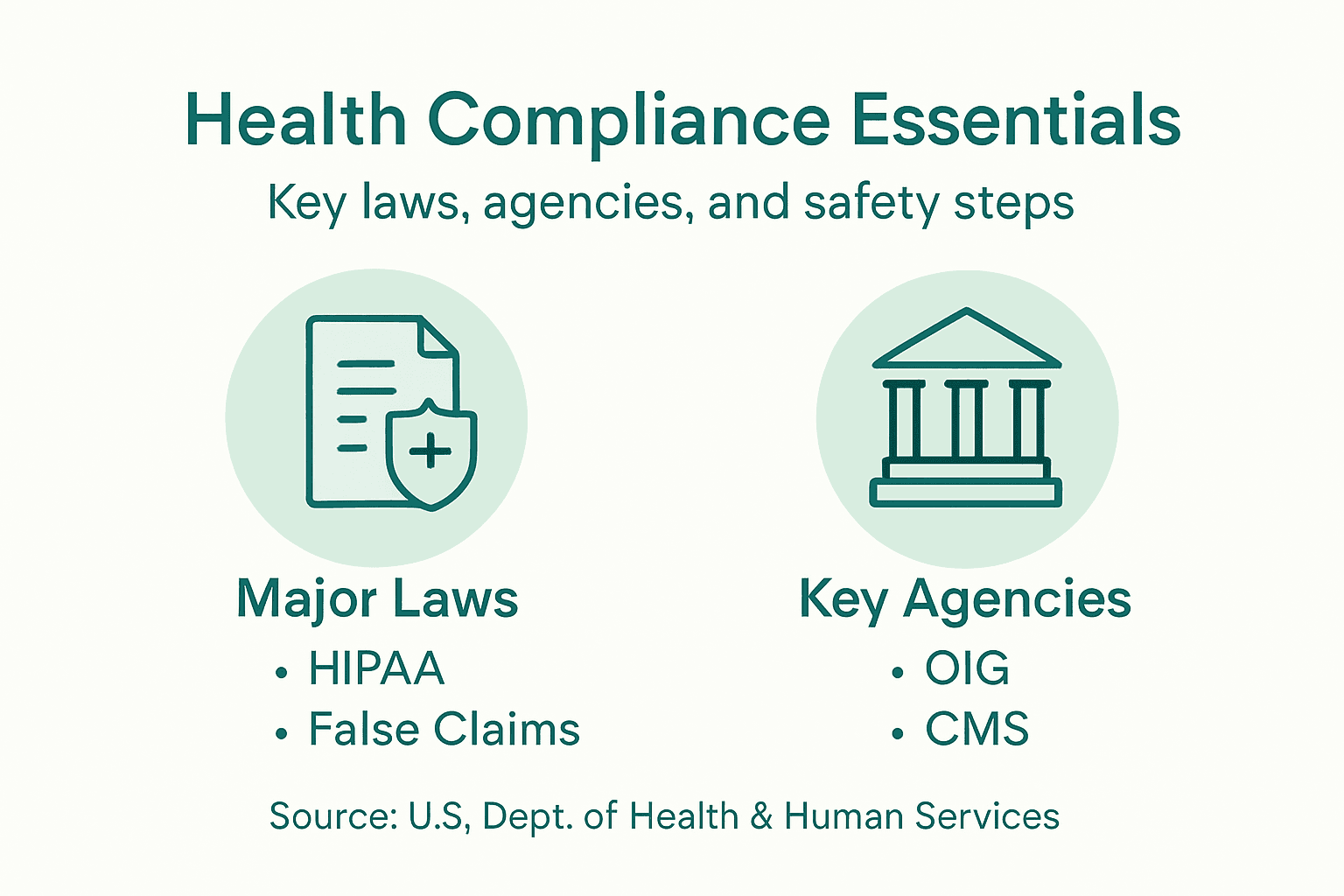
The most foundational law for healthcare facilities is the Health Insurance Portability and Accountability Act, or HIPAA, enacted in 1996. HIPAA establishes federal standards for protecting sensitive patient health information and applies directly to your logistics operations. If your facility manages patient schedules, transport routes, or medical equipment delivery involving protected health information, you’re handling data that HIPAA governs. The law applies to healthcare providers, health plans, healthcare clearinghouses, and business associates—which includes many of your vendors and third party logistics partners. The Department of Health and Human Services enforces HIPAA through Privacy and Security Rules, setting specific requirements for how you collect, store, transmit, and dispose of patient information.
Beyond HIPAA, three additional laws significantly impact healthcare logistics compliance. The Anti Kickback Statute prohibits offering, paying, or receiving anything of value to encourage referrals or generate business in federally funded healthcare programs. The False Claims Act holds healthcare providers liable for submitting fraudulent claims, with penalties that can exceed millions of dollars annually. The Emergency Medical Treatment and Labor Act (EMTALA) requires hospitals to provide emergency services regardless of ability to pay, creating specific compliance obligations for emergency transport and patient stabilization. Each law carries distinct enforcement mechanisms and penalties.

Multiple federal agencies oversee these laws and conduct investigations. The Department of Health and Human Services Office of Inspector General investigates fraud and abuse. The Centers for Medicare and Medicaid Services (CMS) monitors billing compliance and program participation. The Department of Justice prosecutes criminal violations. Understanding which agency enforces which requirement helps your compliance team anticipate audits, respond to inquiries appropriately, and demonstrate good faith compliance efforts. Your state health department adds another enforcement layer, often maintaining stricter requirements than federal standards.
Pro tip: Create a simple compliance matrix listing the five major laws (HIPAA, Anti Kickback Statute, False Claims Act, EMTALA, and Stark Law), their primary enforcement agency, and which of your operations each one affects—this single document becomes your team’s quick reference during vendor onboarding and protocol reviews.
Here’s a summary of how major federal health laws affect healthcare logistics operations:
| Law | Enforcing Agency | Main Impact on Logistics | Example Compliance Risk |
|---|---|---|---|
| HIPAA | HHS Office for Civil Rights | Requires safeguarding patient data | Unencrypted transport schedules |
| Anti Kickback Statute | Office of Inspector General | Prohibits improper referrals | Incentives from transport vendors |
| False Claims Act | Department of Justice | Prevents fraudulent billing claims | Unsupported home visit charges |
| EMTALA | Centers for Medicare & Medicaid Services | Mandates emergency access and documentation | Refusing emergency transport |
| Stark Law | Centers for Medicare & Medicaid Services | Restricts physician self-referrals | Contracts with related suppliers |
Key Compliance Areas: Privacy, Billing, Safety
Healthcare compliance breaks down into three critical operational domains that directly affect how your facility manages patient logistics. Privacy protection, billing accuracy, and workplace safety represent distinct regulatory requirements, yet they intersect constantly in daily operations. Understanding how these areas overlap prevents gaps where violations slip through unnoticed. For compliance officers managing home health services and medical transport, mastering these three domains transforms compliance from a reactive burden into proactive operational excellence.
Privacy and Patient Data Protection forms the foundation of healthcare compliance. Understanding data privacy in healthcare goes beyond HIPAA’s basic requirements. Every patient record you access, every transport route you schedule, and every vendor you contact with patient information triggers privacy obligations. Your facility must implement technical safeguards like encryption, administrative controls such as access restrictions and employee training, and physical security measures protecting paper records and hardware. In logistics operations, this means vetting every third-party vendor handling patient information, creating business associate agreements, and documenting how data flows through scheduling systems, dispatch platforms, and communication channels. A single data breach involving patient names, medical conditions, or insurance information can result in fines exceeding $100 per record, plus notification costs and reputational damage.
Billing Compliance addresses the financial integrity of your operations. Healthcare billing compliance requires following regulations ensuring ethical practices and accurate documentation to prevent fraud and abuse. When your facility bills for patient transport, home health visits, or equipment delivery, every claim must reflect accurate service documentation, proper coding, and legitimate medical necessity. Overbilling, underbilling, and false claims submissions trigger investigations by the Office of Inspector General. For logistics managers, this means establishing clear documentation protocols ensuring every billable service has corresponding evidence of delivery. Improper billing practices expose your facility to penalties, payment recoupment demands, and exclusion from federal healthcare programs.
Workplace Safety under OSHA standards protects your staff. Your logistics and transport personnel face infection exposure, needlestick injuries, and ergonomic hazards. Maintaining safe working conditions includes proper training on bloodborne pathogen exposure, equipment handling, and incident reporting. Safety compliance demonstrates good faith efforts to prevent employee injuries while reducing liability exposure.
These three areas require integrated attention. A patient transport vehicle needs privacy controls for patient information, proper billing documentation of the transport service, and safety equipment for the driver. Addressing each area independently creates blind spots where violations hide.
Pro tip: Audit your current systems by asking three questions for each major logistics process: (1) Are we protecting patient data appropriately? (2) Do we have complete documentation for billing this service? (3) Are staff trained and equipped safely? Missing answers indicate compliance gaps your team should address immediately.
Compare the three main compliance areas in healthcare logistics:
| Compliance Area | How It Protects Operations | Key Failure Example | Improvement Strategy |
|---|---|---|---|
| Privacy/Data Protection | Prevents data breaches & fines | Patient info leaked to vendor | Vendor agreements, encryption |
| Billing Integrity | Ensures valid payments/reimbursements | Overbilling for equipment delivery | Robust documentation protocols |
| Workplace Safety | Protects staff and reduces liability | Staff injury during patient transport | Targeted safety training |
Requirements and Roles in Healthcare Organizations
Building an effective compliance program requires understanding both the structural requirements that regulatory agencies mandate and the specific roles responsible for execution. Your healthcare organization cannot achieve compliance through passive compliance. It demands active, intentional leadership and distributed accountability across multiple departments. For compliance officers and logistics managers, this means knowing what your facility must build, who owns each piece, and how those pieces connect to patient logistics operations.
Healthcare organizations are required to establish comprehensive compliance programs addressing risk assessment, policy development, auditing, and employee education. These aren’t optional enhancements. They’re foundational infrastructure that regulatory agencies expect to find during investigations. Your compliance program must include written policies documenting how your facility handles billing, privacy, reporting mechanisms for staff concerns, and processes for investigating potential violations. You’ll need regular audits evaluating whether operations actually follow these policies, staff training ensuring everyone understands expectations, and disciplinary procedures addressing violations. The compliance structure must also identify a clear chain of command with documented authority to investigate concerns, prevent retaliation, and escalate findings to leadership.
Within this framework, the healthcare compliance officer role becomes critical. Compliance officers develop compliance programs, monitor adherence to federal and state regulations, conduct audits and risk assessments, and train staff to ensure organizational alignment with compliance standards. But here’s what often surprises new compliance officers: this role is fundamentally about risk management, not punishment. Your primary job is identifying where your operations deviate from regulations before regulators discover the problems. That means regularly evaluating your patient logistics processes against applicable laws, looking for gaps where documentation is incomplete, billing practices are questionable, or privacy controls are weak. You’ll conduct targeted audits of specific transport vendors, home health partners, and equipment suppliers to verify they maintain compliance standards. You’ll also lead training programs ensuring your team understands privacy obligations, billing requirements, and safety protocols.
Compliance responsibility extends beyond the compliance officer. Logistics managers must ensure their teams follow established protocols. Finance staff must verify billing accuracy. Information technology staff must maintain privacy controls and security systems. Your facility’s leadership must demonstrate commitment to compliance through budgeting, personnel decisions, and operational prioritization. This distributed accountability means compliance is everyone’s job, but the compliance officer coordinates the overall program and escalates issues requiring leadership attention.
Pro tip: Assign a secondary compliance liaison within your logistics department tasked with flagging potential issues, maintaining vendor compliance documentation, and conducting monthly audits of transport scheduling and billing records—this distributes compliance responsibility and creates early warning systems before problems escalate.
Risks, Penalties, and Common Pitfalls
Compliance failures in healthcare don’t result in gentle warnings. They trigger investigations, financial penalties that can bankrupt facilities, criminal prosecution of executives, and permanent damage to your organization’s ability to serve patients. Understanding the actual consequences of compliance lapses transforms compliance from an abstract regulatory obligation into a concrete business imperative. For compliance officers and logistics managers, recognizing these risks early allows you to prevent violations before they occur.
The financial penalties alone justify serious compliance investment. Civil penalties for healthcare fraud range from $5,500 to $11,000 per violation, and regulators often identify hundreds of violations within a single audit. Facilities submitting false claims face triple damages under the False Claims Act, meaning a $100,000 fraudulent billing can result in a $300,000 penalty plus attorney fees. HIPAA privacy violations carry civil penalties up to $100 per record per violation, and a single data breach affecting 10,000 patient records easily exceeds $1 million in fines. Beyond financial penalties, facilities risk exclusion from Medicare and Medicaid programs, which eliminates 40 to 50 percent of revenue for most healthcare operations. That’s not a fine. That’s operational death.
Common pitfalls in healthcare logistics create compliance exposure. Inadequate vendor documentation represents a frequent failure point. Many facilities use transportation contractors without verifying their compliance history, insurance coverage, or background checks on drivers handling patient information. When a contractor driver breaches patient privacy or causes a preventable transport incident, your facility shares liability despite not directly employing the driver. Documentation gaps in billing trigger audits rapidly. If your system shows a patient transport occurred but lacks corresponding scheduling records, driver logs, or medical necessity documentation, auditors classify it as unsupported billing. Incomplete privacy controls create data breach risk. Patient information accessible through unencrypted email, shared passwords, or unsecured scheduling systems invites both accidental exposure and malicious breaches. Insufficient staff training produces violations through ignorance rather than intentional fraud, yet regulators penalize facilities regardless of intent.
Investigations themselves damage operations. When regulators initiate compliance audits, your staff diverts significant time producing documentation, responding to inquiries, and defending practices. Investigations typically last 6 to 18 months during which your facility operates under uncertainty. If findings are negative, you face remediation costs and ongoing monitoring. Your facility’s reputation suffers even when investigations ultimately find no violations, as news of investigations circulates within the healthcare community and among referring providers.
Pro tip: Conduct an internal self-assessment before regulators do one, documenting findings and corrective actions taken—this demonstrates good faith compliance efforts and significantly reduces penalty amounts if violations are later discovered, sometimes reducing fines by 50 percent or more.
Strengthen Your Health Compliance with Streamlined Patient Logistics
Navigating the complex healthcare regulations like HIPAA, the Anti Kickback Statute, and the False Claims Act demands a proactive approach to compliance. Your logistics operations must protect patient data diligently, ensure accurate billing documentation, and maintain rigorous safety standards to avoid costly penalties and reputational damage. VectorCare understands these challenges and offers a comprehensive digital platform designed to integrate compliance-focused tools directly into your patient transportation, home health services, and equipment delivery workflows.
Empower your compliance officers and logistics managers with features such as AI-driven dispatching, secure communication channels, and vendor management solutions that align with federal and state health requirements. Visit VectorCare now to discover how automated scheduling optimization and real-time updates can reduce operational risks while improving patient outcomes. Don’t wait until a compliance lapse disrupts your care delivery. Take control today with VectorCare’s innovative platform and turn regulatory demands into operational excellence.
Frequently Asked Questions
What is health compliance in the U.S.?
Health compliance in the U.S. refers to adherence to local, state, and federal laws that prevent fraud, abuse, and waste in healthcare operations. It encompasses data protection, treatment standards, and operational integrity.
Why is compliance important for healthcare logistics managers?
Compliance is crucial for healthcare logistics managers to avoid substantial penalties, protect patient data, and ensure ethical practices. Non-compliance can jeopardize patient care and the facility’s reputation.
What are the primary laws affecting healthcare compliance?
The primary laws affecting healthcare compliance include HIPAA, the Anti Kickback Statute, the False Claims Act, EMTALA, and the Stark Law, each governing different aspects of healthcare operations and patient safety.
How can healthcare organizations ensure compliance?
Healthcare organizations can ensure compliance by establishing comprehensive programs that include risk assessments, policy development, training, and regular audits to monitor adherence to regulations.