Emergency Department Patient Satisfaction Strategies

Pressure to deliver outstanding emergency department experiences is higher than ever for American hospitals. For many patients, their satisfaction hinges not just on swift treatment, but on how well they feel informed, respected, and involved every step of the way. Research shows that effective care coordination and clear communication drive perceptions of quality far more than mere wait times. This article explores patient satisfaction through the lens of operational logistics and real-time communication, offering practical insights for every hospital leader.
Table of Contents
- Defining Emergency Department Patient Satisfaction
- Core Factors Influencing Satisfaction Scores
- Operational Variations and Survey Types
- Role of Communication and Environment
- Common Barriers and Risks to Satisfaction
- Logistical Solutions to Boost Satisfaction
Key Takeaways
| Point | Details |
|---|---|
| Holistic Patient Experience | Patient satisfaction in emergency departments requires a focus on quality communication, empathy, and patient-centered care approaches beyond clinical outcomes. |
| Training and Communication | Staff training should incorporate emotional intelligence and communication skills to enhance patient interactions and reduce anxiety. |
| Logistical Improvements | Implementing efficient logistical systems such as real-time tracking and predictive analytics can significantly improve patient flow and satisfaction. |
| Barriers to Satisfaction | Addressing common barriers like wait times and communication breakdowns is essential for enhancing patient perceptions of care quality. |
Defining Emergency Department Patient Satisfaction
Emergency department patient satisfaction represents a comprehensive evaluation of patient experiences during acute care interactions, encompassing far more than traditional clinical metrics. Patient experience complexity involves multiple interconnected dimensions that shape patients’ perceptions of healthcare quality.
At its core, patient satisfaction in emergency departments emerges from several critical components:
- Quality of medical care provided
- Interpersonal communication with healthcare professionals
- Speed and efficiency of treatment
- Emotional support and empathy
- Clear explanations of medical procedures
- Perceived respect and dignity during treatment
Research indicates that patient satisfaction is not merely about clinical outcomes but significantly depends on how patients feel they were treated throughout their emergency care journey. Complex patient experience factors reveal that emotional and interpersonal elements often matter more than pure medical intervention speed.
Understanding these nuanced interactions requires emergency departments to adopt holistic approaches that prioritize comprehensive patient engagement. This means training staff not just in medical protocols, but in communication, empathy, and patient-centered care strategies that transform potentially stressful medical encounters into supportive, reassuring experiences.
Pro tip: Implement structured communication training programs that teach emergency department staff how to balance medical efficiency with genuine human connection and compassionate care.
Core Factors Influencing Satisfaction Scores
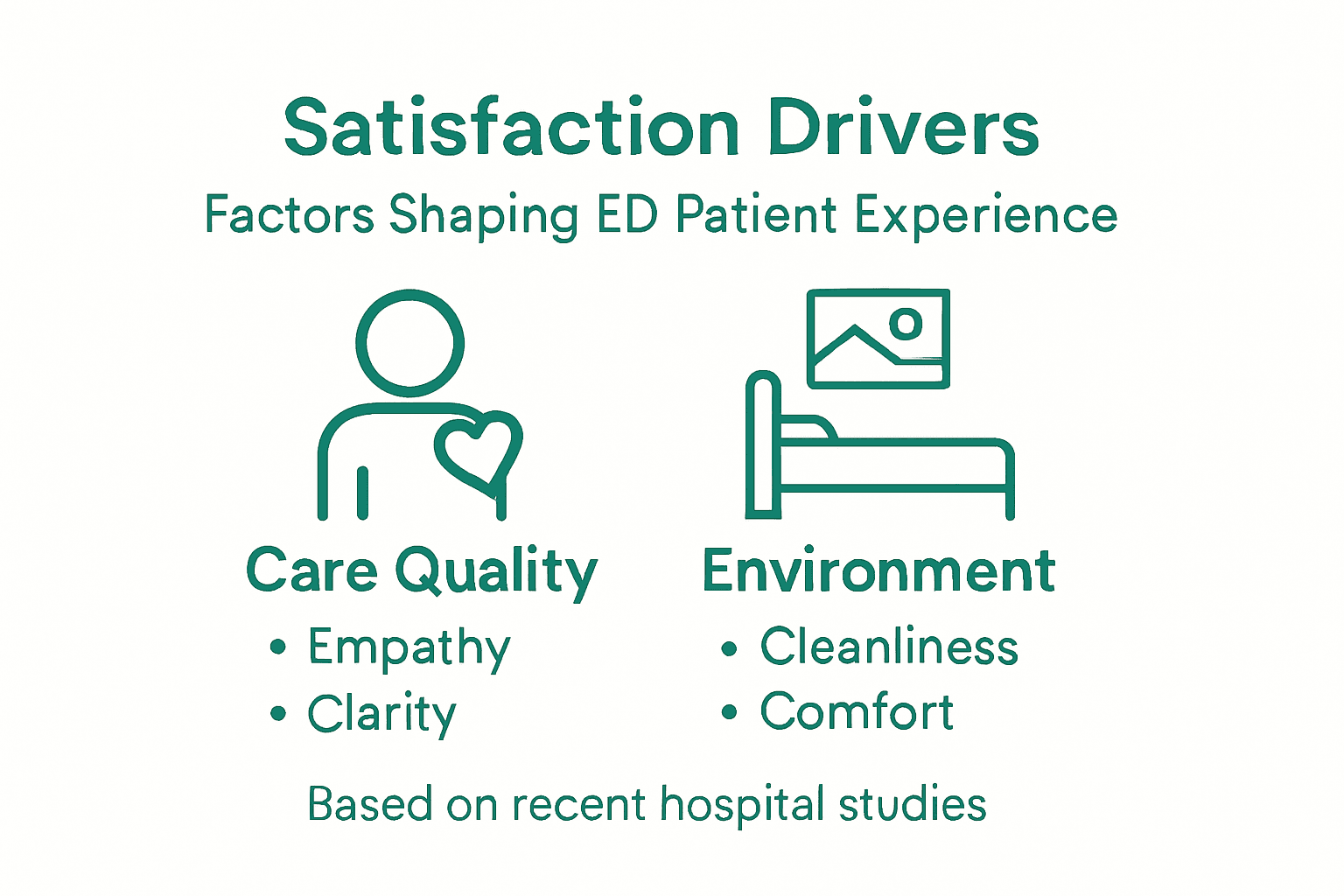
Patient satisfaction in emergency departments is a complex, multidimensional construct driven by several critical interconnected elements. Patient expectations and communication play pivotal roles in determining how patients perceive their healthcare experience.
The core factors influencing satisfaction scores can be categorized into key domains:
- Communication quality and clarity
- Provider empathy and interpersonal skills
- Perceived time and attention from healthcare professionals
- Patient involvement in medical decision-making
- Transparency about treatment plans
- Management of patient expectations
- Physical comfort and environment
Care coordination innovations suggest that emergency departments must move beyond traditional transactional care models. Patients increasingly value holistic experiences that demonstrate genuine concern, clear communication, and a sense of being truly heard and understood.
Successful emergency departments recognize that technical medical expertise alone is insufficient. They must cultivate an environment where patients feel respected, informed, and emotionally supported throughout their care journey. This requires comprehensive staff training that emphasizes not just clinical skills, but also emotional intelligence, active listening, and patient-centered communication strategies.
Pro tip: Implement regular communication skills workshops that train emergency department staff to balance clinical efficiency with compassionate, patient-centered interactions.
Operational Variations and Survey Types
Emergency department patient satisfaction surveys represent complex measurement tools designed to capture nuanced insights into healthcare delivery. Patient satisfaction questionnaire standards have evolved significantly, offering healthcare administrators sophisticated approaches for evaluating patient experiences.
Different survey types provide unique perspectives on patient satisfaction:
- Standard satisfaction surveys
- Standardized questionnaires with numeric rating scales
- Comprehensive experience measurement tools
- Real-time feedback collection methods
- Post-discharge electronic surveys
- Qualitative narrative feedback mechanisms
- Comparative performance benchmark surveys
Emergency department performance metrics demonstrate that effective surveys must balance quantitative measurements with qualitative insights. These measurement tools help hospitals understand not just clinical outcomes, but the entire patient experience landscape.
Successful emergency departments recognize that survey design requires strategic complexity. Modern satisfaction assessments move beyond simple numerical ratings, incorporating sophisticated analysis techniques that reveal deeper patient perceptions about care quality, communication effectiveness, and overall treatment experience.
Here’s a summary of how different emergency department survey tools capture patient satisfaction:
| Survey Type | Measurement Approach | Insights Provided |
|---|---|---|
| Standard Surveys | Fixed questions, basic ratings | Overall satisfaction levels |
| Real-Time Feedback | Immediate responses, digital input | Actionable insights for process improvements |
| Narrative Feedback | Open-ended patient stories | Detailed understanding of patient emotions |
| Benchmark Surveys | Comparative performance analysis | Identification of improvement opportunities |
These approaches vary in their ability to reveal both quantitative trends and qualitative details about patient experience.
Pro tip: Develop multi-dimensional survey instruments that capture both objective performance metrics and subjective patient experience elements to gain comprehensive insights.
Role of Communication and Environment
Patient communication forms the critical backbone of emergency department experiences. Emergency department communication strategies reveal that effective interactions dramatically transform patient perceptions and overall satisfaction levels.
Key communication elements in emergency department settings include:
- Transparent and clear information sharing
- Empathetic and compassionate dialogue
- Active listening techniques
- Consistent updates about treatment progress
- Explaining medical procedures in accessible language
- Managing patient expectations realistically
- Demonstrating genuine care and concern
Patient-centered communication approaches emphasize that the physical environment plays an equally crucial role in patient experience. The emergency department’s physical space can significantly influence patient comfort, anxiety levels, and overall perception of care quality.

Successful emergency departments recognize that communication is a multidimensional process involving verbal and non-verbal interactions. This requires comprehensive training programs that teach healthcare professionals not just medical skills, but also emotional intelligence, cultural sensitivity, and effective communication strategies that reduce patient anxiety and build trust.
Pro tip: Develop standardized communication protocols that emphasize empathy, clarity, and patient-centered language to transform emergency department interactions.
Common Barriers and Risks to Satisfaction
Emergency department patient satisfaction is constantly challenged by complex operational and environmental barriers. Emergency department patient experience risks reveal multiple interconnected factors that can significantly undermine patient perceptions of care quality.
Key barriers to emergency department patient satisfaction include:
- Extended wait times
- Communication breakdowns
- Overcrowded treatment spaces
- Limited patient engagement in decision-making
- Inadequate pain management protocols
- Inconsistent staff interactions
- Insufficient privacy protections
- Complex medical terminology
Emergency department boarding challenges demonstrate how systemic resource constraints directly impact patient experience. When admitted patients remain in emergency departments awaiting inpatient beds, frustration escalates and care quality potentially deteriorates.
Successful emergency departments recognize that addressing these barriers requires comprehensive, multifaceted strategies. This involves not just improving individual interaction points, but redesigning entire patient engagement approaches to create more responsive, empathetic care environments that prioritize patient comfort and understanding.
Pro tip: Develop proactive communication protocols that transparently manage patient expectations and provide consistent, clear updates throughout the treatment process.
Logistical Solutions to Boost Satisfaction
Emergency department logistics represent a critical foundation for improving patient satisfaction. Emergency care system improvements demonstrate that strategic operational redesigns can significantly enhance patient experiences and overall departmental performance.
Key logistical strategies for boosting emergency department satisfaction include:
- Implementing real-time patient tracking systems
- Developing predictive patient flow analytics
- Creating dedicated rapid assessment zones
- Establishing clear communication protocols
- Optimizing staff-to-patient ratios
- Designing efficient triage processes
- Developing transparent wait time communication mechanisms
- Utilizing digital check-in and status update technologies
Hospital-wide patient flow strategies reveal that comprehensive system redesign goes beyond individual interventions. Successful departments focus on holistic approaches that integrate technology, staff training, and patient-centered design principles to create more responsive and efficient care environments.
Emergency departments must view logistical improvements as continuous, dynamic processes. This means continuously analyzing performance metrics, soliciting patient feedback, and adapting systems to meet evolving patient expectations and healthcare delivery challenges.
Compare common logistical solutions by their impact on emergency department satisfaction:
| Solution | Operational Benefit | Patient Experience Effect |
|---|---|---|
| Rapid Assessment Zones | Faster triage and care | Reduced wait and anxiety |
| Digital Check-In Systems | Streamlined patient entry | Improved transparency and control |
| Predictive Analytics | Optimized staffing and flow | Shorter delays and more comfort |
| Quarterly Audits | Ongoing system improvement | Higher reliability and trust |
Different logistical interventions address unique aspects of efficiency and perception.
Pro tip: Implement quarterly operational audits that systematically assess patient flow bottlenecks and develop targeted improvement strategies.
Enhance Emergency Department Patient Satisfaction with Smarter Logistics
Emergency departments face critical challenges such as extended wait times, communication breakdowns, and overcrowded treatment spaces that can diminish patient satisfaction. This article highlights how effective communication, transparent updates, and streamlined patient flow are essential to transform the patient experience into one centered on empathy and efficiency. Addressing these pain points requires comprehensive logistical solutions that reduce delays and foster genuine patient-centered care.
VectorCare provides an innovative digital platform designed to tackle these exact challenges. With features like real-time patient tracking, AI-driven dispatching, scheduling optimization, and secure communication, VectorCare empowers emergency services to deliver faster assessments and clear, consistent updates. By integrating logistics management with patient coordination, healthcare providers can enhance operational efficiency while building trust and respect with patients during the most critical moments.
Take control of your emergency department satisfaction strategies today by exploring how VectorCare’s suite of tools can help you reduce delays, improve communication, and optimize patient flow. Discover more at VectorCare and see how advanced logistics can make a meaningful difference in patient experience.
Ready to redefine patient satisfaction in your emergency department Join the growing number of healthcare organizations improving care coordination and operational outcomes with VectorCare. Visit VectorCare now to learn how streamlined logistics can transform your emergency care delivery.
Frequently Asked Questions
What are the key factors influencing patient satisfaction in emergency departments?
The key factors influencing patient satisfaction include communication quality, provider empathy, perceived time and attention, patient involvement in decision-making, transparency about treatment plans, and the overall physical comfort of the environment.
How can emergency departments improve patient communication?
Emergency departments can enhance patient communication by training staff in empathy, active listening, and providing clear, accessible explanations of medical procedures and treatment progress.
What types of surveys are effective for measuring emergency department patient satisfaction?
Effective surveys include standard satisfaction surveys, real-time feedback collection, comprehensive experience measurement tools, and qualitative narrative feedback mechanisms to capture both quantitative and qualitative insights.
What logistical solutions can boost patient satisfaction in emergency departments?
Logistical solutions to improve patient satisfaction include implementing real-time patient tracking systems, predictive patient flow analytics, dedicated rapid assessment zones, and clear communication protocols about wait times and care processes.
Recommended
- Understanding Improving Patient Satisfaction in Hospital Care Settings
- How Can Hospitals Improve Patient Satisfaction in 2025
- 7 Ways to Improve Patient Satisfaction Scores
- 8 Creative Ways to Increase Patient Satisfaction
- Practical examples of customer service principles in EMS | The Public Safety Consulting Group