Effective Communication in Healthcare Leadership: Driving Patient-Centered Results

Every hospital executive understands that when communication falters, patient safety is at risk and team performance suffers. As communication failures are recognized by the World Health Organization as major causes of medical errors and adverse events, hospital leaders must prioritize building strong communication strategies. This article explores the core principles that empower healthcare teams, offering actionable guidance for leaders seeking to create a culture defined by clarity, mutual trust, and superior patient outcomes.
Table of Contents
- Core Principles of Communication in Healthcare Leadership
- Common Barriers and Misconceptions in Team Communication
- Types and Channels: Digital, Face-to-Face, and Hybrid Models
- Integrating Communication Tools and Technologies
- Leadership Tactics for Engaging and Aligning Stakeholders
- Risks of Poor Communication and How to Avoid Them
Key Takeaways
| Point | Details |
|---|---|
| Effective Communication is Essential | Clarity, active listening, and cultural competence are critical for enhancing patient care and team dynamics in healthcare leadership. |
| Address Barriers to Communication | Recognize and mitigate time constraints, language differences, and hierarchical structures to improve team communication. |
| Utilize Multiple Communication Channels | Adopt digital, face-to-face, and hybrid models to ensure flexible and effective communication across diverse healthcare interactions. |
| Cultivate a Culture of Transparency | Foster an environment where open dialogue is encouraged, promoting trust and understanding among all stakeholders. |
Core Principles of Communication in Healthcare Leadership
Effective communication is the foundation of exceptional patient care. In healthcare leadership, communication transcends simple information exchange - it represents a strategic approach to building trust, ensuring safety, and delivering superior patient outcomes. Effective communication practices are critical for healthcare teams to operate seamlessly and provide comprehensive patient-centered care.
The core principles of communication in healthcare leadership revolve around several key strategies:
- Clarity and Precision: Eliminate ambiguity in medical instructions and patient interactions
- Active Listening: Demonstrate genuine engagement with patients and team members
- Cultural Competence: Respect diverse backgrounds and communication styles
- Empathy: Connect emotionally while maintaining professional boundaries
- Transparency: Share information openly and honestly across all organizational levels
Healthcare leaders must recognize that communication failures can directly impact patient safety. Research indicates that miscommunication contributes significantly to medical errors and adverse events. By implementing structured communication protocols, leaders can mitigate risks and enhance overall care quality.
Successful communication requires a multifaceted approach that integrates technological tools, interpersonal skills, and organizational support. Secure communication platforms enable real-time information sharing, while comprehensive training programs help healthcare professionals develop advanced communication competencies.
Effective communication is not just about transmitting information - it’s about creating understanding, building trust, and ensuring patient safety.
Pro tip: Implement regular team communication workshops that focus on active listening, conflict resolution, and cultural sensitivity to continuously improve interpersonal skills.
Common Barriers and Misconceptions in Team Communication
Healthcare communication encounters numerous complex challenges that can significantly compromise patient care and team effectiveness. Communication barriers in healthcare are multifaceted, involving psychological, cultural, and systemic obstacles that require strategic interventions and nuanced understanding.
The most prevalent barriers in team communication include:
- Time Constraints: Limited interaction windows reducing comprehensive dialogue
- Language Differences: Potential misunderstandings across diverse professional and cultural backgrounds
- Hierarchical Structures: Power dynamics that inhibit open, transparent communication
- Emotional Complexity: Personal biases and emotional states affecting information exchange
- Technological Limitations: Inconsistent communication platform integration
Healthcare leaders must recognize that misconceptions about communication can be as damaging as direct communication failures. Many teams mistakenly believe that standardized protocols alone can resolve complex interpersonal communication challenges. In reality, effective communication requires continuous training, emotional intelligence, and a commitment to understanding individual and team dynamics.
Addressing these barriers demands a comprehensive approach that goes beyond technical solutions. Interpersonal skills training and creating psychologically safe environments where team members feel empowered to speak openly are crucial. Organizations must invest in developing communication competencies that transcend traditional hierarchical and professional boundaries.
Effective team communication is not about eliminating differences, but creating a framework where diverse perspectives can be heard, understood, and integrated.
Pro tip: Implement monthly interdisciplinary communication workshops that simulate real-world scenarios and provide structured feedback to help teams develop more nuanced communication strategies.
Types and Channels: Digital, Face-to-Face, and Hybrid Models
Healthcare communication has evolved dramatically, requiring leaders to master multiple interaction channels. Communication strategies in healthcare now demand sophisticated approaches that blend technology with personal interaction, recognizing that no single method provides a comprehensive solution.
Three primary communication models emerge as critical for modern healthcare teams:
- Digital Channels
- Secure messaging platforms
- Telehealth consultations
- Electronic health record communications
- Video conferencing tools
- Face-to-Face Interactions
- Patient consultations
- Interdisciplinary team meetings
- Emergency case discussions
- Complex treatment planning
- Hybrid Communication Models
- Blended virtual and in-person workshops
- Asynchronous collaborative platforms
- Remote-plus-local team coordination
Each communication channel carries unique strengths and limitations. Digital platforms enable rapid information exchange and documentation, while face-to-face interactions provide nuanced emotional understanding and immediate feedback. Hybrid models represent the most sophisticated approach, allowing healthcare professionals to leverage the best attributes of both digital and in-person communication strategies.

Here’s a comparison of healthcare communication models and their distinct advantages:
| Communication Model | Ideal Use Cases | Main Advantages | Typical Limitations |
|---|---|---|---|
| Digital | Remote consults, documentation | Fast information transfer | Limited nonverbal cues |
| Face-to-Face | Complex decisions, emotional care | Rich feedback and empathy | Scheduling challenges |
| Hybrid | Training, multi-site teams | Flexible, blends strengths | Requires robust infrastructure |
Successful healthcare leaders must develop communication agility, seamlessly transitioning between channels based on context, urgency, and stakeholder needs. This requires ongoing training, technological proficiency, and a deep understanding of communication’s psychological and practical dimensions.
Effective communication is not about choosing one channel, but orchestrating multiple channels to create a comprehensive, responsive dialogue.
Pro tip: Develop a communication matrix that maps appropriate channels for different types of healthcare interactions, ensuring teams know exactly when to use digital, face-to-face, or hybrid approaches.
Integrating Communication Tools and Technologies
Healthcare organizations increasingly rely on sophisticated technological solutions to streamline communication and enhance patient care. Communication technologies in healthcare leadership represent a complex ecosystem of interconnected tools designed to improve information flow, collaboration, and decision-making processes.
Key communication technologies for healthcare leaders include:
- Electronic Health Record (EHR) Systems
- Centralized patient information repositories
- Real-time medical history tracking
- Secure interdepartmental information sharing
- Automated documentation workflows
- Telemedicine Platforms
- Virtual consultation capabilities
- Remote patient monitoring
- Secure video communication
- Digital prescription management
- Collaborative Communication Tools
- Instant messaging systems
- Secure team communication channels
- Project management integrations
- Cross-departmental coordination software
Digital integration requires more than simply implementing new technologies. Successful healthcare leaders must develop comprehensive strategies that address staff training, technological compatibility, and organizational culture. This approach ensures that communication tools enhance rather than complicate existing workflows.
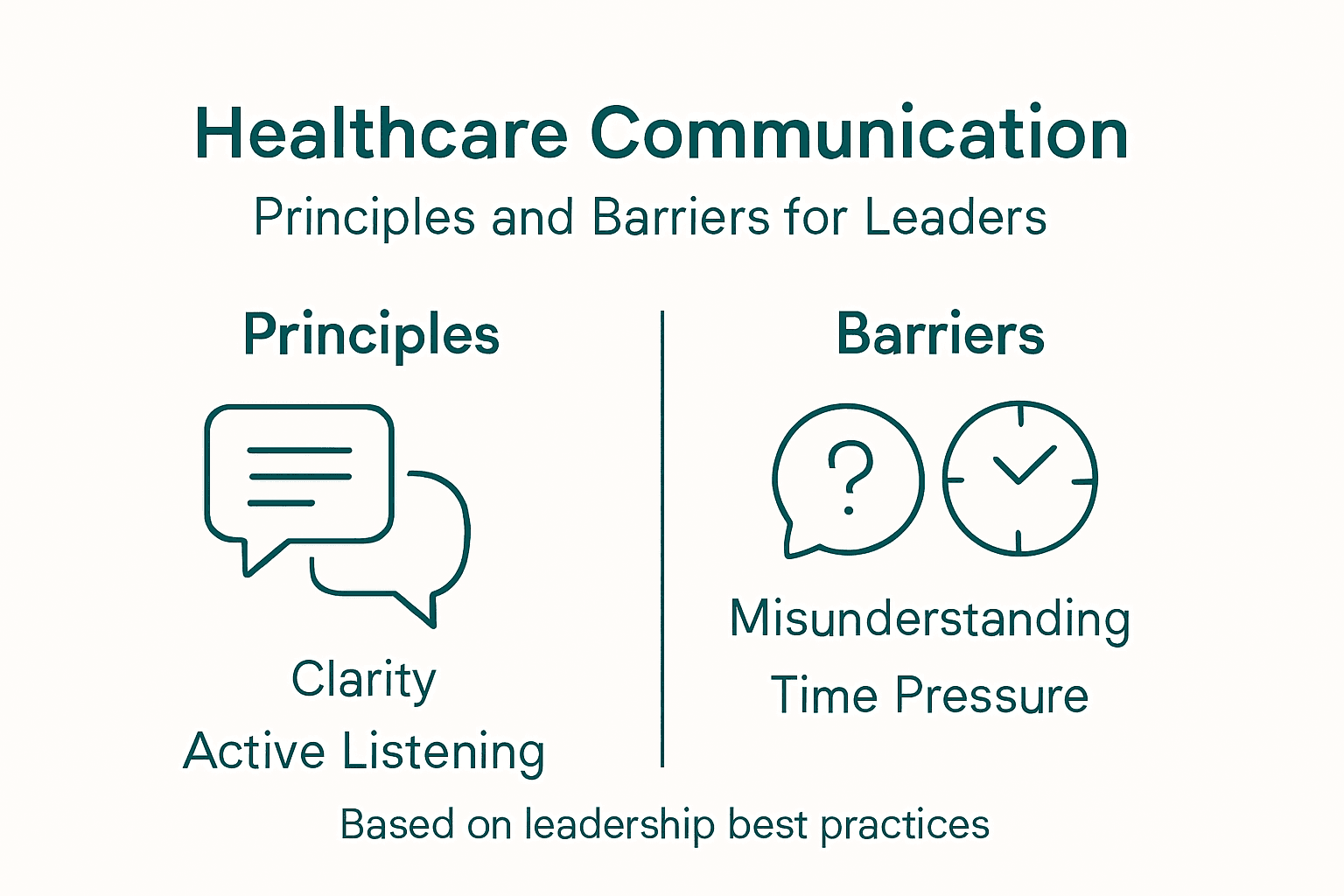
The most effective communication technologies seamlessly blend user-friendly interfaces with robust security protocols. Healthcare organizations must prioritize systems that offer intuitive design, comprehensive training programs, and continuous technical support to maximize adoption and effectiveness.
Summary of technology integration strategies that drive successful healthcare team communication:
| Strategy | Key Benefit | Required Support |
|---|---|---|
| Comprehensive staff training | Improves tool adoption | Ongoing education |
| User-friendly tool selection | Minimizes training time | Technical evaluation |
| Regular performance audits | Identifies issues early | Staff feedback loops |
| Security protocol adherence | Protects patient data | IT oversight |
Technological integration is not about replacing human interaction, but empowering healthcare professionals with tools that amplify their communication capabilities.
Pro tip: Conduct quarterly technology audits to assess communication tool effectiveness, gathering feedback from staff to identify potential improvements and emerging technological needs.
Leadership Tactics for Engaging and Aligning Stakeholders
Successful healthcare leadership requires a nuanced approach to stakeholder engagement that transcends traditional management techniques. Healthcare leadership competencies demand a sophisticated understanding of interpersonal dynamics, strategic communication, and collaborative frameworks that unite diverse professional groups around shared patient-centered objectives.
Key tactics for effective stakeholder engagement include:
- Communication Strategies
- Customize communication style for different audiences
- Practice active and empathetic listening
- Maintain transparency and consistent messaging
- Create opportunities for open dialogue
- Relationship Building
- Develop trust through consistent actions
- Recognize individual and team contributions
- Demonstrate genuine commitment to team success
- Foster psychological safety
- Conflict Resolution
- Address disagreements constructively
- Seek collaborative solutions
- Mediate discussions objectively
- Promote mutual understanding
Emotional intelligence plays a critical role in stakeholder alignment. Healthcare leaders must navigate complex interpersonal landscapes, balancing professional expectations with individual team member needs. This requires a delicate approach that combines strategic vision with genuine human connection.
The most effective leaders create inclusive environments where every stakeholder feels valued and understands their unique contribution to patient care. By promoting a culture of mutual respect and shared purpose, leaders can transform potential conflicts into opportunities for collaborative innovation.
Stakeholder engagement is not about compliance, but about creating a shared vision that inspires and motivates every team member.
Pro tip: Implement monthly cross-departmental listening sessions where leaders actively solicit feedback and demonstrate commitment to team perspectives and organizational improvement.
Risks of Poor Communication and How to Avoid Them
Healthcare communication failures represent a critical patient safety challenge with potentially life-threatening consequences. Communication risks in healthcare can lead to complex systemic problems that compromise patient care, team performance, and organizational effectiveness.
The most significant risks of poor communication include:
- Patient Safety Risks
- Medical errors and misdiagnoses
- Medication administration mistakes
- Delayed or incorrect treatment protocols
- Inadequate patient handoff information
- Organizational Performance Risks
- Decreased staff morale
- Higher employee turnover rates
- Reduced operational efficiency
- Increased legal and financial liabilities
- Interpersonal Breakdown Risks
- Erosion of team trust
- Communication silos between departments
- Reduced collaborative problem-solving
- Increased workplace conflict
Systemic communication failures demand proactive, multilayered prevention strategies. Healthcare leaders must implement comprehensive approaches that address both technical communication infrastructure and human behavioral factors. This requires creating organizational cultures that prioritize transparent, empathetic, and precise information exchange.
Successful risk mitigation involves developing standardized communication protocols, investing in continuous team training, and fostering psychological safety where healthcare professionals feel comfortable reporting potential communication gaps. By recognizing communication as a critical clinical skill, organizations can transform potential risks into opportunities for improved patient care.
Communication is not just about transmitting information - it’s about ensuring understanding, safety, and trust.
Pro tip: Develop a structured communication audit process that regularly evaluates team communication effectiveness, identifying potential risks before they escalate into critical failures.
Enhance Healthcare Leadership Communication with VectorCare
Effective communication is essential for healthcare leaders who want to build trust, streamline coordination, and ensure patient-centered results. This article highlights challenges like miscommunication risks, the need for secure and transparent channels, and leveraging hybrid communication models. If managing complex logistics while maintaining clear, real-time communication feels overwhelming, VectorCare offers a comprehensive digital platform crafted to ease these very pain points.
VectorCare empowers healthcare professionals with AI-driven dispatching, secure communication tools, and real-time updates that reduce delays and operational costs. By integrating scheduling optimization and vendor management, leaders can improve collaboration across diverse teams and stakeholders. Discover how streamlined patient logistics can transform your communication strategy and support safer patient outcomes today. Take action now by exploring VectorCare and see how advanced healthcare communication tools make a difference.
Frequently Asked Questions
What are the core principles of communication in healthcare leadership?
The core principles include clarity and precision, active listening, cultural competence, empathy, and transparency, all essential for enhancing patient care and team operations.
How can healthcare leaders improve team communication and reduce barriers?
Healthcare leaders can improve communication by investing in interpersonal skills training, addressing psychological safety, and implementing structured communication protocols while fostering an environment that encourages open dialogue.
What are the risks associated with poor communication in healthcare?
Poor communication can lead to patient safety risks such as medical errors and misdiagnoses, organizational performance risks including decreased staff morale and higher turnover rates, and interpersonal breakdown risks that erode team trust and collaboration.
What role does technology play in enhancing communication in healthcare leadership?
Technology plays a significant role by providing tools such as electronic health records, telemedicine platforms, and collaborative communication tools that streamline information flow, enhance collaboration, and improve overall patient care.
Recommended
- Understanding Leadership Skills in Healthcare
- Improving Patient Communication: 2025 Strategies for Healthcare Teams
- Improving Patient Communication: 2025 Strategies for Healthcare Teams
- Secure Healthcare Communication Solutions for 2025 Providers
- Complete Guide to Team Communication Improvement Tips - Blog