Essential best practices for DME providers: optimize patient care

TL;DR:Preventable process breakdowns like missing documentation cause claim denials and affect patient access.Implementing best operational practices and tracking KPIs enhance efficiency and compliance.Patient satisfaction improves through timely delivery and proactive communication, serving as a key differentiator.
Claim denials, documentation gaps, and delayed deliveries are among the most persistent operational threats facing durable medical equipment providers today. Many of these failures trace back not to intent but to preventable process breakdowns, from missing Standard Written Orders to inconsistent proof of delivery records. For DME providers and healthcare administrators, the cost of these missteps extends beyond revenue loss, directly affecting patient access to critical equipment. This guide presents a structured, evidence-based approach to compliance, operational efficiency, performance measurement, and patient service, giving your organization the tools to reduce administrative burden and deliver better outcomes.
Table of Contents
- Understanding compliance requirements for DME providers
- Key operational best practices for DME businesses
- Tracking and measuring performance metrics
- Enhancing patient service and satisfaction
- A fresh perspective: Why patient-centric logistics is the ultimate differentiator
- Ready to streamline your DME operations?
- Frequently asked questions
Key Takeaways
| Point | Details |
|---|---|
| Meet compliance standards | Prioritize accurate documentation and supplier accreditation to avoid costly claim denials and regulatory setbacks. |
| Optimize workflow | Digitize proof of delivery and automate processes to accelerate inventory turnover and reduce manual errors. |
| Track key performance metrics | Monitor claim denial rate, clean claim rate, and timely delivery to assess and improve business health. |
| Focus on patient satisfaction | Enhance communication and delivery speed to boost patient outcomes and reputation. |
| Invest in patient-centric logistics | Making patient experience central to logistics strategies drives sustainable business success. |
Understanding compliance requirements for DME providers
To lay the foundation for operational excellence, you must first ensure compliance with evolving regulations. The regulatory environment governing DME providers is detailed and unforgiving, with CMS setting precise documentation standards that directly determine claim approval or denial.
CMS requires a Standard Written Order (SWO) prior to claim submission, which must include the beneficiary’s identification, a detailed item description, and the quantity ordered. For certain higher-risk equipment categories, a Written Order Prior to Delivery (WOPD) is also mandatory, meaning the order must be in hand before the item ever leaves your facility. Missing either document is one of the leading causes of claim denials across the industry.
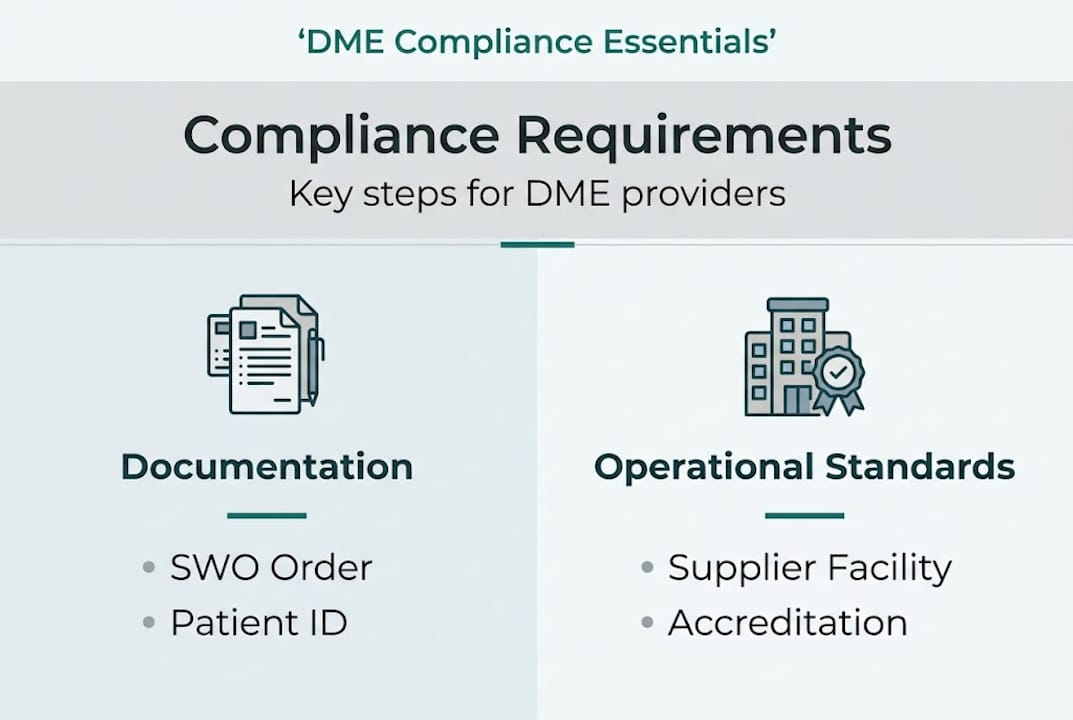
Beyond documentation, DMEPOS Supplier Standards establish the baseline requirements every supplier must satisfy to operate legally. These include maintaining a physical facility that is open during posted business hours, carrying liability insurance of at least $300,000, achieving and maintaining accreditation from a CMS-approved organization, establishing a formal complaint protocol, and strictly avoiding direct solicitation of Medicare beneficiaries.
| Compliance requirement | Details |
|---|---|
| Standard Written Order (SWO) | Beneficiary ID, item description, quantity |
| Written Order Prior to Delivery (WOPD) | Required for select high-risk items |
| Proof of Delivery (POD) | Method, item details, beneficiary signature |
| Liability insurance | Minimum $300,000 coverage |
| Accreditation | CMS-approved accrediting organization |
Accreditation protocols also require periodic re-evaluation, meaning compliance is not a one-time event but an ongoing operational commitment. Providers should designate a compliance officer or team responsible for tracking regulatory updates from CMS and accrediting bodies, reviewing documentation on a rolling basis, and managing the complaint resolution process.
For practical guidance on structuring your delivery workflows to support these requirements, DME delivery best practices offer a strong operational reference. Additionally, reviewing how logistics solutions have been applied in complex patient populations, such as the ESRD patient logistics case study, illustrates how compliance and efficiency can reinforce each other. Strengthening vendor management practices is equally critical, since third-party vendors introduce documentation risk that must be actively managed.
Pro Tip: Conduct a monthly internal audit of SWOs and WOPDs before claim submission cycles to catch missing elements before they become denials.
Key operational best practices for DME businesses
With compliance in place, attention turns to hands-on operational procedures that drive efficiency. Compliance creates the floor; operational best practices build the structure that allows a DME business to scale without sacrificing accuracy or service quality.
Workflow optimization begins with end-to-end order tracking. Every order should move through a defined pipeline with clear status checkpoints: intake, physician order verification, insurance authorization, delivery scheduling, delivery confirmation, and return or renewal management. When any stage lacks visibility, errors accumulate and timelines slip.
Inventory management is equally foundational. Regular audits, ideally monthly for high-turnover items and quarterly for durable goods, prevent both stockouts and excess carrying costs. Tracking inventory turnover rates by equipment category helps identify underperforming assets and informs purchasing decisions. A lean, accurate inventory directly supports faster delivery timelines and reduces write-offs.
Documentation retention is a compliance and operational issue that providers frequently underestimate. Proof of Delivery records must be retained for a minimum of seven years, including the delivery method, item-level details, and the beneficiary’s signature or shipping confirmation. Non-compliance exposes providers to claim denials, overpayment demands, and audit liability.
| Operational area | Best practice | Risk if neglected |
|---|---|---|
| Order tracking | Status checkpoints at each stage | Delays, missed authorizations |
| Inventory management | Monthly and quarterly audits | Stockouts, excess costs |
| Documentation retention | 7-year POD retention policy | Denials, overpayment recovery |
| Renewal management | Automated reminders 30 days out | Lapsed coverage, service gaps |
- Digitize all Proof of Delivery records using mobile capture tools that timestamp and geo-tag signatures at the point of delivery.
- Implement automated renewal reminders triggered 30 days before equipment authorization expiration.
- Assign ownership of each workflow stage to a specific role to eliminate accountability gaps.
- Integrate your order management system with your billing platform to reduce manual data re-entry and transcription errors.
For a broader view of how logistics efficiency strategies translate to measurable gains, maximizing efficiencies through better patient logistics provides actionable frameworks applicable to DME operations of any size.
Pro Tip: Digitizing your Proof of Delivery process and automating renewal reminders are two changes that typically reduce claim denials and administrative rework within the first 90 days of implementation.
Tracking and measuring performance metrics
Operational improvements are only as effective as their measurable outcomes, so tracking KPIs is crucial. Without consistent measurement, providers cannot distinguish between progress and stagnation, and they cannot identify which interventions are generating real returns.
Key performance benchmarks for DME providers include a Claim Denial Rate below 5%, a Revenue Cycle Time under 30 days, a Clean Claim Rate above 95%, a strong Equipment Utilization Rate, and a healthy Inventory Turnover ratio. These are not aspirational targets; they are operational thresholds that separate high-performing providers from those at risk of revenue cycle instability.
| KPI | Target benchmark | What it signals |
|---|---|---|
| Clean Claim Rate | Greater than 95% | Documentation and coding accuracy |
| Claim Denial Rate | Less than 5% | Compliance and authorization quality |
| Revenue Cycle Time | Less than 30 days | Billing and collections efficiency |
| Timely Delivery Rate | Greater than 95% | Logistics and scheduling performance |
| Equipment Utilization Rate | Category-specific | Asset efficiency and inventory health |
Tracking these metrics requires more than a spreadsheet. Providers should invest in reporting dashboards that pull data from order management, billing, and delivery systems simultaneously. Real-time visibility into denial rates, for example, allows billing teams to intervene before a backlog develops rather than discovering the problem during a monthly review.
Using KPIs to drive quality improvement also means establishing clear escalation protocols. When the Clean Claim Rate drops below 95%, that should trigger an immediate documentation review. When delivery rates fall below target, the logistics workflow requires examination.
For providers serving Medicare populations, connecting these operational metrics to broader quality programs is strategically important. The 7-point checklist to improve health outcomes for Medicare offers a practical framework for aligning DME performance with Medicare quality expectations. Similarly, understanding how technology-driven strategies improve Medicare Star Ratings can help administrators see how DME metrics connect to broader payer relationships.
- Review KPI dashboards weekly, not monthly, to enable timely corrective action.
- Segment denial data by payer, equipment category, and ordering physician to identify root causes.
- Set internal targets 2 to 3 percentage points above the minimum benchmark to build a performance buffer.
- Share KPI results with clinical and administrative staff to create shared accountability.
Enhancing patient service and satisfaction
Finally, connecting operational steps to patient-centered outcomes brings the guide full circle. Compliance and efficiency are internal disciplines, but patient satisfaction is the external measure that reflects whether those disciplines are actually working.

Communication is the single most controllable variable in patient satisfaction for DME providers. Patients and their care teams need to know when equipment will arrive, what to expect during delivery, and who to contact if something goes wrong. Proactive outreach before delivery, confirmation at the time of delivery, and a follow-up touchpoint within 48 hours create a service experience that patients notice and remember.
Timely delivery above 95%, documentation accuracy, and patient satisfaction scores are the three quality metrics most directly linked to clinical outcomes in DME management. When equipment arrives late or incorrectly, patient care plans are disrupted, hospital readmissions increase, and payer relationships suffer.
Providers that achieve timely delivery rates above 95% and pair them with structured patient communication protocols consistently report higher satisfaction scores and lower complaint volumes, reinforcing that logistics quality and patient experience are inseparable.
- Assign a dedicated patient service contact for each delivery region or territory.
- Use automated SMS or phone notifications to alert patients of delivery windows and any schedule changes.
- Train delivery staff on patient communication protocols, not just equipment handling.
- Establish a structured feedback loop, collecting satisfaction data after each delivery and routing it to operations leadership.
For providers seeking to address social determinants of health alongside equipment delivery, tools payers can use to improve patient outcomes provides relevant context. Managing standing orders and recurring equipment needs through a centralized platform reduces the coordination burden on both staff and patients. Providers exploring remote patient monitoring as a complementary service will also find that strong DME logistics practices create the operational foundation that monitoring programs require.
Pro Tip: Automated delivery status notifications reduce inbound patient calls by a measurable margin, freeing your service team to focus on complex issues rather than routine status inquiries.
A fresh perspective: Why patient-centric logistics is the ultimate differentiator
Most discussions about DME best practices focus on compliance checklists and billing metrics, and while those are necessary, they describe the floor, not the ceiling. The providers that consistently outperform their peers are not simply more compliant; they have recognized that patient logistics is a competitive differentiator, not just an operational function.
When a patient receives the right equipment on time, with clear communication and a frictionless experience, that interaction builds trust in the entire care system. It reduces unnecessary calls, prevents care plan disruptions, and strengthens referral relationships with physicians and discharge planners who remember which DME providers make their jobs easier.
The uncomfortable truth is that many providers invest heavily in billing software and compliance training while underinvesting in the logistics infrastructure that determines whether the patient actually receives what was ordered. Shifting investment toward patient logistics strategy is not a soft priority; it is a direct driver of revenue cycle health, payer contract performance, and long-term market position.
Ready to streamline your DME operations?
If you are ready to elevate your DME operation, consider leveraging advanced logistics solutions designed specifically for the complexity of healthcare delivery. VectorCare’s platform brings together the scheduling optimization, real-time visibility, and automated workflows that DME providers need to execute on every best practice outlined in this guide.
From managing DME delivery solutions with precision to accessing deeper patient logistics insights that inform smarter operational decisions, VectorCare supports providers at every stage of the logistics lifecycle. Explore the full patient logistics platform and take the next step toward operational excellence, reduced claim denials, and measurably better patient service.
Frequently asked questions
What documentation does CMS require for DME claim submission?
CMS requires a Standard Written Order including beneficiary ID, item description, and quantity, plus a Written Order Prior to Delivery for certain items before the claim can be submitted.
How long must DME providers retain proof of delivery documentation?
Providers must retain proof of delivery records for seven years, including delivery method, item details, and the beneficiary’s signature or shipping confirmation, to satisfy Medicare requirements.
What supplier standards must DME providers meet?
DMEPOS Supplier Standards require DME suppliers to maintain a physical facility, carry at least $300,000 in liability insurance, hold CMS-approved accreditation, operate a complaint protocol, and refrain from direct solicitation of Medicare beneficiaries.
Which performance benchmarks matter most to DME providers?
The most critical benchmarks are a claim denial rate below 5%, a clean claim rate above 95%, and a timely delivery rate above 95%, as these most directly reflect billing accuracy and service quality.
How can DME businesses improve patient satisfaction?
Timely delivery, documentation accuracy, and patient satisfaction tracking are the proven strategies, with proactive communication and automated delivery notifications consistently shown to reduce complaints and improve the patient experience.
Recommended
- 4 Tools to Improve Patient Outcomes | VectorCare
- Maximizing Efficiencies Through Better Patient Logistics | VectorCare
- Managing Standing Orders for Medicare Dialysis Transportation: A New Approach | VectorCare
- 7 Essential Digital Strategies for NEMT Providers
- Sustainable Supply Chain Practices in Medical Warehousing