Communication in Healthcare Leadership: Driving Operational Success

Complex care environments rely on more than skill and technology. For Healthcare leaders managing hospital operations across the United States, lapses in communication can disrupt patient logistics, create bottlenecks, and threaten both care quality and safety. Effective communication—spanning verbal, written, and non-verbal exchanges—forms the backbone of coordination, clarity, and trust between teams and sectors. This article explores actionable strategies and proven tools that can transform how your organization coordinates patient movement and collaboration in even the busiest hospital settings.
Table of Contents
- Defining Communication in Healthcare Leadership
- Types of Communication in Healthcare Settings
- Tools and Technologies Enabling Secure Exchange
- Improving Team Collaboration and Patient Coordination
- Managing Risks, Miscommunication, and Legal Implications
Key Takeaways
| Point | Details |
|---|---|
| Effective Communication is Crucial | Healthcare communication involves verbal, non-verbal, written, and electronic methods that are vital for patient care and organizational success. |
| Collaboration Enhances Outcomes | Interprofessional collaboration leads to improved patient outcomes and can reduce medical errors through clear communication and teamwork. |
| Technology Plays a Key Role | Leveraging health information technology facilitates secure and efficient communication, ensuring that patient data is well-managed and accessible. |
| Proactive Risk Management is Essential | Implementing standardized communication protocols reduces risks associated with miscommunication, enhancing patient safety and legal compliance. |
Defining Communication in Healthcare Leadership
Healthcare leadership communication represents a complex, multifaceted system of exchanging critical information that directly impacts patient care and organizational effectiveness. Effective communication in healthcare is more than simply transmitting data - it’s about creating a comprehensive, transparent dialogue that bridges different professional roles and patient interactions.
At its core, healthcare leadership communication encompasses several key dimensions:
- Verbal exchanges between healthcare professionals
- Written documentation and record-keeping
- Non-verbal communication strategies
- Interdisciplinary collaboration techniques
- Patient-provider interaction protocols
Research indicates that healthcare leadership communication pivots on transparency and collaboration, creating environments where information flows seamlessly across different organizational levels. This approach ensures that critical patient care details are accurately communicated, reducing potential medical errors and improving overall healthcare delivery.
Successful communication in healthcare leadership requires deliberate strategies that promote clear, accurate, and timely information exchange. Effective leaders understand that communication is not just about speaking, but about creating systems that enable precise, bidirectional information flow. Communication breakdown can significantly impair healthcare quality and potentially compromise patient outcomes.
Healthcare organizations must prioritize developing robust communication frameworks that support:
- Clear information transmission protocols
- Standardized documentation practices
- Cross-departmental collaboration mechanisms
- Continuous training in communication skills
- Technology-enabled communication platforms
Pro tip: Implement regular interdepartmental communication workshops to enhance team understanding and reduce potential information silos.
Types of Communication in Healthcare Settings
Healthcare communication encompasses a diverse range of interaction methods that are critical for effective patient care and organizational functionality. Communication in healthcare involves multiple sophisticated channels/03%3A_Effective_Communication_in_Nursing/3.05%3A_Types_of_Communication) designed to ensure comprehensive and precise information exchange across different healthcare environments.
The primary types of communication in healthcare settings include:
- Verbal Communication
- Direct spoken interactions between healthcare professionals
- Patient-provider consultations
- Team discussions and rounds
- Non-Verbal Communication
- Body language and physical gestures
- Facial expressions
- Tone and pitch of voice
- Written Communication
- Medical records and documentation
- Electronic health records (EHRs)
- Prescription and treatment plans
- Electronic Communication
- Secure messaging platforms
- Telemedicine consultations
- Digital patient portals
Healthcare communication requires comprehensive literacy skills that go beyond simple information transmission. Each communication type plays a unique role in ensuring accurate, timely, and compassionate healthcare delivery. Verbal communication remains the most direct method, allowing real-time interaction and immediate clarification of complex medical information.
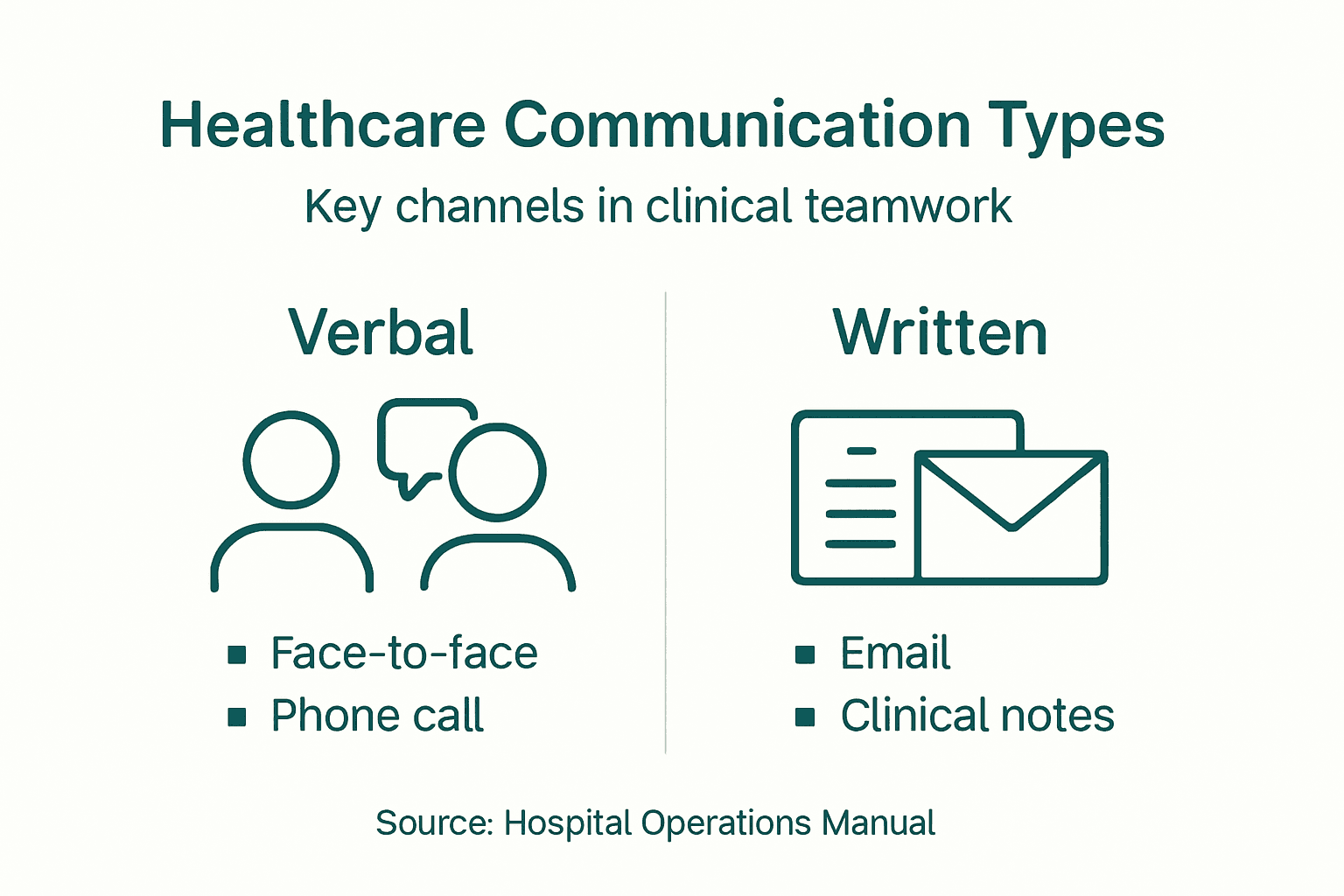
Non-verbal communication is equally significant, often conveying emotional nuances and patient comfort levels that words cannot fully express. Healthcare professionals must develop keen observational skills to interpret these subtle communication signals, which can provide critical insights into patient experiences and potential treatment challenges.
Written and electronic communication methods have become increasingly sophisticated, enabling seamless information sharing across complex healthcare networks. These methods ensure consistent documentation, support legal and regulatory compliance, and create transparent, traceable communication pathways.
Here is a summary comparing the main types of communication in healthcare settings:
| Type of Communication | Typical Use Cases | Strengths | Common Limitations |
|---|---|---|---|
| Verbal | Team briefings, patient consults | Enables fast clarification | Prone to misunderstandings |
| Non-Verbal | Patient assessment, staff interaction | Conveys emotions and comfort | Can be misread or overlooked |
| Written | Medical records, care plans | Creates traceable documentation | Delays in access or updates |
| Electronic | Telemedicine, secure messaging | Enables secure data sharing | Dependent on technology access |
Pro tip: Develop a systematic approach to cross-channel communication by creating standardized communication protocols that integrate verbal, written, and electronic interaction methods.
Tools and Technologies Enabling Secure Exchange
Health information technology has revolutionized secure communication in healthcare, creating sophisticated platforms that enable seamless and protected data exchange. Health IT supports nationwide electronic information sharing across complex healthcare ecosystems, ensuring patient data remains confidential and accessible to authorized professionals.
Key technological tools for secure healthcare communication include:
- Electronic Health Record (EHR) Systems
- Centralized patient data repositories
- Secure access controls
- Interoperable data formats
- Secure Messaging Platforms
- HIPAA-compliant communication channels
- Encrypted messaging
- Role-based access permissions
- Telemedicine Technologies
- Video consultation tools
- Remote patient monitoring systems
- Integrated diagnostic interfaces
- Data Exchange Networks
- Standardized communication protocols
- Multi-platform integration capabilities
- Real-time information synchronization
The national health information exchange network represents a significant breakthrough in healthcare communication technology. These advanced systems enable healthcare providers to securely share critical patient information, dramatically improving care coordination and operational efficiency.
Modern communication technologies prioritize several critical security features, including end-to-end encryption, multi-factor authentication, and comprehensive audit trails. These mechanisms ensure that sensitive patient data remains protected while enabling swift, accurate information exchange between healthcare professionals, institutions, and support services.
The evolution of health information technologies continues to push boundaries, integrating artificial intelligence, machine learning, and advanced analytics to create more intelligent, responsive communication ecosystems. These innovations promise to transform how healthcare organizations manage, share, and utilize patient information.
The following table outlines the business impact of key health communication technologies:
| Technology Tool | Primary Benefit | Organizational Impact |
|---|---|---|
| Electronic Health Records | Centralizes patient histories | Streamlines workflows and reduces duplication |
| Secure Messaging | Enables real-time updates | Improves care coordination |
| Telemedicine Platforms | Expands care access | Reduces appointment no-shows |
| Data Exchange Networks | Integrates multi-system data | Enhances cross-institutional collaboration |
Pro tip: Conduct regular security audits and staff training to ensure maximum effectiveness and compliance with the latest data protection standards.
Improving Team Collaboration and Patient Coordination
Interprofessional collaboration represents the cornerstone of modern healthcare delivery, transforming how medical teams approach patient care and organizational effectiveness. Collaborative healthcare teams demonstrate significant improvements in patient outcomes, reducing medical errors and enhancing overall treatment quality.
Key strategies for effective team collaboration include:
- Clear Communication Protocols
- Standardized handoff procedures
- Regular interdisciplinary meetings
- Shared digital communication platforms
- Role Clarity and Mutual Respect
- Defined professional responsibilities
- Cross-disciplinary training programs
- Recognition of each team member’s expertise
- Patient-Centered Coordination
- Holistic care approach
- Integrated care planning
- Continuous feedback mechanisms
- Technology-Enabled Collaboration
- Integrated electronic health records
- Real-time communication tools
- Secure information sharing platforms
Interprofessional collaboration models are critical in addressing complex patient needs and optimizing healthcare delivery. These frameworks facilitate coordinated teamwork by establishing shared knowledge, mutual respect, and clearly defined roles across different healthcare disciplines.
Successful patient coordination requires more than just technological infrastructure. Healthcare leaders must cultivate a culture of open communication, continuous learning, and shared accountability. This involves creating environments where professionals from different backgrounds can seamlessly collaborate, share insights, and collectively work towards optimal patient outcomes.

The most effective healthcare teams break down traditional silos, encouraging dynamic interactions that transcend professional boundaries. By implementing robust collaboration strategies, organizations can create more responsive, efficient, and patient-focused care delivery systems that adapt quickly to emerging healthcare challenges.
Pro tip: Implement quarterly cross-disciplinary workshops to enhance team understanding and develop shared communication strategies.
Managing Risks, Miscommunication, and Legal Implications
Communication failures represent a critical challenge in healthcare, potentially exposing organizations to significant legal and operational risks. Communication breakdowns contribute substantially to medical malpractice claims, creating complex legal and patient safety challenges for healthcare leaders.
Key risk management strategies include:
- Standardized Communication Protocols
- Structured handoff procedures
- Clear documentation guidelines
- Consistent reporting mechanisms
- Legal Risk Mitigation
- Comprehensive documentation practices
- Regular compliance training
- Transparent communication frameworks
- Error Prevention Techniques
- Simulation-based communication training
- Root cause analysis processes
- Continuous quality improvement systems
- Bias and Equity Considerations
- Addressing communication inequities
- Cultural competency training
- Inclusive communication strategies
Implementing standardized communication tools can significantly reduce adverse healthcare events and potential legal exposure. These frameworks create structured approaches that minimize miscommunication risks and enhance overall patient safety.
Healthcare organizations must develop comprehensive communication strategies that not only protect against legal risks but also prioritize patient-centered care. This requires creating a culture of transparency, continuous learning, and proactive risk management that goes beyond simple compliance.
Effective risk management demands a multifaceted approach that integrates technological solutions, robust training programs, and a commitment to ongoing communication improvement. By systematically addressing potential communication vulnerabilities, healthcare leaders can create more resilient, safe, and legally compliant organizational environments.
Pro tip: Develop a comprehensive communication risk assessment protocol that includes regular audits and real-time feedback mechanisms.
Elevate Healthcare Leadership with Streamlined Communication and Logistics
Effective communication and coordinated patient care are vital challenges highlighted in “Communication in Healthcare Leadership: Driving Operational Success”. Leaders are tasked with bridging interdisciplinary teams, reducing miscommunication risks, and ensuring timely, secure exchanges of critical information. VectorCare’s integrated platform directly addresses these pain points by empowering healthcare organizations with tools that automate scheduling, optimize vendor management, and support secure, real-time communication workflows. Our system enhances collaboration across providers, payers, emergency services, and regional health agencies, leading to fewer delays, lower operational costs, and improved patient outcomes.
Take control of your healthcare logistics and foster transparent, efficient communication that drives operational success. Explore how VectorCare’s AI-driven dispatch and no-code workflow capabilities can transform your healthcare leadership strategy today. Visit VectorCare to learn more and start improving communication and patient coordination now. Discover the future of healthcare coordination at VectorCare’s platform and see why organizations nationwide rely on these tools for enhanced operational excellence.
Frequently Asked Questions
What is communication in healthcare leadership?
Communication in healthcare leadership involves the exchange of critical information among healthcare professionals, emphasizing transparency and collaboration to improve patient care and organizational effectiveness.
Why is effective communication important in healthcare?
Effective communication is crucial in healthcare as it reduces the risk of medical errors, ensures accurate patient information exchange, and enhances teamwork among healthcare professionals, ultimately leading to improved patient outcomes.
What are the main types of communication in healthcare settings?
The main types of communication in healthcare include verbal communication (spoken interactions), non-verbal communication (body language and gestures), written communication (medical records and documentation), and electronic communication (telemedicine and secure messaging platforms).
How can healthcare organizations improve communication among teams?
Healthcare organizations can improve communication by establishing clear protocols, promoting interdisciplinary meetings, providing continuous training in communication skills, and utilizing technology-enabled platforms for secure information sharing.