Ambulatory Transportation: Optimizing Patient Logistics

Patient flow can become a major pain point when transportation hurdles lead to missed appointments and higher hospital stays. As demand grows for efficient and patient-friendly services, American hospitals look for smarter ways to move people without sacrificing quality or cost control. This article uncovers how AI-driven ambulatory transportation integrates advanced digital coordination and flexible solutions, helping logistics managers optimize resources and deliver better outcomes across complex healthcare systems.
Table of Contents
- What Ambulatory Transportation Means In Healthcare
- Types Of Ambulatory Transportation Services
- How Modern Ambulatory Transportation Works
- Technology Innovations And AI-Driven Dispatch
- Compliance, Costs, And Key Risks For Hospitals
Key Takeaways
| Point | Details |
|---|---|
| Ambulatory transportation enhances healthcare access | It provides essential non-emergency transport for patients who can move independently, improving attendance at medical appointments. |
| Technological advancements drive service efficiency | AI-driven scheduling and real-time tracking are integral for optimizing patient mobility and ensuring effective resource allocation. |
| Compliance and financial pressures challenge hospitals | Hospitals navigate complex regulations and rising costs, necessitating strategic management of resources to ensure effective transportation services. |
| Hybrid transportation models improve patient care | Combining Nonmedical Transportation (NMT) and Nonemergency Medical Transportation (NEMT) enhances flexibility and access to medical care. |
What Ambulatory Transportation Means in Healthcare
Ambulatory transportation represents a critical component of modern healthcare delivery, enabling patients to access medical services efficiently and comfortably. Unlike emergency medical transport, this specialized service supports patients who can move independently but require assistance reaching medical appointments.
At its core, ambulatory transportation provides non-emergency medical transportation for outpatient care settings. This service encompasses multiple transportation modes designed to meet diverse patient needs:
- Wheelchair accessible vans
- Stretcher ambulances
- Private medical transport vehicles
- Public transit with medical coordination
The strategic importance of ambulatory transportation extends beyond simple patient movement. It plays a pivotal role in reducing hospital readmissions, managing chronic conditions, and supporting preventive healthcare initiatives. By ensuring patients can consistently attend medical appointments, these transportation services help improve overall health outcomes and reduce systemic healthcare costs.
Modern ambulatory transportation integrates advanced technologies to enhance patient experience. Scheduling algorithms and real-time tracking enable precise coordination, while specialized vehicles accommodate patients with varying mobility requirements. Healthcare systems increasingly recognize this service as a fundamental component of comprehensive patient care, not just a logistical necessity.
Pro tip: Schedule ambulatory transportation at least 48 hours in advance to ensure optimal vehicle and staffing availability for your specific medical needs.
Types of Ambulatory Transportation Services
Ambulatory transportation services represent a diverse ecosystem of patient mobility solutions designed to address varying medical transportation needs. These services are critical for ensuring patients can access necessary medical care, especially for those with limited transportation options or specific mobility challenges.
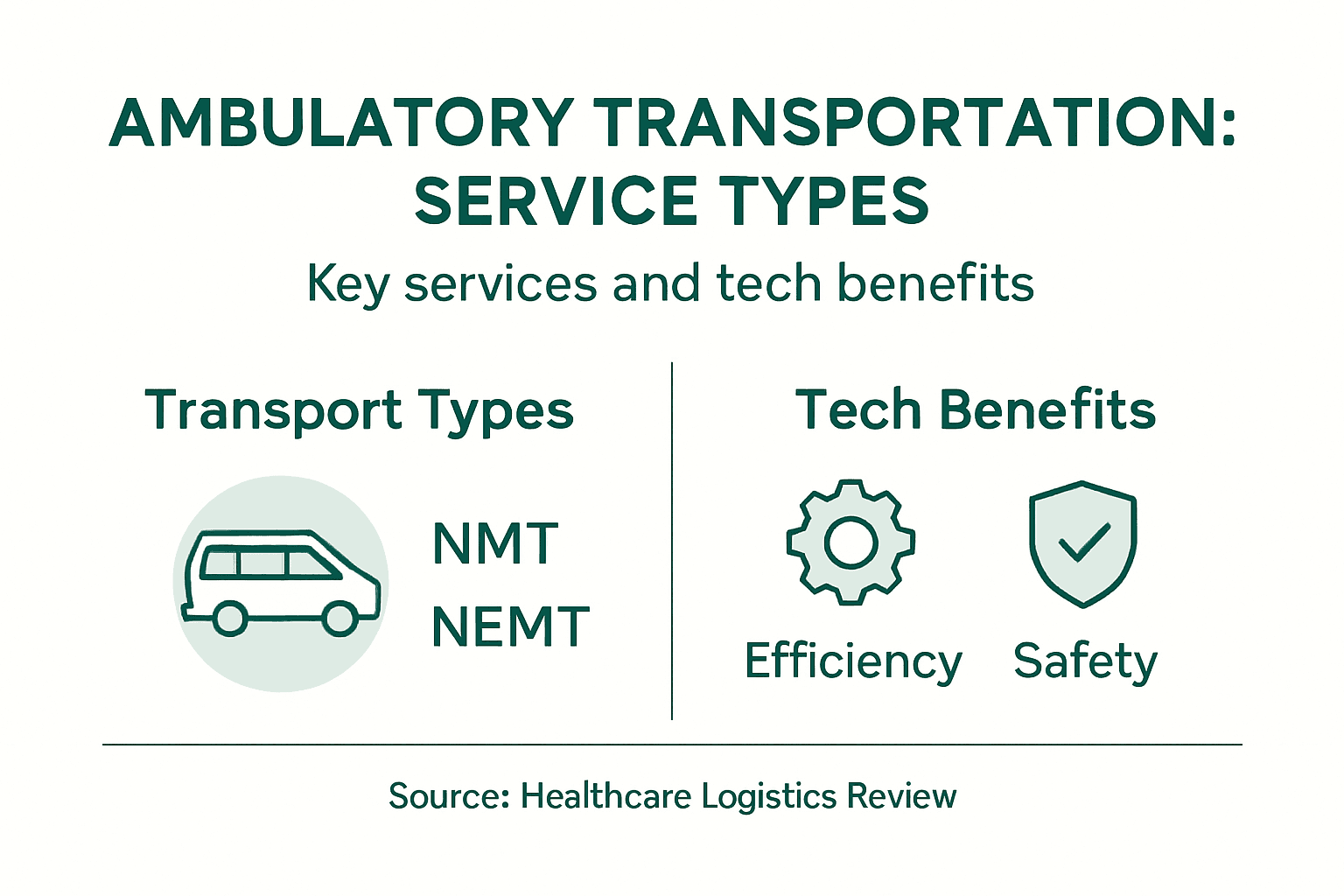
Healthcare systems typically categorize transportation services into two primary types: Nonmedical Transportation (NMT) and Nonemergency Medical Transportation (NEMT). Each type serves distinct patient requirements and operational contexts:
Nonmedical Transportation (NMT):
- Utilizes private or public vehicles
- Supports patients without alternative transportation means
- Covers travel to medical, dental, and mental health appointments
- Generally more cost-effective and flexible
Nonemergency Medical Transportation (NEMT):
Here’s a side-by-side look at how Nonmedical Transportation (NMT) and Nonemergency Medical Transportation (NEMT) differ in patient care focus:
| Aspect | NMT Example | NEMT Example |
|---|---|---|
| Patient Criteria | Ambulatory, low mobility needs | Limited mobility, clinical assistance required |
| Vehicle Type | Standard sedan, rideshare | Wheelchair-accessible van, ambulance |
| Staffing | Basic driver, no medical background | Trained medical personnel present |
| Scheduling Priority | Flexible, less urgent | Scheduled, time-sensitive medical visits |
- Involves specialized medical vehicles
- Includes wheelchair vans, ambulances, and litter transports
- Designed for patients with significant mobility limitations
- Provides door-to-door medical appointment assistance
- Requires specialized staff and medical equipment
Beyond these primary categories, modern ambulatory transportation services have expanded to include advanced technological integrations. Scheduling algorithms and real-time tracking enable precise coordination, ensuring patients receive timely and appropriate transportation tailored to their specific medical needs.
Additionally, some healthcare systems offer hybrid transportation models that combine elements of NMT and NEMT, providing more comprehensive and flexible patient mobility solutions. These innovative approaches help bridge gaps in traditional transportation services, ultimately improving patient access to critical healthcare resources.
Pro tip: Verify your specific insurance coverage and eligibility for ambulatory transportation services before scheduling, as requirements can vary significantly between different healthcare providers and regions.
How Modern Ambulatory Transportation Works
Modern ambulatory transportation has evolved dramatically, transforming from simple patient movement to a sophisticated, technology-driven ecosystem of healthcare logistics. These advanced systems leverage cutting-edge digital technologies to optimize patient mobility and healthcare delivery.

At the core of contemporary ambulatory transportation are digital health technologies and AI-driven solutions that revolutionize patient logistics. These innovations encompass several key technological components:
Digital Coordination Mechanisms:
- Real-time patient tracking systems
- AI-powered scheduling algorithms
- Integrated electronic health record (EHR) interfaces
- Predictive routing and optimization tools
- Secure communication platforms
Operational Workflow Innovations:
- Automated dispatch and resource allocation
- Dynamic vehicle assignment based on patient needs
- Comprehensive patient profile management
- Instant communication between healthcare providers and transportation teams
- Compliance and documentation tracking
Healthcare systems increasingly recognize that modern ambulatory transportation goes beyond simple point-to-point movement. Technological integration enables proactive management of patient transportation needs, reducing healthcare utilization and optimizing resource allocation. These advanced systems support patient-centered care by minimizing unnecessary hospital visits and creating more efficient healthcare experiences.
This summary illustrates how technology streamlines the modern ambulatory transportation workflow:
| Key Technology | Operational Benefit | Impact on Patient Care |
|---|---|---|
| AI Scheduling | Minimizes wait times | Reduces missed appointments |
| EHR Integration | Shares medical info securely | Ensures tailored travel needs |
| Real-time Tracking | Monitors vehicle/patient | Increases safety and reliability |
The technological ecosystem supporting ambulatory transportation continues to evolve, with emerging technologies like machine learning and predictive analytics promising even more sophisticated patient mobility solutions. Healthcare providers are investing in these technologies to create more responsive, efficient, and patient-friendly transportation networks.
Pro tip: Request a comprehensive patient transportation technology assessment from your healthcare provider to understand the full range of digital coordination capabilities available in your region.
Technology Innovations and AI-Driven Dispatch
Artificial intelligence is radically transforming ambulatory transportation, creating unprecedented capabilities in patient logistics and healthcare delivery. The integration of advanced technologies enables healthcare systems to optimize transportation resources with remarkable precision and efficiency.
Contemporary ambulatory transportation leverages AI-driven innovations for enhanced medical coordination. These technological solutions encompass several critical components:
AI-Powered Dispatch Technologies:
- Machine learning-based triage systems
- Real-time geographic routing optimization
- Predictive patient need analysis
- Dynamic resource allocation algorithms
- Intelligent communication platforms
Key Technological Capabilities:
- Automated patient risk stratification
- Electronic health record integration
- Smart dispatch decision support
- Geospatial tracking and route planning
- Comprehensive patient profile management
The most sophisticated AI-driven dispatch systems go beyond simple transportation coordination. Intelligent platforms can now aggregate clinical and social determinants data, continuously monitoring patient needs and enabling proactive healthcare interventions. These technologies create a dynamic ecosystem that supports patient mobility while simultaneously reducing healthcare spending and improving overall service quality.
Healthcare providers are increasingly investing in these advanced technological solutions, recognizing their potential to transform traditional transportation models. By leveraging machine learning, predictive analytics, and integrated communication tools, ambulatory transportation is evolving from a basic logistical function to a sophisticated, patient-centered service.
Pro tip: Request a comprehensive technology assessment from your healthcare provider to understand how AI-driven dispatch can specifically enhance your patient transportation experience.
Compliance, Costs, and Key Risks for Hospitals
Hospital ambulatory transportation represents a complex landscape of regulatory challenges, financial pressures, and operational risks that demand strategic management. Healthcare organizations must navigate an increasingly intricate environment of compliance requirements while maintaining cost-effective patient mobility services.
Hospitals face significant challenges with regulatory compliance burdens that impact their operational efficiency and financial stability:
Key Compliance Challenges:
- Over 600 distinct regulatory requirements
- Estimated $39 billion in annual administrative costs
- Substantial time spent on non-patient care activities
- High risk of medical errors due to administrative complexity
- Increased potential for staff burnout
Financial Pressure Points:
- Rising labor expenses
- Supply chain disruptions
- Inadequate Medicare and Medicaid reimbursement rates
- Persistent negative operating margins
- High administrative overhead
The interconnected nature of these challenges creates a complex risk environment for healthcare providers. Regulatory complexity directly impacts patient care quality, physician retention, and overall organizational performance. Hospitals must develop comprehensive strategies that balance compliance requirements with operational efficiency and patient-centered care.
Technological innovations and streamlined administrative processes offer potential solutions to these multifaceted challenges. By investing in advanced digital platforms, hospitals can reduce compliance-related risks, optimize resource allocation, and create more resilient transportation and logistics systems.
Pro tip: Conduct a comprehensive quarterly audit of transportation compliance processes to identify and mitigate potential regulatory and financial risks before they escalate.
Transform Ambulatory Transportation with Smarter Patient Logistics
Ambulatory transportation is at the heart of delivering seamless healthcare experiences, but complex scheduling, regulatory compliance, and mobility challenges often slow down patient movement and increase operational costs. If your healthcare organization is struggling with coordinating nonemergency medical transport or managing AI-driven dispatch, you are not alone. Common pain points include missed appointments, high administrative overhead, and inefficient resource allocation that directly impact patient outcomes.

VectorCare offers a comprehensive digital platform built to solve these exact challenges by integrating real-time tracking, AI-powered scheduling, and secure communication in one streamlined solution. Designed for healthcare providers, payers, and emergency services alike, our platform helps you eliminate delays, reduce expenses, and create more patient-centered transportation networks. Discover how advanced ambulatory transportation technology can elevate your patient logistics by visiting VectorCare’s platform today and take the next step toward smarter, more efficient care coordination.
Frequently Asked Questions
What is ambulatory transportation in healthcare?
Ambulatory transportation refers to non-emergency medical transportation services that assist patients who can move independently but need help getting to medical appointments. It includes various modes of transport like wheelchair accessible vans and private medical vehicles.
How does modern ambulatory transportation utilize technology?
Modern ambulatory transportation uses digital health technologies such as AI-powered scheduling algorithms and real-time patient tracking systems to optimize patient logistics, improve coordination, and enhance the overall experience.
What types of ambulatory transportation services are available?
There are two primary types of ambulatory transportation services: Nonmedical Transportation (NMT), which uses private or public vehicles for medical appointments, and Nonemergency Medical Transportation (NEMT), which involves specialized medical vehicles for patients with significant mobility limitations.
Why is scheduling ambulatory transportation in advance important?
Scheduling ambulatory transportation at least 48 hours in advance ensures optimal vehicle availability and staffing, allowing for a tailored transportation solution that meets specific medical needs efficiently.
Recommended
- How Technology is Transforming Patient Logistics for SNFs | VectorCare
- 7 Ways to Improve Outcomes for Medicare Advantage Members | VectorCare
- 7 Ways to Lower NEMT costs for Medicare Advantage plans | VectorCare
- Maximizing Efficiencies Through Better Patient Logistics | VectorCare
- Ośrodki Rehabilitacyjne: Rehabilitacja po Udarze Mózgu | UdarRehab.pl