AI transforms healthcare logistics: 5 key benefits

TL;DR:AI transforms healthcare logistics by enabling real-time tracking, predictive scheduling, and automation.Implementing AI improves on-time transport, reduces discharge delays, and enhances patient satisfaction.Overcoming legacy system integration and staff resistance are key to successful AI adoption.
Healthcare logistics looks orderly from the outside. Behind the scenes, however, patient transport delays, missed handoffs, and siloed data create a cascade of inefficiencies that cost organizations millions annually and compromise care outcomes. Legacy systems were never designed to handle today’s volume, complexity, or patient expectations. AI is changing that reality, not incrementally, but fundamentally. This guide examines how AI integrates with patient logistics workflows, where it delivers the most measurable value, how organizations can navigate adoption challenges, and what forward-thinking executives are doing right now to build a sustainable operational advantage.
Table of Contents
- How AI fits into healthcare logistics: The new operating system
- Core AI applications revolutionizing patient logistics
- Benefits and measurable outcomes: What executives can expect
- Challenges and practical strategies for AI adoption
- Future outlook: What’s next for AI in healthcare logistics?
- Our take: Why moving fast on AI matters more than ever
- Discover next-generation logistics solutions
- Frequently asked questions
Key Takeaways
| Point | Details |
|---|---|
| AI streamlines logistics | AI automates and optimizes the movement of patients and equipment to cut costs and delays. |
| Immediate, measurable ROI | Adopting AI in logistics leads to faster discharge, improved satisfaction, and better resource use. |
| Address challenges early | Planning for integration and change management is key to AI project success in healthcare. |
| Future-focused strategy | Leading organizations use AI-driven logistics as a foundation for value-based, patient-centric care. |
How AI fits into healthcare logistics: The new operating system
Healthcare logistics encompasses every coordinated activity required to move patients, equipment, and information through the care continuum. That includes patient transport scheduling, durable medical equipment (DME) delivery, discharge coordination, appointment management, and real-time communication between care teams. When any one of these functions breaks down, the ripple effects are immediate and costly.
Artificial intelligence, specifically machine learning and intelligent automation, acts as a connective layer across these functions. Rather than replacing existing workflows outright, AI integrates with them to surface patterns, predict demand, and automate repetitive decisions. The result is a system that responds dynamically to real-world conditions rather than relying on static schedules and manual interventions.
The most persistent pain points in traditional logistics include:
- Transport bottlenecks caused by manual dispatch and poor route planning
- Resource underutilization when staff and vehicles are not matched to actual demand
- Data silos that prevent care teams from accessing real-time patient status
- Discharge delays triggered by miscommunication between clinical and logistics teams
AI addresses each of these by enabling real-time tracking, predictive analytics, and automated dispatch. A modern patient logistics platform offers predictive scheduling, route optimization, and resource allocation for hospitals, replacing reactive decision-making with proactive coordination.
Interoperability is a critical factor here. Most healthcare organizations operate across multiple systems, including EHRs, scheduling platforms, and third-party transport vendors. Agnostic software for logistics connects these environments without requiring a full system replacement, making AI adoption far more practical for organizations at any stage of digital maturity.
“The organizations gaining the most from AI in logistics are not the ones with the newest infrastructure. They are the ones that prioritize integration, data quality, and a clear operational strategy.”
This distinction matters because AI is only as effective as the data it operates on. Organizations that invest in clean, connected data environments see measurably faster returns on their logistics technology investments.
Core AI applications revolutionizing patient logistics
Understanding the foundational role of AI, let’s examine the top practical applications that are already disrupting logistics processes across hospitals, payers, and regional health networks.
1. Patient transport scheduling and route optimization AI systems analyze historical transport patterns, real-time traffic data, and patient acuity levels to generate optimized schedules. This eliminates the guesswork that plagues manual dispatch and reduces both wait times and fuel costs.
2. Automated supply chain management Machine learning models track inventory consumption rates and trigger replenishment orders before shortages occur. For DME providers, this means fewer emergency deliveries and more predictable logistics costs.
3. Predictive analytics for demand forecasting Hospitals using predictive analytics in healthcare can reduce appointment no-shows and increase utilization rates by identifying at-risk patients and proactively coordinating transportation and reminders.
4. Bed management and discharge coordination AI models predict discharge readiness hours in advance, allowing logistics teams to pre-position transport resources and reduce the average time a patient waits for departure after clinical clearance.
5. Real-time communication automation Automated alerts and status updates keep patients, families, and care teams informed without requiring manual outreach, reducing call volume and administrative burden.
| Logistics function | Traditional approach | AI-powered approach |
|---|---|---|
| Transport scheduling | Manual, reactive | Predictive, automated |
| Inventory management | Periodic audits | Continuous, ML-driven |
| Appointment coordination | Phone-based outreach | Automated, multi-channel |
| Discharge planning | Day-of coordination | Hours-in-advance prediction |
| Vendor management | Spreadsheet-based | Real-time platform integration |
Technology enhancing appointment logistics is particularly impactful in outpatient settings, where no-show rates can exceed 20% without proactive intervention. Similarly, tech in SNF logistics is reducing transfer delays and improving care continuity for skilled nursing facility patients.
Pro Tip: Before selecting an AI logistics vendor, map your top three operational bottlenecks by volume and cost. Prioritize platforms that directly address those specific failure points rather than evaluating features in isolation.
Benefits and measurable outcomes: What executives can expect
Knowing where AI can make the most immediate impact, let’s quantify exactly what organizations can expect to gain from a structured AI logistics implementation.
The most consistently reported improvements fall into four categories: on-time performance, staff utilization, patient throughput, and cost reduction. Organizations that have adopted AI-enabled logistics platforms report significant reductions in wait times and operating costs, with some achieving transport on-time rates above 90% within the first year of deployment.
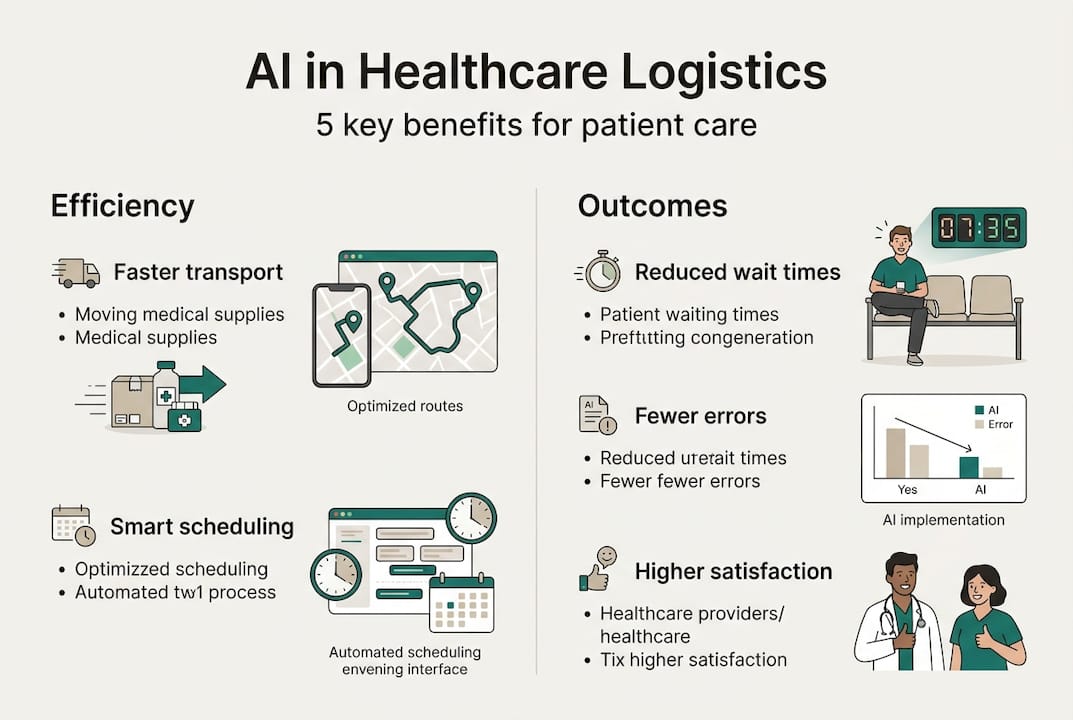
On-time arrivals and patient throughput AI dispatch systems reduce the average transport delay by coordinating pickups based on real-time patient readiness rather than fixed schedules. Faster patient movement through the system directly increases bed availability and reduces the cost of avoidable inpatient days.

Staff utilization When transport coordinators are freed from manual scheduling tasks, they redirect their capacity toward exception management and patient communication. This improves both staff satisfaction and the quality of patient interactions.
Revenue protection through reduced discharge delays The hidden cost of discharge delays is one of the most underestimated financial risks in hospital operations. Every hour a clinically ready patient occupies a bed represents a direct opportunity cost, often measured in thousands of dollars per day.
| Outcome metric | Before AI implementation | After AI implementation |
|---|---|---|
| Transport on-time rate | 60 to 70% | 88 to 95% |
| Average discharge delay | 90 to 120 minutes | 30 to 45 minutes |
| Coordinator call volume | High, manual-intensive | Reduced by automation |
| Patient satisfaction scores | Variable | Consistently improved |
The ROI of patient care logistics technology extends beyond direct cost savings. Elevated patient satisfaction scores influence reimbursement rates, referral volumes, and long-term organizational reputation, all of which compound over time.
Statistic callout: Hospitals that optimize discharge logistics can recover the equivalent of multiple inpatient beds per day in throughput capacity, without adding physical infrastructure.
Challenges and practical strategies for AI adoption
The benefits are clear, but navigating the adoption of AI is often a challenge. The most common barriers are not technological. They are organizational.
Legacy system integration remains the most frequently cited obstacle. Many hospitals and health systems operate on EHR platforms and scheduling tools that were not designed with open APIs or modern data standards. This creates friction when introducing AI layers that require real-time data access.
Workforce resistance is equally significant. Staff who have managed logistics manually for years often perceive AI as a threat rather than a tool. Without deliberate change management, even well-designed platforms face low adoption rates.
Data privacy and compliance concerns are legitimate, particularly given HIPAA requirements and the sensitivity of patient movement data. Organizations must verify that any AI vendor maintains robust security protocols and compliance documentation.
Proven strategies for overcoming these barriers include:
- Phased implementation: Start with one logistics function, demonstrate measurable results, then expand. This builds internal confidence and reduces risk.
- Vendor-neutral platforms: Agnostic software strategy improves integration with existing systems and enhances the scalability of AI solutions, making it possible to adopt AI without replacing your entire technology stack.
- Cross-functional governance: Involve clinical, operational, and IT leadership in vendor evaluation to ensure alignment across departments.
- Staff training programs: Invest in structured onboarding that frames AI as a tool that reduces administrative burden, not one that eliminates roles.
Pro Tip: Evaluate vendors based on their integration track record with your specific EHR platform. A strong AI-powered partnership between your logistics platform and existing systems is more valuable than any individual feature.
Measuring success requires defining baseline metrics before go-live. Track transport on-time rates, discharge delay duration, coordinator workload, and patient satisfaction scores from day one.
Future outlook: What’s next for AI in healthcare logistics?
Challenges managed, it’s time to look forward and understand what tomorrow’s healthcare logistics may look like as AI capabilities continue to advance.
Several emerging trends are already shaping the next generation of patient logistics:
- Real-time adaptive scheduling that adjusts transport assignments dynamically as patient conditions and facility needs change throughout the day
- Autonomous transport coordination using AI to manage fleets of vehicles with minimal human intervention, particularly relevant for non-emergency medical transport networks
- Continuous learning models that improve dispatch accuracy over time by incorporating outcomes data, seasonal demand patterns, and regional traffic conditions
- Predictive and preventive logistics that anticipate patient needs before discharge orders are written, enabling pre-positioning of resources and reducing transition delays
- Value-based care alignment where logistics performance is directly tied to quality metrics and reimbursement outcomes, creating financial incentives for operational precision
AI is rapidly enabling more proactive, patient-centered logistics that anticipate needs before issues arise, rather than responding to them after the fact. This shift from reactive to predictive operations represents a fundamental change in how healthcare organizations think about logistics strategy.
Regulatory and ethical considerations will also evolve. As AI makes more autonomous decisions about patient routing and resource allocation, organizations will need governance frameworks that ensure transparency, equity, and accountability in those decisions.
Organizations investing in transforming technology in patient logistics today are building the data infrastructure and operational muscle that will define competitive positioning over the next decade. Early adoption is not just an efficiency play. It is a strategic investment in long-term organizational resilience.
Our take: Why moving fast on AI matters more than ever
Conventional wisdom in healthcare administration often frames AI as a beneficial addition, something to explore after more pressing priorities are addressed. That framing is increasingly dangerous. AI is no longer a bonus feature in patient logistics. It is becoming core infrastructure, as foundational as the EHR systems organizations depend on daily.
Executives who delay adoption are not simply missing efficiency gains. They are allowing patient expectations and regulatory standards to outpace their operational capabilities. As payers tie reimbursement more directly to care coordination quality, logistics performance becomes a direct financial variable.
AI does not replace skilled coordinators, transport staff, or clinical teams. It empowers them to focus on decisions that require human judgment while automating the high-volume, rule-based tasks that consume their time. True transformation requires treating patient logistics as infrastructure, not as a back-office function, but as a strategic asset that directly influences care quality, cost structure, and organizational reputation. The organizations that move with urgency and vision today will define the standard others follow tomorrow.
Discover next-generation logistics solutions
The gap between organizations that have adopted AI-powered logistics and those still relying on manual coordination is widening every quarter. If your organization is evaluating where to start or how to scale, the right resources and partners make all the difference.
Explore a detailed healthcare logistics solutions comparison to benchmark leading platforms against your operational requirements. For a foundational overview, patient logistics explained provides the strategic context decision-makers need before entering vendor conversations. When you’re ready to see measurable outcomes in action, the VectorCare platform offers AI-driven dispatching, real-time visibility, and seamless integrations designed specifically for the complexity of modern healthcare logistics.
Frequently asked questions
How does AI improve patient transport scheduling in hospitals?
AI systems analyze past transport patterns and real-time data to optimize scheduling, reducing patient wait times and improving resource use across the facility.
What are the biggest barriers to implementing AI in healthcare logistics?
Integration with legacy systems and change management are the main obstacles, but agnostic software improves integration and scalability of AI solutions, easing the transition considerably.
Can AI really increase patient satisfaction scores?
Yes. By minimizing delays and errors in patient logistics, AI enhances the overall patient experience, and streamlining care coordination consistently correlates with improved satisfaction outcomes.
Is AI in healthcare logistics secure and compliant with regulations?
Modern AI logistics platforms are designed for HIPAA compliance and employ advanced security protocols, with the VectorCare platform supporting compliance assurance and secure communications across all stakeholder interactions.
Recommended
- The benefits of transforming Patient Care Logistics with technology | VectorCare
- Top Benefits of Digital Transformation in Healthcare Services
- 4 Ways Technology is Enhancing Patient Appointment Logistics Across Healthcare | VectorCare
- VectorCare - Patient Logistics Platform for Healthcare
- Top benefits of workflow automation for rapid growth | Rule27 Design