7 Key Strategies for Healthcare Cost Control Success

More than 30 percent of hospital resources are wasted due to inefficient workflows, according to recent studies. With rising costs and staff shortages, healthcare systems are under pressure to make every process count. Streamlining patient transport, managing vendors smartly, and embracing powerful technology can drive real savings while improving care. Here, you will find clear, practical strategies proven to help hospitals cut costs, reduce delays, and deliver better results for patients and teams alike.
Table of Contents
- Optimize Patient Transportation Workflows
- Streamline Provider and Vendor Management
- Use Real-Time Data for Expense Tracking
- Automate Scheduling and Dispatch Operations
- Enhance Communication Across Care Teams
- Leverage Ai-Driven Logistics Solutions
- Integrate No-Code Workflows for Flexibility
Quick Summary
| Takeaway | Explanation |
|---|---|
| 1. Optimize Patient Transport Workflows | Streamlining patient transport reduces delays and costs while improving overall quality of care. |
| 2. Automate Scheduling with Technology | Intelligent algorithmic scheduling and real-time tracking enhance efficiency and adapt to changing demands. |
| 3. Enhance Communication Across Teams | Integrated digital platforms improve information sharing, leading to coordinated care and reduced inefficiencies. |
| 4. Leverage AI for Operational Efficiency | AI-driven solutions predict patient flow and streamline logistics, transforming healthcare delivery and resource management. |
| 5. Implement No-Code Workflow Platforms | No-code systems allow staff to create customized workflows rapidly, enhancing operational flexibility without needing technical skills. |
1. Optimize Patient Transportation Workflows
Optimizing patient transportation workflows represents a critical strategy for healthcare organizations seeking to reduce operational costs and improve overall patient experience. By streamlining transport processes, healthcare providers can significantly minimize delays, reduce unnecessary staffing expenses, and enhance resource allocation.
At the core of workflow optimization is implementing intelligent scheduling and tracking technologies. According to a groundbreaking study by PubMed, the Mayo Clinic demonstrated remarkable results by introducing a computerized scheduling tool that balanced patient waiting times with staffing levels. This strategic approach allowed them to reduce staffing requirements while maintaining high quality service standards.
Key Components of Transportation Workflow Optimization:
- Real time patient tracking systems
- Automated scheduling algorithms
- IoT enabled device and staff monitoring
- Data driven resource allocation strategies
Technology plays a transformative role in these optimization efforts. Research from Taichung Veterans General Hospital showcased how utilizing Internet of Things (IoT) technologies for real time tracking of staff and medical equipment can dramatically reduce patient transport delays and improve overall resource utilization.
Healthcare organizations can begin optimizing their workflows by conducting comprehensive process audits, investing in integrated digital platforms, and training staff on new technological systems. The goal is creating a seamless, efficient transportation network that minimizes wait times, reduces operational costs, and ultimately enhances patient care quality.
Implementing these strategies requires a holistic approach combining technological innovation, strategic planning, and continuous performance monitoring. By embracing workflow optimization, healthcare providers can unlock significant operational efficiencies and deliver superior patient experiences.
2. Streamline Provider and Vendor Management
Streamlining provider and vendor management represents a critical strategy for healthcare organizations seeking to control costs and enhance operational efficiency. By creating strategic partnerships and implementing robust management frameworks, healthcare systems can dramatically reduce administrative overhead and optimize resource allocation.
Process mining methods have emerged as a powerful tool in evaluating service efficiency. According to PubMed, these techniques help healthcare organizations identify bottlenecks and delays in patient transport services, providing actionable insights for improvement.
Key Strategies for Effective Vendor Management:
- Develop clear performance metrics
- Implement centralized vendor tracking systems
- Create standardized evaluation processes
- Establish transparent communication channels
- Negotiate flexible contract terms
Innovative approaches are transforming vendor management landscape. A compelling example comes from a California health system that developed a groundbreaking partnership with a transportation management company and rideshare service. HIMSS documented how this collaborative framework significantly improved patient transport coordination and reduced systemic delays.
Healthcare organizations can begin optimizing vendor management by conducting comprehensive vendor assessments, leveraging technology for tracking and performance monitoring, and fostering collaborative relationships that prioritize mutual efficiency and quality of service.
Successful vendor management goes beyond cost reduction. It involves creating a strategic ecosystem where providers and vendors work together seamlessly, sharing data, aligning goals, and continuously improving service delivery. By adopting a holistic and technology driven approach, healthcare systems can transform vendor relationships from transactional interactions to strategic partnerships.
3. Use Real-Time Data for Expense Tracking
Real-time data tracking represents a powerful strategy for healthcare organizations to gain unprecedented visibility into operational expenses and resource utilization. By leveraging advanced technologies and sophisticated monitoring systems, healthcare providers can transform their financial management approaches and identify cost saving opportunities with remarkable precision.
Research from PubMed highlighted the transformative potential of Internet of Things (IoT) devices in patient transport services. These technologies enable continuous monitoring of resource utilization and associated costs, providing healthcare administrators with dynamic insights that traditional tracking methods could never deliver.
Critical Components of Effective Real-Time Expense Tracking:
- Integrated IoT sensor technologies
- Comprehensive digital dashboard systems
- Automated expense categorization tools
- Predictive analytics capabilities
- Instant reporting mechanisms
Process mining methods offer another sophisticated approach to expense management. According to PubMed, these analytical techniques can uncover hidden inefficiencies in patient transport workflows, enabling organizations to identify precise cost saving opportunities that might otherwise remain undetected.
Healthcare leaders can implement real-time expense tracking by investing in integrated digital platforms that consolidate financial data across departments. These systems should provide granular insights into spending patterns, enable immediate expense visibility, and support rapid decision making.
The ultimate goal of real-time data tracking extends beyond mere cost reduction. By creating a transparent and responsive financial management ecosystem, healthcare organizations can optimize resource allocation, improve operational efficiency, and ultimately redirect savings toward enhanced patient care and innovative medical services.
4. Automate Scheduling and Dispatch Operations
Automation in scheduling and dispatch operations represents a game changing strategy for healthcare organizations seeking to optimize resource allocation and improve operational efficiency. By leveraging advanced technological solutions, healthcare providers can transform traditionally manual and time consuming processes into streamlined intelligent systems.
Mayo Clinic demonstrated the powerful potential of computerized scheduling tools by developing a system that automated patient transport staffing. This innovative approach significantly reduced manual intervention while maintaining high quality service standards.
Key Components of Effective Scheduling Automation:
- Intelligent algorithmic scheduling
- Real time tracking capabilities
- Predictive demand forecasting
- Automatic resource allocation
- Dynamic workflow optimization
Research from PubMed further validated the impact of automated systems by highlighting how real time tracking and data driven dispatch mechanisms can dramatically improve scheduling efficiency and reduce systemic delays.
Healthcare organizations can begin their automation journey by identifying repetitive scheduling tasks, investing in integrated digital platforms, and training staff on new technological systems. The goal is creating a responsive ecosystem that adapts quickly to changing operational demands.
Successful scheduling automation goes beyond simple efficiency. It represents a strategic approach to resource management that enables healthcare providers to redirect human capital toward more complex patient care activities while ensuring optimal operational performance. By embracing technological solutions, organizations can create more agile responsive healthcare delivery systems.
5. Enhance Communication Across Care Teams
Effective communication is the lifeblood of successful healthcare delivery, serving as a critical mechanism for reducing operational costs and improving patient outcomes. Breaking down communication silos between care teams can transform fragmented healthcare experiences into seamless collaborative efforts.
Research from PubMed revealed how Internet of Things (IoT) and real-time tracking systems dramatically enhance communication among healthcare teams. These technological solutions facilitate instantaneous information sharing, enabling more efficient patient transport and coordinated care delivery.
Essential Elements of Effective Team Communication:
- Integrated digital communication platforms
- Real-time information sharing systems
- Standardized communication protocols
- Secure messaging infrastructure
- Cross departmental collaboration tools
A compelling example of innovative communication strategies comes from a health system partnership documented by HIMSS. By establishing robust communication channels with a transportation management company, they successfully streamlined patient transport processes and reduced systemic inefficiencies.
Healthcare organizations can enhance team communication by investing in comprehensive digital platforms that support secure, instantaneous information exchange. These systems should prioritize interoperability, allowing seamless data transfer across different departments and external care partners.
Ultimately, enhanced communication transcends technological solutions. It represents a cultural shift toward collaborative care models where information flows freely, decisions are made collaboratively, and patient experiences are consistently prioritized. By breaking down traditional communication barriers, healthcare teams can create more responsive adaptive care environments.
6. Leverage AI-Driven Logistics Solutions
Artificial Intelligence represents a transformative force in healthcare logistics, offering unprecedented capabilities to optimize operational efficiency and reduce systemic costs. By integrating intelligent algorithms and predictive technologies, healthcare organizations can create more responsive adaptive care delivery systems.
Health Management research demonstrates how AI driven solutions can dramatically enhance hospital efficiency by predicting bed availability and discharge timelines with remarkable accuracy. These intelligent systems transform complex operational challenges into manageable strategic opportunities.
Key AI Capabilities in Healthcare Logistics:
- Predictive patient flow modeling
- Automated appointment scheduling
- Real time resource allocation
- Intelligent demand forecasting
- Personalized patient routing
According to NCBI, AI tools have proven particularly effective in managing patient flow by automating complex scheduling processes and predicting admission and discharge patterns. These technologies enable healthcare providers to move beyond reactive management toward proactive strategic planning.
Healthcare organizations can begin implementing AI driven logistics solutions by identifying repetitive administrative tasks, investing in machine learning platforms, and training staff to work collaboratively with intelligent systems. The goal is creating a symbiotic relationship between human expertise and technological capabilities.
Beyond cost reduction, AI driven logistics solutions represent a fundamental reimagining of healthcare delivery. By transforming data into actionable insights, these technologies empower healthcare providers to create more personalized efficient patient experiences while optimizing organizational resources.
7. Integrate No-Code Workflows for Flexibility
No-code workflow platforms represent a revolutionary approach to healthcare operations management, enabling organizations to create complex process automation without requiring advanced technical expertise. These innovative solutions democratize technological capabilities, allowing healthcare professionals to design and implement sophisticated workflows with unprecedented ease.
The Life Science research highlights how AI driven solutions are specifically developing no-code platforms aimed at optimizing hospital workflows and improving patient care delivery. These technologies transform traditional operational constraints into flexible adaptive systems.
Core Benefits of No-Code Workflow Integration:
- Rapid process configuration
- Reduced technical dependency
- Enhanced operational agility
- Lower implementation costs
- Simplified system modifications
According to the American College of Healthcare Executives, hospitals are increasingly implementing predictive analytics and standardized discharge workflows to enhance operational flexibility. No-code platforms serve as the critical infrastructure enabling these transformative capabilities.
Healthcare organizations can begin integrating no-code workflows by identifying repetitive administrative processes, selecting user friendly platforms, and training team members to design custom workflows. The objective is creating an adaptable technological ecosystem that responds quickly to changing operational requirements.
Beyond immediate cost savings, no-code workflow integration represents a strategic approach to healthcare innovation. By empowering staff to design and modify processes without extensive technical knowledge, organizations can create more responsive patient centered care environments that continuously evolve to meet emerging challenges.
Below is a comprehensive table summarizing various strategies for optimizing healthcare operations discussed throughout the article.
| Strategy | Implementation | Expected Results |
|---|---|---|
| Optimize Patient Transportation Workflows | Implement real-time tracking, IoT devices, and intelligent scheduling. | Reduce delays, staff costs, and improve resource allocation. |
| Streamline Provider and Vendor Management | Develop performance metrics, centralized tracking, and standardized processes. | Lower administrative overhead and enhance service quality. |
| Use Real-Time Data for Expense Tracking | Leverage IoT, digital dashboards, and predictive analytics. | Gain visibility into expenses, identify cost savings, and improve financial management. |
| Automate Scheduling and Dispatch Operations | Use intelligent algorithms, predictive forecasting, and dynamic optimization. | Improve efficiency, reduce manual intervention, and enhance resource allocation. |
| Enhance Communication Across Care Teams | Invest in integrated platforms and standardized protocols. | Improve coordination and reduce operational inefficiencies. |
| Leverage AI-Driven Logistics Solutions | Use AI for predictive modeling and real-time resource allocation. | Optimize patient flow and operational efficiency. |
| Integrate No-Code Workflows for Flexibility | Use no-code platforms for process automation and rapid configuration. | Enhance agility, lower costs, and increase adaptability. |
Transform Healthcare Cost Control with VectorCare’s Advanced Solutions
Healthcare organizations face the urgent challenge of controlling costs while enhancing patient care quality. This article highlights pressing pain points such as inefficient patient transportation workflows, fragmented vendor management, and the need for real-time data insights. If you are striving to reduce operational delays, lower administrative burdens, and adopt AI-driven logistics, understanding these strategies is just the beginning.
VectorCare’s comprehensive digital platform offers practical solutions that directly address these concerns. With features like automated scheduling that optimize resource allocation, real-time tracking to enhance communication across care teams, and no-code workflows for easy customization, VectorCare empowers healthcare providers to make intelligent, data-driven decisions. These tools simplify complex logistics, helping reduce costs and improve outcomes in a measurable way.
Take control of your healthcare operations today by exploring how VectorCare can integrate seamlessly into your existing systems.
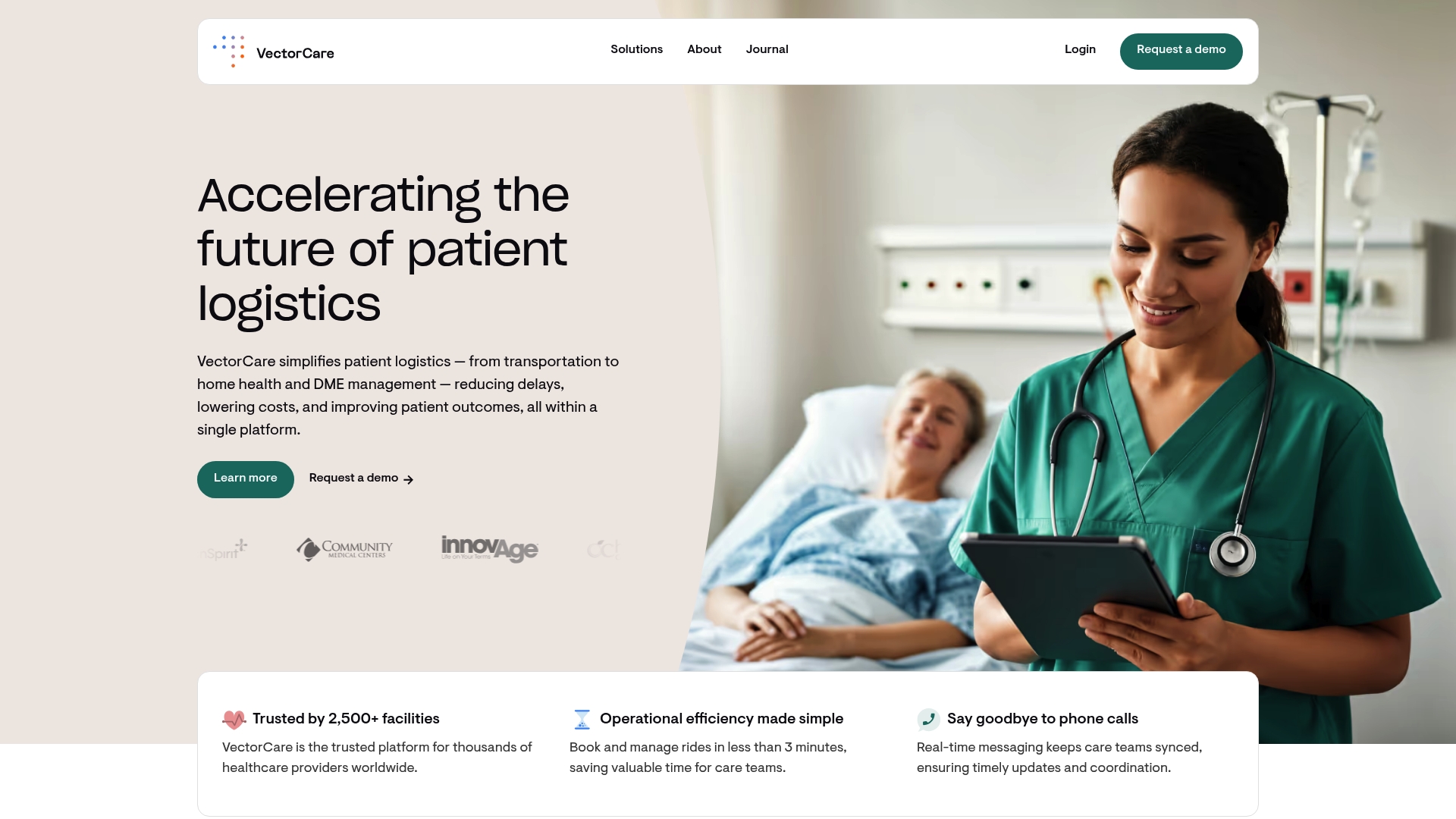
Experience transformative efficiency now by visiting VectorCare’s platform and learn how easy it is to streamline patient transportation and vendor management while gaining immediate access to actionable data. Don’t wait to improve your cost control success—start your journey to smarter healthcare logistics with VectorCare.
Frequently Asked Questions
How can I optimize patient transportation workflows to control costs?
Optimizing patient transportation workflows can significantly reduce operational costs by implementing intelligent scheduling and tracking technologies. Start by conducting a process audit and investing in a digital platform to minimize wait times and improve resource allocation within 30 days.
What steps should I take to streamline provider and vendor management?
To streamline provider and vendor management, develop clear performance metrics and establish centralized tracking systems. Begin by assessing your current vendor relationships and standardizing evaluation processes to reduce administrative overhead over the next 60 days.
How can real-time data be used for expense tracking in healthcare?
Real-time data tracking enhances visibility into operational expenses by using integrated IoT devices and digital dashboard systems. Implement automated expense categorization tools to gain insights into spending patterns and identify cost-saving opportunities within 30 days.
What are effective strategies for automating scheduling and dispatch operations?
Automating scheduling and dispatch operations involves using intelligent algorithmic scheduling and real-time tracking capabilities. Identify repetitive scheduling tasks and invest in an integrated digital platform to enhance operational efficiency and minimize delays.
How can I enhance communication across healthcare teams?
Enhance communication by investing in integrated digital platforms that support secure and real-time information sharing. Standardize communication protocols and invest in cross-department collaboration tools to streamline coordination within 60 days.
What are the benefits of integrating no-code workflows in healthcare organizations?
Integrating no-code workflows allows healthcare organizations to configure processes rapidly without needing technical expertise. Start by selecting user-friendly platforms to simplify administrative processes and enable quick modifications to adapt to operational changes.
Recommended
- 7 Key Healthcare Cost Containment Strategies
- 7 Key Benefits of Reducing Healthcare Costs
- 7 Tips for Reducing Administrative Costs in Healthcare
- How to Reduce Operational Costs in Healthcare Organizations
- Reduce IT Costs Strategies For Your Business | TECHTRON
- 7 Types of Healthcare Marketing for Australian Businesses